Slavika
Slavika Rulebook
Table of Contents
Table of Contents
- Goal of the Game and Victory Conditions
- Box Contents
- Game Preparation
- Description of the Cards in the Game
- Sequence of Play
- Region Cards and the Battle with Evil (Scoring)
- Game End
- Heroes and Their Special Abilities
- Monsters and Their Special Abilities
- Region Special Abilities
- Notes on This Transcription
Goal of the Game and Victory Conditions
In the game Slavika players are the heads of powerful families in the fantastic world of Slavika. Each player has 6 heroes, who will be sent to different regions, where they will fight the monsters threatening them.
The more a player's heroes help defeat the monsters, the more glory is won for their family.
The game lasts several months, until the princess is able to complete the ritual and renew the power of the amulet. At that time, the family with the most glory points earns the right to the hand of the princess and wins the game.
Box Contents
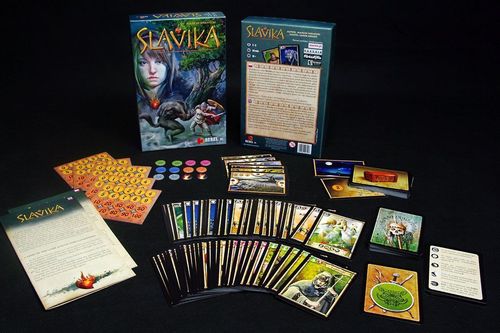
- Hero cards: 5 sets of 6 cards for each player.
- Region cards: 6 cards for the regions used in the game.
- Monster cards: 54 cards for the monsters invading the regions of Slavika.
- Treasure cards: 15 treasure cards.
- Month cards: 5 month cards to indicate the passage of game time.
- Score boards: 5 score boards, for each player to individually track their earned glory points.
- Score markers: 5 sets of 2 markers for tracking earned glory points.
- Szeptuchy markers: 2 markers to show which monsters are being copied by a Szeptuchy.
- Player aids: 5 cards summarizing the special powers of heroes and monsters.
Game Preparation
Each player takes a set of 6 hero cards of a selected color, and a matching score board and 2 score markers.
Region cards are placed in the middle of the table. Region cards are double-sided; place either side face up arbitrarily.
- In a game with 2 or 3 players: all cards with no indicated number of players and the card with a 2/3 indication.
- In a game with 4 or 5 players: all cards with no indicated number of players and the cards with a 4/5 indication.
The monster card deck and the treasure card deck (treasure and month cards) are shuffled and placed face down in easy reach.
Each region has an indicated number of treasures; each region card receives that many face down treasure cards, placed under the region card. Players should not see these cards' faces.
Each player is dealt five cards from the monster deck. They are part of the players' hands. A player's hand consists of hero cards and monster cards.
Decide a starting player. You are ready to play.
The printed rulebook shows an example of a game prepared for 2 or 3 players, with the monster queues and hero queues marked on the table.
Description of the Cards in the Game
Slavika has several types of cards:
Hero Cards
Hero cards show the hero's symbol, the hero's name and the hero's strength (labelled on the printed card diagram).
Many heroes have special abilities, depending on the type of hero. They are described at the end of the instructions and on the player aid.
Each player receives 6 heroes. Hero decks are distinguished by their backs and by the color of the pictures on their faces.
Monster Cards
Monster cards carry the monster's symbol, the monster's strength (if any), the monster's special ability (if any) and the bonus glory points for defeating the monster (if any).
Region Cards
Region cards show:
- The number of treasure cards placed under the region when the region is placed.
- The glory points awarded after a successful battle with evil to the player with the greatest total hero strength, to the second greatest, and possibly to the third greatest.
- The monster queue and maximum number of monsters for the region.
- The hero queue and maximum number of heroes for the region.
- The region's special ability (if any).
- The number of players for which the card is used.
Treasure Cards
Treasure cards show the number of glory points won for owning the treasure.
Score Boards
Each player tracks their own glory points on their own score board. In the example shown, the player has earned 16 glory points so far.
Sequence of Play
Players take turns in clockwise order.
A player's turn consists of 3 actions which must be performed in this sequence:
- 1st action: Send a hero from their hand to a region. If this is impossible, this action is skipped.
- 2nd action: Send a hero from their hand to a region other than the region chosen in the 1st action. If this is impossible, send a monster from their hand to a region other than the region chosen in the 1st action.
- 3rd action: Send a monster from their hand to a region other than the regions chosen in the 1st and 2nd actions.
After the 3 actions, a player must discard 1 monster from their hand to the monster discard pile and draw enough new monsters to have 5 in their hand. (If the monster deck is empty, reshuffle the monster discard pile.)
Sending a hero: The player plays a hero card from their hand to one of the regions. The hero is placed next to the edge of the region card which has the hero symbol, in a queue after any previously placed heroes in that region. If the hero has a special ability which is applicable when placed, then the player may use the ability.
Sending a monster: The player plays a monster card from their hand to one of the regions. It is placed next to the edge of the region card which has the monster symbol, in a queue after any previously placed monsters in that region. If the monster has a special ability which is applicable when placed, then the player may use the ability.
Example of a Turn
Przemek is playing the Owl clan (blue) in a 3-player game. At the beginning of his turn, there is the following situation (see the example diagram on the next pages).
Przemek's hand has:
- Heroes: Wizard and Archer
- Monsters: Wampir, Wiły, Szeptuchy, Utopiec, Wilk
For his 1st action he must play a hero. He can add a hero to the first region or he can exchange a hero with the Ranger from the third region. He decides to send his Wizard to the first region, and thanks to the Wizard's special ability he takes the second position, pushing the Boar clan's Warrior back to the third position.
For his 2nd action he must play a hero or monster. He can exchange his Archer with the Ranger from the third region or (due to the lack of available hero space in the regions) he can send a monster. He is not required to use the Ranger's special ability. He decides to send his Wampir to the fourth region.
For his 3rd action he must play a monster. He sends his Wilk to the third region, which starts the battle with evil, i.e. scoring the region. By sending his Wilk, Przemek will win first place (10 glory points) in the region, plus as many glory points as appear on the region's treasure card.
Having completed his turn, including the region scoring, Przemek must discard a monster - he throws away the Utopiec - and draws 3 new monster cards from the monster deck to have 5 monsters in his hand.
If Przemek had sent the Wilk to the third region as his 2nd action, then the battle with evil would have started before his 3rd action. In that case, his 3rd action would have to be sending a monster to the second, third or fourth region. After scoring a region and turning its card over, it is considered to be a new region, so Przemek could send a monster there again.
Region Cards and the Battle with Evil (Scoring)
A region card has the following information:
- Number of treasure cards, which are placed face down under this region at the moment the region is placed.
- Glory points gained by players with heroes in the region after winning a battle with evil. The first number is the points for the player with the most strength, the second number is for second place, and some regions have an award for third place.
- Monster symbol: the monster symbol indicates the card edge where monster cards are placed, and the number indicates the maximum number of monster cards for that region. When the indicated number of monsters are in a region, a battle with evil begins, i.e. scoring the region.
- Hero symbol: the hero symbol indicates the card edge where hero cards are placed, and the number indicates the maximum number of hero cards for that region.
- Special ability: some regions have a symbol indicating a special ability for the region, which lasts until the end of the battle with evil. These abilities are described at the end of the instructions and on the player aid cards.
Scoring a Region (Battle with Evil)
When the number of monsters in a region reaches the limit indicated on the region card, play is interrupted. The heroes battle with evil and the players score points.
The sums of all the monster strengths and all the hero strengths in the region should be compared, taking into account all the special abilities found on the region, monster and hero cards.
Heroes win. If the sum of the strength of the heroes is greater than or equal to the sum of the strengths of the monsters, then evil is defeated and players earn glory points.
After determining how much strength each individual player contributed, the treasure cards under the region card are revealed. All cards with a treasure will become some player's loot, and each card with a moon (indicating a month has passed) should be set aside in a visible area.
The player who contributed the most strength earns the largest number of glory points, second place earns the second largest number, and so on, as indicated on the region card. In the case of a tie, the tying player with a hero in the closest position to the region card wins the tie.
The first place player receives all treasures, placing them near their score board and receiving glory points as indicated on the treasure cards. (Treasure cards have no additional effect except during final scoring.) An exception is possible if a Thief is among the heroes in the region. A Thief can steal the treasure cards (see more about Thieves below).
In addition, some especially powerful monsters give extra bonus points for defeating them, as indicated on the monster card. If only one player fought and won the battle, that player receives the points. If more than one player is present, then they all receive the points except the player with the lowest total hero strength. If there is a tie for the weakest player, consider each weakest player's hero which is closest to the region card: the one farthest from the region card does not receive the bonus. For example, suppose 3 players are tied for strength and the region's hero queue has (in order) heroes of Anna, Ola, Jan, Ola, Anna. Then Anna and Ola are closest to the region, so Jan does not receive the bonus points.
If a Thief is among the victorious heroes, the Thief's owner can decide whether to steal the treasure cards (and their glory points) or to steal the bonus glory points for defeating especially powerful monsters. If there is more than 1 Thief, only the Thief card closest to the region card may use the stealing ability. Note that stealing is a special ability of the Thief, so in situations where heroes' special abilities are not working, the Thief can not steal. Glory points stolen by the Thief are not received by other players.
After scoring a region:
- Hero cards return to their owners' hands;
- Monster cards go to the monster discard pile;
- The region card is flipped over and placed with the other side face up, and the indicated number of treasure cards is placed face down under it.
Example 1. Przemek is playing the Owl clan (blue). He adds the last monster, a Wiły. Since this is the last monster in this region, a battle with evil takes place, i.e. scoring the region.
At this moment, the situation is such that:
- Because there is a Wiły present, the special hero abilities do not work;
- The sum of the monster strengths is 12 (4 from the Strzyga + 1 from the region special ability + 7 from the Żmij);
- The sum of the hero strengths is 14 (1 from the Thief + 5 from the Warrior + 2 from the Wizard - his special ability is canceled by the Wiły, + 6 from the other Warrior). Note that the Warrior of the Boar clan (green) has full strength for resolving the battle with evil, because the special ability of the Leszy only affects the determination of individual player strength contributions.
Thus, the heroes win. The treasure card is revealed, and it happens to give 2 glory points. Next comes the calculation of individual player strengths:
- Krysia playing the Fox clan (orange) contributed a total strength of 3 (a Thief and a Wizard);
- Przemek playing the Owl clan (blue) contributed a total strength of 5 (Warrior);
- Tomek playing the Boar clan (green) contributed a total strength of 0 (his Warrior has strength of 0 instead of 6 due to the Leszy's special ability).
Przemek (Owl clan) contributed the most and gains:
- 11 glory points for first place (from the region card);
- 2 glory points for the treasure card, which he places by his score board;
- 3 glory points for defeating an especially powerful monster, in this case the Żmij.
Krysia (Fox clan) was second and gains:
- 6 glory points for second place;
- 3 glory points also for defeating an especially powerful monster.
If the Thief's special ability wasn't canceled by the Wiły, then Krysia would be able to steal either the treasure card and 2 glory points or the 3 glory points for defeating a powerful monster - in either case, Przemek would not receive them.
Tomek (Boar clan) was third and gains:
- 3 glory points for third place.
Example 2. In the same situation Maciek (Lynx clan) places a Wampir as the last monster in the region.
- The monsters have 18 strength total (6 from the Wampir + 5 from the Strzyga + 7 from the Żmij);
- The heroes also have 18 strength total (1 from the Thief + 5 from the Warrior + 6 from the other Warrior + 6 from the Wizard), and therefore they win.
The treasure card is revealed to be worth 2 glory points.
Maciek contributed 6 strength and is first place. Przemek contributed 5 strength, so he takes second place. Krysia contributed 1 strength (from her Thief) because her Wizard's strength is 0 due to the special ability of the Leszy, so she takes third place. Krysia's Wizard and Maciek's Warrior are tied for the most strength, but the Wizard is closer to the region card and thus it is the hero affected by the Leszy.
Krysia uses her Thief to take the glory points for the especially powerful monsters. This gives her 5 glory points (stolen from the monsters) plus 3 for third place (from the region), a total of 8 glory points.
Maciek gains:
- 11 glory points for first place (from the region);
- 2 glory points from the treasure card which he receives (since Krysia's Thief stole the monster points instead of the treasure). Maciek places the treasure card near his score board.
Przemek gains:
- 6 glory points for second place.
Monsters win. If the sum of the monster strengths is greater than the sum of the hero strengths (after taking into account all special abilities):
- Treasure cards are not revealed;
- Players do not receive glory points;
- Hero cards return to their owners' hands;
- Monster cards go to the monster discard pile;
- The region card remains (it is not turned over) and the region's indicated number of treasure cards should be placed face down under it. Thus the region may get more and more treasures.
After resolving a region's battle with evil, the game continues.
Game End
The game ends when 4 of the 5 month cards have been revealed. The current region scoring is completed. Then the player with the most glory points wins the game. In the case of a tie, the tying player with the most treasure cards wins the tie.
Heroes and Their Special Abilities
-
Warrior: Warriors have no special abilities.
-
Archer: Archers cause all monsters in the region to have a maximum strength of 4. For example: a Żmij has a strength of 7, but if an Archer is present, the Żmij's strength is reduced to 4 in the battle with evil. An Utopiec has a strength of 3, which is already less than 4, so it's unaffected by Archers. In regions where a Strzyga has +1 strength during the battle with evil, Archers reduce every Strzyga to strength 4.
-
Ranger: a Ranger can be sent as usual to a region, but there are also 2 special actions which can be used instead:
- A player who sends their Ranger to a region with another of their own heroes (placed earlier) may put the Ranger on that other hero's position and return that hero back to their own hand;
- A player may send a different hero to a position occupied by their own Ranger and return the Ranger back to their own hand.
Note that the usual rule about sending a card to a different region in each action still applies.
-
Wizard: In a battle with evil a Wizard gains +2 strength for each Warrior in the region (regardless of which players own them). Additionally, when a player sends their Wizard to a region, the player may freely change the positions of all heroes in the region.
-
Thief: in a battle against evil, a Thief can steal glory points from treasure or from defeating especially powerful monsters.
Monsters and Their Special Abilities
-
Wiły: strength 0. A Wiły cancels special abilities of all heroes in the region. (IPA: [ˈviw]. A beautiful nymph or female forest spirit.)
-
Rusałka: strength 0. When a player sends a Rusałka to a region, the player may remove one hero card from the region and return it to its owner. ([ruˈsawka]. A female water spirit or the ghost of a woman who drowned.)
-
Leszy: strength 0. After resolving a battle with evil, the ability of the Leszy is applied. For purposes of determining how much strength each player contributed, the Leszy reduces the strength of the strongest hero to 0. In the case of a tie, the tying hero closest to the region is reduced to 0. ([ˈleʂɨ]. A male forest spirit.)
-
Szeptuchy: When a player sends a Szeptuchy to a region, the player puts a Szeptuchy marker on any other monster already in the region. The Szeptuchy becomes a copy of the selected monster, copying its strength. If it is a monster with a special ability, then it is applied exactly as if the Szeptuchy were that monster (including an ability which is applied when the monster is sent to a region, e.g. the Rusałka's ability). If there is not another monster, then the Szeptuchy does not copy a monster and simply occupies a position in the region's monster queue. ([ʂɛpˈtuxɨ]. A whispering witch.)
-
Licho: strength 0. In a battle for evil with a Licho, all Warriors in the region have strength reduced to 2. ([ˈlixɔ]. An embodiment of evil fate and misfortune.)
-
Zdrajca: The Zdrajca is a monster which pretends to be a hero. It is placed on the hero side of the region card, not the monster side. The Zdrajca adds 0 to the strength of the heroes in the battle with evil. ([ˈzdrajtsa]. A traitor.)
Note (from the printed rulebook): The Polish monster names are left in their original form to preserve a sense of Slavic atmosphere. But how to pronounce the Polish words? English dialects differ widely, and even within a given English dialect letters indicate many different possible sounds, so it's impossible to reliably indicate pronunciation using English orthography (consider the various sounds of "a" in "hat", "late", "bar", "square", "what", ...). Thus the unambiguous International Phonetic Alphabet is used. E.g. "Wiły" sounds like [ˈviw]. (The accent symbol ˈ appears before the stressed syllable, always the second to last syllable in the monster names.)
Polish vowels used and their IPA equivalents:
- a = /a/ as in "car" (not "bad")
- e = /ɛ/ as in "bed"
- i = /i/ as in "piano" (not "hit" or "high")
- o = /ɔ/ as in "lot"
- u = /u/ as in "boot" (not "but" or "put")
- y = /ɨ/ as in "hit" (not "fly" or "really")
Polish consonants used and their IPA equivalents:
- g = /g/ as in "get" (not "gel")
- j = /j/ as in "yes" (not "jet")
- r = /r/ trilled "r" as in Spanish "perro"
- ch = /x/ as in Scottish "loch", German "Bach"
- sz = /ʂ/ roughly similar to English "sh"
- ż = /ʐ/ roughly similar to "s" in "vision"
The other IPA consonants used all sound as an English speaker would expect: /d k l m n p s t v w z/.
Region Special Abilities
- In a battle with evil in the region, all Rangers have +1 strength (i.e. strength 4 instead of 3).
- In this region, the special ability of Rangers does not work.
- In this region, 2 heroes of the same type (with the same hero symbol) cannot be placed adjacent to each other.
- Every Strzyga and Wilk in this region has its strength increased by 1 in a battle with evil.
Notes on This Transcription
- Pages 10 and 11 of the printed rulebook are illustrated card galleries showing the hero, monster and region cards with no rules text. They are not transcribed here; the card names and abilities are covered in the sections above.
- The printed text reads "szptuchy marker" in one place; it is corrected to "Szeptuchy marker" here. Printed hyphenation at line breaks has been removed.
- Credits, copyright, publisher and distribution lines from the printed rulebook are omitted.