Skyway
Skyway Rulebook
Table of Contents
Table of Contents
Overview
In Skyway, you are a city planner in charge of designing a notoriously convoluted traffic interchange. Over three passes through the deck, you will be drafting stacks of cards from a random market, which you'll place into a 3x3 grid. However, each grid cell may only be stacked three cards high - any more and the bottom cards get discarded. Your aim is to create a path of at least 5 increasing cards for each of the four suits.
Components
- A standard 52-card deck, no jokers
Setup
Separate all twelve face cards. Choose any three face cards and place them face up as round markers, then remove the rest from the game.
Shuffle the rest of the 40-card deck and place it face down. Leave room for a discard pile, a 3-space market, and a 3x3 play area.
Turn one round marker face down to mark the first round.
Gameplay
The game is played over a series of turns. Each turn is composed of the following:
- Reset the market
- Draft and play blueprints
Reset the market
Deal five cards from the deck into three face-up market stacks (blueprints). Two sets of blueprints should have two cards each, while the final blueprint should have one card. Deal the same way every time - don't vary the way you deal as you see the cards that are dealt.
Draft and play blueprints
Choose one of the three sets of blueprints and discard the rest. Place your selected blueprint into one of the spaces in your 3x3 play area, on top of any other cards already there. Fan all cards slightly to the right so all their ranks and suits are visible. You may not rearrange the order of any cards.
Each space of the play area may only be three cards high. If placing cards causes that space to have four or more cards, discard from the bottom of the stack until three cards are left. Place these bottom cards in the same discard pile as the undrafted market cards; they will be available again in future rounds, if any.
The mid-game example on the page is a picture; its caption is transcribed below.
In the mid-game example above, I choose to draft the 7♥ 6♣ blueprint stack and place it on the middle-right space. Since that space now has five cards, the bottom two (4♥ and 2♦) will be discarded. The stack will now be, from bottom to top, 3♣ 7♥ 6♣.
Second and Third Round
When the deck runs out, shuffle the discard pile and continue with it as the new deck (finish dealing the five-card market with the new deck if it runs out halfway). Flip the next round marker face down.
You will go through the deck three times. If the deck runs out of cards in the middle of dealing the market in the third round, shuffle one last time and deal enough cards just to finish the last market.
Game End
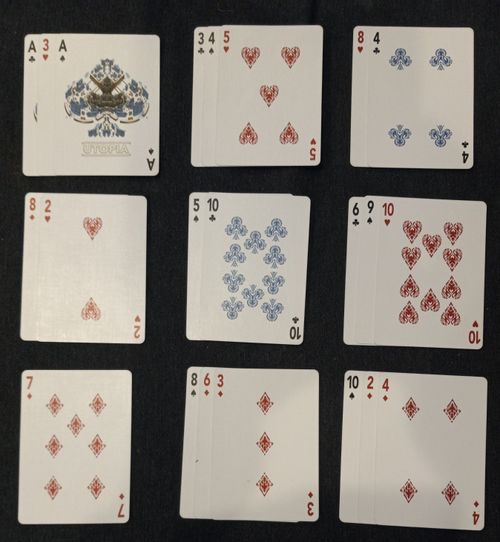
After three full passes through the deck, note your completed 3x3 play area. For each of the four suits, look for the longest sequence of increasing value that can be drawn through vertically and horizontally adjacent cards. The sequence may loop back on earlier spaces, but you must move to a new grid space with each step. The "height" or layer of the card doesn't matter.
If you have at least a 5-card increasing sequence for each of the four suits, you win the game! Your score is the total length of all four sequences.
A winning setup is shown in a picture on the page. Its captions, which describe the sequences in it, are transcribed below.
- Start from bottom-center 2♥, up to 5♥, left to 6♥, right to 8♥, and up to 10♥.
- From bottom-right A♠, left 3♠, left 4♠, up 5♠, up 7♠.
- From middle-right 2♦, up 4♦, left 5♦, right 9♦, left 10♦.
- Top-right A♣, down 3♣, down 5♣, left 8♣, left 10♣.