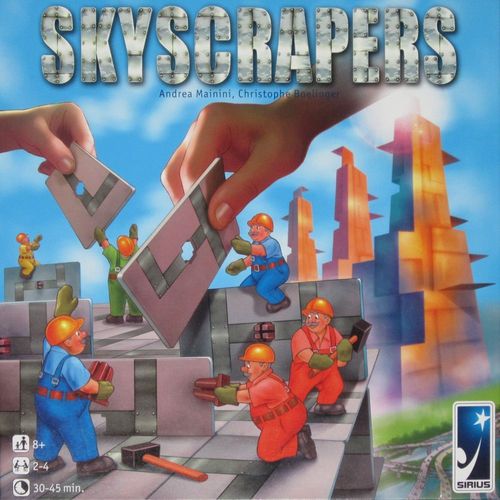
Skyscrapers
Skyscrapers Rulebook
Table of Contents
Table of Contents
Components
- 24 worker figures in four different colours (6 workers for each player)
- 36 "Building Block" cards
- 3 "Foundation" cards (starting cards)
- 8 "Additional Foundation Support" cards in four different colours (2 for each player: 1 vertical and 1 horizontal)
- 52 connectors for the cards
- A game board showing a construction site with a scoring track in the form of small cars with numbers on their roofs
- This rulebook
The box also contains one large slotted card that is not used in the game; return it to the box.
Setup
-
Each player chooses a colour and takes the 6 workers of that colour together with the 2 "Additional Foundation Support" cards of the same colour. Five of the workers are placed on the table in front of the player; this is the player's work crew, which the player can bring onto the construction site. The sixth worker is placed on space "0" of the scoring track.
-
The square part and the round part of the game board are joined with a screw. After this the round part of the board can turn freely relative to the square part, which makes it easier for players to place new building blocks.
-
The 3 "Foundation" cards are joined in the shape of the letter "Н" (H) and inserted into the special holes in the centre of the game board (see Fig. 1). This forms the foundation of the future building.
-
The 36 "Building Block" cards are shuffled thoroughly and dealt to the players. The number of cards each player receives depends on the number of players:
- 2 players: 15 cards each
- 3 players: 12 cards each
- 4 players: 9 cards each
If fewer than four players take part, the cards left over are removed from the game; the players will not need them.
-
The "Building Block" cards received by each player, together with the 2 coloured "Additional Foundation Support" cards, are placed in front of the player. These are the player's private cards, which they will use during the game.
-
The connectors are placed on the table so that each player can conveniently reach them.
! During the game, players should not show their opponents how many cards they have left or which cards these are.
The game can now begin. The first player is the one who, at some point in their life, has climbed to the top floor of a skyscraper. Play then proceeds clockwise.
Object of the Game
Players must use all of the "Building Block" cards they have, and also place as many of their workers as possible on the highest floors of the building under construction. In addition, players must make sure that their workers do not fall from the unfinished floors of the skyscraper.
Turn Order
On his or her turn, a player must perform 3 actions. The player decides in which order to perform these actions, and how many times to perform each of them. The total number of actions a player takes during a turn may not exceed 3 (for example, a player may move one of his or her workers 3 times, but then he or she cannot build).
During a turn, a player may:
- Send a worker onto the construction site
- Build a new block of the building
- Move one of his or her workers
Sending a Worker onto the Construction Site
If a player decides to send one of his or her workers to build the skyscraper, he or she takes a worker figure from the player's work crew and places it next to any "Foundation" card. The worker that has just come onto the construction site is thereby on the lowest floor of the building, and its figure must touch at least one "Foundation" card (see Fig. 2).
The foundation of the skyscraper consists of those cards that are located directly on the construction site drawn on the game board.
A worker may be placed so that it touches two "Foundation" cards. However, the worker's figure may not fail to touch a connector, nor touch only a corner of the card: the figure must stand fully against the chosen card.
During the game each player may send any number of workers onto the construction site, and all of them may stand at foundation level. A player is limited only by the number of workers in his or her work crew.
Building a New Block of the Building
To build a new block or floor of the building, the player must choose one of his or her workers that is already on the construction site. That worker now becomes not just a worker but a builder.
When deciding to begin construction, the player must keep in mind the following rules:
- Any card the player has in hand may be used.
- If a worker is drawn on the chosen card, the player must place or lay the card so that the worker's position is natural, that is, matches the overall orientation of the building (for example, a worker may not hang upside down from a construction beam). On cards where the worker is drawn from the side, an arrow points to the edge of the card that must be on top. If the worker is drawn in plan view from above or below, the card must be laid parallel to the game board.
- If the player does not take the worker's position on the card into account when using it to build the skyscraper, any opponent who notices the error may point it out and require that it be corrected. However, if the error has not been noticed before the next player's turn begins, it may no longer be required to be corrected.
Card orientation illustrations in the original booklet show:
-
Cards placed horizontally, used for building the floor of new storeys
-
Cards placed vertically
-
Cards that the player may use as needed, other than for building the foundation of the building
-
Only "Foundation" cards and "Additional Foundation Support" cards may and must touch the construction site on the game board.
Connectors
Every newly built block of the building must be firmly fastened to the main structure. For this, connectors are used; they are inserted into the special hole in the centre of each new card in the skyscraper's structure. Connectors may not be inserted anywhere else on the card.
Two cards (the new one and the one already part of the skyscraper's structure) must be joined firmly, so that no gap remains between the two parts. If a player has been insufficiently careful in construction, any opponent may require that the cards be joined properly.
A connector may not be attached to a card in such a way that the new block can be joined only from beneath the card (see Fig. 3); the building must grow upward.
- Connectors may be attached to the sides of cards only at the 6 places marked with yellow circles (see Fig. 4). The player may not choose the attachment point of a connector arbitrarily.
- All cards must be joined at a right angle (90º) so that the result is stable, cube-shaped structures. "Half-storeys" may not be built, as shown in Fig. 8E-8F. Each new floor must be higher than the previous one by at least half the height of a card.
- In addition, the player must take care that at least one construction girder (drawn in grey on the card) on the new card connects to at least one girder on a card that is already part of the skyscraper (see Fig. 8, which shows correct and incorrect connections).
- A new building block may be attached only to the card next to which the player's worker stands (see Figs. 5-7).
Illustrations in the original booklet show:
-
Fig. 5: a green builder adds a vertical "Additional Foundation Support" card to the skyscraper's foundation.
-
Fig. 6: a green builder adds 2 new cards to the structure (counted as 2 actions): first a floor for the first storey, then a second card attached so that it does not touch the surface of the game board.
-
Fig. 7: this is not allowed. The card the player used may not touch the game board, because it is not an "Additional Foundation Support" card.
-
If during construction a connector touches the figure of one or more workers, the player may move the workers within the card on which they stand so that they are no longer in the way.
-
During construction the player may use both hands. He or she may touch the skyscraper's structure as he or she wishes, support it, and reinforce the joints between cards if necessary. The player is responsible for everything that happens to the building during his or her turn (see the section "Falling Workers").
The player is forbidden to:
- Touch or move workers (except when they interfere with firmly joining the building blocks)
- Rearrange or remove cards in the part of the building that is already complete
Fig. 8 (original booklet) shows examples of construction that is allowed (A, B) and not allowed (C, D, E, F).
Scoring During Construction of a New Block
- Each time a player attaches a new card to the building under construction, he or she scores points.
- The player scores 1 point for each construction girder on the new card that connects to a girder on a card already part of the skyscraper. Note that the same girder on a new card may connect to several girders on cards already in use. In this case the player scores 1 point for each connection of the new girder to girders already in use.
- If a worker is drawn on the new card, the player scores 1 additional point.
- If the new building block is higher than all previously placed cards, the points scored during the turn are doubled.
- After counting the points scored during the turn, the player moves his or her worker on the scoring track by the corresponding number of spaces.
Moving a Worker
- A player may freely move his or her worker within the card next to which or on which it stands. This is not counted as an action during the turn.
- During his or her turn, a player may move one of his or her workers up or down by one floor, or to any place on the floor where it stands. Such a move of a worker counts as an action of the player.
Example of worker movement (Fig. 9): a green worker no. 1 may:
- move along the foundation of the building so that it touches a different "Foundation" card;
- go up to floor 1, standing next to green worker no. 2;
- go up to floor 1, standing next to green worker no. 3.
A green worker no. 2 may:
- go down to the foundation of the building so that it touches any "Foundation" card;
- go up to floor 2, standing next to red worker no. 4;
- move along floor 1, standing next to green worker no. 3.
Green worker no. 3 has the same options of movement as green worker no. 2.
Red worker no. 4 may only go down to floor 1, standing next to green worker no. 2 or no. 3.
(Note that the worker figures do not have to stand next to each other; the player may choose the place on the card where his or her figure stands.)
- Floors: if 2 cards intended for building a floor are at different heights, they create 2 different floors of the building.
- Sometimes two separate towers (or more) appear in the skyscraper's structure and are not connected to each other. In this case, floors are counted separately for each tower. A worker may not be moved from one tower to another unless there is a crossing (a floor card) between the corresponding floors of the two towers. To move to another tower, a worker must first go down to a floor where such a crossing is possible (see Fig. 10-c). If later a card connecting the two towers appears, direct movement between them becomes possible (see Figs. 10-a and 10-b).
Example of movement between towers (Fig. 10-c): the red worker no. 1 may go up to floor 2 of either the right or the left tower of the skyscraper.
The green worker no. 2 may go up to floor 3 of the left tower and stand next to the red worker no. 3. But it may not move to floor 2 or 3 of the right tower, because there is no crossing card between the right and left towers. If the worker needs to be in the right tower, the player must first go down to floor 1, then move to another card on that floor, and only after that go up to floor 2 of the right tower.
Such a complex movement of a worker will require the player to spend several actions and, possibly, more than one turn.
The blue worker no. 4 is in exactly the same situation: it may go up to floor 3 of the right tower and stand next to blue worker no. 5, which requires only 1 action from the player; however, to move to floor 2 or 3 of the left tower, the player would have to spend several actions and first go down to floor 1 of the skyscraper.
Blue worker no. 5 may only go down to floor 2 of the right tower.
This example again shows that floors are counted separately for each tower of the skyscraper. This rule is important to observe in the final scoring.
- During his or her turn, a player may not move or touch other players' workers (except in situations where a worker interferes with firmly joining cards during construction, see above).
- If during his or her turn a player decides to use 2 or 3 actions to move one worker, for example from floor 1 to floor 4, he or she may not move the worker figure straight to the top floor. The player must place the worker successively on each floor, showing that the worker did not fall from anywhere and that every floor held it.
- During his or her turn, a player may not use any tool (tweezers, for example) to move worker figures. Workers may be moved only with the fingers, very carefully, so as not to drop them or destroy the building.
- It may happen that a worker becomes trapped inside the building under construction and it becomes impossible to retrieve it. Such a worker is lost to the player: it may no longer be moved, cannot be used for building, and is not counted in the final scoring. A player must watch carefully that opponents do not get an opportunity to deliberately trap his or her worker (see Figs. 11-12). If a player has lost all of his or her workers inside the rooms of the building under construction, he or she is considered to have lost and is eliminated from the game.
Example of a lost worker (Figs. 11-12): the blue worker has become trapped inside the building. Fig. 12 shows that once one of the players has built a wall, this worker can no longer be retrieved or even seen. The player who controlled the blue work crew may no longer use this worker in construction, move it, or count it in the final scoring.
- It may happen that an entire floor becomes inaccessible to workers. In that case, to rise higher, the workers must find another route, or the player must continue building the skyscraper so that a new crossing appears.
- Any number of workers may stand on one card that forms a floor. However, players may not stack worker figures (their own or others') on top of one another. If figures have fallen one on top of another as a result of careless actions by players, they must be left in that position until someone decides to move them on their turn.
- Players may not touch or move workers (their own or others') when it is not their turn. Players also may not touch the whole structure of the skyscraper under construction.
Falling Workers
If during a player's turn a worker falls off the building under construction because of that player's careless actions, regardless of whether the worker belongs to that player, the player loses 5 victory points (if several workers fall, the player loses that many points for each of them). The player must move his or her worker on the scoring track back by the corresponding number of spaces.
Players whose workers fell through no fault of their own may put them back on the skyscraper; fallen workers may be placed on any floor. The player responsible for the accident must place his or her fallen workers on the same spots where they stood before the fall.
A player may lose victory points even outside his or her own turn if workers fall because he or she touched the building, the workers themselves, or simply bumped the table. For this reason, if a player is simply waiting for his or her turn, he or she should try not to touch the table.
A player who has been so careless that workers repeatedly fell from the structures because of him or her, and who as a result has reached 40 negative points (his or her worker figure on the scoring track is on the space "-40"), is considered to have lost and is eliminated from the game.
Collapse of the Building
If any player (whether during his or her own turn or during an opponent's turn) breaks the structure under construction with a careless movement, even if only 1 "Building Block" card has touched the game board, the game ends. Whatever the cause of the collapse, whether careless fastening of a new card or moving a worker, an accidental blow to the building or to the table with a hand, the player who caused the disaster is considered to have lost and is eliminated from the game. That player's worker is removed from the scoring track; the figures of the other players remain in place.
The remaining players must now determine which of them is the winner. Each player subtracts from his or her total points 1 victory point for each "Building Block" card he or she has left unused. The player who has the greater total number of points wins.
If the game ended because of the collapse of the building, players must not use the final scoring rules.
End of the Game
The game ends as soon as one of the players, during his or her turn, uses his or her last card to build the skyscraper. This player receives 5 additional victory points, because he or she is the only one who has no cards left. Each of the other players loses 1 victory point for each card still remaining in his or her hand; their worker figures must be moved back on the scoring track by the corresponding number of spaces. Then the players begin the final scoring.
Final Scoring
The player who has more workers on the highest floor of the building (and whose figures are visible to everyone) receives 5 bonus victory points. If two or more players have several workers on the highest floor of the skyscraper, the bonus points go to the player who has more workers one floor below, and so on.
Example of final scoring: at the end of a game with four players, the situation was as follows. The numbers in the table show how many workers of each player are on the different floors of the building.
| Floor | Maria | Fedor | Artem | Anna |
|---|---|---|---|---|
| Ground level | 1 | 1 | 1 | 0 |
| Floor 1 | 1 | 0 | 0 | 1 |
| Floor 2 | 0 | 0 | 2 | 0 |
| Floor 3 | 0 | 1 | 0 | 1 |
| Floor 4 | 1 | 1 | 2 | 2 |
| Floor 5 |
In total, Fedor receives the 5 bonus points, because although he and Maria have an equal number of workers on floors 5 and 4, Maria has no worker on floor 3. Fedor must move his worker on the scoring track forward by 5 spaces.
Winner
The winner is the player who has scored more points, that is, the player whose worker stands farthest along the scoring track.