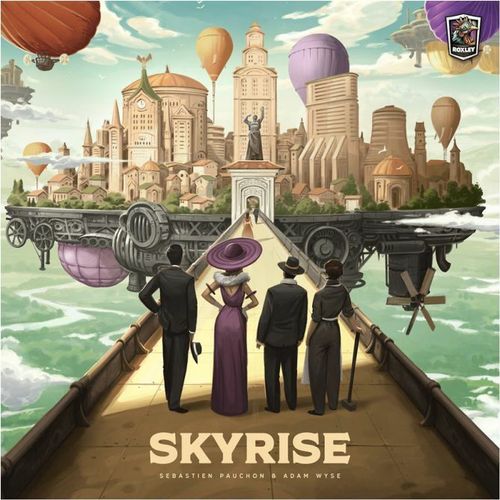
Skyrise
Skyrise Rulebook
Table of Contents
Table of Contents
Introduction
Overview
Welcome to Skyrise: a magnificent city in the sky dedicated to art, science, and beauty! Some of humanity's greatest visionaries have been enlisted to sculpt the city, but only one artisan can be remembered as the greatest! Prove your genius by winning sites in which to build, earning favor across islands and factions, accomplishing both public and secret objectives, courting mysterious patrons, and building your own unique Wonder!
Players: 2-4. Playing time: 30-75 minutes. Ages: 14+.
For a video tutorial, see: roxley.com/skyrise
Components
- 1 Central Island & 4 Outer Islands
- 1 Game Board
- 4 Player Boards
- 4 Patron Value Tiles
- 2 Commissions Discs & 2 Wild Discs
- 1 Large & 1 Small Key to the City
- 16 Patron Discs (4 per type)
- 40 Neighborhood Discs (10 per color)
- 12 Tall Buildings (3 per color)
- 20 Medium Buildings (5 per color)
- 16 Short Buildings (4 per color)
- 4 Wonders (1 per color)
- 4 Scoring Discs
- 1 Draw Bag
- 4 Secret Objective Cards
- 20 Wonder Cards
- 5 Panorama Cards
- 1 Island Control Card
- 1 Reference Card
Setup
Game Setup
-
Put the Game Board in the center of the table. It has a Prestige track that runs around the outside of the board.
-
Take a number of Outer Islands equal to the player count and place them randomly over the game board landscape as shown in the image.
-
Place the Central Island in the middle of the outer islands so its bridges slot into the spaces on the outer islands.
-
Remove the following discs, depending on player count, and return them to the box:
- 4 Players: remove nothing.
- 3 Players: remove a wild disc, a commissions disc, and 3 of each neighborhood disc.
- 2 Players: remove 2 of each patron disc and 5 of each neighborhood disc.
-
Mix up the remaining Neighborhood, Patron, Commissions, and Wild Discs and place them in the Draw Bag.
-
Randomly draw and place 1 disc on each colored neighborhood area of each island. To place the discs randomly, we suggest you start at one corner of an island and move clockwise around placing discs until each neighborhood has a disc.
-
Shuffle the 20 Wonder Cards and deal 3 face-down to each player (5 cards each in a 2 player game). Return the remaining cards to the game box without looking at them.
-
Shuffle the 4 Secret Objective Cards and deal 1 face-down to each player. Return any remaining cards to the game box without looking at them.
-
Place the Island Control Card face-up near the game board.
-
Shuffle the 5 Panorama Cards, draw 2, and place them face-up next to the island control card. Return the other panorama cards to the box.
Player Setup
All players perform the following:
-
Choose a Player Board and place it in front of you with your chosen visionary face-up.
-
Take the Scoring Disc matching your color and place it on the "0" space of the Prestige track.
-
Take the 12 Buildings and the Wonder matching your player color.
In a 2 player game, each player gets 2 Wonders. Each player should take a Wonder of an unused player color and the matching scoring disc to later mark the Wonder card associated with it.
Each player gets a unique set of numbered buildings, so players may want to try different player boards and seating positions from game to game.
-
Each of your buildings has a number on the bottom representing its bid value. Some buildings feature a dot below the number; lay these and your Wonder down to the left of your player board indicating they are not yet available.
-
Place your remaining buildings (without a dot) to the right of your player board in ascending order, number-side up.
-
You may now discreetly view your secret objective and Wonder cards. We recommend that new players wait until later in the game before looking at their Wonder cards.
Start Player
- Randomly determine which player will start the first auction of the game.
Gameplay Concepts
The Goal
The goal of Skyrise is to earn the most Prestige by the end of 2 Eras.
Prestige is earned at the end of each Era and immediately when you construct your Wonder.
Era 1 & Era 2
Skyrise is split into two halves, called Eras. Each Era is played over a series of auctions. After each auction, one structure will be constructed. In Era 1 you only have access to the number-side up buildings to the right of your player board.
- Era 1 ends when one player has constructed all their Era 1 buildings.
- Era 2 ends when all players have constructed all their buildings and Wonders.
Buildings & Bids
Each player has 12 Buildings with numbers on the bottom. This number represents a building's bid value.
A building that is number-side up, whether beside your player board or on an island board, is called a bid.
When not on an island, all your available bids must remain organized, number-side up, and in numerical order beside your player board (so your opponents can quickly assess which bid numbers are still available).
When an auction is won, the winning bid is flipped number-side down and becomes a constructed building. Its number no longer matters once it is constructed, only its height. Buildings come in three heights: short, medium, and tall.
Wonders
At the start of Era 2, each player receives access to their Wonder figure and chooses one of their Wonder cards, which provides their Wonder with a special effect.
Wonders do not have a number on the bottom because they automatically win an auction when placed.
Wonders are not "buildings", but both buildings and Wonders are considered "structures". Wonders do not have a height (short/medium/tall), so do not contribute to scoring island control. Wonders cannot start an auction unless you have no other bids remaining.
Wonder Cards
Each Wonder card has an initiative value and effect described on the card. Effects on Wonder cards are resolved immediately when the Wonder is constructed.
The player whose Wonder card has the lowest initiative value will begin the next auction when:
- Era 2 begins, or
- Any player constructs their last structure in Era 2 (see "Determine Start Bidder", pg 8).
In a 2 player game, a player's initiative is determined by the sum of the initiative values on their 2 chosen Wonder cards. If this sum is equal, the player with the lowest single Wonder initiative value wins the tie.
Islands
The play area consists of up to 5 floating islands: 1 small central island surrounded by up to 4 outer islands.
At the end of each Era, the player with the highest quantity of tall buildings (not Wonders) on each island will score 5 Prestige for that island (see "Score Island Control", pg 9).
Neighborhoods
Neighborhoods are regions of an island where players will place bids and construct structures.
Each neighborhood can only hold 1 bid or structure.
At the start of the game, each neighborhood will have a disc on it.
There are 4 colors of neighborhoods found in Skyrise which are populated by 4 factions of creatives:
- Yellow, populated by philosophers,
- Green, home to naturalists,
- White, where artists gather, and
- Brown, made up of inventors.
Unoccupied Neighborhoods: A neighborhood that doesn't contain a bid or a structure is considered unoccupied.
Adjacent Neighborhoods: One neighborhood is adjacent to another if they share a border (an edge, not a corner or a blimp). Neighborhoods connected by a bridge are also considered adjacent.
Secret Objectives
At the start of the game, you will receive a secret objective card to provide you with a secret long-term goal.
At the end of the game, if you have completed your objective, score the Prestige shown on the card.
Panorama Cards
Panorama cards reward players for building their structures near specific island features.
Panorama cards are scored at the end of each Era. When scoring, a player may gain Prestige multiple times for each instance of achieving the card's objective.
Collecting Discs
Whenever you construct a structure in a neighborhood with a disc in it (neighborhood, patron, wild, or commissions), you collect that disc to your player board.
Neighborhood Discs: Neighborhood discs come in four colors, matching the color of each faction's neighborhood. When you collect a neighborhood disc, place it in the leftmost empty space of its row on your player board. This will generally increase the Prestige value of all your structures that are constructed on that color (see "Score Structures" in "End of Era 2", pg 9).
Tip: To maximize Prestige, avoid collecting exactly 4 neighborhood discs of a single color. Note that each player starts with a disc already filled in under the "2" column. The leftmost empty space for a player's first disc of each color will be in the "3" column.
Shoot the Moon! If you collect a neighborhood disc when you already have 4 of the same color, place the disc on your visionary illustration instead. Each of these will score 10 Prestige at the end of the game, as indicated by the "+10" on the right of your board.
Commissions Discs: When collected, place commissions discs on the visionary illustration of your player board. Each commissions disc you hold at the end of Era 2 will increase the value of each item on your visionary illustration by 1 Prestige. This includes patron discs, the keys to the city, excess neighborhood discs, and even the commissions disc itself (see "Score Discs & Tiles" in "End of Era 2", pg 9).
Patron Discs
Patron discs are black discs with a letter in their center. They represent your visionary creating commissioned work for one of the famous art patrons depicted at the edge of the game board.
When you collect a patron disc, place it on the visionary illustration of your player board.
The letter on each patron disc corresponds to one of four art patrons.
Patron Values: The Prestige value of your collected patron discs is equal to the secret value printed on the underside of that patron's tile (determined during setup).
At any time during the game, you may secretly peek at the value on the bottom of any patron tiles matching the letters of your collected discs.
Example: You have collected a "B" patron disc. You then secretly peek at the patron value tile on B space. You now know all "B" discs are worth 4 Prestige at the end of the game, but feel free to tell your opponents whatever you want.
Wild Discs
Wild discs are neighborhood discs that can be used for any faction. At the time they are collected, they must be assigned a color and placed on your player board in the appropriate spot. After they are assigned a color, they cannot be moved.
Playing the Game
Auction
The game is played over a series of auctions, where players will go around the table choosing to outbid the current bid or pass. Once everyone has passed or can no longer outbid, the highest bid wins the auction and that structure is constructed.
You can never outbid yourself. If the auction comes back around and you are still the highest bidder, it means everyone else has passed and the auction ends.
An auction consists of the following steps:
1. Determine Start Bidder
An auction is always started by the player who won the most recent auction, with the following exceptions:
- Beginning of Era 1: the first auction is started by a random player determined during setup.
- Beginning of Era 2: the first auction is started by the player whose Wonder card has the lowest initiative value.
- When a player constructs their last structure in Era 2: the next auction is started by the remaining player whose Wonder card has the lowest initiative value.
2. Place Starting Bid
The player starting an auction places any of their available bids number-side up in an unoccupied neighborhood that is either:
- Located on the central island, or
- Adjacent to any already-constructed structure belonging to any player on any island.
Once placed, all bids must remain number-side up.
You cannot start an auction with a Wonder unless it is your last remaining structure.
3. Continue Bidding
Bidding then moves clockwise around the table. The next player must do one of the following:
- Outbid: Place a bid of higher value into an unoccupied neighborhood adjacent to the most recent bid.
- Pass: Say "pass." That player may not participate in the rest of this auction.
- Place Wonder (Era 2 only): Place their Wonder into an unoccupied neighborhood adjacent to the most recent bid.
4. End the Auction
The auction ends when one of the following occurs:
- All players except for the most recent bidder have passed, or
- There are no unoccupied neighborhoods adjacent to the most recent bid, or
- A player places their Wonder. (Some Wonders may break this rule and allow Wonders to be outbid.)
When the auction ends, perform the following steps:
- The winning bid gets flipped over to become a constructed building – its number will now be face-down. Wonders are not flipped over.
- Return all unsuccessful bids to their owners' pool of available bids.
- If there is a disc in the neighborhood with the newly constructed structure, the winning player collects it (see "Collecting Discs", pg 7).
- If a Wonder was constructed, enact its effect.
The next auction then begins. Return to "1 Determine Start Bidder," unless the end of an Era has been triggered (See "Eras & Scoring", pg 9).
Example: Turn order around the table is: Red, then Teal, then Yellow, then Blue. Red starts the auction by bidding a 24 in the neighborhood adjacent to a constructed Teal building. Teal passes. Yellow outbids with a 32. Blue outbids with a 64. Red outbids with a 72. Teal is skipped, as they have already passed. Yellow passes. Blue outbids with a 91. Red passes. Everyone but Blue has passed, so proceed to step "4 End The Auction". Blue wins the auction and flips their building number-side down. They collect the white disc on that space, and add it to their player board. Unsuccessful bids from the auction are returned to their owners.
Eras & Scoring
End of Era 1
Once any player has constructed their final Era 1 building, perform the following steps:
1. Score Island Control
For each island (including the central island), the player(s) with control of the island each score 5 Prestige. Island control is determined by:
- Which player has constructed the greatest quantity of tall buildings on the island.
- If there is a tie (even for 0), compare the quantity of medium buildings on the island amongst tied players.
- If there is still a tie, compare the quantity of short buildings on the island amongst tied players.
- If there is still a tie, all tied players score 5 Prestige for island control.
Example: Red scores 5 Prestige for island control because they are the only player who has a tall (T) building.
Example: Red and Blue are tied because they both have the same number of tall (T) and medium (M) buildings. They each score 5 Prestige for island control.
2. Score Panorama Cards
For each panorama card, gain the Prestige value for each instance you fulfill its objective (you can score it multiple times).
A single structure may be used to fulfill the objective of the same panorama card multiple times, and it may also apply to both panorama cards.
Example: Yellow scores the Blimps panorama card twice for 6 Prestige. They also score the Windmills card for 2 Prestige.
3. Choose Wonder Cards
All players choose one of their face down Wonder cards and reveal them simultaneously.
In a 2 player game, each player chooses and reveals an additional Wonder card. They place their extra scoring disc on top of it, assigning the card's effect to their second Wonder.
Return all unchosen Wonder cards to the box. The player who selects the Wonder card with the lowest initiative value will start the first auction in Era 2.
4. Unlock Era 2 Structures
Each player adds their Wonder figure (two Wonders in a 2 player game) and five Era 2 buildings to their pool of available bids on the right side of their player board number-side up, sorted by numerical value.
Era 2: Final Structure
When any player constructs their final structure during Era 2, the next auction is started by the remaining player with the lowest initiative value.
The first player to construct all of their structures in Era 2 places the large key to the city on their visionary illustration, worth 10 Prestige at the end of the game.
In a 3 player or 4 player game, the second player to construct all of their structures in Era 2 places the small key to the city on their visionary illustration, worth 4 Prestige at the end of the game.
End of Era 2
When all players have constructed their final structure, perform the following steps:
1. Score Island Control
Score island control using the same method as in Era 1.
Wonders do not have a height (short, medium, or tall) and therefore do not contribute towards island control.
2. Score Panorama Cards
Score panorama cards using the same method as in Era 1.
Wonders do contribute towards panorama cards' objectives.
3. Score Secret Objectives
All players reveal their secret objective cards. If you have fulfilled your secret objective, score the Prestige shown on the card.
Example: Blue has completed their secret objective of building 4+ times on inventor (brown) neighborhoods.
4. Score Discs & Tiles
Patron Discs: Flip each of the patron value tiles face-up. Score Prestige for each of your collected patron discs based on the revealed patron value tiles (see "Patron Discs", pg 7).
Excess Neighborhood Discs: For each neighborhood disc or wild disc on your visionary illustration, score 10 Prestige (see "Shoot the Moon!", pg 7).
Keys to the City: If you have the large key, score 10 Prestige. If you have the small key, score 4 Prestige.
Commissions Discs: For each commissions disc you have, score 1 Prestige for every patron disc, excess neighborhood disc, key to the city, and commissions disc on your visionary illustration.
5. Score Structures
Remove all of your structures that reside in a philosophers' neighborhood (yellow) from all islands. For each one removed, score Prestige equal to the amount shown at the top of the column of the right-most philosopher disc you've collected. Each structure scores a minimum of 2 prestige, even if no discs of that neighborhood color were collected.
Repeat this process for naturalists (green), artists (white), and inventors (brown).
Note: in this example, the blue player has assigned a wild disc to their inventors row (brown) when it was collected.
Example: Fritz Lang scores 6 Prestige for each of his structures removed from an artist neighborhood.
Game End
After performing Era 2 scoring:
- The player with the most Prestige is declared the winner.
- In case of a tie, the tied player who constructed their final structure first is the winner.
Visionaries
The following visionaries appear on the player boards:
Fritz Lang (Dec 5, 1890 – Aug 2, 1976). Fritz Lang was a visionary film director and screenwriter who is credited with launching or developing several different genres of film. Many of his works are considered masterpieces of visual composition and expressionistic suspense. Lang was one of the best-known emigrants from Germany's school of Expressionism. His most celebrated films include Metropolis and M. Known for being hard to work with, he epitomized the stereotype of the tyrannical Germanic film director. He wore a monocle adding to the stereotype. Leading up to the outbreak of World War II, the Nazi regime banned his upcoming film The Testament of Dr. Mabuse. Fearing persecution due to his part-Jewish heritage, Lang fled to Paris and soon after to the United States. Lang is credited with launching or developing many different genres of film, including the entertainment war flick, the blueprint for the serial killer movie, and film noir - with its recurring themes of psychological conflict, paranoia, fate, and moral ambiguity. Representing: German Expressionism & Gothic Revival. Building Material: Slate.
Vera Mukhina (Jul 1, 1889 – Oct 6, 1953). Vera Mukhina was a prominent Soviet sculptor and painter of international distinction. Known as a leading figure of Socialist Realism, both in style and ideology, she produced some of the greatest Soviet works of art of the era. Mukhina studied and practiced painting and sculpture in Russia, France, and Italy before returning to Russia at the outbreak of World War I. Over the course of the following years, sculptors across the Soviet Union received state orders to create city monuments. Mukhina rose to become one of the most respected and acclaimed. Her most celebrated work was the giant monument Worker and Kolkhoznitza Woman, built for the 1937 World's Fair in Paris and later relocated to Moscow. Renowned not only for its magnificence, it was a marvel of design. Made from stainless steel, it was the world's first welded sculpture. Her other well-known sculptures include Science, Bread and Fertility, Earth and Water, and monuments to Peter Tchaikovski and Maxim Gorky. Representing: Brutalism & Socialist Realism. Building Materials: Brick.
Tamara de Lempicka (May 16, 1898 – Mar 18, 1980). Tamara de Lempicka was a Polish painter who spent her working life in France and the United States. She is known for her polished Art Deco portraits of aristocrats and the wealthy, and for her highly stylized paintings of nudes. Her works were a blend of late, refined cubism and the neoclassical style. She was an active participant in the artistic and social life of Paris between the World Wars. In 1929 Lempicka completed one of her most famous paintings: Autoportrait (Tamara in a Green Bugatti). The piece showed Lempicka at the wheel of a Bugatti racing car wearing gloves, a leather helmet, and wrapped in a gray scarf. It was a portrait of cold beauty, wealth, inaccessibility, and liberation. The best description of Lempicka's work was her own: "I was the first woman to paint cleanly, and that was the basis of my success. From a hundred pictures, mine will always stand out. And so the galleries began to hang my work in their best rooms, always in the middle, because my painting was attractive. It was precise. It was finished." Representing: Art Deco. Building Material: Patina Copper.
Antonio Sant'Elia (Apr 30, 1888 – Oct 10, 1916). Antonio Sant'Elia was an Italian architect and a key member of the Futurist movement. He greatly influenced modern architecture with his bold sketches and vision of what future cities could be. His extremely influential Città Nuova designs featured vast monolithic skyscraper buildings with terraces, bridges, and aerial walkways that embodied the sheer excitement of modern architecture and technology. He envisioned a highly industrialized city of the future as a vast, multi-level, interconnected and integrated conurbation designed around the "life" of the city. Sant'Elia joined the Italian army when Italy entered World War I in 1915. Tragically, his life of tremendous promise was cut short when he was killed during the Eighth Battle of the Isonzo in 1916. Though most of his designs were never built, his futurist vision has influenced many subsequent artists and architects. His work directly inspired building designs in the Blade Runner and Dune films, as well as the Halo videogame series. Representing: Futurism. Building Material: Sandstone.
Charles Z. Klauder (Feb 9, 1872 – Oct 30, 1938). Charles Zeller Klauder was an American architect who created many landmark educational buildings in the Collegiate Gothic and Neo-Gothic styles. Klauder started work at the age of 15 and would spend 31 years climbing the corporate ladder to own his own agency before creating his most famous academic buildings. His style extended traditional Gothic architecture to incorporate elements of Art Deco abstraction and modern building technology. His crowning achievement the Cathedral of Learning, at the University of Pittsburgh, reflected this and was the tallest educational building in the world at the time. Klauder envisioned each campus as its own unique tapestry woven from diverse, distinguishing factors. He used his years of experience designing residences, churches, banks, and offices to fill in the background buildings. Because of this, his influence on the character, culture, and history of many of America's most prominent universities is still felt today. Representing: German Expressionism & Gothic Revival. Building Material: Slate.
Lina Bo Bardi (Dec 5, 1914 – Mar 20, 1992). Lina Bo Bardi was a Brazilian architect who strongly believed in the potential of structures to enhance and shape culture. She integrated Italian rationalism and American modernism with local vernacular design into uniquely creative buildings designed for both art and practicality. Bo Bardi was a Renaissance woman who was endlessly studying, writing, inventing, drawing, painting, and lecturing. In addition to architecture, she created jewelry, furniture, costumes, theatrical set pieces, and new ways to display art. A master of adaptation at every level, she never stopped learning new stylistic elements, exploring new construction materials and techniques, and transforming existing structures into fantastic new creations. Bo Bardi expressed her love for her country through designs that prioritized public accessibility, regional building materials and artisans, and preserving local history. Her quest to enrich, protect, and promote Brazilian culture would lead her to creating many of Brazil's most iconic cultural buildings and make her one of the most prolific women architects of the 20th century. Representing: Brutalism & Socialist Realism. Building Materials: Brick.
Paul R. Williams (Feb 18, 1894 – Jan 23, 1980). Paul Revere Williams was an architect whose modern interpretations of Tudor Revival, French Chateau, Regency, French Country, and Mediterranean architecture influenced Hollywood architecture both on and off the silver screen. A master draftsman, Williams perfected the skill of drawing upside down to work across the desk from White clients who were uncomfortable sitting beside a Black man. He would tour construction sites with his hands clasped behind his back as he didn't know who would be willing to shake his hand. Ironically, Williams couldn't legally purchase or stay in many structures he designed and built. Despite this, celebrities loved his mansions, his luxuriant curving staircases, and his unique ability to make grand spaces feel cozy. The homes he built for them helped establish Southern California as an icon of glamor and luxury. To Williams, this popularity and success provided the means to pursue his own vision: that every building he created would open doors for the next generation. Representing: Art Deco. Building Material: Patina Copper.
Mario Chiattone (Nov 11, 1891 – Aug 21, 1957). Mario Chiattone was a Swiss architect whose desire for positive, achievable architecture helped to create the Futurist movement. He was a passionate, cultured, and tireless designer who explored fantastical ideas and theories but obeyed practical considerations to make his designs into reality. From 1912-1914, in a studio provided by his father, Chiattone and his colleague Antonio Sant'Elia worked together to create a new vision of modern cities that could embrace innovations and new technology while discarding the old and impractical. The Futurists embraced their innovative drawings and concepts, but Chiattone disagreed with much of the movement's rhetoric. He would abandon Futurism entirely after World War I, finding that his Futurism-influenced designs were difficult to sell to traditionally minded clients. Chiattone would find renewed success by returning to traditional architecture and incorporating regional elements into practical, simplified designs. However, his impact on Sant'Elia (and his visionary contribution to the evolution of architecture) had already been made. Representing: Futurism. Building Material: Sandstone.
Wonder & Panorama F.A.Q.
Wonder Cards
General FAQ
- With the exceptions of The Hammer and Atelier (which have additional ongoing effects), all Wonder effects are only resolved at the time they are constructed.
- Unless otherwise stated, only the player who owns the Wonder receives Prestige from its effects.
Card FAQ
-
The Hammer: This Wonder can outbid other Wonders, so if someone has the Hammer, an auction does not automatically end when a Wonder is placed. Once this Wonder is constructed, opponents cannot bid tall buildings into neighborhoods adjacent to it. In the extremely rare case that the only remaining unoccupied neighborhoods are adjacent to this Wonder, ignore this restriction.
-
The Capital Building: When used as a starting bid, this Wonder may be placed in any unoccupied neighborhood (even if it is not on the central island or not adjacent to an existing structure).
-
The Palace: Score 2 Prestige for every bid made regardless of who bid.
-
Atlantis: When constructed, check all islands and count the number of different lakes that are bordered by one or more of your structures. If this count is 3 or more, score 8 Prestige.
-
Zeppelinstone: When constructed, check all islands and count the number of different blimps that are bordered by one or more of your structures. If this count is 4 or more, score 8 Prestige.
-
Lynch's Image: These structures can belong to any player.
-
Opportunity: Check for unoccupied adjacent neighborhoods after the unsuccessful bids are returned to their owners.
-
Kahn's Ambition: Your secret objective card will remain revealed for the remainder of the game and still will not score until the end of Era 2.
Panorama Cards
- A single structure can apply to multiple Panorama cards. For example: a highlighted structure allows both the Lake and Blimp panorama cards to be fulfilled.
- A single structure can apply to multiple instances of the same panorama card. For example: a highlighted structure fulfills the Bridge panorama card twice.
- Chains: The 3 adjacent structures must be on the same island. This can only be scored once per player per island.
Art Patrons
The following art patrons appear on the game board:
Georges Braque (May 13, 1882 – Aug 31, 1963). Georges Braque was a major 20th-century French painter, collagist, draughtsman, printmaker, and sculptor. Along with Pablo Picasso, he was one of the very first patrons of cinema in Europe. In the late 1800s, Braque attended some of the first showings of the new wonder. He became an instant cinephile and patron of the nascent art form.
A'Lelia Walker (Jun 6, 1885 – Aug 17, 1931). A'Lelia Walker, daughter of the first self-made woman millionaire in America, was a business owner and art enthusiast who had a significant impact on the American cultural scene during the Harlem Renaissance. When her mother passed, Walker used much of her inheritance to put on lavish multi-day parties. These extravaganzas hosted artists, musicians, authors, and socialites and were well known safe havens for marginalized communities.
Paul Durand-Ruel (Oct 31, 1831 – Feb 5, 1922). Paul Durand-Ruel is generally considered to be the most important art dealer of the 19th century, and he was the first to financially support the painters he worked with. Impressionism owes much of its global success to his efforts. He was the dealer who discovered Degas, Monet, Pissarro, and Renoir—buying their work at a time when it was ridiculed by the art establishment.
Gertrude Stein (Feb 3, 1874 – Jul 27, 1946). Gertrude Stein was an American novelist, poet, playwright, and art collector. At her Paris salon, she brought together talent that would help define modernism in the arts. She also found a supportive community for both her work and queer lifestyle. Stein's patronage helped Pablo Picasso to continue painting throughout the early 1900s before he received international acclaim.