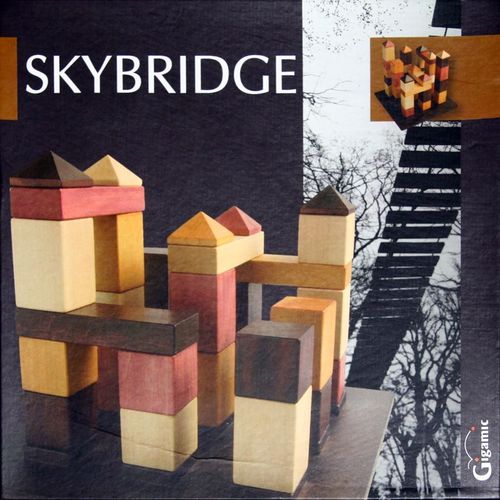
Skybridge
Skybridge Rulebook
Table of Contents
Table of Contents
Game Contents and Setup
A wooden game board with 9 bases and 44 wooden pieces of 4 colors, 11 of each color. Each color set contains one bridge, 4 three-story building blocks, 4 two-story blocks and 2 roofs. Each player receives the set of pieces of one color of their choice (fig. 1).
Object of the Game
Control the greatest number of floors in the city.
Brief Description
Two- and three-story building blocks are used to build towers. Bridges are used to connect neighboring towers. A roof determines who owns a tower. On their turn a player may place only one piece on the board.
Turn Sequence
The players agree on who starts. On their turn each player chooses one of their pieces and places it on the board, following these rules:
- Two pieces of the same color must not touch (fig. 2).
- Two- and three-story building blocks must be placed on the lowest possible level, except when pieces of the same color would then touch. In that case the player places the block on the next level up. Bridges and roofs may be placed on any level and on any piece of another color (fig. 4). If a player has several options for placing a piece, they are free to choose where to put it (fig. 3).
- To score more points, players may use bridges to connect two towers. A bridge can be laid on two neighboring towers of the same height. A bridge cannot be built diagonally. According to rule 1, a bridge cannot be built on pieces of its own color. One bridge may be placed on another only perpendicularly (fig. 5).
- Roofs may be built on any level. By placing a roof on any tower, the player becomes the owner of that tower. No other pieces may be placed on a roof.
If on their turn a player cannot place their piece on the board (all towers have roofs or pieces of that player's color), they skip the turn.
End of the Game
The game ends when all pieces have been placed on the board, or when it is impossible to place any piece on the board.
Each player's points are counted as follows:
- Each player counts the total number of floors of their towers (that is, those towers on which they placed their roof), regardless of the colors of the other pieces in the tower. Large blocks are equal to 3 floors, cubes to 2 floors, and bridges to 1 floor. Roofs and bases are not counted.
- If a player owns a tower connected to another tower by a bridge of the same player, they also receive points for the floors of the second tower, regardless of the color of that tower's roof. Points for the floors of the second tower are also received by the player who built the roof on that tower, and also by players who built another bridge from their own tower to that tower. Thus points for one and the same tower may be received by several players.
- If a player owns two towers connected by their own bridge, they receive points for the total number of floors of both towers, and the resulting number is multiplied by 2 (fig. 6).
The player with the most points wins.
Three-Player Game
At the start of the game each player receives 1 three-story and 1 two-story building block from the fourth color set. Players may use these pieces during any of their turns. The remaining pieces of the fourth color are not used.
Two-Player Game
Play follows the principle of the four-player game. Each player "represents" two players on the board and accordingly plays with two colors, placing one color in one turn and the other color in the next turn. On their turn a player may place a piece on any of the pieces of the other 3 colors. At the end of the game players count the points for each of their colors separately and then add the resulting numbers together.
Illustrations
- Fig. 1: the pieces of one color set.
- Fig. 2: pieces of the same color must not touch.
- Fig. 3: a piece may be placed in any of several legal positions.
- Fig. 4: bridges and roofs may be placed on any level on pieces of another color.
- Fig. 5: a bridge may be placed on another bridge only perpendicularly.
- Fig. 6: scoring example. Dark-roof player: 8 + 7 = 15, x2 = 30. Light-roof player: 10 + 8 + 7 = 25.