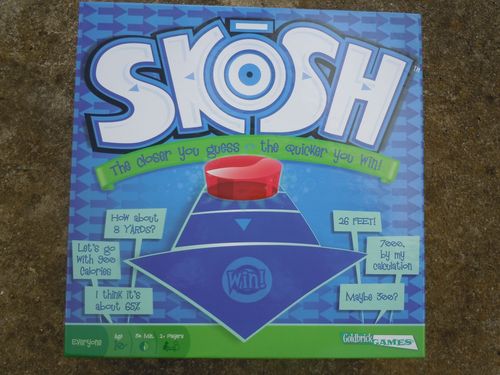
Skōsh
Skōsh Rulebook
Table of Contents
Table of Contents
Contents
- Skōsh gameboard
- Skōsh scoring puck
- 400 Skōsh Q&A cards
- 8 Dry erase cards
- 2 Dry erase markers
- Sand timer (three minutes)
- Game instructions
Object
Be the first team to slide the scoring puck into your winner's circle.
Teams & Players
- There are always two teams, consisting of one or more players each.
- There is no limit to the number of players on a team.
Setup
- Choose teams and seat teammates together.
- Place the gameboard between teams with the scoring puck on the Skōsh logo (center).
- Determine which team will move toward the blue winner's circle (to win) and which towards the green.
- Place a stack of Q&A cards, question side up, near the gameboard.
- Distribute four dry erase cards and one dry erase pen to each team.
Playing the Game
1. Questions: draw four Q&A cards and pass two
- Each team draws four Q&A cards from the stack, keeping the answer side facedown.
- The three-minute sand timer is started.
- Teams have three minutes to decide which two Q&A cards they will keep and which two they will pass to the opposing team.
- When the sand timer runs out, teams swap two Q&A cards each, keeping the answer side facedown.
2. Answers: deliberate, decide and put it in writing
- The three-minute sand timer is started again.
- Teams have three minutes to determine an answer for each of their four questions.
- Teams write one answer for each question on each dry erase card and place the cards next to the corresponding question, keeping the answer side of the Q&A card facedown.
- Teams must have an answer written for each question by the time the sand timer runs out.
3. Revealing and Scoring: read the question, reveal your answer, determine points and move the puck
- Randomly determine which team will be the first to reveal an answer (e.g., flip a coin).
- The first team will read one question, reveal their answer for that question, and then turn the Q&A card over to show the actual answer along with the target scoring range.
- Using the target scoring range for that question, determine awarded points and move the scoring puck accordingly.
- Points are awarded based on how close a team's guess is to the actual answer. For each question, the scoring target will show point ranges both above (>) and below (<) the answer.
- For each answer, teams can score 3, 2, 1 or negative 1 points (Diagram A). The scoring puck is moved one space for each point scored. If a team scores negative 1, the scoring puck is moved one space toward the opposing team's winner's circle (Diagram B).
- Teams take turns reading questions, revealing answers and scoring (one question equals one turn).
- If "Team B" answers the last question in a given round, "Team A" will be the first to answer a question in the subsequent round.
- If a round ends without a winner, put the used questions aside, clean the dry erase cards, and start a new round.
Diagram A: scoring target
The scoring target is a set of rings around the actual answer (shown in the Diagram A example as 60). Each ring is a point range:
| Guess range | Points awarded |
|---|---|
| Greater than 96 (>96) | -1 |
| 79-96 | +1 |
| 64-78 | +2 |
| 57-63 | +3 (answers within this range score 3 points) |
| 42-56 | +2 (answers within this range score 2 points) |
| 24-41 | +1 (answers within this range score 1 point) |
| Less than 24 (<24) | -1 |
Diagram B: negative point
When a team scores negative 1, the scoring puck moves one space toward the opposing team's winner's circle. Team A scores a negative point and moves the puck one space toward Team B's winner's circle.
Winning
- The first team to slide the scoring puck into the winner's circle wins the game (Diagram C).
- Exception: Teams cannot lose a game by scoring negative 1 on a question. If the opposing team is one point away from the winner's circle and your team scores a negative 1, the scoring puck is not moved and your turn is ended.
Diagram C
Team B scores two points and wins!
Additional Rules, Tips & Strategies
- It is not necessary to have an equal number of players on each team.
- Teams may choose to give their two questions away as a benefit to themselves, as a challenge to their opponents, or both!
- If a team determines which two questions they will give to their opponents before the sand timer runs out, the remaining time can be used to work on answers for the two questions they are keeping.
- Teams do not need to "land exactly" in the winner's circle. If you need one point to win and score two, you still win!
- Once a team lands in the winner's circle, the game is over, even if it's the first question in the round.