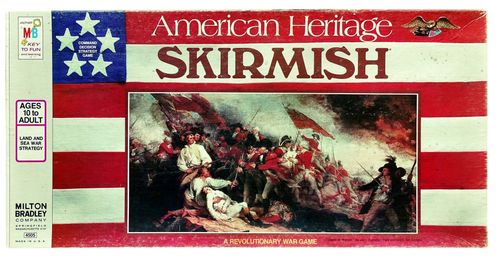
Skirmish
Skirmish Rulebook
Table of Contents
Table of Contents
Set Up
A Game For 2 Players
Open and place board between players. Choose to play the American (Blue) or British (Red) side.
Place the units on the board as follows:
RED BRITISH ARMIES: Make 4 Armies by stacking 4 red basic units and a top British Army unit. Place one each at Boston, New York City, Montreal and Yorktown as shown by the British Flag.
BLUE AMERICAN UNITS: Place one basic unit on each of the small blue stars on the board. Place one Army unit on the large blue star circle in New York State and one on the large blue star circle in Virginia. Place Washington's official "Continental Army" unit on Philadelphia.
Note that the British start with a total of 20 red "units" and the American starts with a total of 16 blue units.
NAVAL WARSHIPS: The British have 3 red warships. Place 1 each on the Red Dot in the harbors guarding Boston, New York and Yorktown.
The Americans have 1 blue warship. Place it on the Red Dot guarding Philadelphia. NOTE that Charleston harbor is "open" — no ship on its Red Dot.
NAVAL TROOP CARRIERS: Place the red troop carrier with TWO red units stacked on it, on the large RED dot in the ocean located on the edge of the board. Place the Blue Troop carrier with 4 blue units on the large BLUE dot at the edge of the board.
MOVING DICE (Black): Two are taken by the American and one by the British Players.
BATTLE DICE (Red): Put aside as it is used for battle only.
DICE CUPS: One to each player.
SKIRMISH CARDS: Shuffle and place, MESSAGE DOWN, on board in reach of both players.
Rules
In brief, players alternate in taking turns throwing the dice and moving according to the rules. If, after the move, a SKIRMISH or MAJOR BATTLE condition applies, the engagement takes place. Special Naval and Reinforcement moves and battles also may occur.
Object of the Game
British player — Defeat the CONTINENTAL ARMY.
American Player — Defeat all 4 British Armies.
Shaking Dice and Determining Moves
I. SHAKING DICE AND DETERMINING MOVES takes place in following sequence:
A. American Player puts 2 black dice in shaker, throws and holds shaker over dice to hide them. He looks at dice, but does not reveal their numbers to opponent.
The British Player also shakes one dice, throws and hides its number from American Player after looking at it.
B. British Player, before revealing his dice throw, must tell American which unit he is going to move. (If a zero was thrown, point out an army anyway so as not to reveal your dice throw).
C. American Player now reveals his dice throw (2 dice) and moves 2 units according to the rules for moving listed next.
D. British player, after American has moved, now moves the unit as indicated in "B" above according to rules for moving.
NOTE: If a "0" came up on the dice, no move is taken.
IT IS IMPORTANT that the exact sequence A, B, C, D be used:
A. Both throw, B. British tells which army he will move, C. American moves, D. British moves.
Moving
II. MOVING:
In rules below, a "unit" refers to either a militia, a one unit army, or multi-unit army, or a ship.
-
The number on the dice shows how many spots the player may move one unit. The dice can be either zero (no move), one, two or three spots. Since the American throws two dice, he must move two units, one for each dice thrown provided he has two units. The British can move only one unit (one dice thrown).
-
A unit must be moved along the lines, forward, backward or sideward but NOT on a diagonal (no lines). A unit may turn a corner or even two corners as long as he is along a line.
-
Player may not move a unit back and forth between the same two spots in the same turn.
-
Land units move only on black spots (not blue). The "starting" spaces such as the militia, Blue stars and "Union Jack" starting spots count as a land spot.
-
You can move through (over) or land on your own units, you must stack or combine your units occupying the same space; but you cannot keep two armies on the same space at end of move.
-
COASTAL OCEAN MOVES:
A. The war ships (not reinforcement ships) may move from harbor to harbor (red marks) each leg being one spot on the dice. (Example, ship can move from New York to Boston with one spot on dice). However, the harbor spot must either be open (no ship on it) or have a friendly ship on the harbor spot.
B. A unit (or army) may move from Coastal City (Boston, New York, Philadelphia, Yorktown or Charleston) to Coastal City along the solid red lines, one spot on the dice provided the harbor is open (no ships on spot) or controlled by your own war ship (your ship on harbor spot).
C. Two or more of your own ships may stop on a harbor spot.
D. If an American ship lands on the same harbor spot as a British ship, a NAVAL BATTLE takes place. (See rules for Naval Battle).
- If the American player has only one army left, he throws only 1 dice.
SUMMARY OF MOVING:
American throws 2 black dice and moves 2 Units (Militia or Army or War ship) one for each dice.
British throws 1 black dice and moves 1 unit (Army or War ship) according to number on dice.
Combining Units to Strengthen Armies
-
Whenever a land unit lands on another of its own land unit, by exact count, the unit or armies may be combined by adding the unit or units to one army. For example: If the American Continental Army of 3 units lands on a militia unit, by exact count, the militia unit can be added to the army now making it a 4-unit army.
-
Armies (British and American) cannot contain more than 6 units.
-
Once Armies have been strengthened as in "1" above, they cannot be split. Exception: If two armies of the same kind join together, one can be decreased and the other increased up to a maximum of 6 units. However, only one army may remain on one space, therefore, after combining armies, separate them by one space.
Skirmish
III. SKIRMISH TAKES PLACE AT THE END OF A PLAYER'S MOVE —
- Whenever opposing armies or a unit of militia and an opposing army occupy next adjacent (not diagonal) spaces, a SKIRMISH takes place between those units. (see diagram).
[Diagram: a central unit with four adjacent "S" dots (above, below, left and right) and four diagonal "N" dots at the corners. Caption: "Unit at 'A' is in skirmish position for any unit on the 4 'S' dots (adjacent), but NOT on the 'N' dots (diagonal)."]
- Draw a Skirmish Card and read what to do. If the card says:
A. Lose a unit — it is immediately removed and the game continues. If this is the top army unit — the army is defeated and removed from the board.
B. If the card calls for moving a piece (or army) the move CANNOT result in a new Skirmish, even if moved adjacent to another opponent unit. You cannot move onto an opponent's unit.
C. If the card calls for a "MAJOR BATTLE", that battle must take place IN THAT SAME TURN.
-
More than one SKIRMISH may take place if more than one opposing units (or Armies) are adjacent to each other. In this case the player who moved into the Skirmish position picks the order of the Skirmishes (i.e., which first, which second, etc.).
-
Losses or movements required by a "Skirmish Card" apply to those two units involved in the Skirmish.
-
Once a Skirmish has taken place between any two units, if they are NOT MOVED in following turns, no new Skirmish is allowed. If one is moved, a new Skirmish is allowed, even between the same two units.
Major Battle
IV. MAJOR BATTLE
-
At the end of players' moves, whenever a player's unit (army) lands on an opponent's unit by exact count, a "MAJOR BATTLE" takes place.
-
The Major Battle goes as follows: A. Count the number of units in each opposing army. Subtract the smaller number from the larger. The difference is the number to be ADDED to the STRONGER army's throw of the dice as his advantage.
B. Each player throws the battle dice (spots 1 to 6).
C. Add the difference as in (A) to the stronger army's throw and compare.
D. The number "difference" of the "corrected" throw is the number of units removed from the lower throw player.
E. If a tie results, neither player removes units.
EXAMPLE OF MAJOR BATTLE:
British Army of 6 units has landed on American Army of 3 units. The advantage to British is 6 − 3 = +3 units advantage. British throws the dice and gets a 3, the American throws a 4. The final result is:
British: 3 (on dice) + 3 (advantage) for a 6 total
American: 4 (on dice) for a 4 total
British won 6 to 4 and REMOVES two units (6 minus 4) from American Army.
-
Regardless of the outcome of the battle (dice thrown), a player CANNOT REMOVE MORE UNITS THAN THE OPPONENT HAS IN HIS ARMY INVOLVED. Thus, a one unit militia cannot lose any more than its one unit even if more difference resulted from the battle won by the British Army.
-
If, as a result of the battle, all units in the army are removed, that army is out of the game.
-
At the end of the battle, the units remaining are moved apart one space. No new battle or Skirmish may result from this move.
-
A NAVAL BATTLE occurs whenever two enemy ships land on the same spot. To have a NAVAL BATTLE, each player throws the Battle dice. Higher throw wins. If a tie, throw again. NO advantage is given to either ship. The losing ship is removed from the game.
Reinforcements
V. REINFORCEMENTS:
At an appropriate time during the game (see below) players may attempt to introduce reinforcements. When the "Reinforcement" Call is made, all land movements, Skirmishes and Battles stop.
-
British Reinforcements: (Two Red units) are on the Red ship at the Eastern part (right side) of the board. When British player has LOST ONE army, he may "Call for Reinforcements".
-
American Reinforcements: (4 Blue units) are on the Blue ship at the Eastern part of the board. When the American Player has won a Major Battle on land, he may "Call for Reinforcements".
-
On "Call for Reinforcements", either British or American, both players roll the Battle Dice to determine how many spots he may move a ship. One side moves his reinforcement ship and the opponent moves a war ship which is located at a harbor space. They move from blue dot to blue dot as in land movements. The reinforcing ship moves first. A player in his turn rolls the dice and moves his ship, his opponent in his turn does likewise.
-
The war ship tries to intercept the reinforcing ship and if it can land on the same space, by exact count, they have a Naval Battle as in rule 6 above. If the reinforcing ship loses, it and all of its units are removed from the game. The victorious warship is then immediately placed at an empty harbor.
-
If the reinforcing ship can get into a harbor Red Dot space, either empty or occupied by his own colored ship, it has successfully reinforced his side. The units carried are immediately removed and placed on the harbor city it has entered. If a friendly army is on that space, the units can be added (up to a total of 6) to the friendly army and the extra units must be placed on an empty adjacent spot. If an enemy unit occupies that city, the reinforcing units must have a Major Battle (land) between the landing reinforcement units and the enemy unit occupying that city.
-
After the reinforcing units are removed from the ship, it remains in the game as a war ship.
[The printed booklet numbers this list 1–7 then 9; no item 8 appears in the source.]
To End the Game
Players continue to move and skirmish or do battle until:
A. If the Continental Army is eliminated — the British player wins.
B. If all 4 British Armies are eliminated, the American wins.
NOTE: To prevent a player from "running away" near the end of the game, if there is no Skirmish or Battle in 10 moves, the player with least total units must surrender and declare the stronger player the winner.
Some Hints on Strategy
I. British Player: His armies have more power at the beginning of the game but lacks mobility. He also has most sea control and can use the coastal ports to advantage in moving.
His strategy usually is to try to engage in MAJOR BATTLES early in the game. Divide and Conquer! Clean up the small militia units as fast as possible — or catch the Continental Army and do MAJOR BATTLE.
II. American Player: Has more mobility. Weak in early part of game, but usually gets stronger as game progresses. Small units have advantage in SKIRMISHES.
His strategy: Stay away (especially Continental Army) from Battles — whittle away at British with Skirmishes. Build up armies to full strength before you go after MAJOR BATTLES. Work toward getting Reinforcements.
There are many "strategies" or "game plans" that can be used. While LUCK plays a part, the player who takes best advantage of his strengths and avoids his weaknesses will win.