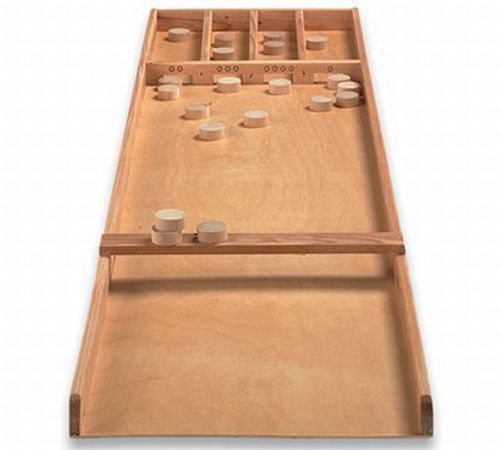
Sjoelen
Sjoelen Rulebook
Table of Contents
Table of Contents
1. General
1.1. The rules of play as described in this regulation must be observed at all federation matches.
1.2. An exception to this may be made by the cup committee for cup matches.
2. Equipment
2.1. The equipment described in this regulation is in accordance with a competition board approved by the federation.
2.2. Sjoelbak (see Figure 1). The sjoelbak is built from the following wooden parts:
- The push-off bar
- Base (floor)
- Side walls
- Gate bar (the crossbar carrying the four arches)
- Divider walls (between the compartments)
- Back wall
Figure 1 shows the board from above: overall length 2000 mm; 1570 mm from the push-off line to the gate bar; the scoring section behind the gate bar is 390 mm deep. The front section (in front of the gate bar) is labelled "VOOR" (front); the run-up section behind the push-off bar is labelled "ACHTER" (back). The six numbered callouts along the bottom mark, in order: (1) the push-off bar, (2) the base, (3) the side walls, (4) the gate bar, (5) the divider walls, and (6) the back wall.
2.3. Gate bar (see Figure 2). On the front of the gate bar, an indication is placed above each opening. This indication may consist of numerals or another means, but in every case must show a set of values that, read from left to right, are 2-3-4-1.
2.4. Dimensions — see Figures 1 and 2. Where no measurements are given in the illustrations, the following dimensions apply:
2.4.1. Thickness of side walls: 12 mm. 2.4.2. Thickness of divider walls: 12 mm. 2.4.3. Thickness of back wall: 14 mm. 2.4.4. Thickness of gate bar: 14 mm.
2.5. A sjoel disc must meet the following description:
2.5.1. Material: beech wood. 2.5.2. Sliding face: concave (hollowed). 2.5.3. Weight: 20 ± 3 grams. 2.5.4. Diameter: 52 mm. 2.5.5. Thickness: 13 mm.
2.6. Check line. A line is marked on the base, perpendicular, directly under the back edge of the push-off bar.
2.7. Parts or dimensions not mentioned are considered of lesser importance for the sport of sjoelen. Note: all measurements are given in millimetres. Tolerance:
2.7.1. ± 3 mm for the length dimension of 2000 mm. 2.7.2. ± 2 mm for the length dimension of 1570 mm. 2.7.3. ± 1 mm for all other dimensions.
3. Rules of Play
3.1. General: wherever this regulation refers to "he," "participant," "player," etc., female members are equally meant, unless explicitly stated otherwise.
3.2. Manner of play:
3.2.1. Each game begins with 30 discs.
3.2.2. The participant is deemed to have counted the discs before the start of the game.
3.2.3. A disc is in play as soon as it has completely passed the line at the push-off bar.
3.2.4. As soon as a disc touches another disc that is in play, that disc counts as a played disc. It has, after all, had an influence on the game.
3.2.5. Once a disc is in play, it may not be touched by anyone.
Exceptions to this are:
3.2.5.1. A disc that ends up outside a compartment or outside the board.
- If the disc leaves the board from the playing field, the jury member sets it aside and makes it available to the player again at a possible subsequent sub-turn.
- If the disc had entered a compartment through the gate bar and afterward ends up outside that compartment without having passed through the gate bar again, the jury member tells the player which compartment the disc came from. At the end of the sub-turn, the jury member places the disc back into that compartment.
- If a disc goes from a compartment back through the gate bar into the playing field, nothing happens and the disc remains lying in the playing field.
3.2.5.2. A disc that goes over the top of the gate bar into a compartment is immediately removed from play by the jury member.
3.2.5.3. A disc that, having passed through the gate bar from one compartment, comes to rest in another compartment or on one of the divider walls or side walls, is placed back into the (correct) compartment by the jury member. The situations shown in Figures 3 and 4 therefore indicate that the disc counts and is not removed. The discs in Figures 3 and 4 are set right once the sub-turn is complete.
Figure 3 shows six examples of a disc that has fallen against or across a divider wall — leaning upright against it, leaning at an angle from either side, lying flat across the top of two low walls, and resting on top of a stack of discs against the wall — all of which count and are set upright in the compartment once the sub-turn ends.
Figure 4 shows a single disc balanced flat on top of a divider wall, which likewise counts and is placed into the compartment once the sub-turn ends.
3.2.5.4. If a disc rebounds and completely passes the line at the back, the player, after permission from the jury, must take the disc out of the board and place it — or another not-yet-played disc — beside the board on the jury's side, separated from the other discs still to be played.
3.2.6. A disc is in the compartment once it has completely passed, beneath the push-off bar, through the front of the gate bar. In doubtful cases, the jury must place a straight closing lath against the front of the gate bar; if this movement moves the disc, then it is not in the compartment.
3.2.7. The jury stacks the discs in stacks of 4 for the first 4 discs sitting in the compartment. Subsequent stacks are of 3 — see Figure 5. The bottom disc of the front stack in all 4 compartments is placed clear of the back wall, or of the disc behind it, by a maximum of 5 mm.
Figure 5 shows the four compartments, numbered from left to right 2, 3, 4, 1 to match the gate-bar order, each illustrating the stacking pattern: a first stack of 4 discs at the front of the compartment, with any further discs stacked in groups of 3 behind it.
4. Scoring
4.1. Scoring is done as follows: in each compartment, 1 disc = 20 points, in each compartment 2 discs = 40 points, in each compartment 3 discs = 60 points, and so on. If more discs than this are in a compartment beyond this calculation, each of those extra discs counts for the point value of that compartment.
Example: each compartment holds 5 discs and there is 1 extra disc in compartment 4. The total is then 100 + 4 = 104 points. The maximum attainable is therefore 148 points.
Above the maximum score of 148 points, a bonus of up to 8 points can still be earned.
If 148 is achieved in one sub-turn, the player gets two single discs back. If the 148 is achieved across two sub-turns, the player gets one single disc back. The disc is played, after which the discs are stacked again.
Only the result of the played disc on the first, and if applicable the second, of these throws counts.
The number of bonus points earned is calculated according to the scoring rules above; a maximum of 4 bonus points can therefore be earned twice.
The final score is the sum of the points earned and the bonus points.
Examples:
- A player has scored 148 points across two sub-turns. He now gets one disc back, which he throws into compartment 2. The player has now scored 148 + 2 = 150 points.
- A player has scored 148 points in one sub-turn. He now gets two single discs back. The first time he throws it into compartment 4, the second time into compartment 1. The player has now scored 148 + 4 + 1 = 153 points.
5. Turn Order
5.1. A sjoel turn consists of 3 sub-turns, played in the following order:
5.1.1. The player counts the 30 discs.
5.1.2. After permission from the jury, the player throws these 30 discs and clearly indicates that all discs have been thrown.
5.1.3. The jury determines which discs may remain in the compartments and returns the remaining discs, as well as the discs covered by the exceptions under article 3.2.5.
5.1.4. The jury then stacks the discs and afterward gives permission to play with the remaining discs. Stacking takes place according to the rules of play. The player checks the discs received back and starts the 2nd sub-turn.
5.1.5. After the 2nd sub-turn, the procedure follows articles 5.1.3 and 5.1.4.
5.1.6. The player then throws, for the last time, with the discs then remaining, the 3rd sub-turn.
5.1.7. The jury then again determines which discs may remain in the compartments and proceeds to score the throw. The jury tells the player the score, and after the player's agreement the result is recorded on the match card, which is then shown to the player if desired.
5.1.8. If a player has thrown 148 across two sub-turns, he gets one disc back to try to earn up to 4 more bonus points as described in article 4. If 148 is scored in one sub-turn, the player gets two single discs back to try to earn up to 8 more bonus points as described in article 4.
5.1.9. If, after the 1st or 2nd sub-turn, all discs are already in the compartments but 148 has not been scored, the jury proceeds to score the throw.
6. Regulations
6.1. A player may choose to sjoelen either sitting or standing, but must at all times remain behind the board during and after play.
6.2. A player may, on request, play 5 practice discs.
6.3. Once a turn has begun — that is, after any of the 5 practice discs have been thrown — the sjoelbak may no longer be shifted. Every player must ensure that the board is placed back in its original position. A player may not make any changes to the equipment by means of lubricants or interim polishing.
6.4. If a disc breaks during play, the entire turn must be played again.
6.5. If a game has been played with more than 30 discs, the turn is void and must be played again.
6.6. If the game has been played with fewer than 30 discs, no correction is possible.
6.7. While a player is sjoeling, the jury may not talk and/or perform other actions that could influence the player. Only at the player's request may the jury indicate how many discs are in the compartments.
6.8. No discs may be placed on the push-off bar.
6.9. The match organisation ensures that the sjoelbak lies stably on the table. This can be done using strips or other means.
7. Federation Match Rules
7.1. While judging, a jury member may not have their own match card on the table.
7.2. If the jury writes down an incorrect score, before moving on to the next board:
- the correct score is established by the ring leader
- the incorrect score is crossed out by the ring leader
- the correct score is filled in by the ring leader to the right of the incorrect score
- the ring leader stamps it for approval.
7.3. In the case of any crossing-out, whatever it may be, the lowest legible number automatically counts.
7.4. The jury hands the match card to the jury member of the next board.
7.5. After recording the 10th turn, the jury member must give the copy of the match card to the player and the original to the ring leader. Under no circumstances may the complete card be given to the player.
7.6. If, on the instruction of the ring leader/match director, a complete sjoel turn must be replayed, this takes place after the conclusion of the 10th sjoel turn.
7.7. Smoking, drinking, or eating is not permitted while sjoeling or judging.
8. Final Provisions
8.1. In cases not provided for by this regulation, the match management decides.