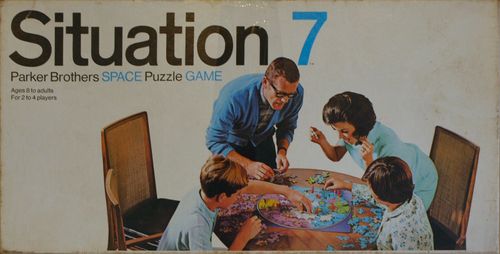
Situation 7
Situation 7 Rulebook
Table of Contents
Table of Contents
Introduction
[S]ituation 7 is a game in which two players or teams race each other to put together the pieces of a puzzle. Whenever the word "player" is used in these rules the word "team" may be substituted. Each player has a complete puzzle which, when assembled, covers the entire playing board. The two puzzles are identical except for background shade and the pieces of each puzzle are interchangeable with those of the other.
Object
The object of the game is to win more points than any other player. Points are won by completely covering sections of the board which are outlined by black grid lines on the board and by covering special objectives that have additional point values.
Equipment
One playing board. Two complete puzzles. Three orange and three yellow satellites. Three orange and three yellow rockets. Three orange and three yellow astronauts.
Preparation
Players sit on opposite sides of the board. The player in front of the yellow home planet takes the purple puzzle and scatters the pieces along his side of the board. The player in front of the green home planet does the same with the blue puzzle. Players are not permitted to arrange the pieces prior to the start of the game. Each player now takes a set of equipment pieces consisting of three rockets, three satellites, and three astronauts.
The Play
Play begins at the same time by both players, starting to build the puzzle from opposite sides of the board. The first puzzle piece played by each player must be placed on the red base line. These pieces are marked with a red border so that they may be easily distinguished. Each additional piece must connect directly to a piece on the base line or through other pieces which have already been played. Certain pieces have additional point value which is indicated by numerals appearing on the piece. These pieces are referred to as objectives and their point value is earned by the player who plays them first.
Use of Rockets
A rocket may be used as soon as a player has covered his rocket base completely including the black border around the base. When a player has completed his rocket base he may launch his rockets. A rocket may be launched into the other player's territory anywhere on the board provided that he can immediately join one of his own pieces to the other player's piece at that point. He may then expand his foothold by playing other pieces that connect to the piece occupied by his rocket. Once a rocket has been placed it cannot be moved for the remainder of the game.
Use of Satellites
As soon as a player has covered his satellite base completely, including all of the black borders, he may move his satellites onto the base. Thereafter the satellites may be used in the same manner as rockets.
Use of Astronauts
As soon as a player has covered his astronaut base completely, including all of the black borders, he may move his three astronauts to the base. Thereafter, he may at any time he wishes place one of his astronauts on any one of his pieces that is connected directly or through other pieces to his base line. The presence of an astronaut on a piece prevents an opponent from connecting one of his pieces to that piece. (See illustration.)
Illustration caption: Astronaut A guards 1, 2 & 3.
Once an astronaut has been played it may not be moved to any other place. An opposing player may neutralize an opponent's astronaut by placing one of his astronauts on one of his pieces in such a way that there is only one empty space between the two sides. Astronaut B neutralizes 3 when placed but astronaut A still guards 1 & 2. Either may then play in that empty space 3. Astronauts can travel only over their own connected land areas and may not cross territory held by opposing players. No two equipment pieces may occupy the same puzzle piece.
Scoring
After the entire puzzle has been completed, a [player] scores 50 points for each grid sector that he has [filled with] his own pieces. Grid sectors are outlined with black lines on the board. Sectors that are covered in part by pieces of both players do not count for either player. Each player totals the points earned by completing objectives, [rocket, satellite and astronaut] bases, planets, man-made objects and the sun. Refer to the list of assigned point values below. The player or team with the highest number of points is the winner.
Point Values
- Man-made objects: 50 points
- Rocket, satellite and astronaut bases: 50 points
- Planets and planet groups: 100 points
- Sun: 200 points
- Grid sectors: 50 points
- Special point circles: [value illegible on scan; the entry reads "as ... " and is most likely "as indicated" on the piece]