Situation 4
Situation 4 Rulebook
Table of Contents
Table of Contents
Introduction
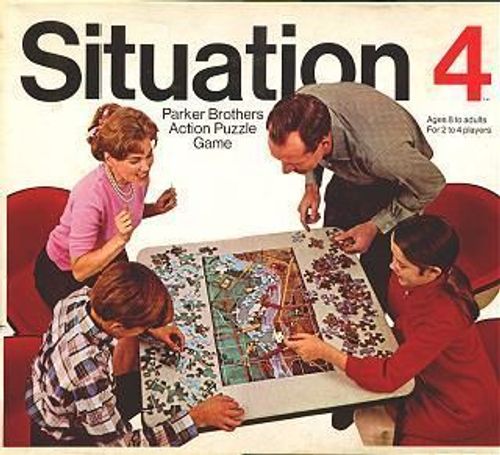
SITUATION 4 is a game in which two players or two teams race each other to put together the pieces of a puzzle. Whenever in these rules the word "player" is used the word "team" may be substituted. Each player has a complete puzzle which, when assembled, covers the entire playing board. The two puzzles are identical except for background shade and the pieces of each are interchangeable with those of the other puzzle.
Object
The object of the game is to win more points than any other player. Points are won by covering complete square sections of the board which are outlined by black grid lines and by covering special objectives that have added point values.
Equipment
One playing board. Two complete puzzles. Two orange and two yellow bridges. Three orange and three yellow parachutes. Three orange and three yellow tanks. A quantity of orange and yellow low flags.
Preparation
Players sit on opposite sides of the board. Each player selects a color and places the pieces of his puzzle along the side of the board which is closest to him. Players are not permitted to arrange the pieces prior to the start of the game.
The Play
The play begins by both players at the same time starting to build the puzzle from opposite sides of the board. The first piece played by each player must be placed on the base line. These pieces are marked with a red border so that they may be easily distinguished. Each additional piece must connect to a piece on the base line directly or through other pieces which have already been played. Certain pieces have additional point value which is indicated by numerals appearing on the piece. These pieces are referred to as objectives and their point value is earned by the player who first plays them. As soon as a player covers an objective, he places one of his flags on it to indicate ownership.
Use of Paratroops
Each player must build continuously from his side of the board except when he makes use of his paratroop forces. As soon as a player has completed his paratroop base, including all of the black border around the base, he may move his paratroopers onto the base. Thereafter he may place one of his paratroopers on an opponent's piece anywhere on the board provided that he can immediately join one of his own pieces to the opponent's piece. The piece so played becomes a beachhead even though it is not connected to the pieces previously played by that player. He may then expand his beachhead by playing other pieces that connect to the piece occupied by his paratrooper or the piece which he has just played. Once a paratroop piece has been played, it cannot be moved so that one player may establish no more than three beachheads during any one game.
Use of Tanks
As soon as a player has completed his tank base, including all of the black border around the base, he may move his three tanks to the base. Thereafter, he may at any time he wishes, place one of his tanks on any one of his pieces that is connected directly or through other pieces to his base line. The presence of a tank on a piece prevents an opponent from connecting one of his pieces to that piece. (See Illustration)
Illustration: Tank A guards 1, 2 & 3. Tank B neutralizes 3 when placed but Tank A still guards 1 & 2.
Pieces are considered to be connected only when they interlock at one or more points. Once a tank has been played, it may not be moved to any other place. An opposing player may neutralize an opponent's tank by placing one of his tanks on one of his pieces in such a way that there is only one empty space between the two sides. Either side may then play in that empty space. No two forces, tanks or paratroops may occupy the same puzzle piece. Tanks must use the bridges to cross the river and they may cross only on bridges placed by their own forces. Tanks can only travel over their own connected land areas and may not cross territory held by the opposing player.
Use of Bridges
A bridge may not be placed in position until a player has placed the land area pieces which the bridge touches on both sides of the river. Bridge positions are marked with a white dot on each side of the river.
Scoring
1. Placement of objective flags
The player properly placing an objective piece must immediately place one of his flags on that objective. If the player fails to play his flag immediately, his opponent may insert one of his flags on that piece and earn the points indicated by the numerals on the piece.
2. Placement of bridges
Whenever a player properly places a bridge in position, he wins 100 points.
3. Value of grid squares
A player scores 50 points for each square on the board that he has filled entirely with his own pieces. Squares that are covered in part by pieces of both players do not count.
After the entire puzzle has been completed, each player totals the points earned from objectives covered by his flags, bridges which he has placed, and grid squares which he has completely filled. The player or team with the highest number of points is the winner.