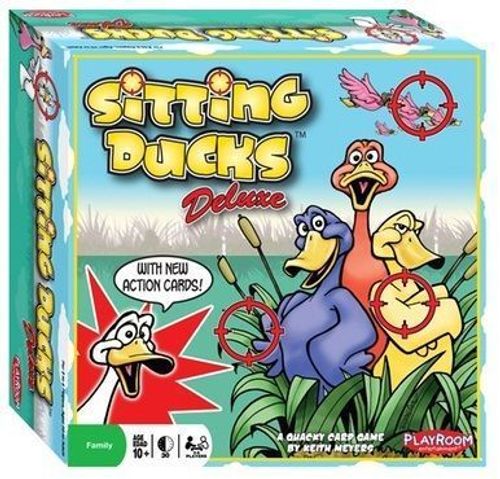
Sitting Ducks Deluxe
Sitting Ducks Deluxe Rulebook
Table of Contents
Table of Contents
Components
- 36 duck cards
- 5 water cards
- 3 duckling cards
- 100 action cards
- 6 crosshairs
- 1 firing range (game board)
Illustration captions printed on the component pictures on page 1 (the card titles are not legible in the printed image, so the captions are given without card names): "Look at the hand cards of one fellow player. Play one of these cards and give him the remaining cards back." / "Remove the duckling from the firing range. It leaves the game." / "Move a player's duck from the firing range under the duck pool."
Setup
The game board is placed in the middle of the table.
Each player chooses a duck colour and places one duck in that colour in front of himself. Ducks in colours that are not used are returned to the box.
The remaining ducks in the chosen colours are shuffled together with the five water cards and the duckling cards:
- 1 duckling with 3 players
- 2 ducklings with 4-5 players
- 3 ducklings with 6 players
The shuffled cards are placed face down as the duck pool on the marked space of the game board. Unused ducklings are returned to the box.
One player turns over the top six cards of the duck pool one after another and lays them in a row from left to right on the six spaces. The ducks should all face left, as if they are swimming away from the duck pool (see illustration). This row of six cards is the firing range.
The six crosshairs are placed next to the duck pool as a supply.
The action cards are also shuffled and placed face down as a stack on the marked space of the game board. During play a discard pile forms next to the action stack. When the action stack is used up, the discard pile is shuffled and placed as the new action stack.
Each player draws one card at a time from the action stack in turn until he has five cards in hand.
Playing the Game
The player whose duck is furthest forward (that is, furthest left) in the firing range begins. Play then continues clockwise.
On his turn a player must:
- play one action card from his hand and carry out the action described on the card (even if the chosen action does not help him or even harms him);
- place the played action card on the discard pile; and
- then draw one card from the action stack.
Exceptions:
- Some action cards allow a player to play several cards. In that case he draws cards until he again has five cards in hand.
- Even if a player has fewer than five cards in hand at the start of his turn, he may only draw back up to five cards at the end of his turn.
- If a player cannot legally play any action card, he shows his cards to the other players, places them on the discard pile and may draw five new cards. His turn then ends.
Duck Cards
Each player has ducks of a particular colour in play. When a player's duck is removed from the firing range, it is placed in front of its owner.
A player who has all six ducks of his colour lying in front of himself cannot win the game (exception: see "Follow-Up" and "Frank-Duck-Stein"). He keeps playing, however, and may aim, shoot and cause general chaos in the firing range as much as he likes. Revenge is sweet!
Duckling Cards
The duckling is a duck that belongs to no player. While ducklings are in the firing range, the action cards "Fire!", "Billy the Duck", "Ricochet" and "Two in One Go" may not be played. When a duckling is removed from the firing range, it leaves the game entirely.
Water Cards
Water cards cause confusion in the firing range. When they are taken out of the firing range, they always return to the bottom of the duck pool.
Action Cards in the Firing Range
During the game action cards may also be placed in the firing range. Such cards count as ducks that belong to no player. When action cards are removed from the firing range, they are placed on the discard pile.
End of the Game
The game ends when only ducks of one colour remain in the firing range or in the duck pool, and the ducks of all other players are lying in front of their owners. The owner of this colour has won the game.
Glossary of Action Cards
Aiming and Shooting
"Aim!" (Zielen!): The player who plays "Aim!" may place a crosshair over any card in the firing range (including a water card) that does not yet have a crosshair on it. The crosshair is not aimed at the card itself but at the position in the firing range. For example, if ducks move in the firing range, the crosshair stays where it is; it can afterwards aim at a different duck or at water.
"Fire!" (Feuer!): "Fire!" may only be played on a card in the firing range over which a crosshair already lies. The duck with the crosshair is removed from the firing range. It does not matter who placed the crosshair. Afterwards all cards behind the removed duck are shifted one position to the left, and the firing range is refilled with the top card of the duck pool. If "Fire!" is played on a crosshair lying over a water card, only the crosshair is removed. Crosshairs go back to the supply.
"Double Run" (Doppellauf): With "Double Run" the player places two crosshairs at the same time, each over two neighbouring cards in the firing range. If there are no two free places for crosshairs next to each other, the player may place only one crosshair.
"Billy the Duck": "Billy the Duck" works like "Aim!" and "Fire!" at once. A player who plays this card may immediately remove a duck from the firing range, regardless of whether a crosshair lies over it or not. If there is a crosshair over it, the crosshair is also removed. Afterwards the firing range is refilled as described under "Fire!".
"Ricochet" (Querschläger): With "Ricochet" the player does not remove the duck over which a crosshair lies, but one of the two neighbouring ducks. The selected duck stays in the firing range; its crosshair and one neighbouring duck are removed from the firing range. If the removed duck had a crosshair, that crosshair stays where it is.
"Two in One Go" (Zwei auf einen Streich): With "Two in One Go" two neighbouring ducks are removed together, provided that both have a crosshair over them. If only one of the two cards has a crosshair, or if they are not directly next to each other, this card cannot be played.
"Further Left!" and "Further Right!" (Weiter links! and Weiter rechts!): These cards allow a player to move any crosshair within the firing range by one space in the stated direction. "Further Left!" may not be played on a crosshair lying over the first card of the firing range. "Further Right!" may not be played on a crosshair lying over the sixth card of the firing range.
Important: a crosshair may only be moved if the space to the right or left of it is also free.
"Swan Song" (Schwanengesang): If "Swan Song" is placed on a duck of a player, that duck is not hidden. If shots are fired at both cards, both are removed. The owner of the duck may immediately remove another duck from the firing range. Afterwards the firing range is refilled as described under "Fire!".
"Follow-Up" (Wiedervorlage): A player who plays "Follow-Up" may exchange one of his ducks lying in front of himself with a duck in the firing range. No crosshair is needed for this card. If a crosshair lies there, it is not removed. The vacated place in the firing range is filled by the player's own duck. This card once again gives the chance to win the game.
"Frank-Duck-Stein" (Frank-Ent-Stein): A player who plays "Frank-Duck-Stein" may remove three ducks from the firing range. The ducks must lie next to each other. No crosshairs are needed. If there are crosshairs over them, they stay where they are. Afterwards the firing range is refilled as described under "Fire!". Then the player places one of his ducks lying in front of himself under the duck pool. This card once again gives the chance to win the game.
"Birdbrain" (Spatzenhirn): With "Birdbrain" a fellow player can be forced to remove his own duck from the firing range. In this case the effect of "Moby Duck" is exceptionally cancelled. The player who plays "Birdbrain" selects a duck with a crosshair over it. If the owner of the selected duck has "Fire!" in hand, he must play this card on his own duck. If not, "Birdbrain" has no effect.
"Shot in the Dark" (Schuss ins Dunkle): The top card of the duck pool is turned face up. If it is a duck, it is removed. A water card goes back under the duck pool. A duckling leaves the game.
"Bird Flu" (Vogelgrippe): All cards are taken out of the firing range. Ducks are removed. Water cards go under the duck pool. Crosshairs stay in their places. Afterwards six new cards are laid out from the duck pool.
"Moby Duck": A player who plays "Moby Duck" chooses a fellow player and places this card in front of him. Until that player is next on turn, "Fire!" cards may only be played on ducks of that fellow player. Then "Moby Duck" is placed on the discard pile.
Movement in the Firing Range
General: For all movements triggered by the following actions, the crosshairs stay in their places.
"Duck March" (Entenmarsch): With "Duck March" the foremost card is taken out of the firing range and placed under the duck pool. Attention: a duckling leaves the game. Then all cards move one space to the left. Finally the top card of the duck pool is turned over and placed on the free space in the firing range.
"No Hurry!" (Keine Eile!): With "No Hurry!" a player may swap the place of one of his ducks with the card directly behind it. This card may not be played on the rearmost duck in the firing range.
"No Time!" (Keine Zeit!): With "No Time!" a player may swap the place of one of his ducks with the card directly in front of it. This card may not be played on the foremost duck in the firing range.
"Turbo Drake" (Turbo-Erpel): "Turbo Drake" allows a player to move one of his ducks to the foremost end of the firing range. The cards behind it, up to the duck's original position, are shifted one place to the right to close the gap.
"Rowdy Drake" (Rüpel-Erpel): A player who plays "Rowdy Drake" may change the order of the cards in the firing range as he likes. Cards lying on top of each other must stay together. All crosshairs stay where they are.
"Alien Duck-napping" (Alien Ent-führung): With "Alien Duck-napping" a player's duck is taken out of the firing range. All cards behind it move one space to the left. The top card of the duck pool is turned over and placed on the free space in the firing range. Afterwards the removed duck is placed face down on top of the duck pool.
"Off to the South" (Ab in den Süden): With "Off to the South" a player's duck is taken out of the firing range. All cards behind it move one space to the left. The top card of the duck pool is turned over and placed on the free space in the firing range. Afterwards the removed duck is placed face down under the duck pool.
"Ducks Brothers": With "Ducks Brothers" all cards are taken out of the firing range, shuffled and laid out again from right to left. If two cards lie on top of each other on one space, the player must make sure that these cards stay together.
"Mixed Up" (Bunt gemischt): With "Mixed Up" the foremost three cards are taken out of the firing range, shuffled and laid out again from right to left. If two cards lie on top of each other on one space, the player must make sure that these cards stay together.
Defensive Actions
"Cover!" (Deckung!) may not be played if no duck lies on a neighbouring space. A duck also cannot take cover behind a water card or a duckling. The firing range moves forward. The ducking duck now moves together with the duck behind which it is hiding. If the duck providing cover reaches the foremost space of the firing range and "Duck March" is played, both ducks go together under the duck pool. If the duck providing cover is removed, the duck behind it is again without cover from then on.
"Tail Up" (Schwänzchen in die Höh): A player places "Tail Up" on any duck in the firing range. The card stays there until that player is next on turn. If "Tail Up" is shot at, only the crosshair is removed. The duck covered by "Tail Up" also stays where it is. If the action card is moved, the hidden duck is moved along with it. Only with "Duck Dance" (Ententanz) do "Tail Up" and the covered duck stay on their space.
"Little Coward" (Kleiner Feigling): A player places "Little Coward" on any duck in the firing range. The duck stays there until "Little Coward" and the hidden duck have reached the head of the firing range. Then the action card is immediately placed on the discard pile. The duck stays on its space. Furthermore, the same rules apply as described under "Tail Up".
"Bodyguard": A player places "Bodyguard" on any duck in the firing range to protect it. If the protected duck would have to be removed, only the crosshair and "Bodyguard" are removed. Furthermore, the same rules apply as described under "Tail Up".