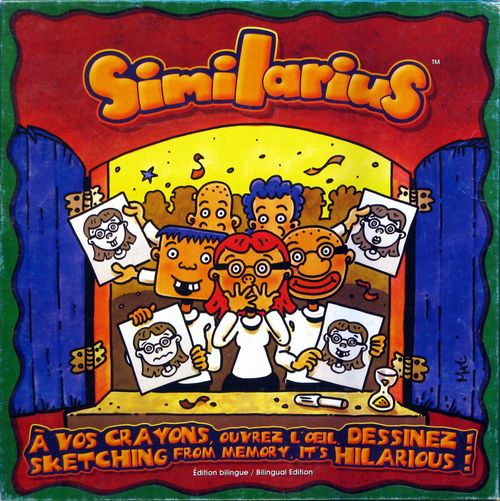
Similarius
Similarius Rulebook
Table of Contents
Table of Contents
Goal of the Game
Score more points than your opponents by reproducing the mystery characters of the Binette family.
Setup
Place the game board on the table, leaving free space to set down the game pieces. The players sit in a semicircle in front of the game so that everyone can see well. Each player takes all the components of one colour (a pawn, a token, the 4 Prediction cards and a pencil), together with a Drawing Board / Memory Aid card.
Shuffle the Character cards and the Surprise cards separately, then place them face down on their respective icons on the game board. Next, shuffle the Scoring cards, draw 5 of them and place them face down on their icon. Return the other Scoring cards to the box. Place the hourglass on the Hourglass icon.
Each player places their pawn on the start arrow of the Star Path (numbered 1 to 70) and their token on the start arrow of the Calculation Table (numbered 1 to 12).
Decide together on the difficulty level of the game. Finally, designate the player who, in addition to taking part in the game, will act as the host. The host takes the Host card.
Note: "draw a card", "pick up a card" and "take a card" all mean the same thing.
Difficulty Levels
The levels vary according to the number of Character cards used in the game.
- Beginner: 2 cards
- Intermediate: 3 cards
- Advanced: 4 cards
- Expert: 5 cards or more
Course of a Turn
Each turn consists of 5 steps:
- Observing the Character cards
- Drawing the mystery Character
- Predicting the best drawing
- Calculating the Drawing and Prediction points
- Transferring the points to the Star Path
1. Observing the Characters
At the start, the host turns over the first Scoring card. Then the host draws the number of Character cards corresponding to the difficulty level chosen at the start of the game. The host places them face up, off the game board, and then turns the hourglass. The players now have one minute to observe and memorise the characteristics of the characters (the head, the eyes, the nose, the mouth, the hair and the little something) as well as the characters' first names.
2. Drawing the Mystery Character
Once the time has elapsed, the host turns the Character cards face down so that the faces are hidden, and shuffles them on the table.
Then one player of their choice turns all the cards face up except one. The character on that card is the one that all players (including the host) must now draw. It is called the mystery character.
Hidden from prying eyes behind their Memory Aid (the card held upright), the players try to reproduce the mystery character on their drawing board (see the section on technical information). They refer to the Memory Aid, on which the 6 characteristics of the characters are shown. At any moment during the drawing period, a player may decide to turn the hourglass over. Then everyone has only one minute left to finish their drawing. Once this time has elapsed (or as soon as all players have finished their drawing), each player puts down their pencil and reveals their drawing.
Translator's note: the printed rules refer to a section on "technical information" about the drawing board. No such section appears in this document, so none is transcribed here.
3. Predicting the Best Drawing
Each player makes their prediction: they take their 4 Prediction cards and choose the colour of the player who, in their opinion, will score the most points with their drawing, because of its resemblance to the mystery character, which remains hidden. The player then places their Prediction card face down, next to their drawing. The host may remove the other Character cards from the game.
Note: Players may choose their own colour, that is, their own drawing.
4. Calculating the Points
Drawing Points
The host reveals the mystery character. They compare each player's drawing to the mystery character, one characteristic at a time, starting with the first characteristic (the head). The host then takes the token of each player who has reproduced that characteristic correctly and moves it forward on the Calculation Table by the number of points shown on the Scoring card.
Example: the head of the mystery character is round and the Scoring card indicates that the head is worth 2 points. The host moves the token of each player who drew a round head forward by two spaces.
The host proceeds in the same way for each of the characteristics.
After the calculation, the host removes from the game the mystery character card and the Scoring card. Players who have successfully reproduced the characteristic marked with a small star on the Scoring card each draw one Surprise card (see the section on Surprise cards).
Prediction Points
Next, the players reveal their Prediction cards. Players who predicted the colour of the player (or one of the players) who scored the most Drawing points are awarded 3 additional points. The host therefore moves the token of these players forward 3 spaces on the Calculation Table.
5. Transferring the Points to the Star Path
Once the points have been calculated, each player's points must be transferred to the Star Path. To do this, the host advances each player's pawn by the number of points that player has just obtained on the Calculation Table. After each transfer, the host returns that player's token to the start arrow of the Calculation Table.
Surprise Cards
There are 7 types of Surprise card. All of them must be removed from the game after use.
"BONUS": A player may use their Bonus cards after the step "Transferring the points to the Star Path". They advance their pawn on the Star Path by the number of points shown on the card. The Bonus card must be the same colour (orange or yellow) as the space (or the number) on which the pawn has stopped. After moving their pawn, the player may use another Bonus card under the same conditions. All Bonus cards may be used in this way during the same turn, or kept for a later turn. Cards with 2 digits may be used on a yellow or orange space.
"DOUBLE": A player may use this card at the same time as one of their Bonus cards. It allows them to double the value of a Bonus card.
"RECYCLAGE" (Recycling): A player may use this card to recover the Surprise card or cards that an opponent has just played. They may use them in a later turn.
"ESPIONS" (Spies): A player may use this card at any moment during the drawing period. It allows them to look at the other players' drawings to refresh their memory. They may do so for the entire duration of the drawing period.
"RETOUCHE" (Touch-up): A player may use this card during the step "Calculating the Drawing points". It allows them to obtain the points or the Surprise card for a characteristic of their choice.
"SABOTAGE": A player may use this card at the end of the step "Calculating the Drawing points". After the Drawing points have been awarded for the characteristics correctly reproduced, the player who uses the Sabotage card moves one opposing token back 2 spaces, or moves 2 opposing tokens back one space each on the Calculation Table. In this way, the card can change who might have been in the lead on the Calculation Table after the Drawing points have been awarded.
"CORBEILLE" (Bin): A player may use this card during the step "Calculating the Drawing points". As a result, no player may obtain the points of a Surprise card. It may be used for a characteristic of the player's choice.
Start of the Next Turn and End of the Game
The game proceeds in the same way as the previous turn. Off you go again! Get to know other funny faces of the Binette family. At the end of the fifth turn, the player who has accumulated the greatest number of points is declared the winner.
Remark: A player who draws more than one "Little something" loses their points for that characteristic. It is not necessary to draw the shoulders, the neck and the ears of the mystery character. The first name of the mystery character must be written without mistakes in order to be awarded the points.
Have fun, and do not be too strict in awarding points. This game is neither a speed contest nor a drawing contest. The important thing is to have fun...
Variants for Children
For Ages 4 to 5: Build Your Own Binette Family Characters!
Reproducing the 6 characteristics: If you look carefully at the Memory Aid, you will see that there are 6 characteristics (the head, the eyes, the nose, the mouth, the hair and the little something), and that each of them offers 6 possibilities. With the help of an adult, the children try to reproduce the various characteristics from the Memory Aid on their drawing board.
Collective creation of a character: We also suggest another fun way to play Similarius. First, borrow a six-sided die from another game. Each player uses a pencil and the same Drawing Board / Memory Aid to create collectively a new character of the Binette family.
Each player rolls the die, and the player who obtains the highest number starts the game. In turn, clockwise, each player must complete the drawing of the previous player. To make it easier to learn how to reproduce the characteristics, it is preferable to follow the order in which they are presented on the Memory Aid. The first player rolls the die for the first characteristic (the head). The number obtained determines which of the 6 heads (counting from the left) they must draw. The second player rolls the die for the second characteristic (the eyes) and reproduces the "eyes" corresponding to the number obtained. The players continue in this way until each of the characteristics has been drawn and a new character has been created.
For example, the first player must reproduce the first characteristic, that is, a head. They roll the die and obtain a six. They must then draw the sixth head, that is, the triangular head. The second player rolls the die and obtains a 5. They must then draw the sad eyes (the fifth pair of eyes) on the triangular head. Once finished, give a first name to your character so that they become part of the family!
Suggestions: To keep your drawings, reproduce them on sheets of paper with another pencil. Active participation by the parents increases the children's motivation and involvement. Be amazed by their progress and congratulate them.
For Ages 6 to 7: Introduce Your Children to Similarius
Difficulty level (without the first name):
- Novice: 1 card and the 4, 5 or 6 first characteristics
- Champion: 2 cards and the 6 first characteristics
This adaptation allows families to play pleasantly together with children aged 6 to 7.
To maintain the children's interest and motivation, avoid awarding points that have not been earned, and congratulate them on their success.
Active participation by the parents stimulates the children's personal investment. Similarius allows children to learn to improve through trial and error. Similarius puts the emphasis on the pleasure of playing as a family and with friends.
Translator's note: the printed text has a few typographical slips, which are rendered here as their evident meaning: "tes" is read as "les" (the shoulders, neck and ears), the closing name is read as "Similarius", and "i carte" in the Novice level is read as "1 card".