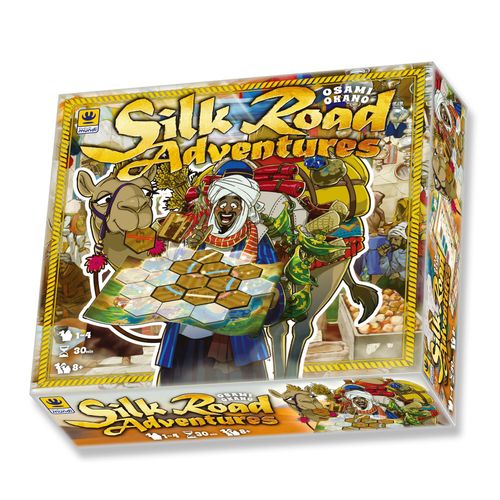
Silk Road Adventures
Silk Road Adventures Rulebook
Table of Contents
Table of Contents
Overall Flow
This game progresses by repeating a series of procedures called "rounds". After first using the trade cards to decide the destination city and value of the local goods, the hourglass is then set, and trading begins. You then refer to your personal specialty goods map while you quickly place route tiles to connect cities together. The fastest merchants, and the merchants that have travelled the most routes will be award with bonuses. At the end, answer keys are placed on top, the goods obtained are confirmed, and points are received. After repeating this four times, the traders that have gotten the most points are the winner.
(Printed wording "will be award with" kept as printed.)
Components
- playboards×4
- market board×1
- specialty goods map×24 (4 rounds, 6 maps each)
- route tiles×84 (3 types, 28 boards each)
- markers×12 (4 types, 3 each)
- answer keys×24 (4 rounds, 6 sheets each)
- trade cards×15 (front and back)
- specialty good tiles×6 (wheat, wine, spice, jewel, silk, lamp)
- bonus route tiles×3
- hourglass×1
- manuals×4
Game Preparation
-
Place the market board at the center of the table and place the trade cards, answer keys, specialty good tiles, bonus tiles, and hourglass around it. Place the cards face down, shuffle them, and stack them in a pile.
-
Each player gets one playboard and seven of each of the three types of route tiles along with three markers of the same color. One of these markers will be used for displaying the score and shall be placed in the place where the '0' is located on the upper left of the market board.
-
Separate specialty good maps by round, shuffle each of them, and hand out one at a time face down. It would likely be easier to play by stacking them from the bottom: 4, 3, 2, then 1.
How Rounds Proceed
1. Adding Specialty Goods
The decided specialty goods will be placed in the center of the front of the board as shown in the figure. Please refer to the table below for which specialty goods to place and where to place them. The three types of specialty goods for round one may be placed in either 2, 1, or -1.
| Round | Specialty goods (icons) | Values |
|---|---|---|
| Round 1 | three goods (red, blue and brown icons) | 2, 1, -2 |
| Round 2 | one good (green icon) | 3 |
| Round 3 | one good (blue-grey icon) | -3 |
| Round 4 | one good (brown icon) | 4 |
(The icons in the table are shown only as colours in the printed sheet; the good names are not printed beside them.)
2. Drawing Trade Cards
When you add a specialty good, next you turn over one trade card from the pile. The next two destination cities and the icon representing the market fluctuations of the local specialty goods are written the card. Each player should put the markers that they are holding on top of the cities displayed on the card. Next, follow the icons at the bottom and change the price of the specialty goods.
The market fluctuation icons on the trade card are:
- Exchange the most and second most expensive specialty goods.
- The most and third most expensive specialty goods are exchanged.
- All the specialty goods become one rank cheaper. However, the cheapest specialty good becomes the most expensive.
3. Beginning Trading
To establish routes quickly and correctly within the two-minute period, preparation is also important. By separating the three types of routes in advance, you can avoid the effort of searching for them. In addition, there are seven of each route tile. If you use too much of the same type of tile, they will quickly run out, so it is also helpful to confirm the number of tiles left in advance. Also, it is important to double check the top and bottom of the specialty good map as well as the specialty good market price chart prior to the start of trading.
Once all players are ready, trading begins. When a representative (a leader, the oldest, or the person with the longest hair) gives the signal and turns the hourglass over, each player turns the specialty good maps for that particular round over to the front and start trading. The time limit is two minutes. Each player lines up route tiles on their own playboard to connect their two destination cities. The specialty goods on completed routes will gain points so it is important to build routes that avoid specialty goods that lose points while passing through specialty goods that gain points.
Once completed…… The players who have finished connecting the tiles raise their hands and declare "I have arrived!". In addition, the players that have declared as such must not touch their tiles until trading has finished. Even if a player should notice the mistakes they made, they are not allowed to make any changes, so declare both speedily and carefully.
Points Regarding Placing the Route Tiles
- Separate the route tiles in advance.
- Align the faces of the specialty good maps and the playboards.
4. Calculating Scores
1. Confirming Routes
Once all the players have declared their arrival or once the sand in the hourglass has completely fallen, trading ends. All players must remove their hands for their tiles and from the board. Once trading finishes, first the routes are checked to make sure that they are completed. If the two destination cities of a player are not are not connected by a single route, that player is disqualified and does not receive any points that round.
(Printed text repeats "are not" here; kept as printed.)
Examples of Disqualification
- The route is broken off.
- It is not connected to the entrance of a city.
- It is connected to a city other than the destination cities.
- It passes through other cities.
2. Ranking Bonuses, Length Bonuses
The players that are not disqualified receive bonus points for the top speed and length. Ranking bonuses are awarded to the player who declares arrival the quickest that round. First place receives the amount of bonus points written in the figure on the market board. Last place receives zero points. Other players each receive one point. The markers on the market board are moved one space for each point received. Next is the length bonus. The player with that used the highest number of route tiles for the routes that round will gain an additional point. If there are multiple players that have the same number of tiles, they all receive one point each.
Ranking Bonus Example: 1st place 3 points; 2nd place 1 point; last place 0 points; disqualification 0 points.
Length Bonus Example: the player with the highest tile count receives 1 point; the other players, at 12, 10 and 9 tiles, receive 0 points; a disqualified player receives 0 points.
(Tie-break for simultaneous arrival is printed in the FAQ, Q4/A4 below.)
3. Trade Goods Score
Players who are not disqualified take an answer key corresponding to the number written in the upper right-hand corner of the specialty good map, align it in the direction of the player board, and stack it. All the specialty goods that the route passes through, are purchased and the points written on the market board are earned. Points are also detracted for specialty goods with negative values. Specialty goods that pass through the bonus route tile receive double the points (Be careful as this includes point deductions as well.) If the total value comes to a negative value, please remove markers from the market board. However, the total value should never go under zero.
Hints for Checking
To confirm whether a specialty good can be purchased, check the adjacent edge to the specialty good. The edges that apply are written on the answer keys, so if the route is passing through here the purchase is a success. On the other hand, even if the route is touching the specialty good, if it is not passing through the edge, a purchase cannot be made.
(Illustration captioned "Travel around the edges", with a crossed-out example.)
5. Receiving Bonus Route Tiles
As the calculation of the score of each round one through three finishes, if the is a single player in last place, that player receives one bonus route tile. If there are multiple players in last place, bonus route tiles are not received. Bonus route tiles can be used in the round you like in the same way as other route tiles. You could use a bonus route tile earned in in round in in the fourth round or you may use multiple bonus tiles in a single round. However, bonus route tiles that have been used cannot be used anymore until the game finishes.
(Printed wording "if the is a single player" and "earned in in round in in the fourth round" is garbled in the source and is kept as printed.)
6. Ending the Game and Deciding Winners and Losers
Once all steps until step five have finished, all the trade cards, specialty good maps, and answer keys are put in the box, and all of the bonus titles and markers on the playboard are removed and put aside. Any bonus route tiles are also put back in the box. In addition, you return to the first step and the next round begins. After four rounds have been completed, the game ends. At that point, the player with the highest number of points is declared the winner. If scores are tied, the player with the highest score it the winner. If the scores are still tied, the game ends in a draw.
(As printed, the tie-break sentence reads "the player with the highest score it the winner"; the intended meaning is that the player with the highest score among those still tied wins. The printed wording is kept as it stands.)
Regarding Solo Play
It is possible to play this game by yourself. You can skip the rules regarding the ranking and length bonuses as well as the bonus route tile rules and count only the score from specialty goods. Upon finishing four rounds, your rank will be as displayed in the chart below.
| Score | Rank |
|---|---|
| 46 ~ 50 | Millionaire |
| 36 ~ 45 | First class merchant |
| 21 ~ 35 | Average merchant |
| 11 ~ 20 | Flea market vendor |
| 0 ~ 10 | Mama's errand boy |
FAQ
Q1. All but one person was disqualified. What happens to the rank bonus?
A1. The player that was not disqualified gains the first-place rank bonus in addition to an extra point. (To be precise, they are also earning plus zero points from being in the lowest position.) In addition, they earn one additional point on top of the growth bonus.
Q2. All players were disqualified this round.
A2. For that round all players receive zero points. Proceed to the next round and play without trying to rush. Rather than aim for 1st place, it is recommended that player confirm their routes prior to declaring anything.
Q3. I connected 2 bonus route tiles and gained specialty goods worth four points. How many points do I receive total?
A3. Eight points. Even if you use two bonus route tiles, the points of one specialty good will never be worth more than double.
Q4. For the rank bonus, there are players who declared their arrival at the same time, and we are unable to tell who was first.
A4. If it is at the exact same time, please prioritize the people with the lowest score. If the scores are the same, prioritize the youngest person. If it still an issue, when the next round begins, place coins near the trade board for each player and have players take one when they make their declaration. The person who takes the coin closest to the trade board is the highest rank. You can use things like chocolate or cookies in place of coins as well.