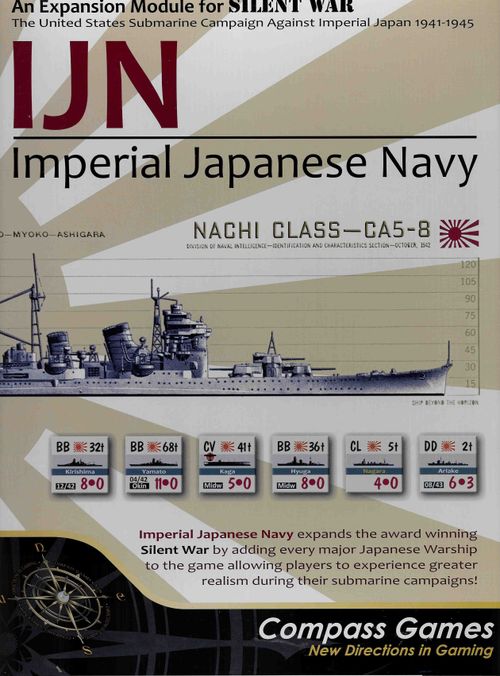
Silent War: IJN – Imperial Japanese Navy
Silent War: IJN – Imperial Japanese Navy Rulebook
Table of Contents
Table of Contents
- 2.0 Components & Conventions
- 3.0 Playing with the IJN Set
- [SW3.3] IJN Expansion Pack Set Up
- 3.1 Using the IJN Set During the Combat Phase
- 3.2 Aircraft Capable Ships
- 3.3 Named Ships from the Original Silent War Set
- 3.4 Sinking IJN Set Ships
- 3.5 Damage to IJN Set Ships
- 3.6 Tonnage Award for Sunk IJN Set Ships.
- 3.7 Special Rules for Encountering Specific IJN Set Ships
- New Rules Additions
- 9.0 IJN Japanese Unit Removal Date & Event Table
2.0 Components & Conventions
Silent War: Imperial Japanese Navy includes new playing pieces (called counters) which are to be used during the play of the game. These counters are used in addition to the existing set of playing pieces as described below.
Inventory
The IJN: Imperial Japanese Navy Expansion Module includes:
- 2 Countersheets
- A Rule Book
- A Sequence of Play Card (for Silent War)
Conventions
Rules are referenced by number using brackets such as [2.0]. When a rule from Silent War is referenced to in the IJN rule book, the reference will appear with SW appended to the front of it such as [SW3.0]. If the SW does not appear, the reference is to a rule the IJN rulebook. The term IJN Set refers to the playing pieces (counters) contained in this, the IJN expansion game. The term SW Set refers to the playing pieces (counters) contained in the basic Silent War game.
2.1 Description of the IJN Set
The new IJN Set playing pieces (called counters) closely resemble the existing, generic set, of counters used in Silent War and use the same general format as in the basic game. The only changes are:
-
Removal Dates: The addition of a removal date or War Event name in a white-text-in-a-black-box to some IJN counters specifying when the player removes the counter from the game. Counters are removed at the beginning of the first turn (week) of the game month shown or at the end of the turn in which the War Event occurs. Some IJN ships have entry dates only; some have both entry and removal dates; and some have no dates at all. Consult the IJN Japanese Unit Removal Date and Events Table at the end of this booklet for the chronological order of removal.
NOTE: If a removal event does not occur, the IJN set counter is not removed.
-
Aircraft Capable Ships: Some IJN ships also have an aircraft silhouette against a red ball (see Aircraft Capable Ships [3.2]).
The backs of the IJN counters feature the imperial chrysanthemum and identify the type of ship (CV, BB, CA, CL, DD, AX), making it easier for players to sort the counters out for play purposes.
The counter layout shows the following printed information: the ship type and tonnage at the top (Type, Tons), the ship name, and the Defense and ASW values at the bottom (Defense, ASW). Japanese Navy Vessels and Japanese Army Vessels are shown with their own counter styles. Units with a pendant flag left of their name follow special encounter rules; see [3.7].
Counter entry and exit dates are shown in the date box on the counter:
- Unit with no entry/exit date.
- Unit with just an exit date (for example, 3/43).
- Unit with just an entry date (for example, 11/44).
- Unit with both an entry & exit event (for example, 08/42 with the event name Poca).
A 1932 Unit (yellow name) is marked with a '32 after its name. The '32 denotes a 1932 scenario only variation; there will be a 1941 scenario version of the ship also.
2.2 Scenario Applicability
The IJN Set represents the Japanese Navy for both the 1932 and 1941 scenarios; some ships overlap both 32 and 41. The following describes each set of ships and when to use them.
-
1932: Ships with names appearing in yellow are used for the 1932 scenario, East Wind Early. Several ships have specific 1932 versions - each having '32 appended to their name (e.g. Fuso `32). Ships without yellow names are not used in 1932.
-
1941: All ships with the exception of those with `32 appended after their names are used for the 1941 and later scenarios, regardless of the color of the name (use both white and yellow names).
NOTE: the AC Izumo is considered a CA for both the 1932 and 1941 scenarios. AR Asahi is considered an auxiliary (AX).
3.0 Playing with the IJN Set
Players should set the game up as described in Setting Up the Game [SW3.0] in the rule book, adding the following step after [SW3.2];
[SW3.3] IJN Expansion Pack Set Up
Place all the IJN Expansion Pack-1 playing pieces face down (the side with the ship silhouette) in a separate area, and sort them by ship-type as listed on the back of the counter, in six (6) separate piles as follows:
- BB Battleships (including BV)
- CV Aircraft Carriers (including CVL, CVE)
- CA Heavy Cruisers (CA, AC)
- CL Light Cruisers (CL)
- DD Destroyers (DD, DE)
- AX Auxiliary Ships (AO, AS, AV, AM, AR, AL)
- Note the start date on the counters: ships without a start date are all considered "at start" for the '32 or '41 Campaigns. Add ships with a start date to the piles at the start of the first turn (week) of their entry month/year.
- Players could alternatively use cups; in the event where they use piles it is suggested to shuffle the counters so as to keep the draws as random as possible.
Once sorted, players should begin play and proceed normally until a tactical resolution is required.
3.1 Using the IJN Set During the Combat Phase
The Combat Phase [SW14.0] proceeds as described in Silent War with the following changes:
! Reminder ! As normally done, at the end of combat return all SW Set ships to their A-B-C-D cups, but remember to return the IJN Set ships to their correct piles, but be careful not to put them into the A-B-C-D cups!
A. Japanese Warships (BB, BV, CV, CA, AC, CL, DD, DE)
When a Japanese warship from the SW Set is revealed, that is a target counter is flipped face up revealing a white playing piece with a Japanese warship on it (but not a Diligent Escort— see C below), the player immediately replaces the SW Set counter with a counter drawn from one of the IJN Set warship piles, selected randomly from the same class as the ship being replaced (BB, CV, CA, CL, DD, AX – For a DE, draw from the DD set). Regardless of what values were on the SW Set counter, the values of the IJN Set counter become the play values used. The SW set counter is returned to the cup from which it was drawn.
Following the Combat Phase, an undamaged IJN Set ship is returned to its pile. For damaged IJN Set ships see Damage to IJN Set Ships [3.5].
Example: The player flips a counter in column B revealing a Japanese Destroyer (DD). The player immediately draws a replacement counter from the face down IJN Set DD pile and places this newly-drawn counter in the location of the original SW Set counter, returning the SW Set counter to cup B. If the original SW Set counter had a value of 7-1, and the IJN Set counter replacing it has a value of 6-2, then 6-2 is the value that will be used in this Combat Phase (including all re-attacks and super-skipper re-attacks).
B. Japanese Auxiliaries (AO, AF)
When a Japanese auxiliary from the SW Set is revealed, that is a target counter is flipped face up revealing a yellow playing piece with a grey center bar featuring a merchant type ship on it (AO or AF); the player immediately replaces the SW Set counter with a randomly drawn counter from the IJN Set AX pile. Regardless of what values were on the original SW Set counter, the values of the IJN Set counter become the play values used. The SW Set counter is returned to the cup from which it was drawn. Following the Combat Phase, an undamaged IJN Set ship is returned to its pile. For damaged IJN Set ships see Damage to IJN Set Ships [3.5].
C. Diligent Escorts
When a Diligent Escort counter from the SW Set is revealed, players still pull a new IJN Set counter from the DD pile, however, the Diligent Escort counter is NOT immediately returned to its cup, but rather it is left on the Combat Display next to the newly draw ship (or placed under or on top of it) to remind players that the newly drawn IJN Set DD/DE is a Diligent Escort. As above in 3.1A, the newly-drawn IJN Set DD/DE's values are used but the ASW value of the newly drawn IJN Set ship is increased by three (+3) due to it being a Diligent Escort, however the final total ASW factor of a Diligent Escort can never be more than six (+6). Note: the defense value of the newly drawn ship is NOT increased. When done with combat, the SW Set Diligent Escort counter is returned to the cup from which it was drawn. If the Diligent Escort was damaged see Damage to IJN Set Ships [3.5].
Example: The player flips a SW Set counter revealing a Japanese Diligent Escort Destroyer (DD). The player immediately draws from the face down IJN Set DD pile and places the newly-drawn counter on top of (next to/under) the revealed Diligent Escort counter. The SW Set Diligent escort has a value of 7-4; the IJN Set counter replacing it has a value of 6-2, however, its diligent escort status adds three (+3) to its ASW value making the 6-2 a 6-5. 6-5 is the value that will be used.
3.2 Aircraft Capable Ships
Some ships, notably aircraft carriers and some cruisers, have an aircraft silhouette on them. These vessels are Aircraft Capable Ships, and are treated as follows:
A) If the ship has an ASW factor, the value is used as if an aircraft for revealed escort level and for counter-attack.
B) If the ship has a zero '0' ASW factor it has no value for calculating revealed escort level but is considered to have an aircraft ASW value of one-half (½) for purposes of counterattack.
Note: Several carriers are not considered "aircraft capable" as they either did not embark operational air-wings (they were transport carriers), did not fly ASW patrols, lacked qualified pilots during the period in which they are active, or their aircraft were not ASW capable, and hence they purposely do not have an "aircraft capable" symbol on them.
3.3 Named Ships from the Original Silent War Set
The SW Set includes several named ships. These are CV Kaga, CV Shokaku, CV Shinano, CV Taiho, BB Yamato, AR Asahi, AC Izumo, and the BV hybrid battleship/carrier counter. These SW Set counters remain in the mix as normal, however if revealed, these ships are treated as generic CVs and BBs (i.e- they only represent the class type- not the named unit); the BV is treated as a BB, the AR Asahi is an AX, and the AC Izumo is a CA.
3.4 Sinking IJN Set Ships
An IJN Set ship that is sunk is permanently removed from play.
3.41 Depletion of a Class Pile of IJN Set Ships
Should a pile of ship types be depleted (e.g. all CLs have been sunk, all auxiliaries have been sunk, etc.) ships of that type are considered not to be present, no IJN Set replacement is drawn, and the SW Set counter is returned to the cup (in order to maintain the game's probabilities). Any expended TDC markers placed on that ship are simply removed and ignored; they are not replaced (exception: see [3.42] Auxiliary (AX) Depletion below).
If a submarine attacks an unrevealed target and that target is found to be a type of ship that has been depleted, the TDC marker is removed from it (and is not replaced). Attack points that had been allocated to the depleted unit may be reallocated to any other unit with a TDC marker on it (exception: see [3.42] Auxiliary (AX) Depletion below).
3.42 Auxiliary (AX) Depletion
If the IJN Set AX pile is depleted, players revert to using the original auxiliaries (AO and AF) as used for normal play and no longer replace them as per [3.1B].
3.5 Damage to IJN Set Ships
During the course of combat, it may be possible to damage an IJN Set ship (the same as would happen under [SW14.15 Step D] in the Silent War rules). All normal rules apply except that at the conclusion of the Combat Phase, the damaged ship(s) are removed from the IJN Set mix for the remainder of the current War Period. They are returned to the IJN Set mix, into their proper type piles at the beginning of the next War Period.
3.51 Optional Damage Table and Repair Capacity Tracking
For those desiring a more realistic method of accounting for damaged IJN Set ships, consult the IJN Set Damage Table below to determine the number of full months after the current month that the damaged ship will be in repair, placing the ship on the date track corresponding to the month of its return. All ships return at the beginning of the month following the required number of full months in repair.
IJN Optional Damage Table (die roll across the top, tonnage down the side)
| Tons | 0 | 1 | 2 | 3 | 4 | 5 | 6 | 7 | 8 | 9 |
|---|---|---|---|---|---|---|---|---|---|---|
| 1 to 4 | 0 | 1 | 1 | 2 | 2 | 2 | 2 | 3 | 3 | 3 |
| 5 to 14 | 0 | 2 | 3 | 4 | 4 | 5 | 5 | 6 | 6 | 7 |
| 15 to 29 | 0 | 4 | 5 | 7 | 8 | 9 | 9 | 10 | 11 | 12 |
| 30 to 44 | 0 | 5 | 8 | 9 | 11 | 12 | 13 | 14 | 15 | 16 |
| 45 to 64 | 0 | 7 | 9 | 12 | 13 | 15 | 16 | 18 | 19 | 20 |
| 65 and up | 0 | 8 | 11 | 14 | 16 | 18 | 20 | 21 | 23 | 24 |
Example (Optional Damage): The current turn is the 2nd week in April, 1942. IJN Set DD Arashi is damaged during a tactical resolution, surviving the combat encounter. The DD Arashi is a 2t and thus the player consults the 1 to 4 line and rolls a four (4) resulting in two (2) months of repairs. Two (2) months are added to the current month of April, meaning that the ship will be in repair through the month of June, 1942 (the remaining weeks in April are ignored) and thus DD Arashi is under repair in May and June of 1942, and available again in the first week of July, 1942. A result of zero (0) means that the ship will return at the beginning of the next month.
3.52 Campaign Game Effects on the War using IJN Optional Damage Repair
A) During Campaign Games 1, 3, and 4, once the player has sunk equal to or greater than one-half or more of the target winning tonnage, all repair times from the Optional IJN Set Damage Table double. That is, if a damaged 14t ship rolls a six (6) on the table, then the time to repair becomes 10 months, not 5.
The Target Winning Tonnage for the Campaign Game is 5.5 million tons thus for this rule, 2,660,000 tons is the tonnage mark for [3.52A].
B) During Campaign Games 1, 3, and 4, once the player has sunk equal to or greater than three-quarters or more of the target winning tonnage (3,990,000 tons), all repair times from the IJN Set Optional Damage Table quadruple. That is, if a damaged 14t ship rolls a six (6) on the table, then the time to repair becomes 20 months, not 5.
The Target Winning Tonnage for the Campaign Game is 5.5 million tons thus for this rule, 3,990,000 tons is the tonnage mark for [3.52B].
3.6 Tonnage Award for Sunk IJN Set Ships.
The tonnage awarded for sinking an IJN Set ship is that given on the IJN Set counter and not that given on the SW Set counter. In a number of cases, these tonnage values will be different.
3.7 Special Rules for Encountering Specific IJN Set Ships
The following rules apply to specific ships in the IJN Set with pendants to the left of their name on the counters.
CL Oyodo – Completed at a time when Japan was unable to supply either the ship's aircraft or much fuel oil, she was designated as the Combined Fleet Flagship and restricted to the waters of the Inland Sea or near Japan. This ship may only be encountered in the Inland Sea or the East China Sea. If drawn outside the indicated water, simply remove the counter, return it to the IJN set CL pile, and no ship is drawn in its place; any assigned TDC is lost.
Yamato class – In addition to the restrictions of [SW30.1] the Yamato class battleships (Yamato, Musashi) may only be encountered in 1942 in: Empire Pacific, Bonins, or North Pacific. During 1943, and 1944, Yamato class battleships may only be encountered in East China Sea, South China Sea, North Philippine Sea, Marianas, and the Carolines. After April 1945, Yamato class battleships may only be encountered in East China Sea or Empire Pacific. If drawn outside the indicated water, simply remove the counter, return it to the IJN Set BB pile, and no ship is drawn in its place; any assigned TDC is lost.
German Merchant Raider HSK9 Michel – Michel (HSK-9) was a German auxiliary cruiser operating as a commerce raider. After a successful first cruise in the South Atlantic and Indian Ocean she was ordered to Japan arriving in March 1943. After refit, Michel sailed from Yokohama on 21 May 1943. Over the next five months Michel sank 3 ships for a total of 27,632 tons before heading back to Japan. About 50 miles (80 km) out from port, sailing on a steady course, Michel was sighted by submarine USS Tarpon, which attacked submerged hitting her with three torpedoes sinking the Michel and bringing an end to the war cruises of German auxiliary commerce raiders.
The Michel is included in the IJN Set and can only be encountered under the Loner rule [4.0]. If she is revealed on the tactical display as part of a Japanese task force, the Michel is returned to the pile and another AX ship drawn in her place. If there are no more AX ships, the Michel is still returned, and no ship drawn in its place. Any assigned TDC is lost.
New Rules Additions
Steel Wolves, Vol 1: The German Submarine Campaign against Britain and its Allies 1939-1943, the follow-on title to Silent War, introduces several new concepts to the Silent War system. This Expansion Pack incorporates three of these new rules: Loners; Crash Dive; and Targeting an Escort. Additionally, a new procedure for transitioning from War Period 3 to War Period 4 is introduced.
4.0 Loners
Unlike the Atlantic campaign where there were a significant number of ships sailing outside of convoys (loners), the vast majority of Japanese shipping was organized into task force style convoys. However, loners did occur, especially lone warships. This rule introduces the concept of loners from Steel Wolves into Silent War apropos to the Japanese experience.
4.1 Determining Loner Contacts
When rolling for contacts on an Area Activity Chart (AAC) War Period row in which there are red boxes and the die roll result is a white box, there is a chance of encountering a loner. On a white box result, roll again. If the second die roll result is a red box on that AAC's War Period line, a loner has been encountered.
4.11 If the initial roll is a zero, the second roll is also used to determine if there is a Sub vs. Sub contact [SW14.6].
4.2 Setting Up Loner Combat
Use the following procedure to set-up and conduct loner combat.
The Target
If a loner has been encountered, a single ship is drawn from one of the cups depending upon the current War Period in accordance with the following table:
- WP1: draw from cup A
- WP2: draw from cup B
- WP3: draw from cup C
- WP4: draw from cup D
Place this ship in the column that is associated with the cup from which the counter was drawn (this is for the purpose of remembering which cup the playing piece came from).
The Submarine
Roll one die, subtracting any Super Skipper value from the result and compare it to the submarine's tactical rating. If the (modified) die roll is equal to or less than the submarine's tactical rating, place the submarine in the same column as the target; otherwise place it in an adjacent column.
4.3 Resolving Loner Combat
The player reveals the target unit.
- If the revealed unit is a Combat Event, roll the die as per [SW19.2], but only apply the event if the result is 3 or 4, treating 0, 1, 2, 5, 6, 7, 8, and 9 as "no-event."
- If the revealed unit is an aircraft (not an Aircraft Capable Ship as per [3.2]), the aircraft receives a single counterattack round after which combat ends.
- If the unit is a
- A) Merchant (green bar on yellow) counter, proceed to the Combat Procedure below.
- B) Japanese Warship (grey bar on white) counter or non warship Auxiliary (grey bar on yellow) counter follow the normal IJN Set rules above [3.1] and proceed to the Combat Procedure below.
Combat Procedure
Resolve combat normally with the exception that the player may voluntarily invoke Combat Event #1 (Surface Gunnery Combat) unless the loner is a naval unit (that is, the loner is a Japanese Warship, however non warship Auxiliaries may be attacked by surface gunnery). Re-attack rounds may be used and a Super Skipper may get an additional re-attack as per [SW14.41]. The player subtracts one (-1) on the combat Endurance Check at the end of the combat.
5.0 Crash Dive!
Steel Wolves introduces crash dive rules and ratings into the Silent War game system. With this IJN expansion pack, these ratings and rules are formally added into Silent War.
The Crash Dive Rating is a rating that gives a submarine a "second chance" against sudden attacks such as from patrol aircraft, diligent escorts, and malfunctioning torpedoes.
5.1 Crash Dive Procedure
During combat resolution, if a Diligent Escort is drawn, or the Combat Events "Circular Running Torpedo" or "Betty Bomber Spots Submarine" is rolled, the submarine may attempt to evade using its Crash Dive Rating. Before resolving the escort, aircraft, or circular torpedo, the player rolls one die, subtracting any Super Skipper rating from the result and comparing the final result to the Submarine's Crash Dive Rating.
- If the result is less than or equal to the Crash Dive Rating, the crash dive is successful. Roll on the Diligent Escort or Event Aircraft Table (as applicable), but change any result except "No Effect" to "Spotted." Circular running torpedoes automatically miss a submarine that has successfully crash dived, continue with combat as normal. If diving to avoid a Betty bomber, proceed to the Endurance Check (as directed by that Combat Event).
- If the submarine fails the roll, the occurrence (escort or event) is resolved normally, and combat continues normally.
5.2 Crash Dive Ratings
The following table provides the Crash Dive Ratings for the Allied submarines appearing in Silent War.
| Submarine Class | Crash Dive Rating | Submarine Class | Crash Dive Rating |
|---|---|---|---|
| S1 | 0 | T | 0 |
| S2 | 0 | Gato | 0 |
| S3 | 0 | Balao | 0 |
| Leviathan | X | Tench | 0 |
| B | 0 | Scheme 17 | 0 |
| Argonaut | X | K-VIII | 0 |
| Narwhal | X | K-XI | 0 |
| Dolphin | 0 | K-XIV | 0 |
| Cachalot | 0 | O-16 | 0 |
| P1 | 0 | O-19 | 0 |
| P2 | 0 | O-21 | 1 |
| P3 | 0 | British S2 | 1 |
| New S1 | 1 | British T2 | 2 |
| New S2 | 1 |
X Indicates that this submarine can not utilize "Crash Dive" whereas zero "0" means that there is a 10% base chance to successfully crash dive.
6.0 Targeting an Escort
Most successful attacks on escorts occurred when the escort was unaware of the submarine's presence until the torpedo hit (or until the torpedo track was sighted with little opportunity to react). In other words, active ASW was not occurring during the attack. The escort generally was steaming at slow speed with the convoy or task force, and perhaps changing station with eyes more interested in keeping out of the way of the bigger ships. This option allows a 10% or 20% improved chance of hitting one escort in line with historical occurrences. Nonetheless, the escort's high defense value must still be overcome and the submarine will still need a good TDC solution.
This rule applies only to the first attack round (but not the re-attack). A submarine can target one (1) escort and that escort's ASW value is not counted as part of the defense of that unit. The ASW values of any other revealed escorts ARE counted. The option may be utilized if the player fires at an unrevealed target but which later turns out to be an escort, so long as only one escort in total has its ASW value ignored. If the escort is damaged or sunk, its ASW value is not used in the counterattack round.
6.1 Restrictions:
This option cannot be utilized if any of the following conditions exist:
- a. The submarine is SPOTTED.
- b. A Diligent Escort has been revealed.
- c. An aircraft has been revealed.
- d. The following Combat Events occur:
- Betty Bomber Spots Submarine.
- Counterattack (escorts spot submarine and hold it down).
- Counterattack - combat (escorts attack before sub can).
- e. A member of a wolfpack has already attacked, alerting the escorts. Only the first member of a pack can take advantage of this benefit.
7.0 Early Advancement to War Period 4
The American submarine campaign was the primary contributor to the degraded ability of the Imperial forces to resist Allied advances. By 1945 imports of bauxite (for aluminum) fell by 88%, iron ore was down by 95%, wood pulp dropped 90%, cotton and wool was down by 91%, oil dropped by 92%, soda and cement fell by 96%, lumber was down 98%, and rubber by an astonishing 99%. The impacts to Japans ability to conduct the war were dramatic:
- Aircraft engine testing fell from 8 hours and five flights per engine to 2 hours of ground testing on only 10% of all engines resulting in an increased failure rate of engines in flight and combat.
- By the end of 1944, 80% of each aircraft was made from substandard aluminum pilings, resulting in significantly reduced quality and strength.
- Lack of aviation fuel resulted in a significant decrease of pilot training.
- Japanese carrier pilots received inadequate training at sea in part because of the reluctance of carriers to leave port to conduct training in ever more dangerous U.S. submarine infested waters.
- Inability of tankers to bring fuel to naval units resulted in those units being stationed close to the fuel supply rather than at distant sites where they could be more effective in countering Allied moves.
- In 1944, the lack of steel forced significant cutbacks in all naval and merchant construction programs and greatly inhibited repairs on damaged units.
- Delivery of supplies to island garrisons fell from a 96% delivery rate in 1942 to 67% in 1944 and 51% by 1945.
This is an adjustment to Silent War rule [SW17.1], which allows an early transition to War Period 4 in response to the player achieving greater results in earlier periods than occurred historically, enabling a more rapid Allied advance, and hastening the demise of the Japanese merchant marine. During the War Progress Phase, rather than use the numbers in the boxes on the War Period Transition Table for War Period 4 (June 44 thru Jan 45) use the following procedure:
Procedure
When both the Ships Sunk marker reaches or exceeds 860, and the Tons Sunk marker reaches or exceeds 3,800 (3.8 million) tons, the current month becomes the new first month for the transition to War Period 4 on the War Period Transition Table. The current month is now considered to have the number '9' in it (the same as the printed June of 1944 turn on the War Period Transition Table) and subsequent months on the table have the corresponding subsequent numbers in them. Once this occurs, rolling on the War Period Modification Table for War Period 4 is performed as it would normally be done.
Example: In March of 1944 the player achieves 860 ships sunk for 3,900t. The War Period 4 transition now advances into the current month with the War Period transition number for March being '9', April is '8', May is now '7', and so on.
9.0 IJN Japanese Unit Removal Date & Event Table
This table provides the removal dates for IJN units in chronological order. Note: events are placed at their historical times in this table, but will only occur as directed by the game's event tables.
| Unit | Removal Date | Historical Date | Unit | Removal Date | Historical Date |
|---|---|---|---|---|---|
| DD Miyuki | End of 1932 Campaign | 1934 | DD Tokitsukaze | Apr-43 | |
| DD Hayate | Jan-42 | DD Kagero | Jun-43 | ||
| DD Kisaragi | Jan-42 | DD Kurushio | Jun-43 | ||
| DD Takanami | Feb-42 | DD Oyashio | Jun-43 | ||
| CV Shoho | Hunt for Wounded Bear (Coral) | May-42 | BB Mutsu | Jul-43 | |
| DD Kikutsuki | Hunt for Wounded Bear (Coral) | May-42 | CL Jintsu | Aug-43 | |
| BB Ise | Midway (Midw) | Jun-42 | DD Nagatsuki | Aug-43 | |
| BB Hyuga | Midway (Midw) | Jun-42 | DD Mikatsuki | Aug-43 | |
| CA Mogami-15t | Midway (Midw) | Jun-42 | DD Hatsuyuki | Aug-43 | |
| CA Mikuma | Midway (Midw) | Jun-42 | DD Yugure | Aug-43 | |
| CV Akagi | Midway (Midw) | Jun-42 | DD Ariake | Aug-43 | |
| CV Kaga | Midway (Midw) | Jun-42 | DD Kiyonami | Aug-43 | |
| CV Soryu | Midway (Midw) | Jun-42 | DD Niitsuki | Aug-43 | |
| CV Hiryu | Midway (Midw) | Jun-42 | DD Kawakaze | Sep-43 | |
| AV Chitose | Midway (Midw) | Jun-42 | DD Arashi | Sep-43 | |
| AV Chiyoda | Midway (Midw) | Jun-42 | DD Hagikaze | Sep-43 | |
| CL Yura | Solomons (Solo) | Aug-42 | CL Sendai | Nov-43 | |
| CA Furutaka | Solomons (Solo) | Aug-42 | DD Mochitsuki | Nov-43 | |
| CV Ryujo | Solomons (Solo) | Aug-42 | DD Yugiri | Dec-43 | |
| DD Mutsuki | Solomons (Solo) | Aug-42 | DD Hatsukaze | Dec-43 | |
| DD Yayoi | Solomons (Solo) | Aug-42 | DD Yugumo | Dec-43 | |
| DD Asagiri | Solomons (Solo) | Aug-42 | DD Makinami | Dec-43 | |
| DD Natsugumo | Nov-42 | DD Suzanami | Dec-43 | ||
| DD Murakumo | Nov-42 | DD Onami | Dec-43 | ||
| DD Oboro | Nov-42 | CL Naka | Mar 44 | ||
| CA Kinugasa | Dec-42 | CL Katori | Mar-44 | ||
| BB Hiei | Dec-42 | DD Tachikaze | Mar-44 | ||
| BB Kirishima | Dec-42 | DD Oite | Mar-44 | ||
| DD Fubuki | Dec-42 | DD Uzuki | Mar-44 | ||
| DD Ayanami | Dec-42 | DD Fumitsuki | Mar-44 | ||
| DD Akatsuki | Dec-42 | DD Maikaze | Mar-44 | ||
| DD Yudachi | Dec-42 | AV Nisshin | Biak | May-44 | |
| DD Hayashio | Dec-42 | CV Hiyo | Philippine Sea (PSea) | Jun-44 | |
| DD Terutsuki | Jan-43 | DD Shiratsuyu | Jul-44 | ||
| DD Shirayuki | Apr-43 | DD Harusame | Jul-44 | ||
| DD Murasame | Apr-43 | DD Hayanami | Jul-44 | ||
| DD Asashio | Apr-43 | DE Matsu | Sep-44 | ||
| DD Arashio | Apr-43 | BB Fuso | Leyte | Oct-44 | |
| DD Minegumo | Apr-43 | BB Yamashiro | Leyte | Oct-44 |
Continued on the next booklet page, left-hand column:
| Unit | Removal Date | Historical Date |
|---|---|---|
| BB Musashi | Leyte | Oct-44 |
| CL Kinu | Leyte | Oct-44 |
| CL Abukuma | Leyte | Oct-44 |
| CA Chokai | Leyte | Oct-44 |
| CA Mogami-13t | Leyte | Oct-44 |
| CA Suzuya | Leyte | Oct-44 |
| CA Chikuma | Leyte | Oct-44 |
| CL Noshiro | Leyte | Oct-44 |
| CL Yasoshima | Leyte | Oct-44 |
| CV Zuikaku | Leyte | Oct-44 |
| CV Zuiho | Leyte | Oct-44 |
| CV Chitose | Leyte | Oct-44 |
| CV Chiyoda | Leyte | Oct-44 |
| DD Wakaba | Leyte | Oct-44 |
| DD Michishio | Leyte | Oct-44 |
| DD Yamagumo | Leyte | Oct-44 |
| DD Asagumo | Leyte | Oct-44 |
| DD Shiranui | Leyte | Oct-44 |
| DD Fujinami | Leyte | Oct-44 |
| DD Hayashimo | Leyte | Oct-44 |
| DD Akitsuki | Leyte | Oct-44 |
| DD Hatsutsuki | Leyte | Oct-44 |
| CL Kiso | Liberation of Philippines (LibP) | Oct-44 |
| CA Kumano | Liberation of Philippines (LibP) | Oct-44 |
| CA Nachi | Liberation of Philippines(LibP) | Oct-44 |
| DD Satsuki | Oct-44 |
Continued, right-hand column of the same page:
| Unit | Removal Date | Historical Date |
|---|---|---|
| DD Uranami | Nov-44 | |
| DD Akebono | Dec-44 | |
| DD Hatsuharu | Dec-44 | |
| DD Nowake | Dec-44 | |
| DD Naganami | Dec-44 | |
| DD Okinami | Dec-44 | |
| DD Hamanami | Dec-44 | |
| DD Akishimo | Dec-44 | |
| DD Shimakaze | Dec-44 | |
| DD Wakatsuki | Dec-44 | |
| DD Yuzuki | Jan-45 | |
| DD Kiyoshimo | Jan-45 | |
| DE Kuwa | Jan-45 | |
| DD Hatakaze | Feb-45 | |
| DE Ume | Feb-45 | |
| DE Momi | Feb-45 | |
| DE Hinoki | Feb-45 | |
| CL Kashii | Feb-45 | |
| BB Yamato | Okinawa (Okin) | Apr-45 |
| CL Yahagi | Okinawa (Okin) | Apr-45 |
| DD Kasumi | Okinawa (Okin) | Apr-45 |
| AV Kamoi | May-45 | |
| DD Isokaze | May-45 | |
| DD Amatsukaze | May-45 | |
| DD Hamakaze | May-45 | |
| CA Haguro | Jun-45 |