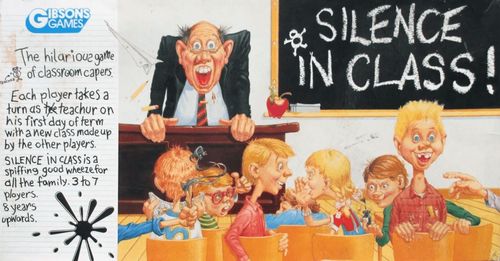
Silence in Class!
Silence in Class! Rulebook
Table of Contents
Table of Contents
Aim of the Game
At the end of the "lesson", have the fewest negative points (minus points) on your account and leave the classroom as the best pupil.
Game Components
- 1 scoreboard (game board)
- 6 game pieces
- 3 dice
- 1 black patience-thread figure
- 58 pupil cards
- 20 teacher cards (back side with a note)
Game Setup
Lay the scoreboard on the table. Each player receives a game piece of their choice and places it on the zero space of the board. The game pieces show how many minus points each player already has in the game. The black patience-thread figure also goes on the zero space.
Shuffle the pupil cards and the teacher cards into two separate face-down stacks next to the scoreboard. At the start of the game, each player is dealt four pupil cards face down. Hold these so that the other players cannot see them.
The player who has completed the most school years begins. After that, play passes clockwise.
Turn Sequence
On your turn, play one pupil card, move the patience-thread figure forward, and possibly move your own game piece. Then top up your hand to four pupil cards and check whether a teacher card comes into play (see "Teacher Cards"). Then the next player takes a turn.
More than one game piece, and also the patience-thread figure, may occupy the same space at the same time.
Pupil Cards
Pupil cards show three numbers:
- Patience points
- Minus points
- Risk roll
-
Patience points (black box): When you play a card (a prank or a forbidden action), the teacher's patience thread is strained. Therefore move the black patience-thread figure forward on the scoreboard by the patience-point number shown.
-
Minus points or risk roll: After the patience-thread figure has moved forward, the prank the pupil played also affects the pupil's own game piece. The player may choose between two options:
- Either they take the minus points shown on the pupil card (2nd box) and move their game piece forward by that minus-point value on the board, in the colour of their piece,
- or they make a risk roll (3rd box). If the roll succeeds, they do not have to move their game piece forward and may stay where they are. To make the roll, the player throws all 3 dice at once. If the total of the dice is at least as high as the risk-roll value, they have escaped the minus points and may stay where they are. If they do not reach that number, they must move their game piece forward by double the minus points shown on the card played (the number in the 2nd box times 2).
Example: Player A plays the card "Cheating" (Schwindeln, see illustration). First, the black patience-thread figure moves forward 9 spaces. Then player A may choose whether to move their game piece forward voluntarily by the 11 minus points, or to make a risk roll. Player A decides on a risk roll. They throw the three dice and get a total of 10. Since they did not reach the required value of 12 (see card), they must now move forward 2 times 11, that is 22 minus points. Had they rolled 12 or more, they would not have had to move at all.
Teacher Cards
When a player's turn has ended, check whether the patience-thread figure has landed exactly on, or moved past, one of the ink-blot spaces (spaces 20, 40, 60 and so on) on the scoreboard. Every ink-blot space, occurring every 20 points, means that the teacher's patience thread snaps. Now the top teacher card is turned face up from its stack. It applies to all pupils (players) together.
The teacher card is settled as follows:
-
Additional patience points (black box): Teacher cards also show patience points. Move the black patience-thread figure forward accordingly.
-
Minus points or risk roll for all pupils: These minus points (2nd box) apply to every player. That is, each player must immediately move their game piece forward by the corresponding number of spaces, in turn order, unless each player individually chooses to make a risk roll (3rd box), which is carried out as described under "Pupil Cards".
-
Detention: If the teacher card shows a star above the three numbers, the teacher is absolutely furious and keeps the whole class in detention. Any player who is standing on an ink-blot space at that moment has overstrained the teacher's patience thread and must move forward to the next ink-blot space (for example, from space 20 to space 40).
On the teacher cards "Test" (Test) and "Inattentive Teacher" (Unaufmerksamer Lehrer), the pupils are lucky: the teacher is so busy that they cannot hand out minus points, and the patience thread is therefore not strained either.
End of the Game
The game ends immediately as soon as the patience-thread figure or a game piece reaches or moves past the space "Caution, Teacher" (Vorsicht Lehrer). Any remaining points are forfeited. Now determine who has the fewest minus points: that player leaves the classroom as the best pupil.