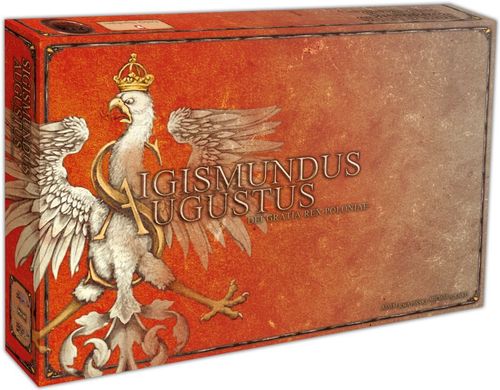
Sigismundus Augustus: Dei gratia rex Poloniae
Sigismundus Augustus: Dei gratia rex Poloniae Rulebook
Table of Contents
Table of Contents
- Components
- Object of the Game
- Limit of Elements
- The Board
- Sejm Cards
- Representative Cards
- Senatorial Office Cards
- Royal Demand Cards
- Policy Cards
- Military Markers
- Foreign Policy Direction Markers
- House Cards
- House Markers
- Figures
- Votes
- Ducats
- Primus Inter Pares
- Preparing for the Game
- Game Turn Overview
- Income
- Draw
- Special Actions
- Foreign Policy
- Actions
- Description of the Fields
- Sejm
- Scoring
- Combat
- Maintaining the Army
- Last Round and Ending the Game
Components
- 1 game board
- 144 cards
- 8 Sejm cards
- 24 Figure cards
- 9 Royal Demand cards
- 5 reference sheets
- 15 cards with symbol descriptions
- 5 House cards
- 3 Representative cards
- 15 Senatorial Office cards
- 20 Foreign Policy cards
- 20 Internal Policy cards
- 20 Military Policy cards
- 200 markers
- 33 military markers (10 Infantry markers, 16 Hussars markers, 7 Artillery markers)
- 6 markers of Foreign Policy Directions
- First player marker
- 50 ducats
- 40 votes
- 70 House markers (14 for each player, including: 10 House markers, 1 victory point marker, 1 Parliamentary Support marker, 1 Senatorial Support marker, 1 Royal Support marker)
- 20 Client tokens
- 2 dice
- This Rulebook
Object of the Game
Each player becomes the head of one of the biggest magnate Houses in Rzeczpospolita at the time. The aim is to gain as much importance (victory points) in Rzeczpospolita and in the international arena as possible. During 8 successive rounds players strive to achieve that by gaining new offices, increasing their influence in Sejm, establishing alliances with foreign powers and sponsoring important figures as their patrons. Also the military power cannot be underestimated. In a critical moment the army may be used as a tool in a fight against the ambitious rivals.
Limit of Elements
The number of elements in the game is limited. If you run out of some type of elements during the game (e.g. votes, military markers or client tokens), you cannot take them anymore; ducats are the only exception. If you run out of ducats, substitute them with other elements.
The Board
The board presents the current situation in Poland and in the international arena. The central part consists of 9 fields connected with actions available to players in their round. On both sides of the board there are the Neighbouring Countries fields, where players fight for influence. The importance of each Neighbouring Country for the current foreign policy of Poland is determined by the Foreign Policy Directions track on the top of the board. The lower part of the board is a place for three Support tracks and for the Policy cards. A victory points track goes around the whole board and is used to mark players' current score.
Sejm Cards
Represent the most important nobility meetings that took place during the reign of Sigismund II Augustus. The number of Sejms determines game time and passing rounds. In the full version of the game there are 8 Sejms, in case of a short game – only 4.
Representative Cards
Used to mark the player with the biggest support of one of the authorities in Rzeczpospolita. At the same time, being a Representative gives the player the possibility of using special privileges.
Senatorial Office Cards
Represent the highest senatorial offices in the Crown. Players compete for three kinds of offices: Ecclesiastical Offices (pink), Ministerial Offices (blue) and Land Offices (orange).
Royal Demand Cards
Represent the king's expectations towards the nobility. There are three kinds of Demands: Tax, Support in Sejm and Noble Host (massive mobilisation of armed forces, Pol. pospolite ruszenie).
Policy Cards
Players may use 3 types of Policy cards: Foreign, Internal and Military Policy. These cards represent special actions available for players in a given part of the game. There are 12 kinds of Policy cards – each represents a different action available for players. You will find a more specific description of these cards further in the rulebook.
Military Markers
There are three kinds of military units: Infantry, Hussars and Artillery. Each marker contains a number that states both the power of the unit and the costs of maintaining it. The reverse of the markers is grey - players turn the markers face down (reverse up) when the chosen units are sent to Noble Host.
Foreign Policy Direction Markers
Represent the Neighbouring Countries. At the beginning of the game they are put on the Foreign Policy Directions track face up (coat of arms without the crown). The reverse side – coat of arms with the crown – should be used when a given country scores points.
House Cards
Represent 5 noble Houses that played an important role during the times of Sigismund II Augustus. These cards contain information about the starting positions on various Support tracks and allow to determine the first player.
House Markers
Each player has 14 House markers. Four of them are used for marking the player's position on various tracks on the board, the rest is used while establishing relations with Neighbouring Countries.
Figures
Represent the most important artists, diplomats and military men who were alive and actively involved in social life during the reign of Sigismund II Augustus. There are two kinds of Figure cards. One of them allows the use of special skills during the game, the second one – marked with a golden ribbon – gives additional victory points at the end of the game.
Votes
Represent the influence in Sejm and nobility's support.
Ducats
Currency used in game, e.g. for maintaining the army.
Primus Inter Pares
First player marker that determines the order of the actions.
Preparing for the Game
Before playing:
- Put the board in the middle of the table.
- Sort the Policy cards into three decks by type (Internal, Foreign and Military Policy). Then shuffle each deck and place them face down on the spaces next to the board. Give each player one card of each type.
- Prepare the Sejm deck by putting cards in a chronological order so that the card with the lowest value lies on top. In case of a short version of the game, discard the Sejm cards for the III, IV, VI and VII round.
- Place the Senatorial Office cards next to the board in three columns according to values on the cards (from left to right and from top to bottom). Each column should correspond to one kind of office.
- Shuffle the Royal Demand cards and place them face down next to the board.
- Shuffle the Figure cards and place them next to the board.
- Shuffle and randomly place the Foreign Policy Direction markers face down on their track.
- Give a House card to each player at random.
- Put the Support markers for each House on the appropriate spaces on the tracks. Players who take the highest positions on the tracks get appropriate Representative cards.
- Give each player 3 Client tokens and House markers in an appropriate colour.
- Give each player one Infantry and one Hussars unit and a Reference Sheet.
- Place the rest of the elements: ducats, votes, military markers and dice next to the board within the reach of each player.
- Choose the starting Senatorial Offices. Each player chooses one Land or Ecclesiastical Office. The number of players determines the offices that are available at the beginning (see the table below). The player with the lowest initiative value chooses first, then the player sitting on their right and so on, until each player has one office to start the game with.
- The player who got his office last gets the first player marker.
| Office | 3 people | 4 people | 5 people |
|---|---|---|---|
| castellanus posnaniensis (15) | X | X | X |
| episcopus posnaniensis (13) | X | X | X |
| palatinus sandomirensis (12) | X | X | X |
| episcopus cuiaviensis (10) | X | X | |
| palatinus posnaniensis (9) | X |
After the setup is complete, the game begins.
Senatorial Office Cards
Each Senatorial Office card is double-sided. In most cases both sides are the same but there are some cards – Ecclesiastical Office cards and Palatinus cards - where there are various values of income and prestige on each side. During the game preparation put these cards higher valued side up. These cards will be reversed if players vote for appropriate Acts of Law in Sejm.
Game Turn Overview
The game turn is divided in 8 successive rounds (or 4, in case of the short version), each of which is composed of nine phases. During each phase, starting with the first player and continuing clockwise, each player may perform actions connected with that phase.
Turn phases:
- Initiative
- Income
- Draw
- Special Actions
- Foreign Policy
- Actions
- Sejm
- Scoring
- Maintaining the Army
Moving Markers on Tracks
Players often change their position on various tracks. With the exception of the victory points track, there can be only one marker per space on a track. This means that if one player has to move their marker one space forwards (or backwards), they switch places with the marker that already occupies that space.
Initiative
a) Passing the first player marker At the beginning of a round the first player marker is passed one player to the left (except on the first turn).
b) Sejm card and Royal Demand card The first player reads the rule on the new Sejm card and then reveals the Royal Demand card from the top of the deck. This card determines the way of competing for the Royal Support in this round (the effects of the card will be played during the Sejm – See Sejm. e) Royal Demand).
c) Figure cards draw Players discard those Figure cards that weren't taken by any of them in the previous round. Then they reveal 3 new cards from the top of the Figures deck and place them face up next to the board.
Income
Each player gains 2 ducats, plus the value of income from one chosen Senatorial Office they control.
Draw
In the order of initiative each player draws one Policy card from one of the three decks.
Special Actions
Magnate's Representative
At the beginning of this phase the Magnate's Representative may perform one additional special action before other players perform special actions in the order of initiative.
During this phase each player may perform one special action. A special action is e.g. playing one of the Policy cards or using the ability of ecclesiastical courts. Special Actions take immediate effect. Cards played or discarded in this phase should be put next to their decks. When the deck runs out, these cards form a new deck.
Ecclesiastical Court
The player who decided to perform an ecclesiastical court action chooses an opponent and takes one random card from their hand.
Policy Cards
- Client – take an additional Client token for this round.
- Primus Inter Pares – take the first player marker.
- Death of a senator – choose a player. That player has to discard one Senatorial Office. That office should be placed on an appropriate position among other Senatorial Offices.
- Church Foundation – discard 3 ducats. Gain 5 victory points. No one can attack you in this round (via Abduction, Sack or Foray).
- Raft of the Vistula River – gain 4 ducats.
- Diplomatic Mission – turn a Foreign Policy marker on the side with the crown.
- Negotiations – you may move a Foreign Policy marker to the first or last space on the Foreign Policy track.
- Secret Pact – put this card on a chosen Neighbouring Country. Until the end of this round no player (including you) can put House markers on this field.
- Enlistment – take one Infantry marker and one Hussars or Artillery marker.
- Abduction – attack. If you win, take one Figure from the defeated player (including the gold on it).
- Sack – attack. If you win, take from the defeated player half of their ducats (rounding down).
- Foray – attack. If you win, take 6 victory points from the defeated player.
Military Policy Cards - Attacks
The last 3 Military Policy cards are Attacks. You will find a more detailed description of the Combat further in this rulebook.
Foreign Policy
Royal Representative
At the beginning of this phase the Royal Representative has to choose one Foreign Policy marker and turn it on the side with the crown.
During this phase each player may put their House markers on one of the Neighbouring Countries. They may also discard Foreign Policy cards - each card gives one additional marker that may be put on one chosen country. If the player puts at least one marker on a given Neighbouring Country field, its marker should be moved one space to the left on the Foreign Policy Directions track.
Actions
Nobility's Representative
The Nobility's Representative uses 4 Client tokens during this phase.
During this phase players place their Client tokens on the board. Each player has 3 Client tokens, unless they used their Special Action to play an appropriate card or they have the Nobility's Representative card. Each player takes one of their Client tokens, places it on a chosen field and performs the action associated with that field. If the player wants to place the token on a field already occupied by other tokens, they have to pay 1 ducat for each Client on the field, including their own.
Description of the Fields
- Envoy – put your House marker on any Neighbouring Country and move its marker one space to the left.
- Patronage – take one available Figure card or bribe another player's Figure. If you take a Figure card, you may put on it as many ducats as you want. To bribe a Figure you have to discard one ducat more than the number of ducats on this Figure card. When you successfully bribe a Figure, take the card together with the gold and put on it one additional ducat from the bank.
- Calling Banners – take one military unit from the bank.
- Vacancy – put your House marker on a free Senatorial Office. In this round there will be an additional voting on this office. You will get 2 additional votes for this voting. There can be only one House marker on each office.
- Nobles' Feast – move your marker one space forward on the Senatorial Support track plus one space for each discarded Internal Policy card.
- Academy – take 2 Policy cards from any Policy deck. You may take a look at the first card before you decide to take the second one.
- Economist – gain 3 ducats.
- Parliamentary Agitation – move your marker one space forward on the Parliamentary Support track plus one space for each discarded ducat.
The Action phase ends when players use all their Clients. Players take the Client tokens off the board. Each player leaves 3 tokens for themselves and puts the rest in the bank.
Economist Field
There are two Economist fields. One of them is marked with a different colour and may only be used in a game for 5 players. Don't use it in a game for 3 or 4 players.
Representative Cards
When you use the Agitation in Sejm or Nobles' Feast field and move your marker to the first space on the appropriate track, take over the appropriate Representative card immediately. You will get the bonus from this card at the beginning of an appropriate phase. This means that taking over Nobility's Representative or Magnate's Representative card doesn't change the current round (players don't gain or lose client tokens).
Sejm
This phase consists of several stages:
a) Counting Votes
Players gain votes in a number indicated by their positions on three Support tracks.
Example: John's House marker is on the second space on the Royal Support track, which gives him 4 votes. He gains another vote from the Senatorial Support track (4th space). For his second position on the last track – Parliamentary Support – John gains 2 votes. In total, John will have 7 votes at his disposal (4+1+2=7), unless he decides to discard Internal Policy cards to gain more votes for Sejm.
b) Additional Votes
To get more votes players may discard Internal Policy cards. They gain 1 vote for each discarded card.
c) Bribery Phase
Players may use bribery to get additional votes and/or ducats. They decide in secret how much they want to pay and hide ducats in their hands. They may also decide not to put any ducats. Then players show the number of ducats they offer to gain additional votes and place the ducats in front of them.
Players decide in secret and hide in their hands any number of votes. Then they open their hands and reveal the number of votes they want to sell to other players. The player who bid the most votes chooses the player that offered the most ducats and exchanges votes for ducats. The player has to give all the offered votes. The player who bid the second highest number of votes does the same, then the third one and so on. Royal Representative settles all ties.
If there are players who offered ducats, but there's no one who would like to sell their votes, players take their ducats back.
If there are players who offered their votes, but there's no one to buy them, the votes are lost – put them in the bank.
Example: John takes 3 ducats in his hand. Andrew takes 2 ducats, Mary - 1 ducat and Kate doesn't take any ducats in her hand. On the mark, players reveal the number of ducats they offer to buy additional votes from opponents. Then players hide votes in their hands. At the same time they reveal the number of votes in their hands. Kate offers 4 votes, John – 3 votes, Andrew – 2 votes and Mary – 0. Kate offered the highest number of votes and gets the right to choose a player, with whom she'll exchange her votes for ducats. Kate chooses John – she gives him her votes and John gives her his ducats. All players repeat this process, starting with the one with the highest number of votes offered.
d) Voting
In this phase players try to get new offices. During each Sejm players fight over the lowest available office (with the highest serial number) and the offices they chose via the Vacancy action. The lowest office is the first to be voted.
The Lowest Office
If the lowest office has been marked with a House marker, there's an additional voting on the lowest office that has not been marked via the Vacancy action.
This means that during each Sejm players vote for one office and all additional offices they marked with their House markers.
Players decide in secret and hide in their hands any number of votes. On the mark, players open their hands and reveal the number of votes. The highest bidder gets the office. The Royal Representative settles ties. All votes used in this voting are discarded. If there are offices with House markers left, repeat the whole process of voting.
Players who marked some offices with their House markers get two additional votes. These votes may only be used to vote for a chosen office.
Example: John wants to gain another office – castellanus cracoviensis. In order to achieve that, John needs to offer more votes than his opponents. Before voting each player hides in their hands the number of votes they want to sacrifice to gain the office. On the mark, they reveal the number of votes in their hands. John offered 7 votes, Kate – 6; Andrew and Mary didn't give any votes. John's the highest bidder so he gains the office. From now on, John will gain additional prestige points from this office. According to the rule on the castellanus cracoviensis card, John also gains an additional Infantry marker.
No Offices Available
It may happen that players gain all the offices available in the game. In this case ignore the voting phase during Sejm completely. Players may use their votes to vote for or against the Act of Law in Sejm or to insinuate themselves into king's favour (if the Royal Demand card says that the king expects the support of the nobles). The only way of making offices available once again is using the Death of a Senator card or voting for the incompatibilitatis rule during the fifth round (Sejm in Piotrków Trybunalski).
e) Royal Demand
At the beginning of this phase players turn their military units sent to Noble Host face up. Then they settle their positions on the Royal Support track and therefore - a new Royal Representative. Players take in their hands their armies, ducats or votes (depending on the Royal Demand) and vote on the Royal Support in the same way as during the voting on offices. The highest bidder places his House marker on the first space of the Royal Support track. The player with the second highest bid takes the second place and so on. The current Royal Representative settles ties. The Royal Representative card is passed on to the other player after all the players take their new places on the Royal Support track.
Players discard all the resources used during this voting with the exception of the army – they turn their unit markers face down (grey side up). This means that players cannot use this part of their army during the next round, but they have to maintain it anyway (see: Maintaining the Army).
f) Act of Law
Players vote on the Act of Law at the end of the Sejm phase. They put all their votes in front of them. Votes don't pass on to the next round. On the mark, players vote with their thumbs: thumb up means "I support the proposal", thumb down – "I'm against the proposal". Count the votes. The Royal Representative settles ties. If the Act of Law is passed, the rules from the card become effective immediately. Place the card next to the board – its effects are binding till the end of the game. If the Act of Law is rejected, discard the "Sejm" card.
Example: On 22.09.1555 in Piotrków in Sejm there was a debate whether or not to found the National Church. In this phase all votes are public and players put them in front of themselves. John doesn't have any more votes, Kate has one vote left. Andrew has 3 votes and Mary has 2 votes. Players vote with their thumbs. On the mark, they show with their thumbs whether they are for (thumb up) or against (thumb down) passing the Act of Law. Mary and Kate are against the National Church foundation. John and Andrew voted in favour of the Act. After counting the votes players see that they have a tie: 3 votes for and 3 votes against the Act. In such a situation the decision belongs to the Royal Representative – John. Although he had no votes at all, he has the card of the Royal Representative and therefore he is to make a decision about founding the National Church. After John's decision the Act comes into force. From now on all the Ecclesiastical Office cards give only one prestige point. Ecclesiastical Office cards have to be reversed. On the reverse there is a sign of passing this Act of Law. The Sejm card should be put next to the board.
Scoring
Players gain victory points from their offices marked with a coat of arms with the crown. Then they gain victory points from the Neighbouring Countries whose markers in this round were turned to the side with the crown. Start with the field with the highest value written below the Foreign Policy Directions track. Players compare their influence in a given Country by counting House markers on the field. The House marker on the seal does not count. The player with the highest number of House markers on the field gains as many victory points as it is written on the board. The second player gains as many victory points as it is written after the slash.
Discard all the House markers from this Neighbouring Country field. Put the House marker of the player with the biggest influence in this country on its seal. If there already was a House marker on the seal, discard it and put the new one in its place. From now on the player gains profits from the influence in this country. After you finish with this Neighbouring Country, turn its marker to the side without the crown and proceed to the next Neighbouring Country field.
In case of a tie, add the values for the first and the second place and divide the sum between the players, rounding down. Do the same in case of a tie for the second place. If there's a tie for the first place, the Royal Representative decides who puts their House marker on the seal and gets the bonus from the Country.
Example: Both John and Kate have 2 House markers on the Grand Duchy of Lithuania field. Andrew has one House marker on this field. Andrew doesn't gain any points from this field. The girls share the points. The marker of the Grand Duchy of Lithuania is on the first space (8/4 points) of the track. There is a tie, which means that both Mary and Kate gain 6 victory points (8+4=12, 12/2=6). The Royal Representative – John – chooses Kate to put her House marker on the seal. From now on Kate gains the bonus from this country. The rest of the markers on the Grand Duchy of Lithuania field should be removed from the board.
Combat
Players may play an attack card during the Special Actions phase. Two players are involved in a combat.
Combat is divided into three phases: Artillery, Hussars and Infantry phase. In each phase units attack the opponent and try to inflict as much damage as possible. Both players inflict damage at the same time. This means that both players may lose their whole armies in one combat.
In each phase each player throws the dice and adds the value of their units to the score (depending on the phase it will be 1, 2 or 3 points for each unit). The score sets the extent of damage. Every 5 points of damage inflict 1 wound to the opponent. Then the players pay for the damage - for each inflicted wound the player has to discard one of the units or one of the Military Policy cards from their hand. The aggressor suffers the damage first.
After completing all the phases, determine the winner. Add up the power of the remaining units. If the aggressor has more points – they win and execute the effects of the attack card. If the defender wins or there's a tie, there are no additional effects.
Example: Kate plays a Foray card and chooses Andrew as her opponent. Andrew has one Artillery marker and one Infantry marker. Kate has two Hussars markers and two Infantry markers. Only Andrew may attack in the Artillery phase. He throws the die. He scores one and adds the power of his Artillery to that. Four points don't cause any damage. Players proceed to the Hussars phase. Kate throws the dice and gets 6, what – after adding four points for her Hussars – gives her 10 points, which means 2 damage. To pay for the damage, Andrew discards one Military Policy card and decides to lose the Artillery marker – he wants to attack with his Infantry. In the Infantry phase both players throw the dice at the same time. Andrew scores 5, Kate – only 1. Kate receives damage and discards one Infantry unit. The combat is over. Kate wins, because the power of her remaining units amounts to 5 and is bigger than the power of Andrew's army (1 point for his Infantry unit). Kate cannot gain 6 victory points, because Andrew has only 4 of them. Kate adds 4 points to her score. Andrew loses all his victory points.
Maintaining the Army
To maintain the army, players have to pay for it. The cost of maintaining a unit is equal to its power. Land Offices and the bonus from Sweden allow to maintain one unit for free. Players have to discard units they don't want to or can't maintain.
Players pay for the units sent to Noble Host in the first place (See: Sejm. e) Royal Demand). If they want to maintain their army, they have to pay for all the units in Noble Host and then for the rest of the army.
Last Round and Ending the Game
In the last round players gain victory points from all the Neighbouring Countries. To make it easier, at the beginning of the 8th round turn all the Neighbouring Countries markers to the side with the crown.
After the 8th round is finished, add all the points from the Figure cards with golden ribbons to your score. The player with the most victory points wins the game. In case of a tie, compare the position on the Royal Support track. The player on a higher position wins the game.