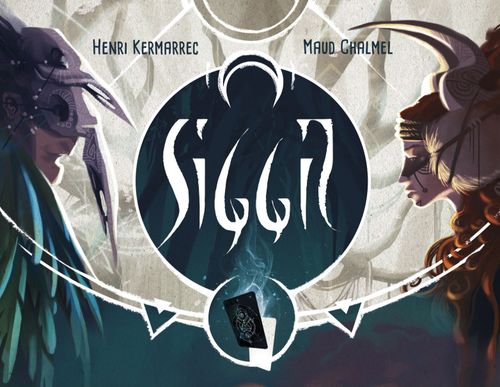
Siggil
Siggil Rulebook
Table of Contents
Table of Contents
Components
The game contains 56 cards: 7 families of 7 cards numbered 1 to 7 and 7 Spirits cards, each associated with a family and a number.
Game Setup
Mix all cards thoroughly, including Spirits, then place them level by level, overlapping face down and face up as shown on the back of this sheet. This card combination is called a Siggil.
A card is designated "available" when no other card covers it. It is then turned face up. If a Spirit becomes "available", it escapes the Siggil and is set aside, face up. Players can then capture it.
Game Sequence
Players take turns in clockwise direction.
On your turn, you must draw a card available from Siggil and take it in your hand. This is mandatory. The hand of each player is kept secret.
Then you can take control of a Spirit, free (aside) or owned by another player. This is an optional action that can only be done once per turn, following one of the three following ways:
- To control a Spirit aside of the Siggil and not yet captured, play a set of 3 cards of the family or 3 cards of the number associated with the Spirit (a set of 2 cards in case of 4 players). The cards are then placed face up in front of you and the Spirit is placed above.
- To control a Spirit already owned by another player, play a set of the family or the number associated, containing one more card than the other player's set. The Spirit is placed on your set. The cards of the player who have lost control of the Spirit are left face up in front of him.
- To regain control of a Spirit that has been stolen, complete the initial set (or play a new one) to obtain a set containing one more card than the set of the player who stole it.
Player A captures the Spirit of the Deer by playing 3 cards of the "Deer" family. Later, player B takes it to Player A by playing 4 cards "2" (it could also be done by playing 4 "Deer" cards). Finally, Player A takes the Spirit by completing the initial set to a total of 5 cards. Player B could retake it by completing a set to 6 cards. The goal is to put down or complete a set with one more card than the opponent.
End of the Game
The winner is the first player who controls 5 Spirits in a 2 players game, 4 Spirits in a 3 players game or 3 Spirits in a 4 players game; or the player who controls more Spirits than the other players at the end of the round of the player who draws the last card of the Siggil. In case of a tie, the winner is the player with the lowest number of cards in hand.
Solitary Game
Mix the Spirits and the other cards separately, then form a deck of cards by secretly placing a Spirit every 7 cards. Use this deck to build a Siggil of your choice.
Each turn, you must first remove an available card from the Siggil and set it aside in a discard pile, either face up (easy) or face down (difficult). Then take a card and if possible capture a Spirit with a combination of 3 or 4 cards (see below).
You win if you manage to capture either 7 Spirits with combinations of 3 cards (easy) or 6 Spirits with combinations of 4 cards (difficult).
Only three Spirits can be free simultaneously (neither in the Siggil nor captured). If a fourth Spirit is released, it drives away the first one, which is then placed in the discard pile and cannot be captured anymore.
Starting Positions
Here are 5 different starting positions and how to build them in 3 steps. Start with "The Pass", then try the other!
Each diagram shows cards face up, face down, or placed only to mark distance, built up in three steps from an initial small cluster to the full layout.
The Pass
The Turtle
The Pyramids
The River
The Pillars
Build this form 4 times, either side by side or one after the other, if you don't have enough space.