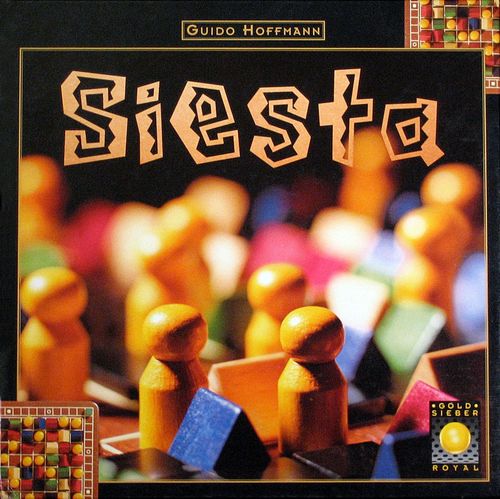
Siesta
Siesta Rulebook
Table of Contents
Table of Contents
Game Materials
The game board is a large square subdivided 12x12 into 144 squares. Into each small square may be placed one of the three types of game pieces:
- Suns (25 in the game). The supply of suns is shared by all players. If the last sun is played, the game ends.
- Shadows (75 in the game). The supply of shadows is shared by all players. If the last shadow is played, the game ends.
- Roofs. Each player has his own supply of 15 roofs in his particular color. If any one player plays his last roof, the game ends.
Each player has a square marker in his color with which to keep track of his score on the track running around the perimeter of the board. Each player should start his scoring marker on a different corner of the board.
Object of the Game
The winner of the game is the player who has the most points when the game ends.
Basic Scoring Unit of the Game: The Siesta
The first player starts the game by placing anywhere on the board three pieces in this order: 1) a sun, 2) one of his own roofs, right next to the sun, and 3) a shadow, in line and right next to the roof, so that it looks like the roof is casting the shadow from the sun's light.
This is the simplest example of the configuration called a Siesta. A Siesta can have any number of suns in a row, any number of roofs in a row, and any number of shadows in a row, but always be in that order: sun(s), roof(s), shadow(s). There can be no empty spaces in a Siesta.
Each shadow in a Siesta scores 1 point. That point is scored by every player who has at least one roof in the Siesta.
(Note that having more than one roof of your color in the Siesta does not score more points. Also note that having more than one sun in a Siesta does not make it score more points.)
The same shadow can be scored in more than one Siesta -- in as many as four Siestas, in fact. A Siesta using a shadow already on the board might be formed at a right angle to the existing Siesta, or at the opposite end of the line from the existing Siesta. A single shadow might eventually be scored from all four possible directions.
Bonus Scoring: The Double Siesta
When one or more shadows is scored as a Siesta at opposite ends of a line by one and only one player, that is called a Double Siesta, and pays a bonus of 2 points.
The bonus is always exactly 2 points no matter how many shadows are in the Double Siesta.
The Siesta and the Double Siesta are the only ways to score points in the game.
Contrary to what it says in the English translation that comes with the game, Double Siesta has nothing to do with whether or not you score for another player on the same play. If the points are on the board, they score.
Playing the Game
After the first player's placement, every piece played must be next to at least one piece already on the board. The first player must play a sun, a roof, and a shadow so as to score one point; he can put them wherever on the board he likes.
Players then take turns in clockwise order. On his turn, a player must play exactly three pieces. He can play suns, shadows, and/or roofs of his own color in any combination and in any order. He is obliged to score at least one point for himself during his turn. (While on occasion he will score points for other players during his turn, this does not fulfill his obligation to score a point for himself.)
Each piece played must observe the rules for that type of piece:
A shadow may only be played in a square where it is part of at least one Siesta. A shadow may be placed next to another shadow(s) or next to a roof(s), but it can never be placed next to a sun.
A sun can never be placed next to a shadow.
A player can play only his own color of roof. A roof can be placed next to any type of piece.
The three pieces played on a player's turn do not have to be next to each other, but each one must be next to at least one piece already on the board.
After the player has placed his three pieces, all the points scored on the player's turn are registered on the scoring track, including any points scored for other players.
End of the Game
When the last sun or the last shadow or one player's last roof is placed on the board, score for that placement, and the game is over.
Ordinarily a player must score at least one point for himself even on the last turn of the game. However, in the extraordinary event that a player is unable to score a point by any legal placement of three pieces, the game ends with no one scoring on that turn.
The winner is the player who has scored the most points when the game ends. The game can end in a tie.
Strategy Comments
Typically the scores are quite close, and the winner is likely to be the player who is in a position to end the game while taking the lead on his turn. Be sure to keep an eye on the dwindling supply of suns and roofs. While theoretically possible, we have never seen a game end by running out of shadows or by a player being unable to score.
Worked Examples (Figures 1-6)
These notes explain the illustrated example sheet included with the game.
Figure 1
This is the basic Siesta: one sun, one roof, one shadow, in that order, with no empty spaces.
Score one point for each shadow for each player who has a roof in the Siesta -- in this case, one point for blue.
Figure 2
A Siesta can have any number of suns, any number of roofs, and any number of shadows.
The extra suns do not increase the score for the Siesta, which is still strictly one point per shadow for each player who has a roof in the Siesta -- in this case, three points for blue and three points for green.
Figure 3a
If Blue plays three shadows on his turn, he will score three more points in this Siesta. He already scored two points for it on a previous turn. He does not score five just because five is the total number now present, but the three he scored previously and two he scores now add up to five.
Scoring is continuous and should be tracked after each turn (or after each piece played -- same difference). You would get the same score if you looked at the completed board at the end of the game and scored everything showing, but you keep track as you go along so that everybody knows where they are in the endgame.
Figure 3b
If White plays the two roofs and one sun on his turn, he will score one point for the new Siesta created at a right angle to the Siesta already on the board for Blue, utilizing one of the shadows already in play.
Figure 4 -- Legal and illegal plays
The sun at "a." cannot be played because it is not next to a piece already on the board.
The shadow at "b." cannot be played because a shadow must be part of a Siesta when it is played.
The sun at "c." cannot be played because a sun and a shadow can never be next to each other.
The sun at "d." and the roof at "e." are legal plays. Unlike shadows, suns and roofs may be played without being part of a Siesta.
Figure 5
If someone were to play the three shadows indicated, Green and Red would both score three points. Green does not score extra by virtue of having more roofs in the Siesta.
Figure 6a -- The Double Siesta
If Green plays the shadow, roof, and sun indicated, he scores: first, for the shadow, one point (as it extends the Siesta already on the board); then, upon placing the roof and the sun, four points for the new Siesta created in the opposite direction AND the two-point Double Siesta bonus, for a total of seven points.
Figure 6b
This is also a Double Siesta. There can be only one player's roofs in both directions of a Double Siesta, but there can be more than one at either end. Scoring for the Double Siesta illustrated is four: one point for the Siesta in each direction plus the two-point Double Siesta bonus.
Figure 6c
This is not a Double Siesta because more than one player has a roof in it. The configuration shown scores two points for Blue (one in each direction) and one point for Red.
General
When making a play, don't forget to count all the scoring created by that play, in all four directions, and for every player entitled to the score. Also don't forget that on your turn, while you may or may not score points for another player, you must score at least one point for yourself.