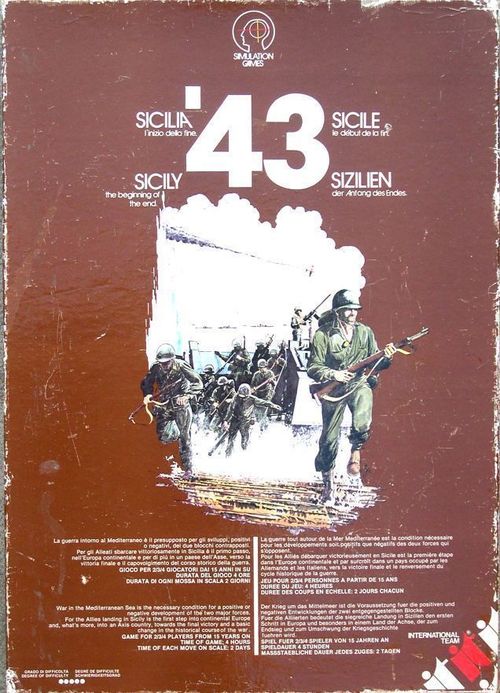
Sicily '43: The Beginning of the End
Sicily '43: The Beginning of the End Rulebook
Table of Contents
Table of Contents
- Map
- Setup and July 10/11 Turn
- Subsequent Turns
- Calendar and Victory Conditions
- Reinforcements
- Course of Play
- Weather
- Movement
- Zone of Control
- Stacking
- Combat
- Retreats
- Reduction
- Paratroopers and Airborne Units
- Amphibious Operations
- Engineer Units
- Artillery
- Ship Bombardment
- Fortresses and Coastal Divisions
- Armored Trains and Railway Lines
- Antiaircraft
- Aerial Bombardment
- Optional Rules
- Terrain Effects
- Combat (continued)
Map
The map contains the set up sites of Axis units as well as the location of towns designated as "fortresses". The strength of each fortress is printed directly on the map next to the town.
Certain towns, designated as victory objectives, have the date by which they must be controlled by the Allies printed next to them.
Setup and July 10/11 Turn
The First Turn consists of the following phases:
Axis Setup
Coastal divisions [represented by an artillery symbol in the unit's center] are placed no more than four hexes from the sea and no closer than 4 hexes from each other. They may not be placed on towns, roads, bridges, or railway lines.
Minefields [15, represented by a unit with a dot matrix] are placed no more than 5 hexes from the sea and no closer than 4 hexes from each other. They may not be placed on towns, roads, bridges, or railway lines.
Other Axis units are placed according to the "Forces on the Field" chart, in conformity with normal stacking rules. A unit may be set up on, or in hexes adjacent to, the location indicated on the chart.
Allied First Landing
The "Forces on the Field" chart indicates the units which are scheduled to come ashore and the towns between which the Allied units must land.
A number of units from those scheduled to land, at the Allied player's discretion, are placed on beach hexes between the designated towns. Normal stacking rules apply.
The Allied player conducts air bombardments with half of the aircraft available.
All Allied units landed are considered reduced for the turn.
The Allied player conducts ground combat with Axis Coastal Divisions and ground units in hexes adjacent to the landing hex [at reduced combat factors].
Naval Units may be placed in any all-sea hexes at the Allied player's discretion. They add their bombardment factors to ground combat.
Allied units forced to retreat are destroyed.
Allied units may not advance beyond the beach hex, except to advance after eliminating a fortress, or eliminating or retreating an enemy ground unit.
Axis First Phase
The Axis player may move any units at half movement allowance [rounded up] and conduct combat normally.
Allied Second Landing
The Allied player may land the remainder of the units designated for each landing area, not landed in the First Landing Phase.
Air bombardment with the remaining half of the available air units is conducted.
Ground combat [at reduced combat factors] is conducted, with Naval support, as in the First Landing Phase.
Newly landed Allied units forced to retreat are destroyed, as are those landed in the First Landing Phase, which cannot fulfill retreat requirements.
Allied Units, newly landed or landed during the First Landing Phase, may not advance beyond the beach hex, except to advance after eliminating a fortress, or eliminating or retreating an enemy ground unit.
Axis Second Phase
The Axis player may move any units at half movement allowance [rounded up] and conduct combat normally.
Subsequent Turns
After the First Turn, each player rolls one die. The player with the higher number moves first during that turn. Ties are re-rolled.
This procedure is repeated for each turn, making it possible for one player to have successive turns before his opponent moves.
Calendar and Victory Conditions
Calendar
The Calendar indicates the passage of time during the game, between the July 10 and 17 August, 1943. The key towns for victory purposes are indicated on the Calendar, beside the dates by which each must be occupied by each Allied army in order to gain Victory Points.
The game lasts 20 turns, or less, with the first turn divided into two phases as indicated above.
The game ends, regardless of the calendar date, or number of turns, when Messina is occupied by 2 units of each Allied Army.
Victory Conditions
The Allies gain 2 Victory Points for each key town occupied before the historical date of its capture.
The Allies lose 3 Victory Points for each town not captured by its historical date.
No Victory Points are awarded for towns occupied on the historical capture date.
Each key town must be occupied by the army [American or British] to which it is assigned on the Calendar; although units of both armies may cooperate.
A town is considered captured if it contains at least one unit of the assigned army.
Should a town be recaptured by the Axis, the Allied player loses the 2 Victory Points previously gained.
Victory Calculation
| Allied Victory Points | Victory Level |
|---|---|
| 12+ | Total Allied |
| 10-12 | Strategic Allied |
| 5-10 | Major Allied |
| 1-5 | Tactical Allied Victory |
| 0 | Historical Outcome |
| -1 to -5 | Major Axis Victory |
| -6 to -10 | Strategic Axis Victory |
| -11 or less | Total Axis Victory |
Reinforcements
The Calendar indicates the earliest arrival date of reinforcements for both sides.
Reinforcements may enter the game during any turn on or after the indicated arrival date.
The Allies may land reinforcements on any beach hex on the island.
The Calendar also shows the starting positions of reinforcements, where applicable.
Course of Play
The First Turn consists of two Allied Landing Phases and two Axis Phases as indicated in the Setup and July 10/11 Turn rules, above.
Each subsequent Turn consists of the following actions:
- The Game Turn is marked on the Turn Record track.
- The players roll to see who is the first player for the current Turn.
- The first player for the current Turn rolls a single die for weather.
- Both players check for losses due to anti-aircraft.
- Air combat is resolved.
- The first player moves his units.
- Combat resulting from the first player's movement is resolved.
- The second player moves his units.
- Combat resulting from the second player's movement is resolved.
While one player moves his units, the other player's units may not move, except as a result of combat resolution.
Weather
The Weather Chart indicates the effect of weather on movement for each turn.
| Dice roll | Weather | Weather effect |
|---|---|---|
| 1-4 | Clear | No effect |
| 5 | Cloudy / Rain | Only ½ of each player's aircraft may fly |
| 6 | Storm | No aircraft may fly. No naval movement or bombardments are allowed. No beach landings may be made. All artillery fires at reduced Combat Factors. The Movement factors of land units not on roads or railways are reduced by ½ [rounded up]. Terrain effects on movement are doubled. On the turn following a roll of 6 on the Weather table, all streams have the same movement restrictions as rivers. |
Movement
Players may move all, some or none of their units each turn along the pattern of hexagons ["hexes"], up to their Movement Allowance. Units with a "0" Movement Allowance and minefields may not move.
A unit's Movement Allowance may not be transferred to other units, or saved from turn to turn.
Engineer units move as Infantry. Supply Units move as Motorized units.
Zone of Control
The six hexes surrounding a unit are its zone of control [ZOC]. Once a unit enters an enemy ZOC it must stop and attack that unit during the Combat Phase. A unit may however enter a hex in an enemy ZOC which is already occupied by a friendly unit that will attack the enemy during the Combat Phase. A unit may also enter any empty hex in an enemy's ZOC if the enemy unit is being attacked by a friendly unit in another hex. In both these cases, the unit may continue its movement.
Artillery units, armored trains, units on railway lines and fortresses have no zones of control.
Stacking
The players may have up to 2 units in a hex at the end of movement.
No units may stack with Coastal Divisions.
Combat
A unit must stop and attack when it enters an enemy Zone of Control. However, a unit may pass through friendly units in an enemy Zone of Control, which are attacking the enemy unit.
Friendly units may also pass through an enemy Zone of Control if other friendly units are attacking the enemy unit from different hexes that turn.
A single unit may attack multiple enemy units if the attack differential is not less than the minimum indicated on the Combat Results Table.
Stacked units may not split their attacker among different enemy units.
Friendly units do not have to attack all enemy units in whose Zones of Control they are located, as long as every enemy unit with friendly units in its Zone of Control is attacked during the turn.
Combat Procedure
The Combat factors of all attacking units are added together. The Combat Factors of all defending units are added together. Any adjustments due to terrain are accounted for and the difference between attacking and defending Combat factors is determined.
This differential is cross referenced with the result of two six-sided dice roll.
The results are immediately implemented.
Combat Results
Combat results are applied to all units in a stack.
| Result | Effect |
|---|---|
| A2/D2 | Attacker or Defender must retreat 2 hexes |
| AR/DR | Attacker or Defender is Reduced |
| A2R/D2R | Attacker or Defender must retreat 2 hexes and is Reduced |
| A3R | Attacker retreats 3 hexes and is Reduced |
| D3R | Defender may retreat 3 hexes or choose to remain in place and be Reduced |
| AE/DE | Attacker or Defender is Eliminated |
| N | No effect. The defending player, in his turn, must attack, reinforce and attack, or withdraw |
Retreats
Retreating units may not enter the same hex twice, or pass through friendly or enemy Zones of Control. Retreating units may not enter terrain forbidden to their unit type. If a retreating unit cannot fulfill these conditions, it is eliminated.
Units stacked prior to retreating may retreat in different directions.
Units may retreat their full amount without penalty for terrain, except that a unit [the source sentence breaks off here; the clause is missing from the translation]. Coastal divisions and fortresses suffer reduction on results of D2. They are eliminated on results of D2R and D3R.
Allied units may [source reads "north"; probable typo, meaning unclear] enter empty fortresses until the 2 points of Combat Factors they possess are eliminated.
If, due to restrictions in the available retreat route, only one unit in a stack can fulfill its retreat, the other unit [of the owning player's choice] is eliminated.
The players may arrange a conditional surrender, prior to the attacker rolling for combat results. If agreeable to both parties, one defending unit is eliminated and the other retreats 3 hexes without combat.
Armor, Motorized Infantry and Artillery, forced to retreat onto or through Streams or Hills are reduced.
If these units are already reduced, they are eliminated if forced to retreat onto or through Streams or Hills.
The attacker or defender may occupy a hex vacated due to combat with up to 2 units.
Reduction
Units reduced as a result of combat [except ships] remain so for one turn, during which they may not move or conduct combat.
On the next turn they regain full combat and movement capabilities, after deducting the number of Combat Factors from the amount available during the turn from the Replacement portion of the Calendar Chart [far right side].
The Axis, Great Britain and US each have an allotment: the Allies through turn 20, the Axis until turn 12.
Once a nationality's replacement allotment for the turn is used, any additional units reduced that turn remain so for the remainder of the game.
Paratroopers and Airborne Units
Paratroopers and Airborne [glider] units may be placed on any non-sea, non-river hex which does not contain enemy units, or is in an enemy Zone of Control. Additionally, British glider troops may not land on Mountain hexes.
To simulate scattering, two six-sided dice are rolled and the Scatter Chart is consulted to determine the number of hexes and direction of scatter.
Scatter Chart
| First Dice Roll | Number of Hexes from Desired Landing Hex | Second Dice Roll | Direction |
|---|---|---|---|
| 1 | 1 | 1 | North |
| 2 | 2 | 2 | Northeast |
| 3 | 3 | 3 | Southeast |
| 4 | 4 | 4 | South |
| 5 | 0 | 5 | Southwest |
| 6 | 0 | 6 | Northwest |
Scatter direction and distance is calculated from the intended landing hex.
The landing unit is eliminated if it scatters into a sea or river hex or one which contains enemy units, or is in an enemy Zone of Control. British glider units are also eliminated if they scatter into Mountain hexes.
Units may not move on the turn they land.
For each Paratroop/Airborne unit attempting to land, one aircraft is required.
Aircraft used in Paratroop/Airborne drops may not participate in bombardment that turn.
Aircraft used in Paratroop/Airborne drops are not subject to Antiaircraft losses.
Amphibious Operations
The Allies may transport up to 4 non-motorized Infantry units by sea per turn, beginning on the 16th turn.
The units performing amphibious operations must remain in a beach hex one full turn, prior to amphibious movement, during which they may not take part in any combat.
If the weather is other than "Storm" the units may move up to 20 sea hexes and land on any beach hex.
Units using amphibious movement may not move inland during the turn they land and are considered reduced for combat that turn.
Ship units present in the game have no transport function, only bombardment support.
Engineer Units
Engineer units may build and destroy minefields, and build and destroy bridges.
They must remain in place for 1 turn to build or destroy a minefield and 3 turns to build or destroy a bridge. During this time they may not engage in any combat.
Artillery
Artillery may not attack alone, but in support of other units.
Artillery adds Combat Factors to those of friendly units that are within range, both in attack and defense.
The Artillery Results Table [ART] determines the number of Combat Factors available to friendly units based upon the target's protection and the range to the target.
The 1st and 3rd columns of the ART are used for artillery, the 2nd and 4th for ship bombardment.
When attacking stacked units, the protection factor of the stack is that of the strongest unit. [Tanks and infantry in the same hex use the tank column.]
Each artillery unit may fire at only one hex.
Multiple artillery units may combine in supporting a single hex, with the sum of their Combat Factors added to the friendly supported unit.
In calculating the final combat differential, artillery support is calculated by both the attacker and defender for artillery in range.
Reduced artillery units contribute ½ of the normal amount, rounding up.
The German "88" guns always use the 1st line on the ART.
Ship Bombardment
Ships may bombard land units from off shore using the 2nd and 4th columns of the ART.
Fortresses and Coastal Divisions
In addition to supporting land units as normal artillery, Fortresses and Coastal Batteries may fire at ships that are within their range.
A single six-sided die is rolled for each firing fortress or Coastal battery. If the die roll is equal to the ship's defense factor, the ship is reduced for the remainder of the game. If the dice roll is greater than the ship's defense factor, the ship is destroyed.
Armored Trains and Railway Lines
Armored Trains
The 3 Italian Armored Trains are used as artillery. They are placed in Augusta, Messina and Trapani at the beginning of the game.
These units must always remain on railway lines.
The armored trains may support land units or fire at ships.
They may stack up to 2 per hex, but may not stack with units other than armored trains.
Their protection factor is that of armored units.
Railway Lines
The Axis player may transport units up to 40 hexes along railway lines.
Units so transported must begin in or adjacent to a town containing a Railway Line.
After at least one turn traveling exclusively along a Railroad Line, a unit may leave the Railway Line at normal movement rates.
Units may not stack along the Line and travel is in "convoys" of up to three units, with a minimum of 5 hexes between each unit convoy.
Two convoys may not travel in opposite directions along the same stretch of Line between towns.
Units traveling by rail may not attack.
Units traveling by Rail have the protection factor of Armored Trains.
Enemy units occupying Rail Line hexes cut the Line for rail travel at that point.
Rail Line hexes in enemy Zones of Control have no effect on Rail travel.
The movement cost to enter a Rail Line hex, other than by rail travel, is that of the terrain in the hex, except that Rail Bridges over streams are crossed at the road movement rate.
Railway hexes have infantry protection factors for aerial bombardment.
A Rail hex hit by aircraft costs 10 movement points to enter during rail travel.
Antiaircraft
Each player must take losses to aircraft assigned to bombing missions during his turn. To calculate these losses, the active player rolls a single six-sided die and consults the following table.
| Dice roll | Planes lost [round up] |
|---|---|
| 1-2 | 10% |
| 3-4 | 20% |
| 5-6 | 30% |
All lost Allied planes are returned on the next turn.
Axis losses are not replaced.
When the Axis player has only 3 planes remaining, he no longer suffers losses to antiaircraft fire.
Aircraft assigned to Paratroop/Airborne landings are not subject to antiaircraft loss.
Aerial Bombardment
Planes assigned to bombardment, after deduction for antiaircraft losses, may attack targets.
Aerial bombardment takes place prior to the player's movement and combat phases.
The number of planes attacking is placed in the target hex and 2 six-sided dice are rolled on the ART. The outcome is determined by the number of planes attacking the target and the target's protection factor, cross referenced with the sum of the dice.
Once a target is hit, a bombing reduction marker is placed on the hex. The effects of bombing reduction last only during the turn in which the bombing occurs.
Planes are removed after the bombing die roll whether the target is hit or not.
Successful bombing of Rail Lines causes an increase to 10 movement points for rail traffic entering the hex for the turn.
Rail Convoys that are hit are reduced and the Rail Line suffers the 10 movement point penalty for the turn.
Bridges [protected as armored units], once hit, remain damaged until rebuilt by Engineer units.
Planes may attack ships, one plane per attack, using the same method as artillery attacks on ships. Reduced ships remain reduced for the remainder of the game.
Optional Rules
Liaison
Every Axis unit must be able to trace a path, free of enemy Zones of Control, not longer than 10 hexes in length to at least 5 other Axis units.
Units able to trace a liaison path to 4 friendly units are reduced by 2 Combat Factors; those able to trace a path to 3 or fewer friendly units are fully reduced.
Reduction due to lack of liaison is calculated during the combat phases in both attack and defense.
Units in towns are exempted from the requirement to trace a line of liaison.
After Turn 11, Italians may only trace lines of liaison to other Italian units and Germans to other German units.
Supplies
Motorized Infantry, Armor and Artillery require supplies to move and attack.
Reconnaissance units and non-motorized Infantry units do not require supply to move and conduct combat.
Towns marked with a star and fortresses are fixed supply sources for the Axis and may be used to satisfy supply requirements.
Units must be able to trace a line no longer than 6 hexes, free of enemy Zones of Control, to a supply unit. This distance is increased to 12 hexes if traced exclusively along roads.
If the route is traced along both road and non-road hexes, the non-road portion can be no longer than 3 hexes. The maximum length under this condition remains 12 hexes [9 along roads].
Supply routes may not be traced through Mountain hexes.
Unsupplied units may attack/defend normally during the first Turn in which they become unsupplied. On following Turns, unsupplied units have a combat factor of "0".
Supply units have Artillery/Naval/Air bombardment protection factors of armored units.
Reduced supply units provide 2 Movement points and 2 combat points less to units drawing supplies from them.
The Combat Factor of a supply unit is "0".
Supply units may provide supply and then move; they may not move and then provide supply.
They move under all of the terrain restrictions to which motorized units are subject.
Supply units may stack with other units.
Augusta
The Axis player rolls a single six-sided die each turn after the Allies' initial landing.
On a roll of 1 or 2, Augusta's defenses are destroyed by their garrison and the town is no longer a fortress.
Terrain Effects
| Terrain | Effect on Movement | Effect on Combat |
|---|---|---|
| All sea hexes | Ships and aircraft may cross; ground units forced to retreat into all sea hexes are eliminated. | None |
| Mountains / hills-mountains | Tanks, motorized or artillery units may not enter, except on roads. 4 Movement Points for other units to enter, except on roads. | Defender's Combat Factors doubled |
| Hills / hills-plains | 2 Movement Points for Infantry. 3 Movement Points for Armor, Motorized, or Artillery units, except on roads. | Defender's Combat Factors of each unit in the hex increased by 2 |
| Roads | 1 Movement Point for each road hex, regardless of terrain, if moving directly from one road hex to another. [A unit pays the terrain cost of the hex on which the road is built to enter a road hex from a non-road hex.] | For roads in mountains or hills, Defender's Combat Factors increased by 1 for each unit in the hex |
| Plains & beaches | 1 Movement Point | None |
| Rivers | 4 Movement Points for Infantry to cross; all other unit types can only cross at bridges. | Attacker's Combat Factors reduced by 4 if attacking across a river |
Combat (continued)
Combat occurs when a unit or units enter an enemy ZOC.
At least one unit in the enemy ZOC must stop and attack during the Combat phase. Other units may join the attack or move through the enemy ZOC as indicated in Movement above.
Artillery units, armored trains, units on railway lines and fortresses do not have ZOC and units may enter hexes adjacent to them without stopping or attacking.
A single unit may attack multiple enemy units, if the difference in Combat Factors is at least the minimum indicated on the Combat Results Table.
If the difference in Combat Factors is less than the minimum, the unit must stop in the enemy ZOC, but may not attack.
The Combat Factors of two units stacked together may not be divided; both must attack the same hex or hexes.
A unit or stack is not required to attack all enemy units in whose ZOC it is, as long as those units not attacked are attacked by other friendly units during the Combat Phase.
To resolve combat, the Combat Factors of all attacking units are totaled, [taking into account decreases due to terrain]. From this is subtracted the Combat Factors of those units being attacked, [taking into account increases due to terrain].
The resulting difference is cross-indexed with the result of a dice roll on the Combat Results Table.
Combat Results (continued)
AE, DE: all defending or attacking units are eliminated.
A2, D2: all defending or attacking units must retreat 2 hexes.
A2R / A3R, D2R / D3R: all attacking or defending units must retreat 2 / 3 hexes and are reduced.
Retreats (continued)
Units are retreated by the owning player.
A unit may not retreat into an enemy ZOC.
A unit may not enter the same hex twice in retreat.
A unit may not enter terrain forbidden to it.
If a unit cannot complete its retreat without violating one of the retreat rules, above, it is eliminated.
Two units stacked together that are forced to retreat may divide and move separately.
In a D3R result, the unit may either retreat the full 3 hexes or remain in place and be reduced, instead. [This only applies if the unit is able to retreat the full 3 hexes. If not, the unit may not be reduced in place and is eliminated.]
Coastal Divisions and fortresses are reduced on D2 results and eliminated on D2R/D3R.
Units which are reduced are turned over after retreating. They may not move or conduct combat for 1 turn.
Reduced units may be turned over to full strength by allocating Recovery Points, if available.
Tank, motorized infantry and artillery units retreating through hills or streams are always reduced.
A reduced unit forced to become reduced a second time is eliminated.