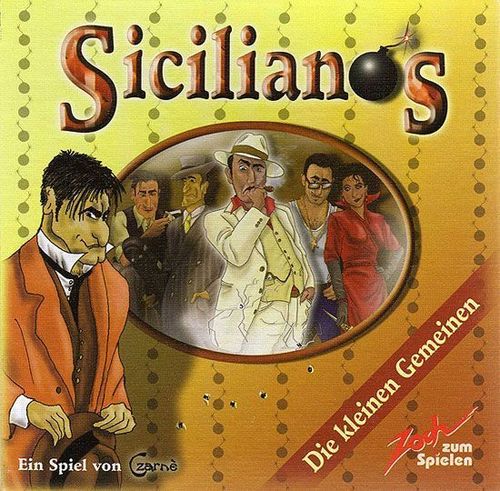
Sicilianos
Sicilianos Rulebook
Table of Contents
Table of Contents
Contents
- 84 cards (66 Family cards, 18 Business cards)
- 70 Sicilianos (bank notes)
- 2 colored dice
- 1 influence die
Idea of the Game
The players collect cards in order to form the strongest possible families, and must pit one clan against another in gang wars to maintain ground. The victor may then put illegally acquired money into respectable businesses, in order to wash it. Whoever possesses the most lucrative business chains, and at the same time the most clean money and the least dirty money, wins. If any player owns all three businesses of a color, he becomes Godfather and wins the game early.
Preparation
Each player receives 2 Sicilianos notes of each denomination. The remaining money is sorted and forms the bank.
The Family cards are separated from the Business cards and sorted according to color. The 6 piles of Family cards are individually shuffled and placed face down next to each other in the middle of the table. The Business cards are placed next to the same-color Family cards face down.
Each player in order draws one Family card. Repeat this process until each player has 4 cards in his hand. These 4 cards must each be a different color.
Play
The player who cooks the best spaghetti begins. Afterwards the play continues clockwise.
On a turn, a player must choose between 2 actions:
- Roll the dice, in order to collect family members.
- Play cards in order to plot a gang war.
Important
Cards in players' hands must be held so that fellow players can recognize the colors on all card backs.
No player may hold more than 10 cards in his hand. If a player reaches this limit, he must begin a gang war on his next turn.
Roll the Dice
A player choosing this action rolls all three dice. The action symbol on the influence die indicates which action the player carries out:
- 2: Take 2 cards
- 1: Take 1 card
- Hand: Steal
Take 2 Cards
The player takes 2 Family cards from the middle of the table, in the colors rolled on the dice, and adds them to his hand. If both dice are the same color, the player takes 2 cards of this color.
Note: If a player already holds 9 cards in his hand, he may take only one Family card. He may choose which of the rolled colors to draw.
If only one of two rolled colors is available, the player takes one card of this color. If neither of the rolled colors is available, the player does not collect a card.
Take 1 Card
The player may either...
Take one card from any Family card deck. The rolled colors do not play a role in this case.
Or...
He takes a complete Family card deck in one of the rolled colors and secretly looks at all the cards. From these he selects one card and adds it to his hand. He puts the remaining cards back on the table as a face-down pile, without changing the order of the cards. If no card deck of a rolled color is available, he must draw one face-down card from any other pile.
Steal
The player selects one of the rolled colors. Then he takes one card of this color from any fellow player.
After completing the dice action, the player's turn is over and it is the next player's turn.
Play Cards
A player choosing this action selects a card in order to begin a gang war. All players can take part, if their hands permit. After the gang war is finished, play continues with the left neighbor of the player that opened the gang war.
The Gang War
In a gang war, players try to present as strong a family as possible (in cards of one color). The strongest family may then wash money and creates a business.
The player who decided to play cards opens the gang war. He puts any Family card from his hand face down in front of him. In addition, he puts out any one of his bank notes that he would like to wash in this gang war.
Now the other players decide whether they would like to participate in the gang war. Those who do will likewise put one Family card from their hand face down in front of them, and one of their bank notes in addition. The Family card may not correspond to a color already played by another player. Those who only possess cards with colors already laid out cannot take part in the gang war. Those not taking part lay out neither a family card nor a bank note.
Now each player in the gang war turns his card face up.
Then the gang war continues: Again, the player that opened the gang war puts out a face-down Family card. It must belong to the same family (color) he played before. The other participants in the gang war do the same in order with the exception of those who played Turncoats (see The Turncoat).
If a player cannot or does not wish to play another card, he may drop out of the card play. At the end of each round, played cards are turned face up.
The remaining participants in the gang war may play further Family cards face down. This continues until no more players can or wish to play a further card.
Winner of the Gang War
Each player now adds up the values of his face-up family cards. Whoever has the strongest family wins the gang war. If there are several families of the same strength, none of the tied players wins the gang war. Instead, the next-strongest family wins.
The winner of the gang war now creates a business for the family played by him: He takes the Business card pile of this color, selects a Business card and puts it face down in front of him. He returns the remaining Business cards to their place, face down. If the Business card pile of this color is already used up, a business cannot be established.
Regardless of whether he could create a business, the winner of the gang war washes his chosen bank note. He puts the note, together with an equivalent cash note from the bank, in front of him as washed money.
Note: Washed money is always kept separate from dirty money. Keep washed money next to acquired Business cards.
If two players become allies in the gang war and win (see The Turncoat), one of them establishes a business and the other one washes his money. In this case the money scrubber does not take a cash note from the bank, he takes the assigned cash note from his ally and puts it together with his own already-washed money. The player of the victorious family chooses the money or the business; the Turncoat gets the remainder.
If a player has no more Family cards to play before the end of a gang war because they were all destroyed by bombs (see The Bomb), he cannot win the gang war nor does he win if his ally wins. In this case, the ally wins the gang war alone.
The bank takes the chosen bank notes from all losers of the gang war. All face-up Family cards are placed back under their respective Family card decks.
The next player who opens a gang war decides again on any Family card (color) from his hand that he would like to play, etc....
The Turncoat
In each family there is a card with two different values (8/4) and colors. Whoever plays this card decides after turning it face up whether it counts as a normal Family card or as a Turncoat, and announces his decision.
Important: The card can only be used as a Turncoat if it is played in the first round of a gang war.
If the card is used as normal Family card, it contributes the value of 8 to the strength of its family.
If the card is used by a player (A) as a Turncoat, it contributes the value of 4 to the strength of the "other" family; that is, the other color pictured on the card. This is only possible, however, if another player (B) is using this "other" family in the gang war. If this is the case, both players (A and B) participate in the gang war as allies they win or lose together. However, the player that played the Turncoat may not play any more cards in this gang war.
Several Turncoats
If several players in a round play the Turncoat, they decide beginning with the opener of the gang war and going clockwise whether they would like to use it as a normal Family card or as a Turncoat. Turncoat cards come in pairs, with the same colors in reverse combination (e.g. yellow-black and black-yellow), so only one of these two cards can be used as a Turncoat.
The Bomb
Whoever plays a Bomb card decides after turning it up whether to use it as a normal Family card or as a bomb.
If he uses it as normal Family card, it contributes the value of 5 to the strength of his family.
If he uses the card as a bomb, he removes an opposing family member from the gang war. The colors of the bombs on the card indicate which families can be affected. The bomber selects a bomb color. Then he removes any face-up card of the selected color from a fellow player.
Exception: When the bomb is used against an opposing family, if a member in that family has the value of 1, this member is always the victim of the assassination attempt (this is always the Bodyguard card, for they sacrifice themselves). The removed family member and the Bomb card are returned to the bottom of their respective Family card decks.
Note: The bomb can only be used in the round that it is turned up. In later rounds it cannot explode.
Several Bombs
If several players in a round play a bomb, they decide beginning with the opener of the gang war and going clockwise whether they would like to use it as a normal Family card or as a bomb. It can happen that a player bombs an opponent before the opponent's bomb goes off.
Ending the Game and Final Scoring
The game ends if a player possesses all three businesses of a color. This player wins the game and may call himself Godfather.
If no player does this, the game ends as soon as one player possesses no more dirty money. Then it's payday and with it comes the final scoring:
Each player adds up his washed money. From this he subtracts his remaining dirty money.
The bank pays as a bonus...
- 50,000 Sicilianos to everyone who possesses three different business in different colors.
- 100,000 Sicilianos to the owner of the most antique shops, the owner of the most restaurants, and the owner of the most laundries. If two or more players own the same number of a business, none of them collect anything.
Whoever has most the Sicilianos wins the game.