Siatka
Siatka Rulebook
Table of Contents
Table of Contents
Goal of the Game
Players are volleyball team coaches. Using the movement die, they play the ball and try to get it over to the other side of the net and score a point.
The key to victory is making good use of the players' abilities and tactic cards. The player who first scores 9 points wins.
Note: the game is not a faithful simulation of a volleyball match; some rules have been simplified for the purposes of the game.
Components
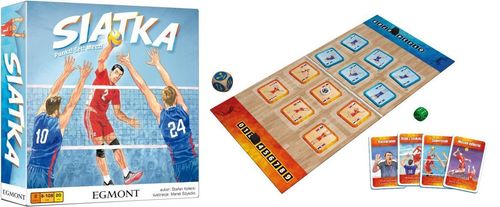
- 1 pitch board (court), with numbered fields on each half, a point track along the edge, and a marked field from which the serve is made (labelled on the board as the field from which the serve is made)
- 12 player tiles (6 per player). Each tile shows a defence value (a number) and an ability letter (A, B, R or Z; used only in Variant 1), each printed in two opposite corners of the tile
- 24 tactic cards (12 per player, in the colour of the player's team)
- 1 movement die (blue, with three symbol types on its faces)
- 1 attack / serve die (green)
- 1 ball
- 2 point markers (one per player)
- 1 block marker (red; used only in Variant 2)
Setup
Before the first game, stick the stickers on the ball and on the movement die (one on each face).
- Place the board in the middle of the table.
- Each player takes 1 point marker and places it on the "0" space of their own point track.
- Choose the colours of the teams you will play, and place the player tiles freely on your own half of the court, one per field.
- Each player takes their 12 tactic cards in their team colour, shuffles them, and draws 3 into their hand. Keep your hand hidden from your opponent.
- The player who most recently watched a volleyball match takes the ball and starts the game with the serve.
Serve
The serving player places the ball on their own player who stands on field 4, and rolls the green attack / serve die. The result indicates the field on the opponent's half where the ball will be played.
The opponent now takes over and plays the ball.
Example: The die shows "3". The serving player places the ball on the opponent's player on field 3.
Playing the Ball
The player playing the ball uses the movement die. They may make at most 3 bounces (3 rolls of the movement die). After each roll, the player moves the ball 1 field in the direction shown by the result. To read the direction correctly, hold the die with its line facing you.
Each result gives 2 possible bounces:
- Diagonally forward left / right (the arrows pointing diagonally forward): the ball moves diagonally forward to the left or to the right.
- Forward / backward (the arrows pointing up and down): the ball moves straight forward or straight backward.
- Sideways left / right (the arrows pointing left and right): the ball moves sideways to the left or to the right.
There are 3 possible outcomes when playing the ball:
- If the player gets the ball over to the opponent's half with the 1st or 2nd bounce, the opponent now takes over. The opponent plays the ball from the field where it ended its movement (see Example 1).
- If the player gets the ball over to the opponent's side with exactly 3 bounces, the player performs an attack (see page 4 of the rulebook: Attack) and has a chance to score a point (see Example 2).
- If after 3 bounces the player has still not got the ball over, or if the ball is sent out of the court, the opponent scores a point (see Example 3).
Example 1: Getting it over with the second bounce. The player does not score a point. The opponent plays the ball from field 3.
Example 2: Getting it over with the third bounce. The player performs an attack and has a chance to score a point.
Example 3: The player fails to get the ball over with 3 bounces. The opponent scores a point.
Attack
If a player gets the ball over to the opponent's side with exactly 3 bounces, they perform an attack. They roll the green attack / serve die and check whether they score a point.
- If the result on the die is greater than the defence value of the opponent's player the ball was played to, the attacking player scores a point. They move their point marker 1 space to the right. Then play resumes with a serve (see Serve).
- If the result on the die is less than or equal to the defence value of that player, the attacking player does not score a point. The opponent has successfully received the ball and now takes over. They play the ball, starting from the field where it ended its movement, and have at most 3 rolls of the movement die (see Playing the Ball).
Example: The attacking player rolls on the attack die more than the defence value of the opponent's player (3), so they score a point. If they had rolled 3 or less, they would not have scored.
The player who scored a point moves their point marker 1 space to the right. Then play resumes with a serve (see Serve).
Tactic Cards
During the play of a ball, a player may (but does not have to) play up to 3 cards from their hand. They may play several cards at once and combine their effects. After the ball has been played over to the opponent's side, the player refills their hand to 3 cards.
Played cards go face up onto the player's discard pile. When the draw pile is exhausted, shuffle the discard pile to form a new face-down draw pile.
Rozegranie (Playing the Ball)
If the player does not like the result on the movement die, they may play this card and roll again. This extra roll does not count towards the limit of bounces; it is treated as a repetition of the failed roll. The player must follow the new result, or may play another Rozegranie card (if they have one).
Mocne odbicie (Strong Bounce)
The player may play this card to bounce the ball a distance of 2 fields (instead of the standard 1). This allows the player to bounce the ball from the second row or to play it to a further field on the opponent's half.
Superatak (Super Attack)
The player adds 1 to the result of the green attack die roll during an attack. The player must play this card before the roll of the green die. Up to 2 Superatak cards may be played, to add 2 to the result of the roll.
Atak z zaskoczenia (Surprise Attack)
This card allows an attack to be performed after the ball is played over with two bounces (instead of three).
Example of card use:
- On the first roll, the player rolls a result that does not suit them, as they would have to play the ball over with the first bounce and would not score a point. The player plays a Rozegranie card and rolls again. This time they roll a different result. They bounce the ball backward.
- On the second roll the player rolls a result. They bounce the ball to the left.
- On the third roll the player rolls a result. They play a Mocne odbicie card and move the ball 2 fields, playing it over to the other side of the net. Because they played the ball over with 3 bounces, they perform an attack. Before rolling the attack die, they play a Superatak card. They roll the green die and get a 4. Thanks to the Superatak card played earlier, the player increases the result by 1 and now has 5, which is more than the defence value of the opponent's player, so they score a point!
Note: the card names are printed on the cards in Polish. The English names in the headings above are the transcriber's translation; the card text is translated in full.
End of the Game
The game ends at the moment one player scores their 9th point. That player is the winner.
Optional Rules for Advanced Players
The variants are optional and may be combined with each other freely. They are recommended for players who have mastered the basic rules.
Variant 1: Special Player Abilities
In this variant, players may use the special abilities of their players, marked with a letter in a circle.
Attack (Atak, A): When a player with this ability performs an attack, the player adds 1 to the result of the attack die roll. This may be combined with the card or cards of Superatak, to increase the chance of scoring a point further.
Block (Blok, B): If during an attack against a player with the Block ability the result on the green die is equal to or less than their defence value, the blocking player scores a point. (A higher result gives the point to the attacking player.)
Note: this ability can only be used when the player stands in the front row (on one of the three fields closest to the net).
Example: The red player performs an attack against a blue defender with a defence value of 3 and the Block ability. The red player rolls a 3 on the attack die, which equals the blue defender's value. The blue player scores a point.
Playing the ball (Rozegranie, R): When the ball is played to a player with this ability, the player may move it 1 field in any direction (instead of rolling the movement die). This counts as a further bounce (one of the three).
Serve (Zagrywka, Z): When a player with this ability performs a serve, the player places the ball on any field on the opponent's half. They then roll the green die. If a 6 comes up, they score a point (a service ace!). If any other value comes up, the opponent plays the ball normally.
Variant 2: Block Marker
The block marker is taken by the player who does not have the ball (that is, the player who will defend against the opponent's attack). They may place it on one of their players at the net at any moment, but before the opponent rolls the 3rd movement die. The block marker works the same way as the Block (B) ability (see Variant 1).
The block marker stays on the tile until the ball is played over to the other side of the net. Then the opponent will have a chance to place their own block.
If the block marker is placed on a player who has the Block ability, it has no effect (the effect does not double).
Tip: try to predict where the ball will be played, and place the block marker on that tile. A well-placed block can win you a point!
Variant 3: Player Rotation
When the player receiving the serve scores a point, they perform a rotation of their players. Each player tile moves 1 field in the clockwise direction (the player on field 1 moves to field 2, and so on).