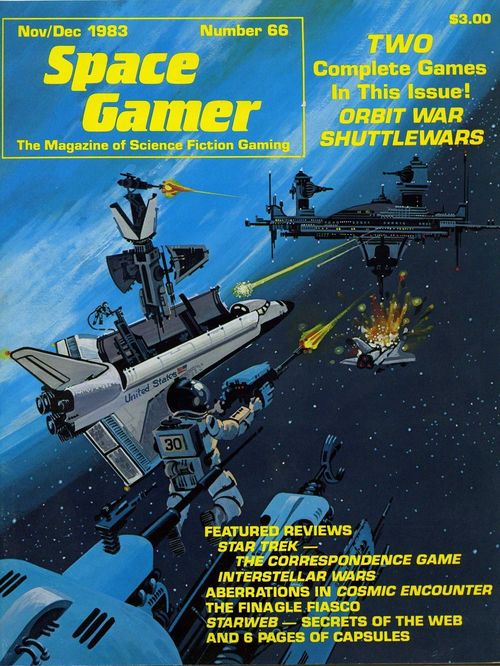
Shuttlewars
Shuttlewars Rulebook
Table of Contents
Table of Contents
Game Map
Each hex on the game map represents a distance of 1000 km (622 miles), and the entire mapsheet is about 40% of the length of a single orbit. The hexes are numbered with a two-digit code used to individually identify each one. The lettered hexes are used for initial Satellite deployment and the arrowed hexes are for Shuttle entry.
Playing Pieces
The game requires moveable units to be placed on the game map; coins are suggested. The Shuttle can be represented by a nickel or dime, and three pennies will suffice for Satellites. Other playing pieces can be improvised by the players if they desire.
Initial Setup
Satellite placement is determined by a roll of a six-sided die (not included). On a roll of 1 or 2, place one satellite on each A deployment hex; on a roll of 3 or 4, use the B hexes; and on a roll of 5 or 6, use the C hexes. Shuttle entry is determined by a die roll also: place the Shuttle marker on the arrowed hex corresponding to the die roll. The Shuttle marker should be placed heads-up to indicate an operative laser weapon (see below).
Game Turn Procedure
Each game turn, a number of actions take place in a specific sequence, as follows:
a. Move the Shuttle two hexes. b. Determine Shuttle entry (if needed). c. Move all Mine Satellites one hex. d. Fire the Shuttle laser. e. Fire the Laser Satellites.
Shuttle Movement
The map edge that the Shuttle enters is labeled Trailing and the map edge that the Shuttle exits is labeled Spinward. The Shuttle moves two hexes per turn from the Trailing edge toward the Spinward edge. Placing the Shuttle on a numbered arrow hex counts as one hex of movement. The Shuttle need not move in a perfectly straight line, but it must always proceed toward the Spinward edge and it may only leave the map area via that edge.
The Shuttle may not stop and always moves two hexes per game turn. When the Shuttle leaves the Spinward edge of the game map, use the Shuttle Entry Procedure described above to re-enter it for another pass. Examples: A Shuttle in hex 25 may move to 15, 26 or 35 as a legal move. Once in 15, it may only move to 16 or 26. It may only exit the map on a later turn from 19, 29, 39, 49, 59 or 69.
Satellite Movement
When each Satellite is placed, flip the marker in a random fashion: if heads, it is a Laser Satellite; if tails, is is a Mine Satellite. Place the markers on the map with the proper side up. Laser Satellites do not move. Mine Satellites attempt to intercept the path of the Shuttle: each turn, after the Shuttle moves, each Mine Satellite moves one hex in the direction of the shuttle. A Mine Satellite will not enter a hex occupied by another Satellite (of either type).
Mine Satellite Detonation
When the Shuttle and a Mine Satellite simultaneously occupy the same hex (as a result of movement by either party), the Mine Satellite immediately explodes and is removed from play. Roll the die: on a roll of 1, the Shuttle is destroyed. On a roll of 2 or 3, the Shuttle laser is destroyed (flip the coin over to the tails side), and on a roll of 4, 5 or 6, the mine has no effect. If the Shuttle already has its laser destroyed, a damage roll of 2 or 3 will destroy the Shuttle.
Laser Combat
To fire a laser (either from the Shuttle or a Laser Satellite), count the number of hexes between the laser and its target (count the target's hex, but not the laser's). Roll the die: if the die roll is greater than the range in hexes, the target is hit (effective range is thus limited to 5 hexes). Fire at a target in the same hex is resolved as if at a range of one hex: a 1 is always a miss. Resolving laser hit damage is the same as resolving Mine Satellite detonation, except that when the Shuttle is firing, the satellite is always destroyed (no die roll needed).
Victory Conditions
The game continues until either the Shuttle is destroyed or all three Satellites are destroyed (note that if the Shuttle laser is out, the game is not over). The Shuttle player receives one point for each Satellite destroyed, and the Satellite player receives three points for destroying the Shuttle OR two points for destroying the Shuttle laser (not both: three points maximum). The player with the most points wins, and a tie is a victory for the Shuttle player. There are four levels of victory depending upon the difference between the point totals:
0 Pyrrhic Victory (Shuttle player only) 1 Marginal Victory 2 Decisive Victory 3 Double Decisive Victory
Variations
Free Deployment: The Satellite player may choose what types of Satellites to use and may deploy on any lettered hex (one satellite per hex). The Shuttle player may enter the map on any Trailing edge hex, by choice.
Supershuttle: The Shuttle has two lasers on board and may fire twice per turn, but it only moves one hex per turn.
Shuttlerace: Give both sides a Shuttle. The second player will enter one to three turns after the first (roll the die and divide by two, round fractions up).
Total Shuttlewar: Give the Shuttle player two Shuttles and the Satellite player six Satellites; divide victory points by two (round fractions up). Suitable for team play.