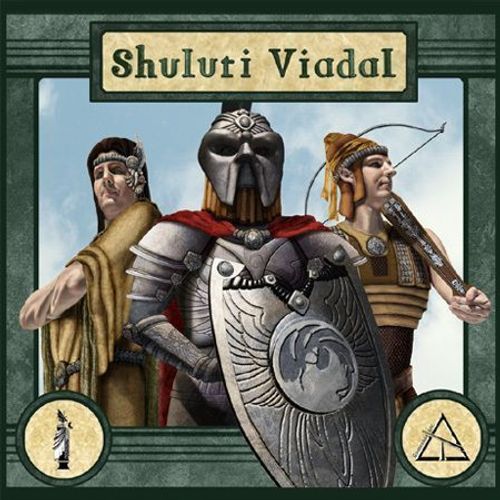
Shuluri viadal
Shuluri viadal Rulebook
Table of Contents
Table of Contents
- Two-Player Viadal
- Rules
- Preparation
- Using Maneuver Points
- Movement
- Combat
- Injuries
- Magic
- Spells
- Spell List
- Curse (Átok)
- Intestinal Wasting (Bélsorvadás)
- Life-Force Drain (Életerőszívás)
- Lightning Blade (Villámpenge)
- Acid Cloud (Savfelhő)
- Dizzying Poison Spell (Szédítő mérgvarázs)
- Lightning (Villám)
- Burning Nerves (Izzó idegek)
- Numbing Poison Spell (Zsibbasztó mérgvarázs)
- Pain (Fájdalom)
- Mighty Lightning (Hatalmas villám)
- Traps
- The Character Sheet
- Characters
- Custom Teams
- Skills
- Optional Rules
- Four-Player Viadal
Two-Player Viadal
Rules
Translator's note: the printed rules use the following abbreviations, expanded here for reference: Ép (life points; health), Sp (damage points), STP (structural points, for armour), SFÉ (damage absorption value), TÉ (attack value), VÉ (defence value), CÉ (aim value), MAN (maneuver point), Eg (Health attribute), ME (Mental attribute), Af (basic skill level), Mf (master skill level).
The playing area of SHULURI VIADAL® is a circular arena divided by walls. The walls divide the arena into a central fighting area and four quarters. (The quarters should be fitted together correctly according to the diagram on page 37 of the printed book, taking into account the positions of the weapon piles.) The walled spaces within the quarters are the arc segments. The playing area is further divided into hexagonal squares. Seven neighbouring squares form a block.
During VIADAL the players embody the strategists who sit in the tall towers along the arc of the arena's central circle, and from their position they see everything that happens on the arena floor.
In the role of strategists, the players move a team across the board. Each team has six "characters": apart from the strategist, one gladiator who fights in the central circle, one battle mage capable of casting spells, one crossbowman and two dagger-throwers. Each character type is marked with its own token (the icons themselves are not reproduced in the text layer): gladiator, crossbowman, battle mage and dagger-thrower.
Gladiators may fight only inside the inner circle, while the other members of the team, unlike them, may not set foot on the central fighting area and may use only the rest of the arena. The combatants may not climb the walls and may not cross them in any way, only through the gates! Moreover, except for ranged attacks and spells, they may not reach over the walls, so they can support the gladiators fighting in the inner circle only with their magic and their shots. The double-leaf gates set into the walls are all closed at the start of the game, but the combatants may open and close them later as they wish. The twelve gate-marker discs in the box are used to mark the current state of the gates. (A gate remains open or closed until someone deliberately changes it.) In the board game the gates cannot be used as cover; in terms of their role they can only be closed or open. A character who stands on a square with an open gate belongs to both quarters or arc segments adjoining it, so until it moves away from there – or closes the gate – any trap or spell that takes effect on either side also affects it.
The aim of the game is to destroy the opponent's gladiator. The player who accomplishes this task first wins VIADAL.
The game is divided into rounds and steps. The players act alternately, and one round consists of six steps. For a game in which "A" and "B" are the players, one round proceeds as follows:
- step: player "A" chooses two of his characters – 2. step: player "B" chooses two of his characters
- step: player "A" chooses two of his characters – 4. step: player "B" chooses two of his characters
- step: player "A" gladiator – 6. step: player "B" gladiator
In the first four steps both players, apart from the gladiator, may freely choose which characters act; in the fifth and sixth steps only their gladiator may be moved. A character may attack once in a step. If it has attacked, it may not leave the combat position (it cannot break away from the fight) – and conversely: if it has broken away from the fight, it may no longer attack even with a ranged weapon. This rule applies with a small modification to the battle mage: if it has cast a spell, it may not attack with a weapon in that step, nor break away from combat, unless the spell was aimed at itself. Combat activity and spellcasting, however, can be freely combined with movement or skill use.
At the start of each step the players must name the two characters with which they will act in that step. They must do so even if one (or both) of the characters receives no MAN in that step and does nothing. In the first step of the round the players may choose the characters they name as they wish; in the second they may act only with characters with which they have not yet acted in that round. At the start of each round they may again choose from the available characters; they do not need to follow the order of action set up in the previous round.
Preparation
Before VIADAL begins, the players must divide the traps, amulets, spells and magic resistances available to them among their characters, and decide which player chooses a side of the arena and which player may make the first step.
After the trap cards are shuffled, each side randomly draws three of them. Both teams have three amulets, which the player may distribute freely among his characters with the proviso that one character may wear only one at a time. The amulets are as follows: poison-negating (this protects against every effect for which a poison resistance must be rolled), lightning-denying (the character wearing it is not harmed by lightning) and curse-warding (it neutralises the battle mage's curse-type spells).
Each player randomly draws six spell-level discs from among the spell discs.
As the character sheet also shows, the battle mage is the only fighter who has magic resistance by default. In addition, among the other members of their team the players may distribute one piece of Magic resistance 2 and one piece of Magic resistance 3, provided they may not increase the battle mage's. (A character wearing an amulet may also be given magic resistance in this way, but one character may not receive both magic resistances.)
After the players have looked at their cards, a simple dice roll decides who may determine whether to choose a side or to start the game. (The player who rolled the higher number may decide which he prefers.) The player choosing a side may turn the board as he wishes – the only condition being that at the end of the turn each player has a complete half-circle in front of him. The opponent of the side-chooser always makes the first step.
Finally, the players must note which weapon their gladiator starts the bout with.
The information above is secret; the other player learns of it only when it becomes apparent during play. (For example, when the gladiators first see each other's weapons, when a trap is activated, when a spell is spoken, when a character resists an effect thanks to an amulet it carries, when a fighter is forced to make a magic resistance roll, and so on.)
When the preparations are finished, play can begin in the round system described above: first the starting player must place all his fighters on the board in the immediate vicinity of the gates on his side of the arena, and then the second player must place all his figures on the squares that touch one of the two gates on his side.
The players' strategists take their seats in the towers that stand in the middle of each player's own half of the arena.
When both sides have placed all their figures, the first step may take place.
Using Maneuver Points
The only resource in the game is the maneuver point (MAN). Characters use it to move, fight, cast spells, use skills and activate traps. Each step, players may spend six maneuver points, which they may divide freely between the two characters acting in that step. (They may even decide that one character gets nothing while the other uses all six MAN.) Gladiators who act in the last step of a round each have six MAN, and strategists each have four MAN per round. Apart from the gladiator, strategists may pass on as they wish any of this per-round quantity to the other characters during the round. Unused MAN do not add up and cannot be carried over to the next step or round – they are simply lost!
The number of maneuver points may decrease when a strategist or characters are killed:
If the strategist is murdered during the bout, his team loses its four MAN per round. The death of each fighting character costs its team three MAN. (That is, in any step in which only one character can act, the number of maneuver points available to it is at most 3.)
Activity table:
| Activity | MAN cost |
|---|---|
| Movement | 1 MAN per square |
| Activating traps | as shown on the trap cards |
| Spellcasting | the level of the spell |
| Opening/closing gates | 1 MAN |
| Skill use | 1–2 MAN (as given with the skill) |
| Combat (ranged and melee alike) | 2 MAN |
| Weapon change (affects only the gladiator) | 1 MAN |
| Breaking away from melee | 2 MAN |
Movement
Every character's sheet shows a Movement value, which determines the maximum number of squares the character may cover in one step. Spells or traps may modify this value. A character may move in any direction across the squares of the playing area, except of course it may not pass through walls. Each square entered costs 1 MAN, unless the character is using the Running or Stealth skill (see the chapter ON SKILLS). No more than three characters may occupy one square at the same time.
A character may move onto a square occupied by an enemy character only if the character arriving there still has MAN with which it can also attack its opponent in that step.
Combat
Two kinds of combat situation can arise during the game: melee and ranged combat.
Melee
For characters to engage in melee they must stand on the same square. (The exception is when gladiators fight each other with a halberd; then they may fight from neighbouring squares.) In one step a character may deliver only one attack, which the attacked character may defend against. Defending does not cost MAN, unless the defending side uses a skill for it (for example Evasion). In that case the cost of the skill use is deducted from the maneuver points of the next step in which that character would act.
The effects of traps and spells that modify TÉ and VÉ always apply to the melee values. (Where this is not the case, it is specially noted for the trap or spell concerned.)
Once in melee, a character can disengage only by backing off (see below), or when the combat ends because one side has died.
As a general rule for melee between gladiators: the side that rolls higher – whether attacking or defending – may move both itself and its opponent one square. Other characters may do this only if they have the Acrobatics skill.
During combat a gladiator may change its weapon for 1 MAN, but only on the square where its weapon pile is. Players must mark the change on their character sheets.
Attack and defence
When attacking, the attacking side rolls a ten-sided die and adds it to the attack value (TÉ) shown on the character sheet: Attack = TÉ + d10.
The defending side also rolls a ten-sided die and adds it to the defence value (VÉ) shown on the character sheet: Defence = VÉ + d10.
If the attacker's Attack is greater than the defender's Defence, the attack counts as successful. (A Defence that is lower than or equal to the Attack means the defence succeeds.)
Damage
The defence value is subtracted from the attack value, and the result is divided by two. This value, which shows the extent of the wound caused by the attacker, may be reduced by the damage absorption value (SFÉ – see there): [Attack – Defence] / 2 – SFÉ = damage.
Backing off
If a character attacked in the previous step wishes to back out of the combat position on its own step, it must spend 2 MAN to break away, and a further 1 MAN to move one square.
Ranged combat
In ranged combat, the blocks formed by neighbouring squares of the board determine whether a character can hit its target with its ranged weapon.
Throwing-dagger users may attack only targets within their own block, or on the two directly neighbouring blocks. Crossbowmen – counting in the same way – may attack at a distance of four blocks. The lightning spells of battle mages also work by this rule: uniformly, they can reach three blocks beyond the mage's own block.
| Weapon user | Range |
|---|---|
| Dagger-throwers | own block + 2 blocks |
| Battle mages (lightning) | own block + 3 blocks |
| Crossbowmen | own block + 4 blocks |
Ranged attack is calculated similarly to melee:
Ranged attack = Aim value (CÉ) + d10
The defence value against a ranged attack is calculated as follows:
- each block boundary and each wall lying on the line of fire counts as 2 points of VÉ
- each further character standing on the same square as the target adds another 2 points of VÉ (that is, at most 4 VÉ in total, since a square can hold at most 3 characters)
- each character standing on the line of fire also adds 2 VÉ (except those who are hiding or sneaking)
Ranged defence = 2 × [block boundaries + walls + characters on the target's square + characters on the line of fire] + d10
Shots cannot be fired over the walls dividing the arena into four quarters! It is likewise impossible to attack with ranged weapons through gates that a character blocks with its own body – unless that character is sneaking or hiding there at the time.
Beyond these, the effects of certain spells may also modify the defence value against a ranged attack. The success of the attack and the damage are determined in the same way as for melee. Damage caused by thrown or shot weapons may likewise be reduced by SFÉ.
Attention! A gladiator can be attacked with ranged weapons only once its SFÉ has been reduced to the appropriate level, whereas for the other characters this does not apply!
Attention! Combat-value modifiers arising from traps or from the consequences of spells never add up: at any one time only one – the less favourable one – applies!
Injuries
Wounds suffered in combat, or from a trap or spell, automatically reduce the characters' life (Ép). The extent of a wound may sometimes be affected by the armour the characters wear. Armour has two characteristics, both shown on the character sheets: one is structural points (STP), which measure the integrity of the item, and the other is the damage absorption value (SFÉ), which shows the protective power of the armour. The SFÉ must be deducted from the wound in every case where the damage is expressed in Sp (damage points); if instead the wound is expressed in Ép, it must be deducted in full from the injured character's life.
The gladiators uniformly wear armour of metal, while their team-mates protect themselves with leather armour. The material of the armour is of great importance against lightning magic: only leather armour protects against this type of spell; the SFÉ of metal armour cannot be counted against them!
Each time, in an attack, a fighter in the outer arcs suffers 3 Sp (or more) at once, or a gladiator suffers 4 Sp (or more) at once, that fighter's armour also loses one of its STP. (The players must show this on their character sheets by crossing out the STP boxes.) Armour cannot suffer structural damage from spells or ranged weapons. If a piece of armour has lost all its STP, its damage absorption ceases – that is, it is no longer useful and its SFÉ is no longer deducted from the Sp damage.
Only the gladiator's SFÉ lasts until the end of the game, even after its armour's STP have run out. If the gladiator's armour loses 2 STP, the crossbowman may begin shooting it from outside; if two more are lost, the dagger-throwers may attack it too – but until then they cannot harm it, however hard they try. Consequently, the players are obliged to signal when their gladiator's armour has deteriorated to the level that is adequate for the archers and dagger-throwers!
Magic
At the start of the game the battle mage draws six spell-level discs at random. He may use them during the game as follows: when he wishes to cast a spell, he chooses from the spell list a spell of a level for which he still has a disc. After the spell is spoken, the disc must be returned to the pool. (If the character has created a spell lasting several rounds, however, it is advisable for the player to keep the disc on the table in a clearly visible place until the effect expires.)
Attack with magic
Next to every spell on the spell list we have shown its Strength (E) value, against which the targets may be entitled to resist. The player casting the spell adds his d10 roll to this value. If the resulting sum is higher than the target's magic resistance, the spell takes effect. (With equal values, the defence counts as successful.)
Spell attack = Strength (E) + d10
Magic resistance
Next to every spell on the spell list we have also shown what resistance options the target has. Where the marking is Eg (Health), the Eg value on the character sheet must be used; where it is Me (Mental), the character's ME value is used.
Magic resistance = Eg + d10, or ME + d10
(For a mental spell, if the target does not have such a resistance, the spell can be opposed only by the result of the d10 roll.)
Translator's note: the printed spell list writes "Eg" (Egészség, Health) and "ME" (Mentális, Mental); both are transcribed as printed.
Spells
Most of the battle mage's spells fall into three clearly distinct types: curses (rontás), poison (méreg) and lightning (villám) magic. In addition they may know a few special spells that belong to none of these categories. The type of each spell is given next to it on the spell list, where one applies. A character wearing the matching amulet enjoys complete protection against spells of that group!
By duration, spells also come in three kinds: instant, lasting two or three rounds, and permanent. Instant spells take effect on the target at once, but multi-round spells are also treated as if they took effect immediately after being spoken. The first round of a spell's duration ends at the end of the round in which it was cast, after the gladiators' step. At the end of the following round – the second in the duration count – two-round spells end, and in the round after that, the third, three-round spells end. Permanent spells last until the end of the game.
Combat-value modifiers arising from spells – and possibly from traps – never add up; only the strongest of those currently in effect applies!
Next to each spell its range is also given, that is, the distance at which the battle mage can cast it.
Touch spells take effect only if the caster stands on the same square as the target and makes a successful melee attack against it. This rule is modified, apart from what is written for individual spells, for spells aimed at a fellow team member: the caster then receives a (+5) bonus to his TÉ.
Lightning spells. Against lightning spells the SFÉ of the gladiators' armour does not apply (except for the SFÉ granted by the swordsman's special Golden Chime skill – see the chapter ON CHARACTERS). A spell's damage is the value given in its description, regardless of how much the battle mage's roll exceeded the target's defence. A player casting a lightning spell adds his d10 roll not to his own aim value but to the aim value (CÉ) given in the spell; defence against lightning spells is determined in the same way as against ranged weapons.
Poison spells. Except for the Dizzying Poison Spell, every poison spell has two effects: the milder one always applies, while the more severe one applies only if the target fails his resistance roll.
Curses. For curse spells that can have two effects, the battle mage decides which one applies to the target.
Spell List
The spells are listed as printed on the spell cards. Each entry gives the spell's type (where one is listed), range (Hatótáv), Strength (Erősség, E), magic resistance, duration and MAN cost.
Curse (Átok)
- Type: none listed
- Range: 3 blocks
- Strength: 4
- Magic resistance: Eg
- Duration: 2 rounds
- MAN cost: 1
The battle mage points the index finger of his left hand at his enemy and speaks a terrible curse upon him. If the victim, at most 3 blocks away, fails his Health test, for 2 rounds his attack value is reduced by 4 and his aim value by 2 (−4 TÉ, −2 CÉ).
Intestinal Wasting (Bélsorvadás)
- Type: curse
- Range: 3 blocks
- Strength: 4
- Magic resistance: Eg
- Duration: one-off
- MAN cost: 1
One of the most horrible of the magically summonable sicknesses known to battle mages. A target at most 3 blocks away who fails his Health test suffers 3 Ép amid terrible cramps.
Life-Force Drain (Életerőszívás)
- Type: none listed
- Range: touch
- Strength: none listed
- Magic resistance: none listed
- Duration: one-off
- MAN cost: 1
Masters of the dark arts can use this spell to drain part of their opponent's life force. To drain it, the battle mage must make a successful attack roll against his opponent, with a (+5) TÉ bonus to his attack value. If he hits the target – that is, manages to touch him with his bare hand – the target suffers 4 Ép.
Lightning Blade (Villámpenge)
- Type: lightning
- Range: touch
- Strength: none listed
- Magic resistance: none listed
- Duration: 3 rounds
- MAN cost: 1
Living, hissing energy discharges surround the weapon in the hand of a person chosen by the battle mage. Because of the frightening sight, the weapon's wielder may attack his enemies with a (+5) TÉ bonus. The spell can be cast only on a figure standing on the same square as the battle mage, and the discharges last 3 rounds.
Acid Cloud (Savfelhő)
- Type: special
- Range: 2 blocks
- Strength: none listed
- Magic resistance: none listed
- Duration: one-off / 3 rounds
- MAN cost: 1
At a centre chosen by the battle mage, within 2 blocks, and over an area of one block, a caustic, corrosive cloud takes shape. Those present who breathe it in suffer 1 Ép damage in the first round (except the battle mage himself, who is immune to his own magic). The acid cloud dissipates over three rounds. Anyone who wishes to make a ranged attack from within the cloud's area, or through it, takes a (−2) CÉ penalty to his aim value. (This also applies to the battle mage's lightning spells.) The wizard who created the cloud may move it: for 1 of his own MAN he may shift the centre of the cloud by 1 square, in any direction.
Dizzying Poison Spell (Szédítő mérgvarázs)
- Type: poison
- Range: 2 blocks
- Strength: 4
- Magic resistance: Eg
- Duration: 3 rounds
- MAN cost: 1
The mildest of the poison spells known to battle mages, which can be planted from a distance into the victims' bodies. It can be used against a target at most 2 blocks away who, if he fails his Health test, defends with a (−3) VÉ penalty for three rounds because of the dizziness caused by the magic.
Lightning (Villám)
- Type: lightning
- Range: 3 blocks
- Strength: none listed
- Magic resistance: none listed
- Duration: one-off
- MAN cost: 1
From the battle mage's outstretched left hand a dazzling bluish-white bolt of lightning crackles toward the chosen target at most 3 blocks away. The caster may fire the bolt with an aim value of 7. The spell deals 3 Sp to everyone, from which the SFÉ of leather armour must be deducted. (The gladiator's is not, because he wears metal armour, which is ineffective against lightning.)
Burning Nerves (Izzó idegek)
- Type: curse
- Range: 3 blocks
- Strength: 4
- Magic resistance: Eg
- Duration: 2 rounds
- MAN cost: 2
Under the effect of this terrible sickness-spell, a victim at most 3 blocks away who fails his Health test suffers for two rounds from a feeling that permeates every nerve, and thrashes about almost helplessly. That is, for two rounds he may use at most 2 MAN, or else takes a (−5) VÉ penalty to his defence value – as the battle mage chooses.
Numbing Poison Spell (Zsibbasztó mérgvarázs)
- Type: poison
- Range: 2 blocks
- Strength: 4
- Magic resistance: Eg
- Duration: one-off / 2 rounds
- MAN cost: 2
A poison spell often used by battle mages, which plants poison into the victim's body from a distance and can be used against a target at most 2 blocks away. If the target makes a successful Health test, he suffers only 2 Ép from the magic poison that numbs his whole body. If he fails it, then beyond this damage, because of the dizziness caused by the spell, he can no longer make aimed attacks, and defends with a (−3) VÉ penalty for three rounds. If the victim is a gladiator, as an additional effect he cannot direct his opponent for that duration.
Translator's note: the printed duration on the card reads "egyszeri/2 kör" (one-off / 2 rounds), but the description gives the (−3) VÉ penalty as lasting three rounds. Both are transcribed as printed.
Pain (Fájdalom)
- Type: curse
- Range: 3 blocks
- Strength: 6
- Magic resistance: Eg
- Duration: one-off
- MAN cost: 2
One of the spells for summoning magical sicknesses. A victim at most 3 blocks away who fails his Health test suffers 4 Ép from a pain almost impossible to bear, which cramps his body.
Mighty Lightning (Hatalmas villám)
- Type: lightning
- Range: 3 blocks
- Strength: none listed
- Magic resistance: none listed
- Duration: one-off
- MAN cost: 2
A multi-branched bolt leaping from the battle mage's left hand deals 4 Sp to a victim at most 3 blocks away, if the caster has managed to hit him with the bolt's aim value of 9 CÉ. The SFÉ of gladiators' metal armour does not apply against this spell.
Lightning Denial (Villámtagadás)
- Type: lightning
- Range: 2 blocks
- Strength: none listed
- Magic resistance: none listed
- Duration: 3 rounds
- MAN cost: 2
An invisible aura, produced by one of the battle mages' rare protective spells. A target at most 2 blocks away becomes protected for three rounds against lightning spells of levels 1–3, so that they cannot harm him.
Lightning Armour (Villámvért)
- Type: lightning
- Range: touch
- Strength: none listed
- Magic resistance: none listed
- Duration: 3 rounds
- MAN cost: 2
The caster surrounds his own body, or that of a target standing on the same square as him, with a bluish energy armour. Anyone who makes a successful attack against the person protected by the energy armour is himself harmed by its electric discharges, suffering 4 Sp. The energy armour works for three rounds.
Life-Force Robbery (Életerőrablás)
- Type: special
- Range: touch
- Strength: none listed
- Magic resistance: none listed
- Duration: one-off
- MAN cost: 3
One of the darkest necromantic spells. A victim touched – or hit by a weapon – by a successful attack roll made with a (+5) TÉ bonus suffers 5 Ép (this amount is the combined damage of the weapon and the spell), while the battle mage, by robbing him of part of his life force, heals by the same amount. (However, his Ép cannot rise above the original maximum value.)
Creation of the Undead (Élőholt teremtése)
- Type: special
- Range: touch
- Strength: none listed
- Magic resistance: none listed
- Duration: permanent
- MAN cost: 3
With this spell the battle mage can create a zombie, that is, an undead creature, from a dead fighter. The zombie's combat values are the same as those of the original character, but it has only half its Ép, and it may not use the fighter's skills. Moreover, with a staggering, lurching movement it can cover only 3 squares per round. The zombie – if it receives no other command – automatically attacks the nearest person (but never the battle mage himself). The player who created the undead receives 3 MAN each round, which only the zombie may use. The undead may move only in the step in which the battle mage who created it acts. The strategist may not give it MAN, but the battle mage may give it two of his own MAN, provided that in that step he gives up casting a spell. He may then direct it verbally with a concrete, clearly understood command (for example: "Guard this gate!", "Kill him!", "Go there!" and so on), which the zombie obeys. An undead that has been destroyed once cannot be created again.
Muscle Wasting (Izomsorvadás)
- Type: curse
- Range: 3 blocks
- Strength: 6
- Magic resistance: Eg
- Duration: 2 rounds
- MAN cost: 3
Under this magical sickness-spell, the muscles of a target at most 3 blocks away lose all their strength for a time. If the victim fails his Health test, then at the battle mage's choice either every movement of his costs twice as many MAN as normal for two rounds, and he may not use his Running skill; or he suffers a (−4) penalty to his attack and defence values, and a (−2) penalty to his aim value.
Quintarha
- Type: poison
- Range: 2 blocks
- Strength: 4
- Magic resistance: Eg
- Duration: one-off (in the following round)
- MAN cost: 3
By this spell, one of the magically created monsters of ancient times, a quintarha, materialises in the immediate vicinity of a target at most 2 blocks away and bites the stunned fighter. A fighter who, from the shock, takes a (−4) VÉ penalty against melee and a (−3) VÉ penalty against targeted attacks – and if he also fails his Health test, cannot use any MAN for one round. The shock takes effect for the whole round beginning when the spell is spoken.
Firestorm (Tűzvihar)
- Type: special
- Range: 3 blocks
- Strength: none listed
- Magic resistance: none listed
- Duration: 3 rounds
- MAN cost: 3
By this terrible spell, a magical firestorm rages for three rounds over one block of area centred on the point chosen by the battle mage. At the moment of summoning, the fire-shower deals 3 Sp to everyone in that area except the battle mage, and because the molten fire pours down suddenly, the SFÉ of armour does not apply at that moment. In the following round, and in the round after it, the storm deals a further 3 Sp each at the end of the round to those present in the area (but by then the SFÉ of their protective equipment does count, since the fighters have had time to take cover after the first surprise). Shooting through the firestorm, or into its area, is difficult: the target receives a (+2) VÉ bonus against such attacks.
Gnawing Poison (Marcangoló mérgvarázs)
- Type: poison
- Range: 2 blocks
- Strength: 2
- Magic resistance: Eg
- Duration: one-off / permanent
- MAN cost: 3
This very strong kind of magic poison, which battle mages plant from a distance into their victims' bodies, affects a target at most 2 blocks away: because of the gnawing pain he suffers 3 Ép. Moreover, if he fails his Health test, his Health is fatally shattered – that is, its value falls to zero for the rest of the game.
Terrible Lightning (Rettenetes villám)
- Type: lightning
- Range: 3 blocks
- Strength: none listed
- Magic resistance: none listed
- Duration: one-off
- MAN cost: 3
From the battle mage's left hand bursts a manifold weave of lightning that deals 5 Sp to a victim at most 3 blocks away, if the caster has managed to hit him with the bolt's aim value of 11 CÉ. The SFÉ of gladiators' metal armour does not apply against this spell.
Painful Poison (Fájdalmas mérgvarázs)
- Type: poison
- Range: 2 blocks
- Strength: 4
- Magic resistance: Eg
- Duration: one-off
- MAN cost: 4
This battle mage poison spell can be used against a target at most 2 blocks away. The victim, if he makes a successful Health test, suffers 4 Sp from a stabbing pain spreading through his whole body. If he fails the test, the cramps caused by the sudden pain make him suffer a further 4 Ép.
Turning Lightning (Forduló villám)
- Type: lightning
- Range: 3 blocks
- Strength: none listed
- Magic resistance: none listed
- Duration: one-off
- MAN cost: 4
With the help of one of the cleverest lightning spells in the battle mage's art, the master of energies can steer his lightning even along a bending path. The distance covered by the energy bolt, which is able to turn, is measured in a straight line, but the target may be at most 3 blocks away. The bolt can bend through open gates, or even over the two-metre-high wall. Therefore the protective values that the walls provide are not counted in the target's defence value. The lightning's aim value (CÉ) is 9, its damage 6 Sp, but only the SFÉ of leather armour applies against it.
Limb Withering (Végtagsorvasztás)
- Type: curse
- Range: 3 blocks
- Strength: 6
- Magic resistance: Eg
- Duration: permanent
- MAN cost: 4
When the spell is spoken, the battle mage afflicts his victim with a horrible magical sickness, as a result of which one of the victim's limbs withers away for ever. Which limb it is depends on the caster's decision. If a leg withers, for the rest of the game the victim may move two squares fewer per step. When an arm becomes unusable, the victim suffers (−2) VÉ and (−1) CÉ penalties, likewise until the end of the game. If the affected party is the enemy battle mage, then because his hand has withered he must spend (+1) MAN on every spell thereafter. The harmful magic, however, can be escaped without harm by a successful Health test. The spell can be cast on a person at most 3 blocks away.
Fire Form (Tűzalak)
- Type: special
- Range: self
- Strength: none listed
- Magic resistance: none listed
- Duration: 3 rounds
- MAN cost: 4
The battle mage can cast this peculiar spell only on himself. Its effect is that his body and equipment, for three rounds, literally turn into living fire; in this form he most resembles a spirit made of flames. While it lasts he cannot be harmed by ordinary weapons, but he himself cannot cast spells. His flaming touch and terrifying appearance, however, give him a (+8) TÉ bonus.
Blood Clotting (Vérdermesztés)
- Type: curse
- Range: 3 blocks
- Strength: 4
- Magic resistance: Eg
- Duration: 3 rounds
- MAN cost: 4
With this spell the battle mage temporarily and literally clots the blood of a victim at most 3 blocks away. A victim who, as a result, fails his Health test can fight for three rounds only with (−5) TÉ, (−5) VÉ and (−2) CÉ penalties, and may not use the Aiming or Running skills.
Haemophilia (Vérzékenység)
- Type: curse
- Range: 3 blocks
- Strength: 8
- Magic resistance: Eg
- Duration: permanent
- MAN cost: 4
The reverse of Blood Clotting. A target at most 3 blocks away who fails his Health test suffers, until the end of the game, an additional (+1) Ép after each wound he takes, because his blood does not clot and keeps trickling from his wounds.
Imprisonment (Bebörtönzés)
- Type: lightning
- Range: 1 block of area
- Strength: area
- Magic resistance: none listed
- Duration: 3 rounds
- MAN cost: 5
This peculiar spell affects one block of area, the centre of which is always the square on which the battle mage stands. By its effect the area is enclosed for three rounds by an energy cage of dense electric discharges. Anyone who crosses the walls of the energy cage suffers 8 Sp (only the SFÉ of leather armour applies against this effect). Spells may be freely cast and shots freely fired from or into the caged area, but thanks to it the battle mage gains a (+4) VÉ bonus against aimed attacks.
Lightning Chain (Villámlánc)
- Type: lightning
- Range: 3 blocks
- Strength: none listed
- Magic resistance: none listed
- Duration: one-off
- MAN cost: 5
The most complex of the battle mage's lightning spells, by which the master of energies can strike several victims at once: he can strike two or three persons with his lightning chain if they are within a circle of radius 3 blocks. The battle mage determines the order of the strikes; the lightning chain may jump only from person to person. A target may not be struck by the chain again, unless the lightning strikes it again from a different person. The aim value (CÉ) against the first victim is 11, against the second 9, and against the third 7. The damage is 6, 4 and 3 Sp respectively. If the lightning chain breaks somewhere, of course it strikes no one further. Only the SFÉ of leather armour applies against it.
Assassination (Orgyilkosság)
- Type: special
- Range: 3 blocks
- Strength: 6
- Magic resistance: ME
- Duration: 2 rounds
- MAN cost: 5
One of the most terrible of the mind-affecting spells. A target at most 3 blocks away who fails his Magic resistance temporarily goes mad and becomes a captive of delusions. When the spell is spoken, the battle mage must choose a character whom the victim, in his eyes, may make his mortal enemy. The affected victim wants to kill the character so chosen – even one of his own team-mates! – at all costs; for this purpose, every step he receives 4 MAN, which he may spend only on this activity. During the spell's duration the victim may deal with nothing else and may attack only the designated target – but with the full use of his abilities and opportunities. The strategist decides when in the round the victim takes his step. Within the step, the victim acts first; the attacked character may act only afterwards.
Dance of Death (Haláltánc)
- Type: none listed
- Range: 2 blocks
- Strength: 6
- Magic resistance: ME
- Duration: 2 rounds
- MAN cost: 5
A target at most 2 blocks away who fails his Magic resistance begins, under the effect of this spell, a mad dance of death, which he does not stop for two full rounds; therefore during this time he may not use his maneuver points either.
Deadly Poison (Végzetes mérgvarázs)
- Type: poison
- Range: 2 blocks
- Strength: 6
- Magic resistance: Eg
- Duration: one-off / 3 rounds
- MAN cost: 5
A mystical poison planted from a distance by battle mages into the victims' bodies. A target at most 2 blocks away suffers 5 Ép from a pain that nearly tears his body apart. Moreover, if he fails his Health test, for three rounds he suffers (−3) TÉ and (−3) VÉ penalties from continuous dizziness and nausea.
Traps
The game includes sixteen trap cards, numbered 1 to 16. Eight of them are distance traps and eight are direct traps. Each card's number is shown in its top-left corner, and the lowest written line on the card gives the MAN needed to play it. During preparation the players may each draw three trap cards at random, and use those drawn during the bout. Traps whose damage is given in Sp damage the armour's STP; the others do not.
Translator's note: the printed rules describe only the general mechanics of traps. The effects of the individual trap cards (1–16), and of the Erupting Spring (Kitörő forrás), are given on the cards themselves, which are not part of this PDF, so they are not transcribed here.
Distance traps (1–8) are devices that must be activated on one square in order for their effect to occur on another. The activation squares are indicated by the numbers on the trap cards. If the player who plays the trap directs one of his characters onto the square marked with the matching number and invests the MAN shown on the card, the device takes effect, under the conditions written on the card, wherever the player wishes. A character must step onto the numbered square and spend the necessary MAN within one step to activate a trap!
Direct traps (9–16) work more simply: their effect applies directly to the person or thing the player targets with them. They are paid for from the 4 MAN per round that the strategist controls. (MAN cannot be "borrowed" from the following or previous round; if the strategist no longer has enough maneuver points in the round, the devices do not operate!) A direct trap may be played against any enemy character that meets the conditions written on the card – but the player must announce its activation while the target is moving (although he may do so at any square along its movement). Direct traps tied to gates may exceptionally be played on a character standing still, but only if that character is opening or closing the gate.
To sum up: a distance trap may be activated by the player only in his own step, and its effect arises on an enemy character that is standing still; a direct trap may be played only by interrupting the opponent's step, against one of the characters that is moving.
Attention! In the gladiators' inner fighting circle no trap's effect may apply other than that of the Erupting Spring, because the organisers do not place any other traps there!
The Character Sheet
The character sheets in the box show the values of the basic team on one side. The basic team is perfectly suited to playing an exciting and enjoyable SHULURI VIADAL® in every respect – but if the players wish, they may assemble their own teams using the rules below. (The blank side of the character sheets is for recording the values of custom teams.)
Since each character type has its own table on the sheet, it is best to record a custom team's values in the order of the basic team's characters. On the right side of the tables are circles representing life points, which are crossed off during play to mark the character's injuries and current state of health.
The character tables all uniformly include the rows Health, Magic resistance, Movement, Amulet and Vial. The empty entries may be filled in by the players during preparation. The Vial row serves to record, if the players use the relevant optional rules (such as the Poison Vial or the Magic Potion rule), which character holds one. At the bottom left of the sheet are the numbers and descriptions of the skills the character may use. Beneath these, the crossbowman and the two dagger-throwers have a further row decorated with stylised arrows, on which the use-up of their daggers or arrows is recorded. The gladiator's table has a column headed "Worn" (Viselt), in which players may write which weapon the gladiator is fighting with, or record that one of his weapons has become unusable.
The small table at the very bottom of the sheet helps play: here the players may note which multi-round effects their characters are under – separately the type, duration and exact effect of traps and spells. The second-to-last column is where a character that is sneaking is marked. The information in this table is public, and must be disclosed on the opponent's request!
The example printed beside the sample sheet reads: The gladiator fell victim to the enemy battle mage's magic: he could not resist the three-round curse spell Blood Clotting. The player recorded the effect as shown, marking with an X the round in which the spell took effect. Each subsequent round he marks a further X to show when the effect ends. If the effect lasts two rounds, he first marks the box numbered 2 with an X, and so on.
Characters
The gladiator
The numbers beside the gladiator's weapons show which skills he may use while wielding that weapon. Most of the weapons he uses work as described under melee, but there are certain exceptions:
- Dagger: gladiators keep their daggers not in the weapon pile but on their belts, so the dagger is always at hand. If one of them is left without a weapon – for example because his opponent destroyed it using the Weapon Breaking skill – he may attack and defend with the dagger's values. This weapon cannot be broken, but no skill may be used alongside it.
- Halberd: this is the only weapon that does not require the wielder to step onto the same square as the enemy, because the gladiator can attack from an adjacent square with it. Although no skill may be used together with it, it is ideal for luring the enemy: a halberd wielder can, within one and the same step, back out of the combat situation (2 MAN to disengage + 1 MAN to move) and attack (2 MAN), and then even move one square (1 MAN), since he is no longer in a melee situation. A gladiator fighting with a halberd cannot be knocked down (see the Knockdown skill).
- Throwing spear: three throwing spears are in the arena at the gladiator's disposal. They are always with him, strapped to his back, so he need not go back to the weapon pile to attack with them. Together with a two-handed weapon, or while wielding two one-handed weapons, however, the spears cannot be used; so if the gladiator wants to throw one in such a case, he must first drop his two-handed weapon or one of his one-handed weapons. (Picking up a dropped weapon again costs 1 MAN.) A spear can be thrown two blocks, but it uses melee TÉ; the opponent also defends against it with his melee VÉ.
- Throwing net: before entering the arena, the gladiator fastens two throwing nets to his belt, so he need not go back to the weapon pile to use them either. To throw a net he must free his hand, as with the throwing spear. A successful attack with this weapon causes no wound, but renders the opponent immobile: the opponent may not use any MAN in his next step (when he would next act). The net can be thrown only at the block where the gladiator stands, or at the area of blocks directly adjacent to it.
- Swordsman's armour: the swordsman is one of the most unusual gladiator types. Although he can attack more often and more successfully than most heavily armoured fighters, his protection is far less: his light armour gives him only 1 SFÉ. Moreover, the armour has only 2 STP, so it can easily be ruined. (If one of the swordsman's armour's STP runs out, a crossbowman can already attack him successfully!) In return, the swordsman may use, with any of his weapons, his own special skill, the Golden Chime. This skill gives him (+1) SFÉ from the moment it is used until the next time he is due to act. Using the Golden Chime costs 1 MAN.
The battle mage
The team's basic battle mage knows the spells of all three main styles – poison, lightning and curse magic – equally well. But when players assemble their own teams, they may choose a battle mage from among three specialists, each of whom has a different mastery of the various forms of magic.
- Lightning specialist (dassychín): he may cast lightning spells one level higher than the levels shown on his spell discs, but may cast curse spells only one level lower than what his discs show. He knows poison spells at the level shown on his discs.
- Curse specialist (vomicator): he may cast curse spells one level higher than the levels shown on his spell discs, but may cast poison spells only one level lower than what his discs show. He knows lightning spells at the level shown on his discs.
- Poison specialist (catratanor): he may cast poison spells one level higher than the levels shown on his spell discs, but may cast lightning spells only one level lower than what his discs show. He knows curse spells at the level shown on his discs.
The crossbowman and the dagger-throwers
Both the crossbowman and the dagger-throwers may fight with a limited number of weapons during the bouts: the dagger-throwers take eight (throwing) daggers each, and the crossbowman takes ten bolts into the arena. The players must keep track of the use-up of these weapons on the character sheet. If the crossbowman has shot all his bolts, and the dagger-throwers have thrown all but one of their weapons each, they may no longer attempt ranged attacks and can excel only in melee: the dagger-throwers may fight with the daggers they have left, and the crossbowman may attack at close range with his special crossbow fitted with a bayonet.
The strategist
The strategist is a very important figure in the bout, since he alone can see the entire area of the arena. The 4 MAN that the player may distribute each round among his team members represent the help and information the strategist can give his fighting comrades. Of these extra maneuver points, only the gladiator may not receive any; all other characters may. MAN received from the strategist may not be used:
- for more movement than the character is allowed (see the Movement value on its character sheet);
- for a second attack in the same step;
- for re-using a skill already used in that step;
- for tower climbing (see below).
At the start of each step the players must state numerically whether, in that step, they wish to give MAN from the strategist's pool to the characters acting. If, however, the player wants to play a trap using the strategist's MAN, he need not announce his intention in advance; he only needs to do so at the moment the trap is played.
Since the strategist is one of the key elements of the bout, his person is not inviolable either: if a player gets one of his dagger-throwers up into the opponent's tower, he may easily kill the strategist. This does not necessarily end the game, however, since the game ends only when a gladiator is rendered unable to fight. But a team that has lost its strategist is at a serious disadvantage: firstly, it can no longer use the 4 MAN per round it would otherwise receive from him; secondly, the player must hand over his remaining traps to his opponent, who may then use them as his own.
Tower climbing: the only way to kill a strategist is for an enemy character to climb up to him in the tower and dispatch the immobilised, strapped-in director. Only the two dagger-throwers can undertake this difficult but not impossible task; no other character can!
A climber must step onto a square adjacent to the side of the tower, and can attempt to get up into the fortress only from there. The tower has four levels, so it takes four rounds to climb to the top. This activity costs the dagger-thrower 2 MAN per round. Thus in one round he can climb at most one level, and he may do nothing else in that round – for example, no ranged combat. Having reached the top in the last round, he may kill the strategist for a further 2 MAN. After the director has been eliminated – for another 2 MAN – the assassin can get down from the tower within one round. (He no longer needs to climb, so he cannot fall; he can still be attacked with ranged weapons.) There is no reason for him to stay, since he cannot direct the team, and from such a height his throwing daggers are of no use to him. The whole operation thus costs 12 MAN in total.
This activity is very dangerous, because the climber becomes an open target: if anyone attacks him with a ranged weapon, the protection the arena's walls provide no longer counts toward his defence value; only the straight-line distance between him and the attacker counts. However, on reaching the third level the climber gets a (+2) bonus to his VÉ because of the height. If, during climbing, the dagger-thrower takes 4 Sp (or more) in one step, he falls from the tower and, depending on where he slipped, suffers further injuries: if he fell from the second level he takes 1 Ép, from the third 2 Ép, from the fourth 3 Ép.
Besides ranged weapons, a few battle mage spells may also endanger the climber: if he falls under the effect of Burning Nerves, Muscle Wasting, Limb Withering or Dance of Death, he too falls. (After a successful Limb Withering he may no longer attempt the climb at all.) However, the climber cannot be attacked with any trap.
Custom Teams
Below are the characters from which the players may assemble their own teams, if the basic line-ups do not appeal to them. Each character is given a point value, since the players building a custom team may spend at most 50 points! The same dagger-thrower may not appear twice in the same team. The skills are given as numbers; their descriptions are in the chapter ON SKILLS below.
Each entry lists the weapons with their skills (in brackets), TÉ and VÉ; then the SFÉ, STP, Eg (Health) and Movement values; then the skills, the point value and the printed description. Where a value is marked "special", the weapon's rules are given under ON CHARACTERS above.
Gladiators
Bahrada – point value 13
| Weapon | Skills | TÉ | VÉ |
|---|---|---|---|
| Sabre | (2), (5) | 39 | 38 |
| Sabre | (2), (5) | 39 | 38 |
| Flail | (1), (7) | 40 | 36 |
| Spear | (5) | 41 | 39 |
| Throwing spear | special | 42 | 35 |
| Throwing net | special | 32 | – |
| Dagger | special |
SFÉ 2 · STP 4, 4, 4, 4 · Eg 4 · Movement 5 Skills: (1) Battle Fervour, (2) Dual Wielding, (5) Torment, (7) Knockdown
Although the richly worded, pompous-loving people of the Great Desert use the word bahrada chiefly for their animal fighters, the connoisseur audience of Toron's arenas also calls by this name one of the gladiators' lightly armed types, who rely on cunning combat tricks and mobility.
Rowoni – point value 10
| Weapon | Skills | TÉ | VÉ |
|---|---|---|---|
| Short sword Mf | (2), (5) | 38 | 36 |
| Longsword | (2), (5) | 39 | 39 |
| War hammer | (1), (5) | 39 | 37 |
| One-handed battle axe | (1), (4) | 39 | 36 |
| Throwing spear | special | 42 | 35 |
| Dagger | special | 32 | 32 |
SFÉ 2 · STP 4, 4, 4, 4 · Eg 4 · Movement 5 Skills: (1) Battle Fervour, (2) Dual Wielding, (4) Devastation, (5) Torment
The printed text gives "Mf" beside the short sword without explanation; it is transcribed as printed.
One of the gladiators' most versatile types takes its name from the notorious Rowoni mercenaries. With his medium-weight equipment he holds his own just as well against killing machines armoured from head to toe in metal as against far more agile prizefighters. The Rowoni are, moreover, famous for their dirty tricks…
Dracon – point value 15
| Weapon | Skills | TÉ | VÉ |
|---|---|---|---|
| Shield | – | – | 39 (+2 vs. ranged) |
| Knight's sword | (3), (6), (7) | 41 | 37 |
| Flanged mace (tollas buzogány) | (4), (6) | 39 | 38 |
| Broadsword | (3), (4), (7) | 43 | 36 |
| Halberd | special | 42 | 35 |
| Dagger | special | 32 | 32 |
SFÉ 2 · STP 4, 4, 4, 4 · Eg 4 · Movement 4 Skills: (3) Weapon Breaking, (4) Devastation, (6) Shield Use, (7) Knockdown
The heaviest-armoured gladiator type of Toron is called the Dracon, that is, "Dragon", an unmistakable reference to the invulnerability and titanic strength of the monstrous beasts of ancient times. Only the strongest fighters can wield the shields or two-handed weapons of the Dracons, clad in heavy armour; but whoever thinks they are no more than brutal, steel-wrapped colossi is in for a bitter disappointment.
Swordsman (Kardművész) – point value 12
| Weapon | Skills | TÉ | VÉ |
|---|---|---|---|
| Slan sword | (3), (8) | 41 | 37 |
| Slan dagger | (2), (8) | 39 | 38 |
| Slan dagger | (2), (8) | 39 | 38 |
| Spear | (5) | 41 | 39 |
| Dagger | special | 32 | 32 |
SFÉ 1 · STP 4, 4 · Eg 4 · Movement 5 Skills: (2) Dual Wielding, (3) Weapon Breaking, (5) Torment, (8) Chi Fighting
The swordsmen represent a quite special kind of gladiator: lightly armoured fighters, expert in a few weapons – but at a very high level – who are all versed in some mystical martial art. Native-born Toron men are almost never found among them; most come into the arenas of Shulur from the northern monasteries of Tiadlan and Enoszuke.
Quicchures – point value 12
| Weapon | Skills | TÉ | VÉ |
|---|---|---|---|
| Short sword | (1), (2), (4) | 36 | 36 |
| Longsword | (2), (4) | 39 | 39 |
| Two-handed battle axe | (1), (3) | 42 | 36 |
| Spiked mace | (1), (2) | 38 | 38 |
| Flail | (1), (4) | 40 | 36 |
| Halberd | special | 42 | 35 |
| Dagger |
SFÉ 2 · STP 4, 4, 4, 4 · Eg 4 · Movement 5 Skills: (1) Battle Fervour, (2) Dual Wielding, (3) Weapon Breaking, (4) Devastation
"Quicchures" means "victorious": the basic type of gladiator in the games of Toron. Their fighting style and weapon combinations boast a history of several thousand years – and not without reason…
Battle Mages
All four battle mage types have the same stat line: dagger TÉ 23, VÉ 22; Eg 2, ME 3, Movement 4; skill (9) Stealth.
Catratanor – point value 15 Poison specialist: −1 level Lightning, +1 level Poison.
Named after the Catratan Transy, one of the most fearsome of the Empire's poison-magic sects of battle mages.
Dassychín – point value 18 Lightning specialist: +1 level Lightning, −1 level Curse.
The majority of the schools of battle mages most practised in lightning magic traditionally come from the mountainous parts of the province of Dass. The lightning experts of the bouts were given the nickname dassychín – "those from Dass" – after them.
Magitor – point value 11 No specialisation.
"Magitor" – "master of magic" – is, beyond being the common name for battle mages throughout the Toron Empire, also the name of one of the classic figures of the gladiatorial games.
Vomicator – point value 16 Curse specialist: −1 level Poison, +1 level Curse.
Vomicator, "curse-speaker", is the name of the school of arena battle mages whose followers are regarded as outstanding experts in curse magic across the whole continent.
Crossbowmen
Kobra – point value 10
| Weapon | TÉ | VÉ | CÉ |
|---|---|---|---|
| Crossbow | 24 | 24 | 13 |
SFÉ 1 · STP 3, 3 · Eg 2 · Movement 6 Skills: (12) Running (Af), (14) Acrobatics (Mf)
The archers' particularly quick and agile, acrobatic fighting style is famous, and the audience of the games traditionally nicknames that type "Kobra" after one of the largest underworld organisations.
Iaciator – point value 9
| Weapon | TÉ | VÉ | CÉ |
|---|---|---|---|
| Crossbow | 24 | 23 | 11 |
SFÉ 1 · STP 3, 3 · Eg 2 · Movement 4 Skills: (10) Aiming, (11) Dirty Trick
"Iaciator", meaning "archer": the classic (kyr) name of another millennia-old type of gladiatorial performer.
Mountain Hunter (Hegyivadász) – point value 11
| Weapon | TÉ | VÉ | CÉ |
|---|---|---|---|
| Crossbow | 27 | 28 | 11 |
SFÉ 1 · STP 3, 3 · Eg 3 · Movement 4 Skills: (15) Evasion, (17) Sharpshooting
Recalling the feared reconnaissance units of His Imperial Majesty XXXVII Zaphyrir's Legions, the audience of the arenas calls the type of archer who excels particularly at sharpshooting "Mountain Hunter".
Sóhajtestvér – point value 9
| Weapon | TÉ | VÉ | CÉ |
|---|---|---|---|
| Crossbow | 25 | 23 | 10 |
SFÉ 1 · STP 3, 3 · Eg 2 · Movement 4 Skills: (14) Acrobatics (Af), (10) Aiming
Sóhajtestvér ("sigh-brother") is the usual arena name for crossbowmen who are versed in both aiming and acrobatic action, after one of the Empire's bounty-hunter orders.
Dagger-Throwers
Laeva – point value 6
| Weapon | TÉ | VÉ | CÉ |
|---|---|---|---|
| Dagger | 26 | 24 | 7 |
SFÉ 1 · STP 3, 3 · Eg 2 · Movement 8 Skills: (12) Running (Mf), (11) Dirty Trick
The official name of a traditional dagger-thrower type of the gladiatorial games is uque laeva spama, "the left blade". Laeva dagger-throwers are known above all for their fast, tricky fighting style.
Deasta – point value 6
| Weapon | TÉ | VÉ | CÉ |
|---|---|---|---|
| Dagger | 26 | 24 | 7 |
SFÉ 1 · STP 3, 3 · Eg 2 · Movement 6 Skills: (9) Stealth, (13) Backstab
The official name of the other classic dagger-thrower school is uque deasta spama, "the right blade". Fighters of this type are most famous for their brilliant surprise attacks.
Légiós (Legionary) – point value 9
| Weapon | TÉ | VÉ | CÉ |
|---|---|---|---|
| Dagger | 27 | 24 | 6 |
SFÉ 1 · STP 3, 3 · Eg 3 · Movement 6 Skills: (2) Dual Wielding, (16) Climbing (Af)
One of the fiercest schools of dagger-throwers is celebrated by the audience of the benches as "Legionaries", after the glorious Imperial Legions. (Of course this is shameless praise even for the best of them.)
Láncbarát (Chainfriend) – point value 5
| Weapon | TÉ | VÉ | CÉ |
|---|---|---|---|
| Dagger | 27 | 25 | 7 |
SFÉ 1 · STP 3, 3 · Eg 2 · Movement 6 Skills: (5) Torment, (15) Evasion
One of the most notorious dagger-thrower types takes its name from the Empire's largest slave-trading organisation, and not without reason: its representatives, like the true Chainfriends, pounce on their opponents without mercy.
Kékkarú (Blue-arm) – point value 4
| Weapon | TÉ | VÉ | CÉ |
|---|---|---|---|
| Dagger | 26 | 24 | 8 |
SFÉ 1 · STP 3, 3 · Eg 2 · Movement 6 Skills: (11) Dirty Trick, (16) Climbing (Mf)
Dagger-throwers of the Blue-arm school show outstanding talent in the field of tricky combat manoeuvres. They take their name from one of the Empire's famous underworld organisations.
Kétkés (Two-knife) – point value 4
| Weapon | TÉ | VÉ | CÉ |
|---|---|---|---|
| Dagger | 24 | 23 | 7 |
SFÉ 1 · STP 3, 3 · Eg 2 · Movement 6 Skills: (10) Aiming, (15) Evasion
Fighters trained in the Two-knife dagger-throwing school are known above all for their extraordinary aiming ability.
Marakodó (Brawler) – point value 8
| Weapon | TÉ | VÉ | CÉ |
|---|---|---|---|
| Dagger | 24 | 23 | 9 |
SFÉ 1 · STP 3, 3 · Eg 2 · Movement 6 Skills: (9) Stealth, (14) Acrobatics (Mf)
Dagger-throwers of the Marakodó school are famous for their incredible dexterity and their silent running.
Cápa (Shark) – point value 7
| Weapon | TÉ | VÉ | CÉ |
|---|---|---|---|
| Dagger | 27 | 25 | 7 |
SFÉ 1 · STP 3, 3 · Eg 2 · Movement 8 Skills: (9) Stealth, (12) Running (Mf)
Like the namesake of the Shark style, dagger-throwers who fight in it are fast, sly and merciless.
Skills
The skills that characters may use during the bout are listed below. The two most important rules about them: each use must be announced every round, and a character may use any one of its skills only once per round!
- Battle Fervour (Harci láz): this skill gives (+3) TÉ to the melee weapon with which the character can use it. If a fighter uses Battle Fervour together with Dual Wielding, and can apply it with both of his weapons, he pays its cost only once to add the bonus attack value to the combat value of both weapons. MAN cost: 2
- Dual Wielding (Kétkezes harc): when using this skill a character may wield one weapon in each hand, and attack with both within the same step. But the left-hand weapon may be only a short sword! A dagger-thrower with this skill makes both of his attacks with the values given for the dagger. MAN cost: 2
- Weapon Breaking (Fegyvertörés): with this skill the gladiator can break an opponent's weapon held in hand, if he deals 4 Sp or more in the attack for which he announced the use of the skill beforehand. If the opponent holds two weapons, the attacker must also state in advance which of them he wants to break. An attack made to break a weapon may not inflict any wound on the opponent. MAN cost: 2
- Devastation (Pusztítás): if the attacker uses this skill, then on each successful attack his opponent additionally suffers (+1) Ép, as a result of the devastating fighting manner. MAN cost: 2
- Torment (Kínokozás): if the user of this skill makes a successful attack and also deals damage – that is, would still cause a loss of Ép after the SFÉ is deducted – he deals an additional (+1) Ép. MAN cost: gladiator – 2 MAN, others – 1 MAN
- Shield Use (Pajzshasználat): for a character with this skill, if it holds its shield in hand, the defence value is increased by (+2) VÉ against ranged attacks and lightning spells, with no MAN cost. Moreover, by declaring Shield Use before its attack, the character may also deliver an attack against its opponent with the shield. MAN cost: 2
- Knockdown (Földrevitel): if a character using this skill deals 3 Sp or more with its attack, it knocks its opponent to the ground, and the opponent can get up again only by spending 2 MAN. A fighter wielding a halberd cannot be knocked down!
Aranyharang (Golden Chime) – the swordsman's special skill, described under ON CHARACTERS above: (+1) SFÉ from its use until the swordsman is next due to act. MAN cost: 1
Optional Rules
The following rules are not compulsory. Applying them can make VIADAL just as interesting and exciting as the freely assembled custom teams, so we recommend that more experienced players try them! Of course it is not necessary to try all the options described here in one game; everyone may choose freely among them.
Cover: characters may, for 1 MAN, duck behind the walls, or rise up again from their cover. A crouching character cannot be seen from the other side of the wall, so neither spells nor ranged attacks can be aimed at it from there. Opponents elsewhere in the arena who can see it may still attack the character seeking cover, but even then (+2) VÉ is added to its defence value against aimed attacks. Attention! A battle mage hiding in cover cannot cast spells; he must first rise from it! A character in cover may move along the line of the wall, stooping, but then it may move one square fewer than its permitted maximum number of squares. A character sheltering in cover receives (−1) VÉ against melee attacks; if it attacks someone without rising from cover, its TÉ and CÉ are reduced by one.
Borrowed weapon: gladiators may pick up weapons from each other's weapon piles, but only weapons that they know how to wield. When a weapon is borrowed, the player must note on the gladiator's character sheet that the weapon has left his pile, and also note when a weapon has been put into it, because a borrowing gladiator can take a weapon from his opponent's reserves only if he has first put down the one he holds in his hand – in the same place.
Poison vial: before the game the players may distribute two vials among their characters, but they may not give any to the gladiator; a single fighter may however receive both. (They must note on the relevant character sheets who received the vials.)
One vial contains water and the other a poison that can be applied to a weapon. If a player wants to use the vials, then when the relevant character is due to act – after announcing his intention – he must roll a die: if the result is even, the vial held by the character who is acting at that moment contains the poison (the other one holds water). With an odd result the situation is reversed. Using the weapon poison requires no separate maneuver point, and its effect lasts three rounds; a successful attack always inflicts (−4) TÉ and (−2) CÉ penalties on the victim, who additionally takes a (−4) VÉ penalty against melee, and (−2) VÉ against aimed attacks, if he fails his Health test (which is to be rolled as described for magic poison). The poison's Strength is 4.
Magic potion: the organisers of the gladiators' arena have hidden in the fighting area one vial of Healing Potion and one small flask of the Potion of Power. During preparation the players determine by a dice roll which gladiator can grab which vial during the fight (the player who rolled the higher number gets the Potion of Power for his fighter). The potions stay with the gladiators until used, and they cannot take them from each other. A gladiator may throw its own vial from the central fighting area, for 2 MAN, to a team-mate within two blocks, who may then use it for a further 2 MAN. If the character receiving the vial would rather pass it on to a team-mate standing farther away, the two characters must step onto one square, where the handover can take place without MAN cost. The Healing Potion may be used (after the necessary 2 MAN have been invested) not only by the other team members but also by the gladiator himself: the character who drinks its contents recovers half of its maximum Ép (rounded up) – though it cannot gain more than its original Ép by this. The Potion of Power, on the other hand, affects only the battle mage: when he drinks it his magical energies are renewed, and he may draw three further spell-level discs.
Gate guarding: characters fighting in the arena may try to "block" certain gates important to them. To do this they must be one square away from the gate and declare that they are guarding the passage in question. If an opponent's character then wishes to pass through the guarded gate, the guarding fighter may prevent it with an immediate melee attack. Gate guarding, however, is possible only by using the strategist's maneuver points – if the strategist does not have enough MAN in that round, the team member cannot guard the passage (that is, during the bout the strategist could not warn of the enemy approaching the guarded gate from the other side). Gate guarding costs 2 MAN; once this is invested, the character may step onto the passage's square at no further cost and block the entry with a melee attack. It can also wound with this attack, but may not use a skill with it. If a player wishes to keep up gate guarding over several rounds, he must declare that intention at the start of each round, when he acts with that character. A team may guard only one gate in this way at a time.
Open roll: if the players roll a ten on the ten-sided die when attacking or defending, they may roll again each time, as long as the die shows its highest number. The re-rolled values may also be added to their attack or defence values. This gives them the chance to increase their damage further, or to avoid, with bravado, a seemingly certain melee wound or a deadly arrow.
Courage: the gladiators must clash every second round at the end of the round. If this does not happen, then from the first step of the next round both fighting teams – apart from the gladiators – are subject to a maneuver-point penalty until the hesitant fighters in the central circle gather their courage again. The penalty is, per step, (−1) MAN in the first round, (−2) MAN in the second, (−3) MAN in the third, and so on. If the teams' maneuver points run out completely, the bout ends in a draw, and the fighters slink off the field in disgrace.
Overwhelming numbers: from the second attacker onwards, each additional opponent attacking a character imposes a (−1) VÉ penalty on that character's defence value. If three characters already stand on a square but another character wants to join the fight, it may do so from the adjacent square on which its figure is placed next to the character it wants to attack, and only then may it continue the fight. If a fighter leaves the square that was the centre of the combat – or dies there – an attacker standing on an adjacent square is obliged to step into the vacated place, for 1 MAN, and only then continue the fight.
Four-Player Viadal
The board-game version of SHULURI VIADAL® also offers the possibility of four teams facing one another in the arena at once. When VIADAL is played by four players, they may choose between two options: forming pairs that fight against each other, or everyone regarding everyone else as an opponent. Whichever is chosen, VIADAL basically follows the rules described above, with some modifications. The first and most important of these: in four-player play the strategists are inviolable!
Paired Play
At the start of the game the pairs sit facing each other. Their strategists take their seats in the towers with matching markings, and their teams enter the arena through the gate of the quarter on the right-hand side of their own tower; the gladiator of the central fighting area also begins its bout in the part of that area corresponding to the quarter.
In paired play there is no option to turn the board during preparation. Moreover, after the players have drawn their trap cards, a pair may swap distance traps between its members, so that each goes to the player who is in the better position to play it. If one member of a pair did not draw a distance trap but his partner wishes to swap, the first may offer a direct trap in place of a distance trap.
Partners may not show each other their spell discs and trap cards! Moreover, they may speak with each other only openly, in a way that the other pair can hear.
The bout is begun by the player who rolls highest on the ten-sided die; the others follow in clockwise order. First, everyone places his team close to the gate through which his team enters the quarter assigned to it – only then may play begin.
The player who acts first in the round may freely choose which opposing gladiator his own gladiator will fight. (When asked, the players must say what weapons and armour their gladiator starts the bout with.) The remaining two gladiators automatically attack each other. The duels continue until one of the fighters emerges victorious. But the winners may not hurry to the aid of their team's gladiator! If, however, the two paired duels end with opposite results, the two winning gladiators may then take up combat with each other. Meanwhile, the members of the team whose gladiator was defeated, and those fighters whose gladiator has no opponent left, may freely assist their team-mates in the outer arcs of the arena.
If the players use the optional Magic Potion rule, the partners who rolled the higher number may freely decide whether their gladiator has the Healing Potion or the Potion of Power. The other partner naturally receives the other potion.
Everyone Against Everyone
Compared with paired play, the rules for everyone-against-everyone combat change only in the following respects:
- in the arena only direct traps may be used, that is, only these are dealt out at random among the players during preparation;
- any gladiator may attack any other, and indeed several may attack the same fighter;
- when the optional Magic Potion rule is used, in preparation the players who roll an odd number receive the Healing Potion, and those who roll an even number receive the Potion of Power;
- the members of a team whose gladiator has been defeated must be removed from the board; they may take no further part in the fighting.