Shove Ha'penny
Shove Ha'penny Rulebook
Table of Contents
Table of Contents
The Game
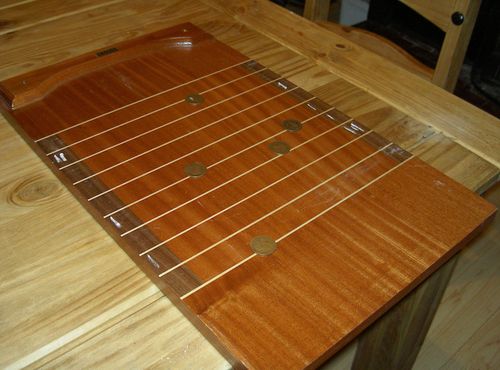
Shove-ha’penny is played on a slate or mahogany board with metal discs; Discs are shoved with the hand into the spaces marked on the board. Any number of persons can play, the winner being the player who first secures the number of beds agreed upon.
The Slate
The board is marked with nine equal beds numbered from 1 to 9, no. 1 bed being nearest the base line from where the shove is made. On each side of the nine beds are spaces for scoring with chalk.
The Discs
The discs are 1” diameter, of equal size and weight.
Order of Play
The order of starting is decided by each player playing one disc for No. 9 bed. The player with the best-placed disc has choice of play. Anyone cannoning plays last.
Length of Game
The game is won by the first player who succeeds in getting three discs into each of the nine beds. Longer or shorter games can be played only if agreed and marked on the board in the space provided, prior to the commencement of the game.
To Shove
Each player in turn shoves five consecutive discs from the base line with any part of his hand, usually the ball of his thumb. He must then mark his score up and leave the discs in the exact position for the next player to remove. Only one attempt to shove any disc is allowed, whether the disc is moved or not. A player can cannon and score off any disc, by hitting one disc with another. A disc shoved or cannoned off the board cannot be played again in that turn.
To Score
The score is determined by the position of the discs after the whole five discs have been shoved. The disc or discs must be wholly within the bed or beds, no part being over the lines or scoring spaces. Where brass lifts are provided, a disc is not scored when touched by a raised lift. Should the shover, at the end of the play of the five discs, have secured more discs in a bed or beds than required, the opponent or opponents can each claim these points, provided they require the discs in the same bed or beds, with the exception of the last point required to win a game, which must be played and secured by the winner.
How to Mark up the Score
After the five discs have been played, and before they are moved, the shover marks his score up, with a chalk mark for each of the first and second disc in any bed, and for the third disc he makes a cross mark so as to indicate to his opponent that he has finished, so far as that bed is concerned. The first player uses the right-hand side of the bed and the second the left-hand side for marking up his score.
Penalties
A game is lost by a player damping or holding down a part of the board during play.
If a disc is touched before the score is properly recorded the score is lost for that turn only.
For playing out of turn, a shover forfeits his score from that turn and misses his following turn.
Interference by Bystanders
If a disc is moved by other than the shover, the shover shall have the choice of either replaying the disc, or replacing it in the original position. The non-shover must allow ample room for the play.
Handicapping
Players may be divided into three classes, viz., Handicap, Scratch and Plus players.
A Handicap player receives a number of points.
A Scratch player plays for an ordinary full slate.
A Plus player has to give points to a Scratch player which must all be used on No. 1 bed first and any over on Nos. 2, 3 and 4 beds; as, for example, a player of 7 Handicap would, before starting, have his Nos. 1 & 2 beds full and a point on No. 3 bed.
The Plus player has to play extra points, but only 1 disc on each bed, starting with No. 1 bed; as, for example, Plus 4 player would have to get an extra disc on each of Nos. 1, 2, 3 and 4 beds.
The Referee
The referee shall not give advice during play, but shall be the sole judge of fair and unfair play, and is responsible for the proper conduct of the game and scoring. His decision shall be final.