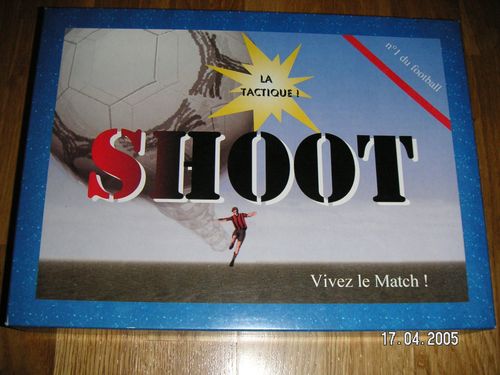
Shoot
Shoot Rulebook
Table of Contents
Table of Contents
Side Selection
This game has two teams of eleven players, distinguished by the different colour of their uniforms. The two people playing a game first choose the side where they will place their team, either by agreement or by the highest total on the dice. Each person then becomes the "coach" (entraîneur) of their team.
Team Setup
Place the eleven players of each team on the numbered squares corresponding to the team's side of the centre line:
- No. 1 (the goalkeeper) on square 1.
- Nos. 2 and 3 (the backs) on squares 2 and 3.
- Nos. 4, 5 and 6 (the midfielders) on squares 4, 5 and 6.
- Nos. 7, 8, 9, 10 and 11 (the forwards) on squares 7, 8, 9, 10 and 11.
The ball must be placed on the centre of the large white circle, on the centre line.
Start of Play
Each coach throws the dice to obtain possession of the ball. The one with the highest total takes the ball and places it on the small white circle, immediately in front of their centre-forward (no. 9).
That coach throws the dice again to start the game. With the total of this throw, they must advance the ball. Then they throw the dice once more, this time to move their players. Players and the ball are moved on the pitch according to the rules in the following sections: Forwards, The Ball, Midfielders, Backs and Goalkeeper.
It is understood that this double dice throw (one for the ball and one for the players) occurs only at the start of the game. Once play has begun, the game proceeds according to the normal rules (see the rules of passing under Taking the Ball).
Players move only on the dark green squares. The ball moves only on the light green squares.
Rules of Play
Forwards
Only the forwards are used to score a goal. The forwards (nos. 7, 8, 9, 10 and 11) move only forward, in the direction of the opposing goals, always staying on dark green squares. They may be placed anywhere on the pitch, including the goal zone. They may advance diagonally or in a zig-zag from one square to another, but always forward. However, within the repair zone and the goal zone, they may move backward as well as forward (but they may not move backward beyond that zone).
The forwards and the goalkeeper are the only players who may use the total sum of the two dice to move. However, the coach is free to use the points shown on each die on two different players: two forwards, or one forward and any other player of the team. For example, a throw of 3 and 4 allows you to move any forward 4 squares and another player 3 squares, or vice versa. Or you may, by adding the total of the points (in this case 7), move a single forward 7 squares.
The Ball
The ball may be moved only on light green squares, toward the opposing goals, diagonally or in a zig-zag, and by as many squares as the total of the two dice. The coach in possession of the ball at the start of the game must throw the dice and use the total of the points to advance the ball forward. That is how the game begins.
Then the coach throws the dice again to move their players and try to take possession of the ball. If they succeed in taking the ball, they throw the dice once more and follow the rules of passing (see Taking the Ball). If they fail to take the ball, it is the opposing coach's turn to throw the dice and try to take possession of the ball.
Taking the Ball
When a dice throw allows you to place a player on one of the four dark green squares adjacent to the ball, that player is said to be in possession (être en possession) of the ball. This automatically gives you the right to a new dice throw. The total of the points obtained must be used to advance the ball. If this new dice throw (used for the ball only) allows you to move the ball to one of the four squares adjacent to one of your players, this is called making a pass (faire une passe).
A successful pass gives you the right to a new dice throw, which is used for the ball only. This passing play may be repeated as long as the ball can be placed on a square adjacent to a player of your team. When the ball can no longer be moved to a square adjacent to one of your players, it is said to be loose (libre) at that moment. It does not come back into play until one or the other team has regained possession. The team that achieves this then follows the rules of the passing game, as indicated above.
Midfielders
The midfielders (nos. 5 and 6) may move in any direction, forward or backward, but always diagonally or in a zig-zag. However, unlike the forwards, you are not allowed to play the total sum of the two dice on a single midfielder. The two dice must be played either on two midfielders, or on one midfielder and another player. You may play only one die per player.
Their task is to regain possession of the ball, if possible, and pass it to their teammates, especially the forwards. They cannot score goals, but they are of great use in organising counter-attacks and protecting their goalkeeper. They may move forward or backward anywhere on the pitch except in their own repair zone (where the two backs, nos. 2 and 3, are placed), and in the goal zone, where they are not admitted at all.
Backs
Like the midfielders, the backs (nos. 2 and 3) may move in any direction, forward or backward, but always along a diagonal or zig-zag course. In no case may they go beyond the line of the midfielders (where squares 4, 5 and 6 are marked), or enter the small white rectangle delimiting the goal zone.
As with the midfielders, you are not permitted to play the total sum of the two dice to move a single back. You may play only one die per player. The backs cannot score goals. Their role is to try to regain possession of the ball, when possible, and pass it to their teammates. They must also protect their goal and clear their goal area.
Goalkeeper
The goalkeeper (no. 1) may move in any direction, forward or backward, but always along a diagonal or zig-zag course. He must remain inside the small white rectangle that delimits the goal zone.
As with the forwards, when moving the goalkeeper you may use the total sum of the dice, but you may also use the points of a single die if that is more advantageous. The points of the second die are then played on another player of the team.
If the ball enters the goal zone without crossing the goal line, and the goalkeeper regains possession of the ball by his dice throw, he then has the right, with a new dice throw (see the rules of passing), to clear his goal area. However, he may choose another alternative: once he is in possession of the ball, the coach places this ball on one of the white circles found in each corner inside the repair zone (large rectangle). The coach then places the right back on the right-hand corner, or the left back on the left-hand corner, according to the coach's choice, on the dark green square immediately behind the ball. Thanks to a new dice throw (granted for the restart of the ball), the goalkeeper can then clear his goal area and pass the ball to a teammate, if that is possible.
Scoring a Goal
A goal is scored when the ball crosses the goal line. This can be accomplished only when a forward is in possession of the ball and, with the aid of a new dice throw (see the rules of passing), the ball is moved to the goal line and crosses it.
When a goal is scored, all players of both teams are returned to their respective numbered squares. The losing team has the advantage of possession of the ball for the restart, the ball being placed on the white circle in front of the centre-forward (no. 9).
Offside
No forward may receive a pass and score a goal if he is located behind the opposing backs (nos. 2 and 3). He may not score, or receive a pass from his teammates, unless one of the opposing backs is between him and the goalkeeper.
Free Kick
When one of the two coaches obtains two 6s with a dice throw and the ball is loose, the coach must either move two of their players 6 squares each, or use the total sum of the two dice (in this case 12) on a single forward. The coach then has the right, by the free kick, to another dice throw. This is used again on their players, unless, thanks to the preceding throw, the coach has been in possession of the ball. In that case, the second throw is used in total on the ball.
The coach throws the dice again and, this time, moves their players. If the coach can regain possession of the ball, play resumes as described above.
However, when a coach obtains two 6s while already in possession of the ball, the total of the two dice (i.e. 12) must be used on the ball. The coach's second dice throw (from the free kick) is then used on their players. As in the previous case, if this second throw allows the coach to regain possession of the ball, the coach throws the dice again (see the rules of passing). If, on the contrary, the second throw does not give the coach back possession of the ball, the opposing coach plays on their turn.
Penalty
When one of the two coaches obtains two 6s while the ball is loose in the repair zone or in the opposing goal zone, the ball must at that moment be placed on the white circle situated on the line of the repair zone (in the middle of that line). The centre-forward is then placed in turn immediately behind the ball. The coach then moves either one forward 12 squares, or two of their players 6 squares each.
The coach then throws the dice again and uses the total sum on the ball. If there is a goal, all players return to their first positions. Otherwise, play continues.
If the coach obtains two 6s while one of their forwards is already in possession of the ball in the repair zone, this results in a goal.
Duration of Play
There is no time limit for playing Shoot unless the two coaches agree on one before playing. If you wish, you may play two "halves" of 45 minutes each, as in the real game of football, changing sides at half-time. Usually, the coaches agree on a number of goals (3, 5 or 7), and the winner is the one who scores 2 goals out of 3, or 3 out of 5, and so on.
Generalities
You will also notice that there exists a "science of the game." By lining up your players so that they can receive passes, and by placing these same players in the line of the ball, you will obtain victorious offensives. Likewise, you will see the importance of the midfielders, who are indispensable both as defenders and for supplying passes to their teammates, the forwards. You will also notice that each player of the team has their importance in the game.