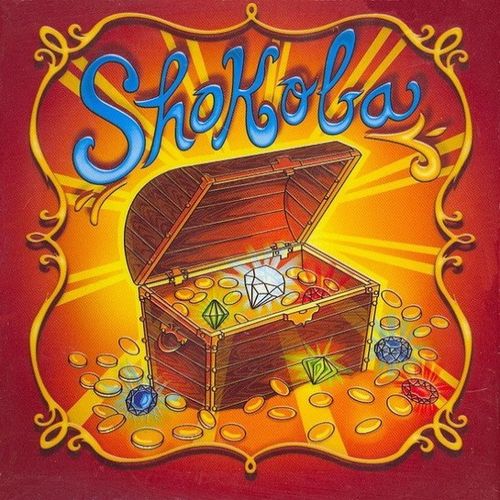
Shokoba
Shokoba Rulebook
Table of Contents
Table of Contents
Content of the Game
- 1 deck of 40 cards with:
- 1 diamond card (Light blue)
- 3 emerald cards (Green)
- 9 ruby cards (Red)
- 27 sapphire cards (Blue)
- 1 bag of plastic or cardboard gemstones (each one is worth one point)
Goal of the Game
To be the first player (or the first team) to win 11 points, represented by the plastic gemstones.
Number of Players
This game can be played by 2 or 3 players playing individually, or 4 players either individually or in two teams of 2. When played in teams, the partners sit opposite one another and cannot communicate. Each partner has their own hand of cards, but combines their collected cards and points.
Game Sequence
The game is played in several rounds, and each round consists of several turns. The turn ends when all players have played all the cards in their hands. They will then be dealt more cards and the round will continue. When the deck runs out, the round ends and is scored.
Round Sequence
-
The youngest player deals first. The dealer remains the same throughout the whole round. The dealer shuffles the cards and deals 3 cards face down to each player. The dealer then flips 4 more cards face up in the center of the table. The player on the left of the dealer begins and play proceeds clockwise. Let's call the first player Kim.
-
Kim's objective is to collect one or more of the cards on the table. To do so, she must play a card which is either exactly equal to a card on the table, or to the sum of several cards on the table. Therefore, with a 7, Kim can take another 7, or a 4 and a 3, or two 2s and a 3, or any other combination adding up to 7. Kim takes the card(s) she has collected as well as the card she has played, and keeps them all face down in front of her. They must be kept separate from her hand – she cannot play these cards later in the round. Rather, they will be counted towards her score at the end of the round.
-
On Kim's turn, she must play a card, whether or not she can (or wants to) collect any cards. If the card played matches the value of a single card or the sum of several cards, those cards must be collected. If her card does not match the values or sums of any cards on the table, it remains in the centre of the table with the other cards and can later be collected by any player.
-
If Kim manages to take the last face up card(s) on the table, she must shout "SHOKOBA" as she takes them. She then scores one SHOKOBA point and takes one plastic gemstone to indicate this. Since the player who plays after her has nothing to collect, they will have to put down one of their cards in the middle of the table.
-
When all players have played all the cards in their hands, the dealer deals three new cards to everyone. No new face-up cards are dealt to the middle of the table. Kim starts again and the game continues as before.
-
The round ends when there are no more cards to deal. The last player to have collected a card also picks up all the cards remaining in the middle of the table, but without scoring a SHOKOBA point (unless all cards were exactly collected by the card played). At the end of each round, up to 5 gemstones will be handed out, as follows:
- One gemstone for the person who picked up the diamond card
Variations and Particular Cases
- Longer games: If the majority of players agree, the number of precious stones required to win the game can be increased to 16 or 21, making the games longer. The decision must be made before the beginning of the game.
- Error: It may happen that a player throws a card down without realizing that he could have used that card to pick up one or more cards. In this case, the next player can do so in his place. This player thus takes all the cards that the absent-minded player would normally have picked up, and then plays his own turn.
- Tie: In case of a tie at the end of a game (for example: 2 players have each won 12 precious stones), one or more additional rounds must be played only between the players who are tied, until there is a winner.
- Advanced rules (optional):
- If the card played matches a card on the table exactly, that card must be collected – the player cannot choose to capture multiple other cards instead, even if their total adds up to the card they played. Example: The cards on the table are 9, 5 and 4. Under the basic rules, by playing a 9, a player could choose to take either the 9 on the table, OR the 5 and the 4. With this optional rule, the player does not have a choice – they must take the 9.
- When played in teams, 9 cards are dealt to each player at the beginning of each round instead of 3 cards dealt 3 times during each round.
Tips to Improve Your Chances of Winning
- Try to remember which cards have already been played during a round, particularly the diamond, emerald, and ruby cards.
- There is no advantage to taking further cards in a category once it is certain who will have the majority. Thus, if one player already has two emeralds, you would prefer to take another card rather than the last emerald if you had a choice.
- It is not always correct to collect a card when you can do so. Leaving cards with lower than 11 total value on the table potentially allows the next player to collect them all and score a SHOKOBA point.
- End-of-round planning is crucial, because the last player to collect a card gets the remaining cards for free.