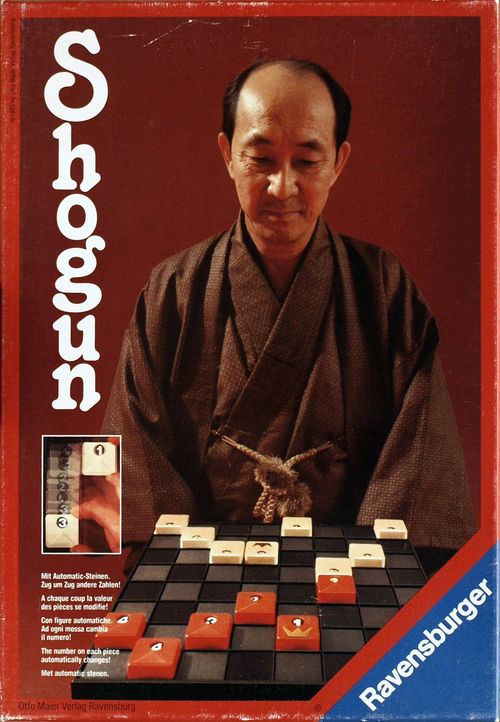
Shogun (1976)
Shogun (1976) Rulebook
Table of Contents
Table of Contents
Game Components
- 1 board
- 7 white and 7 red playing pieces
- 1 white and 1 red Shogun playing piece
Object of the Game
The object of Shogun is either to capture the opponent's leader, his Shogun, or to defeat him so that he is left with only his Shogun and one other piece on the board.
Players should try to attack their opponent's pieces while protecting their own; that is, they try to capture "enemy" pieces without leaving their own unprotected.
Setup
One player takes the white pieces, the other the red. The pieces are placed along the first row on each player's side of the board, as shown in the diagram.
The Shogun (crown) is placed on the 4th square from the right. The other pieces may be placed in the row as you wish. The arrows on the pieces and the points of the crown must point toward the opponent.
Play
The players decide who moves first. Then they move their pieces in turn; each turn is made with only one piece.
How pieces move
The number shown on a piece shows how many squares the piece must be moved. Only the numbers 1 and 2 appear on the Shogun; on the other pieces the number can vary from 1 to 4.
The number on a piece changes as it moves across the board. The number on the piece before the move begins gives the number of squares to move. The number displayed after the move is completed is valid for the next move with that piece.
Pieces can be moved only horizontally and vertically, not diagonally. Only one right-angle turn is allowed in each move. Pieces always move so that the arrows or the points of the crown remain facing the opponent's side.
The diagrams in the original illustrate all possible moves of a piece for the numbers 1 to 4.
A piece may never jump over another piece.
A piece must not move forward and backward in the same move.
A move once made cannot be changed (with the single exception, see below).
How to capture
Any piece can capture any of the opponent's pieces by landing, at the end of its move, on the square occupied by that piece. The captured piece is removed from the board. The Shogun is something of an exception here, since it can capture like the other pieces, but capturing it is more complicated.
If the opponent's Shogun stands on a square where it can be captured, the attacking player must point this out to his opponent (say "Shogun").
The opponent tries to:
- move his Shogun out of danger, or
- move a piece into a position under protection which blocks the threatening move, or
- capture the piece threatening his Shogun.
Likewise, if a player inadvertently endangers his own Shogun, the other player must tell him so. The move that endangers his Shogun is cancelled, and he must make a different move instead. Since this type of move with the Shogun is a rule violation, it cannot be used to make the last, decisive capture that would end the game.
End of the Game
If a player cannot remove the threat to his Shogun, that player has lost the battle and the game is over. The game also ends when a player is left with only his Shogun and one other piece on the board.
Examples
-
A piece showing "2" can move 2 squares forward and capture a piece showing "3". However, if it is the opponent's turn, he must move his piece with the "3" to safety.
-
Here the piece with "3" must move 2 squares forward and 1 to the left, thereby capturing the opponent's piece with the number "1". It can also capture the enemy piece with the number "4". However, if it did so, the opponent would capture it with the piece showing "2".
-
In this situation the Shogun can capture the opponent's piece with the number "1", but it would then be captured by the opponent's piece with the number "2". The Shogun can also capture the opponent's piece showing "2". Then, however, his opponent can capture him with his piece with the number "3". The Shogun would also be under threat on squares A and B. Thus, since the Shogun cannot move to safety, the player who owns the Shogun must surrender - he has lost the game.
Board Rotation
After several rounds the board can be rotated by 90 degrees. This changes the effect of the board on the numbers on the playing pieces.