Shogi
Shogi Rulebook
Table of Contents
Table of Contents
Introduction & History
The board is usually made of wood, but occasionally paper diagrams are used instead. Pieces are punt-shaped and are of wood or ivory. Traditional sets are marked with Japanese characters, though westernised sets are available.
From the time of the shoguns, annual tournaments have been held, with the title of meijin going to the winner. In the past the game was most popular with the literate classes, but today the intellectual elite prefer go. There are about 10 million shogi players in Japan.
How to Play
Though there are a number of shogi variants, the most popular game is standardised and its rules are given here.
Beginning the Game
-
Shogi is played on a board of nine rows of nine cells, rectangular in shape, with four small marks dividing each player's territory from the neutral zone in the middle.
-
There are forty pieces all of the same colour, each having its original name on one side, and a promoted name on the other.
-
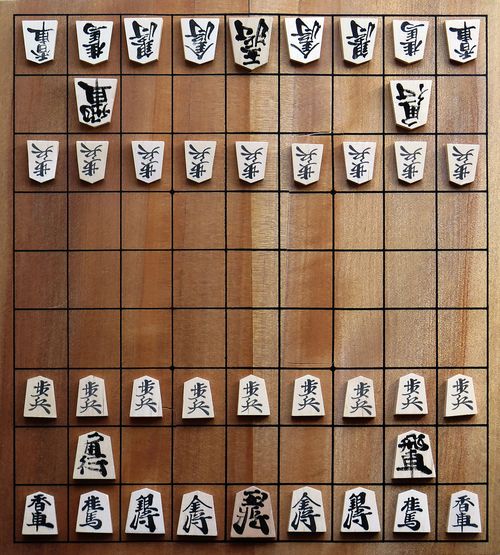
Each player starts with twenty pieces pointing towards his opponent: a jewelled general, two gold generals, two silver generals, two horses, two lancers, a chariot, a dragon and nine soldiers, laid out as shown in Illustration 1.
Illustration 1: board set up for play. Symbols from bottom left are lancer, horse, silver, gold and jewelled generals (mirrored); second row dragon and chariot; third row soldiers.
- The first move is decided by tossing a soldier, though subsequent games are begun by the previous winner.
Moving the Pieces
- The moves of the pieces are shown in Illustration 2 and described as follows:
- the jewelled general moves one square in any direction;
- the gold general moves one square forward, backward, left, right or diagonally forward;
- the silver general moves one square forward or one square diagonally;
- the horse moves two squares forward then one square left or right, jumping over any intervening piece;
- the chariot moves any distance forward, backward, left or right, though cannot jump;
- the dragon moves any distance diagonally, but cannot jump;
- the lancer moves any distance forward, without jumping;
- the soldier moves one square forward.
Illustration 2: moves of the pieces. Light grey arrows are the moves of the promoted dragon and chariot. The other pieces when promoted move as a gold general (above centre).
-
When a piece other than the jewelled or gold general moves into, within or out of enemy territory, it may optionally be promoted. Most pieces promote to a gold general, except the following:
- the chariot becomes a flying chariot, moving as before or one square diagonally;
- the dragon becomes a dragon horse, moving as before or one square forward, backward, left or right.
-
A piece moving in enemy territory must promote if it could not move further in its present form.
Capturing Prisoners
-
An enemy piece is captured by landing on it.
-
Soldiers, as other pieces, move the same way in capturing as in making ordinary moves.
-
Instead of moving a piece, a player may opt to drop a piece he has previously captured, placing it as one of his own on any empty square of the board, with a few exceptions:
- only one unpromoted soldier may occupy a file at once;
- a soldier may not be so placed as to give immediate check-mate, though giving check is allowed (see rule 12 for definitions);
- a soldier, lance or horse cannot be placed on a square from which it could never move.
-
A piece so dropped takes its original value, even if dropped into enemy territory.
Ending the Game
-
A player wins by threatening the enemy's jewelled general with capture (check) that the enemy has no way to avoid (check-mate).
-
A jewelled general threatened with capture must be moved or protected; failure to do so is considered as resignation of the game.
-
Similarly, moving the jewelled general into immediate danger also signifies resignation.
-
The game is drawn if a jewelled general enters enemy territory.
-
Perpetual check is not permitted; the player giving check must vary his move to avoid repetition.
-
Stalemate is not permitted; a player must leave his enemy room to move unless giving check-mate.
Further Information
Readers interested in shogi can find more information in the following books:
- Bell, R. C. Discovering Old Board Games, pp. 27-29. Aylesbury: Shire Publications Ltd., 1973.
- Bell, R. C. Board and Table Games from Many Civilizations, vol. 2 pp. 33-38. New York: Dover Publications, Inc., 1979.
- Botermans, J. et al. The World of Games, pp. 137-139. New York: Facts on File, Inc., 1989.
- Murray, H. J. R. A History of Chess, pp. 119-148. Oxford: The Clarendon Press, 1913.
- Parlett, D. The Oxford History of Board Games, pp. 291-294. Oxford: Oxford University Press, 1999.
- Pritchard, D. Brain Games, pp. 155-164. Harmondsworth: Penguin Books Ltd., 1982.