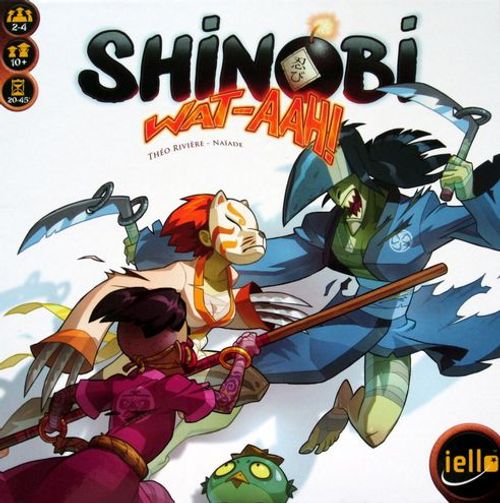
Shinobi WAT-AAH!
Shinobi WAT-AAH! Rulebook
Table of Contents
Table of Contents
Contents
- 94 Shinobi cards (large format) comprising 81 Clan cards (9 cards per clan), 4 Ronin cards, and 9 Yokai cards.
- 10 Temple of the Shadow cards.
- 10 Imperial Court cards.
- 5 Boss cards.
- 1 Shosho of the Emperor token.
- 4 Ninja Master tokens.
- 48 Ninja pawns (4 colors).
- 1 gameboard.
Description of a Shinobi Card
Here is a Clan of the Carp card with a strength value equal to 1.
- Strength of the card
- Name of the Clan
- Powers of the Clan
During the game, the cards of a clan are splayed vertically.
The Ronin and Yokai cards appear in the same fashion as the Clan cards, and can be splayed with them; however, the Yokai cards are distinguished by their bamboo frame.
Grasshopper Mode
Setup
In this mode, you will need the Shinobi cards and the Ninja Master tokens.
- Each player takes a Ninja Master token, and places it in front of himself.
- The Shinobi cards form the common deck. Shuffle this deck, then place it in the center of the table, face-down. Reserve a space directly beside it for the Jigoku (the discard). Whenever the Shinobi deck becomes empty during the game, shuffle the cards of the Jigoku. These cards then form a new Shinobi deck.
- Each player reveals the first card of the Shinobi deck. The player who revealed the card with the highest strength value will be the first player. In the case of a tie, repeat this process. Place the revealed cards face-up in the Jigoku.
- Each player receives 8 cards from the Shinobi deck to form his starting hand, except for the first player, who only receives 7.
How to play
Play goes clockwise, starting with the first player. Your turn comprises 3 phases:
- Draw cards.
- Place cards.
- Discard a card.
1. Draw Cards (obligatory)
There are 2 ways to draw cards, and you must choose before you draw:
- Recruit: You draw the first card from the Shinobi deck, and integrate it into your hand without showing it to the other players.
OR
- Be Corrupt (Gasp! That's immoral!): You draw the first card from the Shinobi deck. After having shown it to the other players, place it face-down under your Ninja Master token. Then draw as many cards from the Shinobi deck as the strength value of this card + 2.
From now on, the cards under your Ninja Master token form your Corruption pile. The values of the cards in the Corruption pile will be negative points during the final scoring at the end of the game.
Example: Bruce is not satisfied with his hand, and thinks that drawing only one card (recruiting) would not have sufficient impact on it. He therefore decides to be corrupt. He reveals the first card of the deck: It is a ninja from the Clan of the Crow, with a strength of 3. He places this card face-down under his Ninja Master token, then draws 5 cards from the Shinobi deck (card strength of 3 + 2).
2. Place Cards (optional)
There are 2 ways to place cards:
- Place a clan: Once per turn, you can form 1 clan by placing 2, 3, or 4 cards of the same clan. The rules for this placement are as follows:
- A clan contains a maximum of 4 cards.
- You must place a new clan that is not already present in front of you.
- The clan's power is activated when you place the cards.
- Placing 2 cards of the same clan activates the money power.
- Placing 3 or 4 cards of the same clan activates the victory-points power.
- The Ronin is considered a wildcard, and can stand in for a card in any clan.
OR
- Reinforce a clan: Once per turn, you can place 1 or more cards on a clan already in the game. The rules for this placement are as follows:
- A clan contains a maximum of 4 cards.
- You can reinforce a clan by placing 1, 2, or 3 cards of the same clan (possibly including a Ronin). If you place 2 or 3 cards, the money or victory-points power, respectively, is triggered, but it does not take into account the cards that were already in play before.
- You can instead reinforce a clan by placing 1 Yokai card on the clan. Its power is triggered immediately. A Yokai card can only be placed on a clan already in play.
Example: It is Bruce's turn. With the cards in his hand, he can do one of the following: place a new clan composed of three ninjas from the Clan of the Carp (the victory-points power is triggered immediately); reinforce his clan composed of three ninjas from the Clan of the Dragon, either by playing a 4th ninja from this clan (the power would not be triggered, because he'd be placing only one card from the Clan of the Dragon), or by playing 1 Yokai card on this clan, thus triggering the power of this Yokai. Bruce is also welcome to do nothing at all.
Attention! A clan in play must contain at least one actual Clan card in order to be considered a clan. The Ronin and/or Yokai cards cannot constitute a clan by themselves. If they should find themselves without a Clan card, due to the effect of a power (Spider or Toad), they are destroyed, and placed in the Jigoku.
3. Discard a Card (obligatory)
If you still have cards in your hand, you discard one card from your hand, and place it in the Jigoku, face-up. Your turn is complete. Now the player to your left takes his turn.
End of the Game
The game ends whenever a player places his 4th clan (and applies the power). Each player determines the total strength of his troops by adding the values of the cards placed in front of him. From this total, each player subtracts the total value of the cards in his Corruption pile.
The player with the highest final total is declared the victor. In the case of a tie for first place, the less corrupt player among those tied wins. If the tie persists, play again!
Example of final scoring: 9 (troop strength) + 12 (troop strength) = 21; 21 - 3 (Corruption pile) = 18. Chuck's final score is 18 points.
Grand Master Mode
Now, you are an accomplished Ninja master. So to you we reveal Grand Master Mode! This mode of play comprises 3 successive rounds in which the gameplay is identical to that in Grasshopper Mode; however, you must place your Ninja pawns at the end of each round and discover the identity of the Final Boss in order to score maximal victory points in the final scoring.
Setup
In this mode, you need to use all of the game material.
- Place the gameboard in the center of the table. Separately shuffle the Shinobi, Temple of the Shadow, and Imperial Court cards, then place them as face-down decks at their dedicated locations beside the gameboard.
- Shuffle the five Boss cards. Discard one of them face-down. From the 4 remaining cards, place one face-down on the Final Showdown space; this one is the Final Boss. Place each of the three other cards face-down beside the gameboard, at their dedicated locations; these will be called Decoys.
- Each player takes 12 Ninja pawns and 1 Ninja Master token of the same color.
- Each player reveals the first card of the Shinobi deck. The player who revealed the card with the highest strength value will be the first player. In the case of a tie, repeat this process. Place the revealed cards face-up in the Jigoku.
- Each player receives 8 cards from the Shinobi deck to form his starting hand, except for the first player, who only receives 7. He also takes the Shosho of the Emperor, which he places in front of himself.
How to play
The gameplay for a turn is identical to that in Grasshopper Mode; however, the number of points earned at the end of a round will affect the number of Ninja pawns you can place on the gameboard.
A round ends as soon as a player places his fourth clan (and applies the power). Each player determines the total strength of his troops by adding the values of the cards placed in front of him. From this total, each player subtracts the total value of the cards in his Corruption pile. The rank of each player's score determines the number of Ninja pawns he will receive from his reserve.
Attention! Keep any cards still in your hand at the end of the round for the following round. After the Ninja pawn placing phase, the only cards you discard are the cards you placed during the round, and the cards of your Corruption pile; place them face-up in the Jigoku.
Ranking
- With 2 players: 4 Ninja pawns for first, 2 Ninja pawns for second.
- With 3 players: 4 Ninja pawns for first, 3 Ninja pawns for second, 1 Ninja pawn for third.
- With 4 players: 4 Ninja pawns for first, 3 Ninja pawns for second, 2 Ninja pawns for third, 1 Ninja pawn for fourth.
In the case of a tie for the same rank, all players tied for that place receive the full number of Ninja pawns for that rank. Additionally, the next players step up to fill in the vacant rank. If everyone is tied, they are all considered to be first place.
Example: In a 3-player game, Bruce and Michelle are tied for 1st place with a total of 25 points each. They each receive 4 Ninja pawns from their personal reserves. Chuck receives 3 Ninja pawns, because he now finds himself in 2nd place, despite his pitiful score of 10 points, which would have earned him 3rd place if the other two players hadn't tied.
- Once the ranking is resolved, the winner of the round receives the Shosho of the Emperor token. If several players were tied, the least corrupt among them receives the token. If the tie persists, the current holder of the token decides which of them receives this precious token.
- Then, each player takes a number of Ninja pawns from his reserve, as determined by his place in the ranking. Finally, the player who ranked last place gets a free activation of one of the two powers of Temple of the Shadow (see The Locations on the Board below).
Place the Ninja Pawns
Starting with the possessor of the Shosho of the Emperor token, then going clockwise, each player places one or more Ninja pawns (stacked) on the different locations on the gameboard: Imperial Court, Missions, or Final Showdown (see description of the locations below). The rules for this placement are as follows:
- During your turn to place, you must place one or more Ninja pawns on a single location.
- If you still have pawns, you must wait for your next turn to place, in order to place the rest of the Ninja pawns on another location, or even the same one.
- You can only place Ninja pawns that you received at the end of the round (see Ranking above).
Once all the players have placed their Ninja pawns, the next round can start. The holder of the Shosho of the Emperor token is the first player for this new round.
End of the Game
The end of the game occurs at the end of the third round. Once the ranking and placement of Ninja pawns is complete, the Final Boss card, placed at the start of the game on the Final Showdown space, is revealed.
Calculate your final score at the end of the game as follows:
- 10 victory points for each Ninja pawn present on the Imperial Court space.
- 10 victory points for each Ninja pawn present on the Missions space.
- X victory points according to the number of Ninja pawns present on the Final Showdown space. Each Boss has a specific scoring system (see The Bosses below).
The player with the highest final total is declared the victor. In the case of a tie for first place, the less corrupt player among those tied wins. If the tie persists, several players are honored.
The Locations on the Board
Temple of the Shadow: Only the last-place player (see Ranking above) can have access to this. You never place Ninja pawns on this location.
It offers you two choices:
- Draw 2 cards from the Temple of the Shadow deck, choose one, and put the other back under the deck. Put the chosen card face-up; you can use it during the next round, then discard it at the end of that round. Its power is permanent.
OR
- Secretly peek at one of the 3 Decoy cards, then put it back, face-down.
Imperial Court: Only one Ninja pawn can be placed per player per round on this location.
When you place a Ninja pawn on this location, you immediately receive the first card from the Imperial Court deck, which you will place face-down in front of you. You will use this during the next round, and discard it after using it (or at the end of the next round, if you ended up not using it).
At the end of the game, each Ninja pawn placed on the Imperial Court space earns 10 victory points for its owner.
Missions: Your ninjas have been sent on a reconnaissance mission, and report back with precious intelligence! As soon as your total number of Ninja pawns on this location reaches an even number, you can secretly peek at one of the 3 Decoy cards, then put it back, face-down.
At the end of the game, each Ninja pawn placed on this location earns 10 victory points for its owner.
Final Showdown: Over the course of the game, the players will place their Ninja pawns on this space (card), based on the intelligence they have gathered by peeking at the Decoy cards. In this way, they will discover the likely identity of the Final Boss.
The victory points earned at the end of the game vary depending on the characteristics of the Boss cards: each Boss first inflicts Damage — the Ninja pawns that each player on the Final Showdown space loses upon revelation of the Final Boss card — and then awards victory points according to the number of Ninja pawns you still have on the Final Showdown space after Damage.
- Grugazor: If Grugazor is the Final Boss, each player loses 2 Ninja pawns that he's placed on the Final Showdown space. Then, each Ninja pawn remaining earns 30 victory points for its owner (120 maximum).
- Dark Shogun: If the Dark Shogun is the Final Boss, each player with one or more Ninja pawns on the Final Showdown space (card) earns 50 victory points.
- Zombies: If the zombie horde is the Final Boss, each player loses 1 Ninja pawn that he's placed on the Final Showdown space (card). Anyone who now has no Ninja pawns on this space loses 30 victory points.
- Gaijins: If the army of gaijins is the Final Boss, each player with 2 or fewer Ninja pawns on the Final Showdown space (card) loses 30 victory points. Each Ninja pawn beyond 2 that a player has on this space earns him 30 victory points (90 maximum).
- Ma' Maho: If Ma' Maho is the Final Boss, each player loses 10 victory points for each Ninja pawn he's placed on the Final Showdown space (card) (50 maximum). Additionally, any player who has no Ninja pawns on this space loses 50 victory points.
Dictionary of the Perfect Little Ninja
Discard: Place one or more cards from your hand in the Jigoku (face-up).
Destroy: Send a card or a clan already in play into the Jigoku (face-up).
Jigoku: In the game, this is the name of the face-up discard pile for Shinobi cards. Historically, Jigoku is Hell or the underworld in Japanese mythology.
Corruption Pile: This refers to the cards placed under your Ninja Master token whenever you decide to use the Be Corrupt action. A corrupt card refers to a card in the Corruption pile.
Shinobi deck: This refers to the principal deck of the game. It comprises Clan, Ronin, and Yokai cards. Historically, the term "shinobi" is a synonym of "ninja".
Yokai: In the game, this refers to the Shinobi cards of which each copy is unique. Historically, Yokai are the spirits of the fantastic creatures of Japanese mythology.
Questions for the Grand Master
Can I have 2 clans of the same type in front of me? No. A single player can form only one clan of each type.
Must I apply the effect of a power whenever it is triggered? Yes. Note that even if the effect of the power cannot be applied, the clan or Yokai can still be placed.
Can I play a Yokai on any clan, for example, playing the Tengu on the Spider clan? Yes. Yokai can be played on any clan.
Can I play several different Yokai in the same turn? No. A Yokai always reinforces a clan, and is played alone on it.
Can I play several Yokai on the same clan, but over several different turns? Yes. The only limit is that your clan can only have a maximum of 4 cards. You can play several Yokai on the same clan, just not on the same turn.
When I place 4 cards of the same clan, can I choose to apply the money power twice, rather than applying the victory-points power? No.
Is there a limit to the number of cards in my hand? No.
Can I place just one Clan card to do the Place a Clan action? No. The Place a Clan action requires at least 2 cards.
A solitary ninja forms a clan? Yes. A solitary Clan card counts toward the number of clans necessary to end the game, and is always considered as a clan.
Reinforcing a clan with 2 or 3 cards of the same clan triggers the power of the clan? Yes. If you use 2 or 3 cards to reinforce a clan, you trigger the money or victory-points power, respectively. Attention! Don't count the cards already in play when determining which power is triggered by the reinforcement. For example, 1 Clan card coming into play to reinforce 2 cards of the same clan does not trigger the victory-points power.
In Grand Master Mode, can I place Ninja pawns on the Temple of the Shadow? No. Ninja pawns never go to the Temple of the Shadow. Only the players that are last place in the rankings benefit from its effects.
In Grand Master Mode, if all players are tied during a ranking at the end of a round, do they all have access to the powers of the Temple of the Shadow? No. The players are all considered to be first place. They do not qualify for access to the Temple of the Shadow.
In Grand Master Mode, several players are tied for last place during the ranking. Do they all get access to the Temple of the Shadow? Yes.
For convenience, is it OK if we stack Ninja pawns of the same color in each location? Yes, it is highly recommended!
Am I allowed to throw my Ninja pawns at an opponent's face? No. This can cause serious injury. Remember to maintain honor for your opponents… and even more so for yourself!
Summary of a Game Turn
- Draw Cards (obligatory): Recruit (1 card) or Be Corrupt (X cards).
- Place Cards (optional): Place a clan (2, 3, or 4 Clan/Ronin cards) or Reinforce a clan (1, 2, or 3 Clan/Ronin cards or 1 Yokai card).
- Discard a Card (obligatory).
End of the Game
Grasshopper Mode (1 round): As soon as a player places his 4th clan (and applies its power).
Grand Master Mode (3 rounds):
- End of a round: As soon as a player places his 4th clan (and applies its power).
- End of the game: After ranking at the end of the 3rd round, reveal the Final Boss and score.
Grand Master Mode — End of the Round
- Ranking:
- With 2 players: 4 Ninja pawns for first, 2 Ninja pawns for second.
- With 3 players: 4 Ninja pawns for first, 3 Ninja pawns for second, 1 Ninja pawn for third.
- With 4 players: 4 Ninja pawns for first, 3 Ninja pawns for second, 2 Ninja pawns for third, 1 Ninja pawn for fourth.
- Transfer the Shosho of the Emperor to the winner of the round.
- The last-place player in the ranking for the round activates the Temple of the Shadow.
- Place the Ninja pawns.
The Bosses
- Dark Shogun: 0 Ninja pawns present → 0; 1 → +50; 2 → +50; 3 → +50; 4 → +50; 5+ → +50.
- Gaijins: 0 → -30; 1 → -30; 2 → -30; 3 → +30; 4 → +60; 5+ → +90.
- Grugazor: 0 → 0; 1 → +30; 2 → +60; 3 → +90; 4 → +120; 5+ → +120.
- Ma' Maho: 0 → -50; 1 → -10; 2 → -20; 3 → -30; 4 → -40; 5+ → -50.
- Zombies: 0 → -30; 1 → 0; 2 → 0; 3 → 0; 4 → 0; 5+ → 0.
Final Scoring — Grand Master Mode
- 10 victory points for each Ninja pawn present on the Imperial Court space.
- 10 victory points for each Ninja pawn present on the Missions space.
- X victory points according to the number of Ninja pawns present on the Final Showdown space. Each Boss has a specific scoring system (see above).