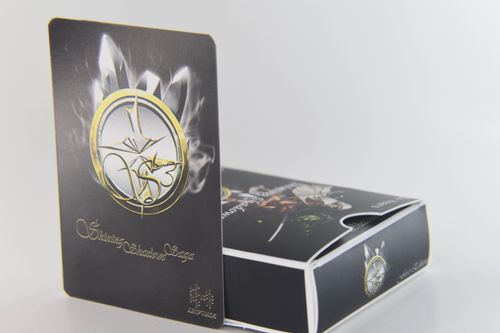
Shining Shadows Saga
Shining Shadows Saga Rulebook
Table of Contents
Table of Contents
- The World
- Welcome to the Coliseum
- The Basics
- Modern Champions Cards
- Champion Types
- Main Deck
- Offensive Skills
- Defensive Skills
- Spells
- Charged Spells / Skills
- Strategy
- Inventory Deck
- Modern Cards -VS- Legacy
- Legacy Champions Cards
- Legacy Main Deck Cards
- Legacy Will
- Legacy Ally
- Legacy Offensive Skills
- Legacy Defensive Skills
- Legacy Spells
- Legacy Charged Spells / Skills
- Legacy Strategy
- Legacy Inventory Deck
- Legacy Union
- Legacy Mounts
- The Arena
- Phases
- Last Stand
- Victory Conditions
- Advanced Terms
- Game Types
- Restrictions & Limitations
- Monthly Collectibles
The World
When a peculiar black stone, shining with the light of the stars, catapults the realm of Limsia back into Chaos after 1000 years of tranquility, the inhabitants find themselves on the verge of war. Ancient magic is returning to the land, resurrecting old war artifacts, and threatening their golden age. Tension is on the rise. Fear is engulfing the world.
Welcome to the Coliseum
In the coliseum you'll summon up to 3 legendary champions and use your customized main deck and inventory deck to defeat your opponent's party. The first Monarch to reduce all of an opponent's champions HP to 0 will be declared the victor.
This guide will teach you the basics of being a Monarch. It includes all you'll need to get started, advanced techniques, restrictions & limitations, and how to strengthen your party with the most up to date skills, spells, and weaponry by utilizing the monthly collectibles. This guide will also pinpoint some of the notable locations on Sanctuary and how to join the S3CCG community. Are you ready to join the fight, Monarch?
The Basics
What You'll Need
To begin you will need the following:
Champions (Max 3)
- Start the match with 3 champions of different names.
- You cannot have more than one champion of the same name in your party at a time.
- Select your champions from the heroes and villains of the S3 Universe.
- Utilize the champion's unique mastery and stats to create the ultimate party.
Deck (40 - 60 cards) (varies by game type)
- The deck is made of skill, spell, will, ally, and strategy cards.
- Can only contain between 40-60 cards.
- Card Duplication Limit: You can only have 4 copies of the same card name in your Deck except will cards.
- No card duplication limit for will cards.
- Only 3 Ally cards per Deck.
Inventory (Max 15 Cards) (varies by game type)
- Inventory is made up of items, weapons, stones, and unions.
- Card Duplication Limit: You can only have 4 copies of the same card.
- Kept separate from the Main Deck.
Quest Deck (Max 15 Cards)
- Quest decks can be made up of any card type: Champion, skill, spell, will, ally, strategy, items, weapons, stones, and unions.
- When playing 'best 2/3', you can only swap cards from your quest deck.
- For in-person tournaments, all decks (main, inventory, and quest) and champions are locked; no cards can be added or removed between matches, however, you are able to swap cards with your quest deck.
No card duplication Along with the mandatory items, you may need the following:
- Playmat: Used to keep track of zones.
- Dice: Some card effects require dice roll to determine the effect.
- Coins: Some card effects require a coin flip to determine the effect.
- Crests: Some cards may state to use a crest. You can use official crests or any other items you may have to indicate that a crest has been placed.
- Calculator: For damage calculation, a calculator may help make the results as accurate as possible.
- Pencil and Paper: To help keep track of each Champion's HP, you may want to use a pencil and paper to create an HP Tracker.
- Card Sleeves: To protect your cards from wear and tear, consider using a card sleeve to place your cards in.
- Meeple: Use the game piece to keep track of which character is acting. Move the meeple after each turn to help you stay organized.
Modern Champions Cards
What are Champion Cards?
Crafting a successful Deck begins at champion selection. To create the perfect team, you'll need to understand the breakdown of the champion card.
- Champion Name & Moniker: Each champion has a unique name identifier and moniker. Only 1 champion of the same name can be used in a party.
- Champion Art: The artistic representation of the champion.
- Champion Card Icon: This icon represents Champion Cards.
- Species: Each champion belongs to a species that gives them access to special strategy cards and bonus stats.
- Class: There are 4 distinctive class groups.
- Sub-class: Each class group has 3 sub-classes.
- Prestige (B, A, S, SS, S3): Represents the champion's legendary status.
- Health Points: Amount of health your champion starts with. Your champion may gain HP past this amount. If the HP reaches 0, the champion is 'downed' and can no longer act.
- Attack Points: Used to apply damage when using offensive skills.
- Defense Points: Used to reduce damage from ATK attacks.
- Spell Damage Points: Used to apply damage when using offensive spells and some mystic striking skills.
- Intellect Points: Used to reduce damage from SDG attacks.
Champion Types
There are 4 unique primary classes to choose from, each with 3 sub-classes creating a total of 12 distinctive champion types. Each Subclass has a unique 'Baked Effect'. Baked Effects are effects that are granted to the champion in addition to their master due to being a part of their subclass.
Classes
Knight
Knights are the protectors of Limsia, the realm of s3. This class has excellent base stats for your offensive and defensive physical abilities but has lower magical stats than its peers.
Sub-classes include:
- Guardian
- Berserker
- Barbarian
Guardian
Specializing in higher defensive capabilities, Guardians make for natural survivalists. Utilize their strong defense against foes with higher attacking abilities to nullify your opponent's strategies.
Baked Effect: Once per round, defensive skills used by a Guardian cannot be shattered.
Berserker
Berserker champions are known for their high ATK and HP. These units have an affinity for melee offensive skills. In exchange for their prowess in damage dealing, Berserkers are more susceptible to receiving damage than their Knight type peers.
Baked Effect: A Berserker can equip a primary and a secondary weapon simultaneously, but you must declare the secondary weapon. The effect from the secondary weapon is not granted, however, the stats are applied.
Barbarian
Barbarians have the highest SDG of their knight type peers and utilize potions to maximize their survival. Many of their masteries focus on potions usage and damage through SDG instead of ATK to provide them a unique adaptability in combat.
Baked Effect: Once per round, Will used to charge skill cards can be applied toward the skill's WC when activated by Barbarians.
Assailant
Cunning and powerful, Assailants can deal a fair amount of damage quickly and unexpectedly, making them an extremely dangerous asset.
Sub-classes include:
- Swordsaint
- Assassin
- Rogue
Swordsaint
By sacrificing HP and many of their defensive capabilities, Swordsaints aim to deal the most damage output by having the highest ATK of all classes. Utilizing their natural base stats with powerful high prestige weapons, Swordsaints can take down the strongest tanks.
Baked Effect: Other than during the first round, unless acting last, Swordsaints can equip a weapon and enter the Action Phase during the same turn.
Assassin
Assassins have strong ATK and SDG output and decent intellect, making them versatile in combat and strong against units that have higher defensive abilities.
Baked Effect: When an Assassin downs an opposing champion or mount, the Assassin gains 30 HP.
Rogue
[Source note: the Assailant sub-class list prints "Rogue", but the entry below is printed under the heading "Hunter", and the rest of the rulebook names the Hunter subclass as the one that can use Ranged skills. The entry is transcribed as printed under its printed heading.]
Hunters are the only sub-class capable of using 'ranged' offensive skills. This perk allows Hunters to use an arsenal of powerful attacks and bypass certain defenses. Hunters excel at dealing damage to multiple targets.
Baked Effect: Hunters can activate Ranged Offensive Skills and Trap type Item Cards.
Magician
Mastering the arts of the ancients, Magicians excel at using spells to down their foes. Learning the secrets to each element will unlock their true potential.
Sub-classes include:
- Sage
- Sorcerer/Sorceress
- Occultist
Sorcerer/Sorceress
With an affinity for the harmonic elements, Sorcerers can leverage the element that best fits the situation, making them adaptable and unpredictable. This uniqueness also opens several possible union combinations.
Baked Effect: Once per round, Will used to charge spell cards can be applied toward the WC of the spell card when activated by a Sorcerer/Sorceress.
Occultist
With access to the forbidden element, Shade, Occultists have an arsenal of unpredictable spells. Although they still have access to harness the strength of other elements, Shade Spells are where Occultists show their strength.
Baked Effect: Once per round, reduce the WC of 1 Shade Spell by 2 when cast by an Occultist.
Sage
Sages are proficient at absorbing and dealing spell damage. With higher spell defenses and spell offenses, Sages are strong against other magic dealing units.
Baked Effect: Once per round, defense spells used by Sage type Champions cannot be shattered.
Support
Assistance comes in various ways. Support classes can play a critical role in your party's dynamic, whether it be by strengthening your team's defenses or by bolstering their offenses mid fight.
Sub-classes include:
- Cleric
- Tactician
- Engineer
Cleric
From healing allies to providing stat boosts, Clerics make for excellent support through their use of Sol spells. Clerics also have higher defense against spell attacks, which make them able to sustain damage from other spell casters.
Baked Effect: Once per round reduce the WC of 1 Sol Spell by 2 when cast by a Cleric.
Tactician
While other classes excel at dealing or receiving damage, Tacticians use strategy cards and the cards in their Inventory to their benefit. With well-rounded stats and their mastery, Tacticians can outmatch even the toughest opponents.
Baked Effect: Tacticians can activate 1 tactical spell during the Planning Phase.
Engineer
Engineers specialize in the creation, utilization, and enhancement of weapons. With a master Engineer in your party, you can overpower your opponents with haste.
Baked Effect: Once per turn, Engineers can 'enhance' 1 Weapon card of any champion in the party without the use of card effects so long as the requirements are met for the enhancement.
Main Deck
Your Main Deck holds all your Will, Ally, Skill, Spell, and Strategy cards. You can only have 4 copies of the same card, excluding Will cards (there are no limits for Will cards) and cards on the limitation list in your deck. Each turn you will draw cards from your Main Deck until your hand equals 5 cards, unless otherwise impacted by a card effect.
Will
Will cards are crucial to the deck building process. If you have too many Will cards you won't be able to draw skills or spells you need to deal damage. On the other side, not having enough Will cards in your deck will prevent you from using skills and spells. Finding the right balance is the key aspect of deck building.
Skills, spells, and other card effects may require Will to be used in order to activate them. To do this, you'll move Will from the Will Zone to the Used Will Zone. This is called consuming Will. Will of the Universe is the most basic type of the Will cards.
Will card anatomy:
- Name: Name of the Will card.
- Image: Image of the Will card.
- Card Icon: This icon represents Will. You can identify other Will cards by this icon.
- Description: Description of the Will card.
Ally
Ally cards are powerful support cards that can turn the tide of the battle. Only 3 Ally cards can be present in your Deck at a time. You may have more than 1 Ally card of the same name in your deck unless otherwise stated on the limitation list.
While Ally cards provide a boost to your party, you can gain an even greater advantage if you use an Ally card utilizing the Champion (Name or Name & Moniker depending on the effect) on the card in your party.
Typically, there is no Will Cost to using Ally cards, however, it is important to check as some may require a cost. Generally, Ally cards are 1TU (one time use) cards, meaning once they are used, they are placed in the Used Card Zone. Note: Ally cards are not considered skill or spell cards.
Ally card anatomy:
- Name: Each Ally card has a unique name.
- Action Link: Cards of the same Action Link can be activated in succession that turn.
- Ally Sub-Type: The Sub-Type of the Ally Card.
- Image: Artistic representation of the Ally.
- Icon: This icon represents Ally cards.
- Champion Name: The name of the champion ally.
- Champion Moniker: The moniker of the champion ally.
- (WC) Will Cost: The cost of the Will needed to activate the card.
- (CC) Cooldown Counter: During the Conclusion Phase, this determines where the card is moved from the activity zone.
- Effect: Upon the activation of the card, this is the effect that will take place.
Offensive Skills
Offensive skill cards are the primary action of most non-spellcasting champions. These cards are activated in the Action Phase.
Note: The first Spell or Skill used this turn will dictate which skill or spell cards you can activate for the rest of the Action Phase. You can activate skills of the same name regardless of Action Link during the Action Phase or skills & spells of different names if they are of the same Action Link. You cannot do both unless the Skill of the same name is also of the same Action Link. More on this in the Action Phase section.
Offensive skill card anatomy:
- Name: Each weapon has a unique name identifier.
- Action Link: Cards of the same Action Link can be activated in succession.
- Image: Artistic representation of the Skill.
- Icon: This icon represents 'Offensive' or 'Defensive' skill cards.
- Style: This represents the style of skill. Offensive skills have 3 styles while defensive skills have 2.
- Level: This represents the offensive skill level in the Champion's Skill Tree required to activate the skill.
- Origin Weapon: The name of the Weapon Card that the Skill Card originated from.
- (WC) Will Cost: To activate the Skill you must consume Will equal to the Will Cost (WC).
- (CC) Cooldown Counter: During the Conclusion Phase, unless affected by a card effect, Skills are moved to the Cooldown Zone equal to the CC number or sent to the Used Card Zone if they are 1TU.
- Effect: Upon activation, the effect takes place.
Defensive Skills
Defensive skills help protect your champion from damage. Any time a champion is targeted by an attack, you can activate 1 defensive skill or spell in response. If more than 1 champion is targeted, each champion gets the opportunity to activate a defensive skill or spell as a response.
Defensive skills must also follow the same chaining rules as Offensive Skills. If you begin a chain using the same name or the same action link, then you must continue with this chain.
Defensive skill card anatomy (numbering as printed): 11. Name: Each weapon has a unique name identifier. 12. Action Link: Cards of the same Action Link can be activated in succession. 13. Image: Artistic representation of the Skill. 14. Icon: This icon represents 'Offensive' or 'Defensive' skill cards. 15. Style: This represents the style of skill. Offensive skills have 3 styles while defensive skills have 2. 16. Level: This represents the offensive skill level in the Champion's Skill Tree required to activate the skill. 17. Origin Weapon: The name of the Weapon Card that the Skill Card originated from. 18. (WC) Will Cost: To activate the Skill you must consume Will equal to the Will Cost (WC). 19. (CC) Cooldown Counter: During the Conclusion Phase, unless affected by a card effect, Skills are moved to the Cooldown Zone equal to the CC number or sent to the Used Card Zone if they are 1TU. 20. Effect: Upon activation, the effect takes place.
Spells
Spell cards are the primary action of the Magician type champions. Spell cards are activated in the Action Phase.
The first Spell or Skill used this turn will dictate which skill or spell cards you can activate for the rest of the Action Phase. You can activate spells of the same name regardless of Action Link during the Action Phase or skills & spells of different names if they are of the same Action Link. You cannot do both unless the Spell of the same name is also of the same Action Link. More on this in the Action Phase section of the guide.
Spell card anatomy:
- Name: Each Spell has a unique name identifier.
- Action Link: Cards of the same Action Link can be activated in succession.
- Image: Artistic representation of the Spell.
- Icon: This icon represents the element of the Spell cards.
- Style: This represents the style of Spell: offensive, defensive, and tactical.
- Level: This represents the elemental spell level in the Champion's Skill Tree required to activate the Spell.
- (WC) Will Cost: To activate the Spell's effect you must consume Will equal to the Will Cost (WC).
- (CC) Cooldown Counter: During the Conclusion Phase, unless affected by a card effect, Skills are moved to the Cooldown Zone equal to the CC number, or sent to the Used Card Zone if they are 1TU.
- Effect: Upon activation, the effect takes place. Effects can range from dealing damage, defending from attacks, or an array of other abilities that can give you the advantage.
Spell Elements – Harmonious
Flame: Mystical and powerful, Flame spells embody the might and destructive nature of the flame itself. Flame spells focus on more of the brute damage dealing aspects of magic.
Frost: Frost spells offer more defensive techniques than the other elements. Protective and preventative in nature, these spells are also lower in cooldown than the other elements.
Wind: As unpredictable as the weather itself, Wind spells offer a wide array of tactical advantages. Wind spells are also relatively balanced in terms of attack and defense, making it a great well-rounded element.
Nature: Nature Spells can provide a great number of benefits such as increasing Champion stats. Additionally, Nature Spells can also cause ailments to foes.
Spell Elements – Chaos
On the opposite end of the spell element spectrum are the chaos spells: Sol, Shade, and Ion.
Sol: The Sacred Spell. An element favored by the Gods, Sol Spells favor healing abilities and protection of allies, but also have many damage capabilities.
Shade: The forbidden Spell. Powerful spells too complex for many to master, Shade spells are generally only cast by Occultists. Shade spells can be seen as tricky due to being rarely seen, which provides an advantage to the caster.
Ion: The Unstable Spell. Considered the most dangerous of the elements, Ion spells can only be used by each champion one time, unless affected by a card effect. Ion spells can be used by any champion regardless of level. Max 1 per Deck.
Charged Spells / Skills
Certain Skills and spells have 'Charged' and 'Hyper' versions. To activate 'Charged' cards, you will need to first store the card. Next, you'll need to charge the card using Will during your champion's Preparation Phase. Once the card has charges equal to, or greater than the CH needed for activation, you can send the Will to the Used Will Zone to activate the card by paying the WC. Charged/Hyper cards are considered the same name as their 'normal' variant (i.e. Charged Fireball = Fireball). In the deck, hand, or field, however, they do not count towards the 4 max card duplication limit.
Charged card anatomy: 10. (CHC) Charge Cost: This number, represented by CH, is the amount of Will that needs to be attached to the card via charging before the card can be activated.
Strategy
Strategy cards effect the battle in various ways. Although many are not designed to deal damage or defend against attacks, strategy cards are equally as important and should be taken into consideration when designing your deck. When removed from the Activity Zone from the stored position, they are sent to the Library. When removed after activation, they are sent to the Used Card Zone.
Strategy card anatomy:
- Name: Each Strategy card has a unique name identifier.
- Image: This is the image of the card.
- Restrictions: Like weapon cards, some strategy cards may have a restriction of race, class, or prestige that will limit which Champions can use them.
- Icon: This icon represents strategy cards.
- Effect: This is the card effect. Upon activation of the card, this effect will take place.
- Type: Strategy cards can come in many types.
- i. Basic: These are normal Strategy cards that are played from your hand and removed from the field at the conclusion phase of the turn activated.
- ii. Lingering: Unlike the basic type, Lingering Strategy cards stay on the field after the conclusion phase and remain on the field until removed by a card effect.
- iii. Reactive: These type of cards can be played from your hand during your opponent's turn.
Inventory Deck
The inventory deck is made up of Item, weapon, union, and stone cards.
Item
Item cards provide quick access to additional tools to use in battle. Each character can use 1 item per turn. Item cards are stored in your inventory zone. The Inventory limit changes depending on game-type.
Item card anatomy:
- Name: Each Item card has a unique name identifier.
- Image: This is the image of the item.
- Card Icon: This icon represents 'Item' cards.
- Item type: There are a few different types of Item cards. Be mindful of card effects that target specific types of Items.
- Effect: This is the card effect. Upon activation of the card, this effect will take place.
Stone
Stone cards are extremely powerful assets and thus are much more rare than average cards. Planning the best time to use your Stone card in battle may bring your team victory. Stone cards are removed from the field following their activation. Only 1 Stone card of the same name is allowed per deck.
Stone card anatomy:
- Name: Each Item card has a unique name identifier.
- Image: This is the image of the stone.
- Card Icon: This icon represents 'Item' cards.
- Effect: This is the card effect. Upon activation of the card, this effect will take place.
Weapon
Weapons can turn the tide of the battle in your favor. To equip a weapon, simply place the weapon under the champion. The weapon stats (ATK, DEF, SDG, and INT) as well as their skill tree are then added to the character.
Excluding Berserkers, only 1 weapon can be equipped per Champion. You can swap weapons by equipping a new weapon and returning the previously equipped weapon to the Inventory Deck. Weapons of the same name cannot be swapped, instead, try 'juggling'.
Things to Note:
- Not every weapon can be equipped by every Champion. The icons shown for the equipable classes will dictate which champions can equip the weapon.
- Also, weapons equipped to downed champions remain equipped.
Weapon card anatomy:
- Name: Each weapon has a unique name identifier.
- Image: Artistic representation of the weapon.
- Icon: This icon represents 'Weapon' cards.
- Equipable Classes: This represents the class or subclasses that can equip the weapon.
- Equipable Prestige (B, A, S, SS, S3): Represents the prestige of the weapon. The higher the prestige the stronger and rarer the weapon.
- ATK: ATK added to the ATK of the equipped Champion.
- DEF: DEF added to the DEF of the equipped Champion.
- SDG: SDG added to the SDG of the equipped Champion.
- INT: INT added to the INT of the equipped Champion.
- Effect: Many weapons have abilities that can be used in combat.
- Skill Tree: Number of skills and spells added to the equipped Champion.
Enhanced Weapons
Certain weapons can be enhanced using card effects or using the Engineer's Baked Effect. To enhance a weapon, you must utilize the required, equipped base weapon(s) and the enhancement material(s).
Enhanced weapon card anatomy (numbering as printed): 12. Enhanced Weapon Icon: This icon represents 'Enhanced Weapon' cards. 13. Requirements: These are the requirements needed to perform the enhancements. The weapon(s) with an [E] must be equipped to perform the enhancement. Other items listed are enhancement materials. Enhancement materials can be sent from your hand or Library to the Used Card Zone or Used Inventory Zone respectively.
Union
Union Cards are the combination of various skills/spells to create an even stronger version. Union cards are stored in your inventory until they can be formed and are considered Skill or Spell cards when activated.
Union card anatomy (numbering as printed):
- Name: Each Union has a unique name identifier.
- Action Link: Cards of the same Action Link can be activated in succession.
- Image: Artistic representation of the Union.
- Icon: This icon represents union cards.
- Type: Union cards can be Skill or Spell types.
- Style: This represents the style of Union.
- Level: This represents the number of markers required by the champion in their skill tree in order to activate the Union.
- Origin Weapon: The name of the Weapon Card that the Union Card originated from.
- Will Cost: The amount of Will needed to consume for activation.
- Cooldown Counter: Once activated, certain spells/skills cannot be used for a number of turns. Once the count is over, the spell/skill can be used again.
- Union Type: There are two types of unions:
- (AL) Action Link: Cards of different names but are the same Action Link.
- Straight: Cards of the same name with sequential Action Links (i.e. 4, 5, 6).
- Effect: Upon activation, the effect takes place. To activate union cards, you must combine the required cards from your hand by sending them to the Used Card Zone.
Mounts
Mounts can give your champion a leg up by providing a greater stat boost, new markers for your skill tree, and a new target for your opponent to worry about. While mounts cannot attack on their own, their effects can cause a potential problem, so be very wary of mounts on the field.
Things to Note:
- Not every mount can be mounted by every Champion. The icons shown for the mountable classes will dictate which champions can utilize the mount.
- Also, mounts attached to downed champions remain mounted.
Mount card anatomy (numbering as printed):
- Name: Each mount has a unique name identifier.
- Image: Artistic representation of the mount.
- Equipable Classes: This represents the class or subclasses that can mount the mount.
- Mount Icon: This icon represents 'Mount' cards.
- Equipable Prestige (B, A, S, SS, S3): Represents the prestige of the mount. The higher the prestige the stronger and rarer the mount.
- HP: This is the individual HP of the mount. Mounts can be targeted by skills, spells, and other actionable cards. Damage calculation is based on the mount's stats when targeted.
- ATK: ATK added to the ATK of the mounting Champion.
- DEF: DEF added to the DEF of the mounting Champion.
- SDG: SDG added to the SDG of the mounting Champion.
- INT: INT added to the INT of the mounting Champion.
- Effect: Many mounts have abilities that can be used in combat.
- Skill Tree: Number of skill and spell markers added to the mounting Champion.
Library Card
You may start the match with 1 face-up 'Library Card' in your Library Zone per champion. These cards count toward your Main Deck card limit and can also be used in your Main Deck if desired. You may activate them at any point during the match. Afterward they are treated as a normal Main Deck card.
Library card anatomy:
- Tag: Library cards will say 'Library' in the tag.
- Card Icon: This icon represents 'Library' cards.
Modern Cards -VS- Legacy
Graphical updates were made to make playing S3CCG even easier! During your play you may encounter some of the older Legacy cards. These cards are still perfectly playable and tournament legal. Take the time to familiarize yourself with the older Legacy design in this next section.
Legacy Champions Cards
Legacy champion card anatomy:
- Champion Name & Moniker: Each champion has a unique name identifier and moniker. Only 1 champion of the same name can be used in a party.
- Champion Art: The artistic representation of the champion.
- Champion Card Icon: This icon represents Champion Cards.
- Species: Each champion belongs to a species that gives them access to special strategy cards and bonus stats.
- Class: There are 4 distinctive class groups.
- Sub-class: Each class group has 3 sub-classes.
- Prestige (B, A, S, SS, S3): Represents the champion's legendary status.
- Health Points: Amount of health your champion starts with. Your champion may gain HP past this amount. If the HP reaches 0, the champion is 'downed' and can no longer act.
- Attack Points: Used to apply damage when using offensive skills.
- Defense Points: Used to reduce damage from ATK.
- Spell Damage Points: Used to apply damage when using offensive spells and some mystic striking skills.
- Intellect Points: Used to reduce damage from SDG.
- Mastery: Each champion has a unique skill they can utilize in combat. Unless a mastery has an activation requirement, it can be activated at any time during the champion's turn.
- Skill Tree: Represents the level of offensive skills, defensive skills, and elemental spells that the champion can use, indicated as a marker.
Legacy Main Deck Cards
Your Main Deck holds all your Will, Ally, Skill, Spell, and Strategy cards. You can only have 4 copies of the same card, excluding Will cards (there are no limits for Will cards) and cards on the limitation list in your deck. Each turn you will draw cards from your Main Deck until your hand equals 5 cards, unless otherwise impacted by a card effect.
Legacy Will
Will cards are crucial to the deck building process. If you have too many Will cards you won't be able to draw skills or spells you need to deal damage. On the other side, not having enough Will cards in your deck will prevent you from using skills and spells. Finding the right balance is the key aspect of deck building.
Skills, spells, and other card effects may require Will to be used in order to activate them. To do this, you'll move Will from the Will Zone to the Used Will Zone. This is called consuming Will. Will of the Universe is the most basic type of the Will cards.
Legacy Will card anatomy:
- Name: Name of the Will card.
- Image: Image of the Will card.
- Card Icon: This icon represents Will. You can identify other Will cards by this icon.
- Description: Description of the Will card.
Legacy Ally
Ally cards are powerful support cards that can turn the tide of the battle. Only 3 Ally cards can be present in your Deck at a time. You may have more than 1 Ally card of the same name in your deck unless otherwise stated on the limitation list.
While Ally cards provide a boost to your party, you can gain an even greater advantage if you use an Ally card utilizing the Champion (Name or Name & Moniker depending on the effect) on the card in your party.
Typically, there is no Will Cost to using Ally cards, however, it is important to check as some may require a cost. Generally, Ally cards are 1TU (one time use) cards, meaning once they are used, they are placed in the Used Card Zone. Note: Ally cards are not considered skill or spell cards.
Legacy Ally card anatomy:
- Name: Each Ally card has a unique name.
- Action Link: Cards of the same Action Link can be activated in succession that turn.
- Ally Sub-Type: The Sub-Type of the Ally Card.
- Image: Artistic representation of the Ally.
- Icon: This icon represents Ally cards.
- Champion Name: The name of the champion ally.
- Champion Moniker: The moniker of the champion ally.
- Will Cost: The cost of the Will needed to activate the card.
- Cooldown Counter: During the Conclusion Phase, this determines where the card is moved from the activity zone.
- Effect: Upon the activation of the card, this is the effect that will take place.
Legacy Offensive Skills
Offensive skill cards are the primary action of most non-spellcasting champions. These cards are activated in the Action Phase.
Note: The first Spell or Skill used this turn will dictate which skill or spell cards you can activate for the rest of the Action Phase. You can activate skills of the same name regardless of Action Link during the Action Phase or skills & spells of different names if they are of the same Action Link. You cannot do both unless the Skill of the same name is also of the same Action Link. More on this in the Action Phase section.
Legacy offensive skill card anatomy:
- Name: Each weapon has a unique name identifier.
- Action Link: Cards of the same Action Link can be activated in succession.
- Image: Artistic representation of the Skill.
- Icon: This icon represents 'Offensive' or 'Defensive' skill cards.
- Style: This represents the style of skill. Offensive skills have 3 styles while defensive skills have 2.
- Level: This represents the offensive skill level in the Champion's Skill Tree required to activate the skill.
- Origin Weapon: The name of the Weapon Card that the Skill Card originated from.
- Will Cost: To activate the Skill you must consume Will equal to the Will Cost (WC).
- Cooldown Counter: During the Conclusion Phase, unless affected by a card effect, Skills are moved to the Cooldown Zone equal to the CC number or sent to the Used Card Zone if they are 1TU.
- Effect: Upon activation, the effect takes place.
Offensive Skill Types
There are 3 different types of Offensive Skills: Striking, Ranged, and Mystic. Ranged Skills can only be used by the Hunter subclass, unless otherwise affected by a card effect.
Striking (Legacy Striking Icon): Striking skills are the main offensive skill type used in combat. Striking skills generally consist of more Action Links per card than any other offensive skill type for ease of chain creation. Mix and match skills to create the ultimate attack.
Ranged (Legacy Ranged Icon): Ranged skills are a specialty skill that can ONLY be used by the Hunter Subclass. From high-powered hard-hitting attacks to quick snipes, this skill type varies in capabilities, making the combatant extremely versatile.
Mystic (Legacy Mystic Icon): Mystic attacks are favored by the magically adept. These skills harness the power of the user's SDG to deal ATK. These types of skills can throw an unexpected foe off guard.
Legacy Defensive Skills
Defensive skills help protect your champion from damage. Any time a champion is targeted by an attack, you can activate 1 defensive skill or spell in response. If more than 1 champion is targeted, each champion gets the opportunity to activate a defensive skill or spell as a response.
Defensive skills must also follow the same chaining rules as Offensive Skills. If you begin a chain using the same name or the same action link, then you must continue with this chain. Defensive skills must be used on your opponent's turn unless stated otherwise.
Legacy defensive skill card anatomy:
- Name: Each weapon has a unique name identifier.
- Action Link: Cards of the same Action Link can be activated in succession.
- Image: Artistic representation of the Skill.
- Icon: This icon represents 'Offensive' or 'Defensive' skill cards.
- Style: This represents the style of skill. Offensive skills have 3 styles while defensive skills have 2.
- Level: This represents the offensive skill level in the Champion's Skill Tree required to activate the skill.
- Origin Weapon: The name of the Weapon Card that the Skill Card originated from.
- Will Cost: To activate the Skill you must consume Will equal to the Will Cost (WC).
- Cooldown Counter: During the Conclusion Phase, unless affected by a card effect, Skills are moved to the Cooldown Zone equal to the CC number or sent to the Used Card Zone if they are 1TU.
- Effect: Upon activation, the effect takes place.
Defensive Skill Types
There are 2 different Defensive Skills you can utilize in combat. Each of the types can give you an advantage when being targeted by an attack.
Physical (Legacy Physical Icon): Physical defenses are defenses that rely on making contact with the attack. While these generally boost DEF, skills and spells that have effects that activate on contact will still have their effects activated.
Evasive (Legacy Evasive Icon): Sometimes getting out of the way of the attack is the better option. Evasive defenses may cost more will and have a longer cooldown than Physical defenses, but the Evasion defense will not break.
Legacy Spells
Spell cards are the primary action of the Magician type champions. Spell cards are activated in the Action Phase.
The first Spell or Skill used this turn will dictate which skill or spell cards you can activate for the rest of the Action Phase. You can activate spells of the same name regardless of Action Link during the Action Phase or skills & spells of different names if they are of the same Action Link. You cannot do both unless the Spell of the same name is also of the same Action Link. More on this in the Action Phase section of the guide.
Legacy spell card anatomy:
- Name: Each Spell has a unique name identifier.
- Action Link (Formally known as Ranks): Cards of the same Action Link can be activated in succession.
- Image: Artistic representation of the Spell.
- Icon: This icon represents the element of the Spell cards.
- Style: This represents the style of Spell: offensive, defensive, and tactical.
- Level: This represents the elemental spell level in the Champion's Skill Tree required to activate the Spell.
- Will Cost: To activate the Spell's effect you must consume Will equal to the Will Cost (WC).
- Cooldown Counter: During the Conclusion Phase, unless affected by a card effect, Skills are moved to the Cooldown Zone equal to the CC number, or sent to the Used Card Zone if they are 1TU.
- Effect: Upon activation, the effect takes place. Effects can range from dealing damage, defending from attacks, or an array of other abilities that can give you the advantage.
Legacy Charged Spells / Skills
Certain Skills and spells have 'Charged' and 'Hyper' versions. To activate 'Charged' cards, you will need to first store the card. Next, you'll need to charge the card using Will during your champion's Preparation Phase. Once the card has charges equal to, or greater than the CH needed for activation, you can send the Will to the Used Will Zone to activate the card by paying the WC. Charged/Hyper cards are considered the same name as their 'normal' variant (i.e. Charged Fireball = Fireball). In the deck, hand, or field, however, they do not count towards the 4 max card duplication limit.
Legacy charged card anatomy (numbering as printed): 10. Required Charge: This number, represented by CH, is the amount of Will that needs to be attached to the card via charging before the card can be activated. 11. Charged Label: Charged and Hyper cards will have a label shown as either 'Charged' or 'Hyper'.
Spell Types
There are 3 types of Spells to utilize in battle: Offensive, Defensive, and Tactical. Mastering all 3 can give you a well-rounded Deck.
Offensive (Legacy Offensive Icon): Offensive spells are used to deal SDG against your opponents. Some elements are heavier on attack type spells than others.
Defensive (Legacy Defensive Icon): Defensive spells are used to protect the caster against enemy skills and spells and generally have a slightly longer cooldown than their offensive counterparts. The effects of the spell are reset after each calculation. Defense spells must be used on your opponent's turn unless stated.
Tactical (Legacy Tactical icon): Tactical Spells are spells used to provide support in combat. They may not deal damage or provide cover against attacks, but they are equally important. Many tactical spells are single use spells.
Legacy Strategy
Legacy strategy card anatomy:
- Name: Each Strategy card has a unique name identifier.
- Image: This is the image of the card.
- Restrictions: Like weapon cards, some strategy cards may have a restriction of race, class, or prestige that will limit which Champions can use them.
- Icon: This icon represents strategy cards.
- Effect: This is the card effect. Upon activation of the card, this effect will take place.
Legacy Inventory Deck
Legacy Item
Item cards provide quick access to additional tools to use in battle. Each character can use 1 item per turn. Item cards are stored in your inventory space. The Inventory limit changes depending on game-type.
Legacy item card anatomy:
- Name: Each Item card has a unique name identifier.
- Image: This is the image of the item.
- Card Icon: This icon represents 'Item' cards.
- Item type: There are a few different types of Item cards. Be mindful of card effects that target specific types of Items.
- Effect: This is the card effect. Upon activation of the card, this effect will take place.
Legacy Stone
Stone cards are extremely powerful assets and thus are much more rare than average cards. Planning the best time to use your Stone card in battle may bring your team victory. Stone cards are removed from the field following their activation. Only 1 Stone card of the same name is allowed per deck.
Legacy stone card anatomy:
- Name: Each Item card has a unique name identifier.
- Image: This is the image of the stone.
- Card Icon: This icon represents 'Item' cards.
- Stone type: Stone cards can come in various elements.
- Effect: This is the card effect. Upon activation of the card, this effect will take place.
Legacy Weapon
Weapons can turn the tide of the battle in your favor. To equip a weapon, simply place the weapon under the champion. The weapon stats (ATK, DEF, SDG, and INT) as well as their skill tree are then added to the character.
Excluding Berserkers, only 1 weapon can be equipped per Champion. You can swap weapons by equipping a new weapon and returning the previously equipped weapon to the Inventory Deck. Weapons of the same name cannot be swapped, instead, try 'juggling'.
Things to Note:
- Not every weapon can be equipped by every Champion. The icons shown for the equipable classes will dictate which champions can equip the weapon.
- Also, weapons equipped to downed champions remain equipped.
Legacy weapon card anatomy:
- Name: Each weapon has a unique name identifier.
- Image: Artistic representation of the weapon.
- Icon: This icon represents 'Weapon' cards.
- Equipable Classes (Restrictions): This represents the class or subclasses that can equip the weapon.
- Prestige (B, A, S, SS, S3) (Restrictions): Represents the prestige of the weapon. The higher the prestige the stronger and rarer the weapon.
- ATK: ATK added to the ATK of the equipped Champion.
- DEF: DEF added to the DEF of the equipped Champion.
- SDG: SDG added to the SDG of the equipped Champion.
- INT: INT added to the INT of the equipped Champion.
- Effect: Many weapons have abilities that can be used in combat.
- Skill Tree: Number of skills and spells added to the equipped Champion.
Legacy Enhanced Weapons
Certain weapons can be enhanced using card effects or using the Engineer's Baked Effect. To enhance a weapon, you must utilize the required, equipped base weapon(s) and the enhancement material(s).
Legacy enhanced weapon card anatomy (numbering as printed): 12. Enhanced Weapon Icon: This icon represents 'Enhanced Weapon' cards. 13. Requirements: These are the requirements needed to perform the enhancements. The weapon(s) with an [E] must be equipped to perform the enhancement. Other items listed are enhancement materials. Enhancement materials can be sent from your hand or Library to the Used Card Zone or Used Inventory Zone respectively.
Legacy Union
Union Cards are the combination of various skills/spells to create an even stronger version. Union cards are kept in your inventory until they can be formed and are considered Skill or Spell cards when activated.
Legacy union card anatomy (numbering as printed):
- Name: Each Union has a unique name identifier.
- Action Link: Cards of the same Action Link can be activated in succession.
- Image: Artistic representation of the Union.
- Icon: This icon represents union cards.
- Type: Union cards can be Skill or Spell types.
- Style: This represents the style of Union.
- Level: This represents the number of markers required by the champion in their skill tree in order to activate the Union.
- Origin Weapon: The name of the Weapon Card that the Union Card originated from.
- Will Cost: The amount of Will needed to consume for activation.
- Cooldown Counter: Once activated, certain spells/skills cannot be used for a number of turns. Once the count is over, the spell/skill can be used again.
- Union Type: There are two types of unions:
- Action Link Kind: Cards of different names but are the same Action Link.
- Action Link Straight: Cards of the same name with sequential Action Link (i.e. 4, 5, 6).
- Effect: Upon activation, the effect takes place. To activate union cards, you must combine the required cards from your hand by sending them to the Used Card Zone.
Legacy Mounts
Mounts can give your champion a leg up by providing a greater stat boost, new markers for your skill tree, and a new target for your opponent to worry about. While mounts cannot attack on their own, their effects can cause a potential problem, so be very wary of mounts on the field.
Things to Note:
- Not every mount can be mounted by every Champion. The icons shown for the mountable classes will dictate which champions can utilize the mount.
- Also, mounts attached to downed champions remain mounted.
Legacy mount card anatomy (numbering as printed):
- Name: Each mount has a unique name identifier.
- Image: Artistic representation of the mount.
- Icon: This icon represents 'Mount' cards.
- Mountable Classes (Restrictions): This represents the class or subclasses that can mount the mount.
- Prestige (B, A, S, SS, S3) (Restrictions): Represents the prestige of the mount. The higher the prestige the stronger and rarer the mount.
- HP: This is the individual HP of the mount. Mounts can be targeted by skills, spells, and other actionable cards. Damage calculation is based on the mount's stats when targeted.
- ATK: ATK added to the ATK of the mounting Champion.
- DEF: DEF added to the DEF of the mounting Champion.
- SDG: SDG added to the SDG of the mounting Champion.
- INT: INT added to the INT of the mounting Champion.
- Effect: Many mounts have abilities that can be used in combat.
- Skill Tree: Number of skill and spell markers added to the mounting Champion.
The Arena
-
Activity Zone: When skills, spells, wills, strategy, or ally cards from the hand or library are activated, they are placed in the Activity Zone until the Conclusion Phase where they are moved to the appropriate Cooldown Zone or Used Card Zone. Only 5 cards can be active in the Activity Zone at a time. Cards can be placed face-up or face-down.
-
Champion Zone: At the start of the match, each player will select champions and place them on the field from left to right. The order will dictate the order in which the character will act. The face-up Champion on your far left is considered your Lead Champion. 'Downed' Champions, Champions whose HP reach 0, are turned face-down until revived by a card effect.
-
Cooldown Zone (CDZ): From the left, the Cooldown Zones are 4, 3, 2, and 1. During the Prep Phase for your Lead Champion, unless affected by a card effect, you will move each card in the Cooldown Zone over to the right by 1 zone. Cards in Zone 1 are moved to the library. During the Conclusion Phase, cards from the Activity Zone are placed in their appropriate Cooldown Zone face-up as indicated on the card unless affected by a card effect.
-
Library: Cards that come off cooldown are placed in the library face-down. Each turn, you can access cards in your Library, as well as your hand, to activate during the Action Phase. Cards with a CC of 0 are immediately placed in the library during the Conclusion Phase of the turn that the card is activated.
-
Used Will Zone (UWZ): Will cards consumed for card effects are placed here face-up until your next Prep Phase.
-
Will Zone (WZ): During the Prep Phase, Will cards from the Used Will Zone are moved to this zone face-up. During the Conclusion Phase, Will cards from the Activity Zone are moved to this zone face up. To activate certain card effects, you can use Will cards from this zone to meet the card's WC requirements and send them to the Used Will Zone.
Phases
Match Start
At the start of the match, each player will place their Champions face-up in the Champion Zones from Left to Right. Note: The face-up Champion furthest to the left is considered the party leader/lead champion. Once all the Champions are placed on the field, toss a coin, or roll a pair of dice to determine which player will act first. Add 3 Will of the Universe cards from your main deck to the Will Zone for each acting champion you control. Shuffle your Deck.
Preparation (Prep) Phase
The first Prep Phase starts the first Round. Rounds are completed once every acting champion has completed all the phases. At the start of the Prep Phase, if any Will exists in your Used Will Zone, move it to your Will Zone.
Next, if it is your party leader's turn, move every card currently on active cooldown over to the right by one space. Cards in Cooldown Zone 4 are moved to 3, 3 to 2, 2 to 1, and cards in Cooldown Zone 1 are moved to the Library. If it is not your party leader's turn, then this part of the phase is skipped.
Lastly, wipe the field, remove all cards from the Activity Zones and send them to their respective Cooldown Zones or to the Used Card Zone if the card is 1TU unless you put a charge on them. To place a charge on a card, move one Will card from your Will Zone to the card you wish to charge. You must charge the card during each champion's Prep Phases or the card is wiped.
Draw Phase
At the start of your Draw Phase, draw cards until the number of cards in your hand equals 5. If your hand already has 5 cards or more, then you can draw 1 card.
Planning Phases
During this phase, you can choose to use a card in your inventory, activate Will, store cards face-down, activate a strategy card, or start your Action Phase. Note: if you choose to use a card in your inventory, your Action Phase is skipped. Once you enter your Action Phase you will not be able to access your Inventory Deck.
Action Phase
In this phase, you can activate Will, Skills, Spells, Strategy, and/or Ally cards by placing them in the Activity Zone face-up or store them by placing them face-down. Remember, you will need to consume Will from your Will Zone to activate the effect of any card with a Will Cost (WC). Will cards played from your hand are played in the Activity Zone. Cards placed in the Activity Zone cannot be overridden (sent to the Used Card Zone by placing a new card in its place) on the same turn that it is placed on the field.
Calculating Damage from Battle
Spells, like Fireball, and Skills, like Power Slash, augment the attacking character's stats during the attack. For example, Fireball adds +55 SDG to the Champions base SDG. The total then has the defending Champion's Base or augmented stats deducted from it. The results, if positive, are deducted from the defending Champion's HP. When calculating damage, it is important to remember that INT is deducted from SDG and DEF is deducted from ATK.
Let's review a mock engagement: Champion 1 uses Fireball. The Champion's base Stat is 10 SDG and gains +6 from casting Fireball bringing the total SDG in this engagement to 16.
Note: During the first round, no champion can enter an Action Phase except for the last champion to act.
Calculation (Calc) / Results Phase
The defending Champion, Champion 2, has an INT of 12. 16 (the attacking SDG) has 12 (the defending INT) deducted from it, resulting a in net Damage of 4. 4 is then deducted from the defending Champion's HP. Champion 2's HP was 100 before damage calculation, but afterwards, Champion 2's HP is 96.
If any card is activated that would deal damage either by effect or battle, the Calculation & Results Phase activates to determine how much damage is dealt and deduct it from the defending Champion's HP. Repeat the Action Phase and Calculation Phase until there are no more cards to be played.
Let's take the previous example and add a defensive spell: When an Offensive Skill or Spell is activated, your opponent may activate 1 card per champion in response, so long as the card effect allows.
Champion 1 uses Fireball. Champion 2 activates a defensive spell that increases INT by 5. This results in a difference that is negative after calculation. Negative numbers result in damage not being taken. In this updated example, Champion 2 receives 0 damage to HP.
The effects from the Attacking and Defensive spells are reset after calculation, meaning Champion 1's SDG resets back to 10 and Champion 2's INT resets back to 12 unless affected by an effect.
Continuing the example: Champion 1 then chain's Fireball with another Fireball spell. Champion 2, if there is enough Will to reactivate the defensive Spell, can choose to do so and go through the calculation process again or take the damage.
Conclusion Phase
After a player concludes an Action Phase, that player will enter the Conclusion Phase. In this phase, card effects apply, Will from the Activity Zone is moved to the Will Zone, cards that linger on the field are moved to the Lingering Zone, and activated cards or moved to their appropriate Cooldown Zone (or Used Card Zone). If a player has more than 6 cards in their Hand, they must send cards from their Hand to the Used Card Zone until their Hand contains 6 cards. At the end of the Conclusion Phase, the next player's Champion acts, starting from the Planning Phase. Once every champion has completed the phases, a new round begins.
Last Stand
When a champion's HP reaches 0 or below, the champion is flipped face-down and is considered 'Downed'. If all but 1 of your champions have been 'Downed' your remaining champion enters Last Stand and the turn structure changes. While in Last Stand, your champion will only act after each of your opponent's champions. If one of your 'Downed' champions is revived, Last Stand is deactivated, and the turn structure returns to normal.
Victory Conditions
When every Champion in a player's party is Downed, the match is over and the player with Champions remaining is declared the winner. If all Champions are Downed at the same time, the match is declared a draw.
Advanced Terms
Will Consumption
Will is needed to activate certain skills, spells, and other card effects. Consuming Will is the act of moving will from the Will Zone to the Used Will Zone equal to the required Will Cost (WC). Once the consumption of Will has taken place you can activate the card's abilities.
In this example, Fireball has a WC of 5. To activate Fireball's effect, you will need to move 5 Will Cards from the Will Zone to the Used Will Zone. Afterward, the acting Champion can attack 1 opposing unit.
Face-down/Face-up & Dumping
Any card from your Main Deck can be placed face-down and some cards must be placed face-down on the field before activation. Placing a card face-down is called storing and requires no will. However, to activate the card and change it to the face-up position, Will may need to be consumed depending on the Card's WC.
Defensive Skills and Defensive Spells must be placed face-down on the field. When an action is taken that prompts the effect of the card, you may change the card from the face-down to the face-up position during either player's turn.
Outside of Defensive Skills and Defensive Spells, any other card from your Main Deck can be placed in the Activity Zone face down. Dumping, is an advanced tactic that can be used to guarantee that you can draw fresh cards on your next turn. Will from the charged cards is then moved to the Used Will Zone. Note: you can only assign 1 card either face-up or face-down to a particular Activity Zone per turn. Example, if you place a card face-down in Activity Zone 1, you cannot use Activity Zone one to activate or override the card you placed until your next turn. Overridden cards are either sent to the library if they have a CC or sent to the Used Card Zone if they do not.
Defensive Skills & Spells, as well as, Strategy, and Tactical Spells depending on the effect, can be activated on your opponent's turn if the card has an effect that activates due to your opponent's action.
Will Lock & Leaking
Sometimes consuming Will is not enough. Some cards require Will to be assigned to the card, this act of assigning Will is called Will Locking. To assign Will simply place the will on top of the card that Will is being assigned to.
Leaking refers to the removal of locked Will from a card to the Used Will Zone. Some card effects require you to Lock x amount of Will and Leak Will each turn.
Chains
Chains, or combos in the legacy format, are a great way to deal more damage each turn than your opponent and can be initiated in two ways:
- Chains linked by name: Activating cards of the same name.
- Chains linked by Action Link: Activating cards of the same Action Link.
You can only do one or the other per turn.
Chain Example: If you are planning on activating Slash (1), you can do the following chains:
Slash (1) & Slash(3) & Slash(K) Or Slash (1) & Throw Blade(1) & Fireball(1) Or Slash (1) & Slash(1) & Throw Blade(1)
You cannot do the following:
Slash(1) & Slash(3) & Fireball(of any Action Link)
Since Slash(3) is of a different suit than Slash(1), your chain is linked by name and not by Action Link, thus preventing the use of Fireball.
Unioning
Another great way to increase your damage output is through the use of Union Cards.
Union cards are kept in your inventory until you send the cards that correspond to the union from your hand to your Used Card Zone.
Once the cards have been sent, the Union card is added to your hand.
After the union, the card is played like any other skill or spell. WC and CC information on the card applies. Additionally, if the champion does not meet the skill level requirements, the card cannot be used.
Defense Breaks
Defense cards can help shield you from damage. Physical defense cards raise your DEF to reduce or nullify oncoming damage.
If, after the defensive skill resolves, if the ATK of the attacking champion is higher than the DEF of the defending champion, then the defense is considered "shattered", and the defensive skill card is sent to the Used Card at the end of the turn. Turn the card to its side (horizontally) to show the card has been shattered. This also applies to defensive spells and SDG vs INT situations.
The Joker
Cards can be chained by name or Action Link. Some cards may have a Joker Action Link. The Joker can be used to imitate any Action Link you desire. For example, if you play a Action Link 2 card, then you can chain a Joker card as a Action Link 2 card. Jokers can also be used to union. If the Union calls for all the cards to be the same Action Link or sequential, you may use the joker to declare the Action Link of the card and fit it where it's needed. Multiple Jokers can be used during the same turn.
Card Charging
Charging a card during the Prep Phase allows the card to remain on the field after the 'Wipe'. To charge a card you must move 1 Will from your Will Zone to the card's Activity Zone, overlapping the card you wish to charge. During each champion's Prep Phase, you must continue to charge the card, or, the card is removed during the 'Wipe'. If a charge card is wiped, the Will used to charge the card is moved to the Used Will Zone. Cards that have a charge are activated by consuming the amount of Will listed on the card's WC and sending the Will charged to the card to the Used Will Zone.
Countering
Some cards allow you to counterattack after evading/defending against an attack. Cards used for the counter can be played from your hand or Library.
Things to Note:
- The effect of the card will tell you when you are able to counter. You cannot counter unless directed by a card effect.
- You will still need to pay the WC to activate cards for counters.
Status Effects
There are various status effects that can be applied in battle using skills, spells, or other card effects. Listed below are the elements and their status effects. Note: you can only apply one status effect of the same element at a time to a champion. You cannot stack the same status effect to a champion that is already affected.
Flame | Burnt
The burned/burnt status effect deals additional damage at the start of the burned champion's turn.
Frost | Freeze
Frozen zones cannot be used to activate or store cards. Additionally, cards that are already in frozen zones cannot be used or removed from the Activity Zone, but also do not need to be charged to remain in the Activity Zone.
Wind | Blister
Blistered champions have +1 added to the CC of any Skill or Spell going into the Cooldown Zone on their turn.
Nature | Bind
Bound champions cannot access the inventory deck and/or cannot add cards from their deck to their hand outside of their Draw Phase.
Nature | Plagued
Plagued champions receive damage each time they cast a spell.
Sol | Blind
Blinded Champions cannot target a specific opponent with a skill or spell attack, however, they can activate skills or spells that deal damage to an entire party.
Sol | Graced
Graced champions gain various effects when healed, such as, extra HP.
Shade | Fright
Frightened champions must consume extra will to activate any cards that requires Will.
Shade | Muffled
Muffled champions cannot activate spells.
Shade | Charmed
You control your opponent's champion's Action Phase. Your opponent cannot access their inventory while charmed. You may only use cards in your Hand or Library to control the charmed champion.
Ion | Stun
Stunned champions must skip their turn entirely.
Removing Status Effects
To remove a status effect from your party, you must send 1 spell of the opposite element from your Library to the Used Card Zone. By sending 1 spell card to the Used Card Zone, all status effects are removed for the opposite element. Status effect removals must be done during the Planning Phase.
To remove Ion status effects, you'll need to move 1 spell of every element from your Library to your Used Card Zone.
For status effect removals:
- Flame removes Frost.
- Frost Removes Flame.
- Nature removes Wind.
- Wind Removes Nature.
- Sol removes Shade.
- Shade removes Sol.
- Flame + Frost + Nature + Wind + Sol + Shade removes Ion.
Juggling
While you cannot swap weapons of the same name, you can attempt an advanced tactic called 'juggling'. 'Juggling' involves cycling through your weapons, swapping weapons 1 turn, then swapping back on the next, to capitalize on the effects of a particular weapon that you've already used. For example, Battle sword allows you to search your deck for a card with 'Slash' in its name when equipped. By equipping that weapon, swapping for another weapon, and equipping that weapon again, you can reuse the effect of Battle Sword. Note that, outside of Swordsaints, each time you equip a weapon, you will not be able to partake in your Action Phase.
Crest
Certain card effects apply crests. Crests are like tokens and work as indicators to apply effects. You may use anything as a token to represent crests being applied.
Game Types
There are several different game types you can play in S3CCG. Find the game type that best suits your playing style or build decks for each game type! Keep an eye out for additional Game Types and Game Modifiers!
Joust
The Joust game type is played with two players. You can Joust with 1, 2, or 3 Champions. Depending on the Joust type, the time frame and difficulties may increase.
Joust 3v3 (Classic)
- Number of Players: 2
- Champions Per Player: 3
- Deck Size Per Player: 40-60 Cards
- Inventory Deck Size Per Player: 1-20 Cards
Joust 2v2
- Number of Players: 2
- Champions Per Player: 2
- Deck Size Per Player: 30-40 Cards
- Inventory Deck Size Per Player: 1-15 Cards
Joust 1v1 (Gladiator)
- Number of Players: 2
- Champions Per Player: 1
- Champion Stock: 3 (Default)
- Deck Size Per Player: 20-30 Cards
- Inventory Deck Size Per Player: 1-10 Cards
In Gladiator, both champions begin with 3 stock. Each time a champion's HP is reduced to 0 the champion loses 1 stock and the turn immediately ends. Afterward, revive the downed champion with full HP. When a champion has 0 stock they are officially defeated and the match is over.
Joust 1v1 (Sudden Death)
- Number of Players: 2
- Champions Per Player: 1
- Champion Stock: 1
- Deck Size Per Player: 20-30 Cards
- Inventory Deck Size Per Player: 1-10 Cards
In Sudden Death both champions begin with 1 stock.
Duos
The Duos game type is played with 4 players. You can play Duos with 1 or 2 Champions. Depending on the Duos sub-type, the time frame and difficulties may increase.
Duos 4s (2&2 v 2&2)
- Number of Players: 4
- Champions Per Player: 2
- Deck Size Per Player: 30-40 Cards
- Inventory Deck Size Per Player: 1-15 Cards
- Share Arena: No
Duos 2s (1&1 v 1&1)
- Number of Players: 4
- Champions Per Player: 1
- Deck Size Per Player: 20-30 Cards
- Inventory Deck Size Per Player: 1-15 Cards
- Share Arena: No
Duos Team and Turn Structure
In Duos, two Monarchs are paired against another set of Monarchs. Duos plays much like Joust with a few noticeable differences.
Each team consists of two players. Teams will roll a die to determine turn order. Highest number (player 1) will play first using their lead champion and then pass the turn to the opposing team. The highest roller on the opposing team (player 2) will act next with their lead champion and pass the turn back to Team 1. The second player for Team 1 (player 3) will act and pass the turn to the second player on Team 2 (player 4).
If playing Duos 2s a new round starts. If playing Duos 4s, once player 4 has acted, player 1 will now act with their second champion. Repeat the turn order using each player's second champion until the end of player 4s turn. Afterward, a new round starts.
Last Stand for Duos
When a player has a champion knocked out, they will enter last stand. While in last stand, any time it is their turn, they will act with their remaining champion and follow the turn structure for the last stand champion.
Example: Player 3 is in last stand. Player 1 will act with champ 1. Player 2 will act with champ 1. Player 3 has lost champ 1 and therefore will act with champ 2. Player 4 will act with champ 1. Player 1 will act with champ 2. Player 2 will act with champ 2. Player 3 will act with champ 2. Player 4 will act with champ 2. New Round starts.
When a player has both champions downed and their teammate still has two active champions, the downed player is knocked out.
Example: Player 3 is downed. Player 1 will act with champ 1. Player 2 will act with champ 1. Player 4 will act with champ 1. Player 1 will act with champ 2. Player 2 will act with champ 2. Player 4 will act with champ 2. New Round starts.
When a player has both champions downed and their teammate only has 1 remaining champion. The remaining teammate will now act with their last stand champion after each of their opponent's champions act.
Duos F.A.Q.s
Q: Can I defend for my teammate? A: Only if a card permits. Ex. Suppressing storm allows any capable champion to activate its effect, in that case, you may activate it when the timing is appropriate.
Q: Can I select my teammate as an attack target? A: No... your teammate does not have opposing champions.
Q: Will my ally cards gain bonuses if my teammate has the corresponding champion? A: Yes. Cards that gain bonuses that require you to have a specific active champion will extend to your teammate's field.
Q: Can my teammate and I use the same champions? A: Yes.
Q: Can I target multiple player's champions? A: Yes, so long as the card targets multiple champions, you may select champions controlled by different players.
Q: Can I use my teammates Will or other cards on their arena? A: No, your arena and your teammates arena are separate and may not be accessed by each other.
Q: Can my downed teammate activate cards from their field while downed? A: No, once a player is downed, the player is removed from the game unless a champion they control is revived.
Q: Can I use my engineer to enhance my teammate's weapon? A: Yes, so long as you can meet the requirements for your teammate.
Recommendation: use card protectors to keep track of which cards are yours and which are your teammates.
Tag!
The Tag game type is played with 2 players controlling 2 different champions much like the 2v2 game type, however, you will start with 1 champion face-up and another face-down. The "tagged-in" champion is face-up and the "tagged-out" champion is face-down.
- Number of Players: 2
- Champions Per Player: 2
- Deck Size Per Player: 30-40 Cards
- Inventory Deck Size Per Player: 1-15 Cards
- Starting Will: 6 Will of the Universe Cards
Tagging
The act of switching between "tagged in" and "tagged out" champions is called tagging. You may tag during the Tag Phase, after activating your tagged out champion's Ally card (before the effect resolves) or as a result of a tag card's effect. Tagged champions keep all their weapons and equipped cards while "tagged out".
You will complete phases as normal with your "Tagged in" champion and can only target your opponents "tagged in" champion unless otherwise stated by a card effect.
Cards that "target/attack all" will not deal damage to your opponent's "tagged out" champion.
Tag Phase
The Tag Phase is a new phase that occurs between the Draw Phase and Planning Phase. During this phase you may decide to "tag in" your "tagged out" champion by declaring "Tag!" and flipping your "tagged in" champion face-down and your "tagged out" champion face-up. Once a tag has been completed, you will finish the turn as your newly "tagged in" champion. You may choose to tag only once during your Tag Phase.
Note: Tagging is the only thing that you may complete in this phase. You may not use a champion's mastery or any card effected outside of "Tagging" or activating a Tag restricted Strategy card.
Tag Strategy Cards
Tag restricted Strategy cards can only be played in the Tag game type. Look for the words Tag in the Restriction area of the card. Tag type cards are activated by sending the card from your hand or Library directly to the UCZ. Some Tag cards may be activated during your opponent's turn depending on the card effect.
Example Tag strategy card (Emergency Switch): Restriction: Tag. Type: Tag. "When your opponent activates a card, you may activate this card in response to 'tag in' a 'tagged out' champion."
Winning Condition
When the opposing champion's HP reaches 0 during the acting champion's turn, then the turn is immediately ended, and your opponent will start the turn with the "tagged out" champion now "tagged in". If the acting champion is downed during their own turn, then the "tagged out" champion is immediately "tagged in" and the turn resumes.
Once both of your opponent's champion's HP reaches zero you have won the match!
Tag F.A.Q.s
Q: Can I use a potion with my "tagged in" champion for my "tagged out" champion? A: No, your tagged out champion cannot be selected as they are "tagged out".
Q: If I activate an ally card while the corresponding champion is "tagged out", will I still get the bonus? A: If you choose to "tag in" using the Ally card before the effect resolves, then yes! If not, then no.
Q: Can I swap weapons between my "tagged out" and "tagged in" champion? A: No, not outside of card effects.
Q: If I've accessed my inventory and tagged with a strategy card, can I still enter my Action Phase? A: No, by accessing your inventory during the Planning Phase, you as the player must skip your Action Phase unless instructed otherwise by a card effect.
Q: If my "tagged out" champion is downed, can I still tag? A: No, if your "tagged out" champion is downed while "tagged out" then they cannot be "tagged in".
View more ruling, updates, and FAQs at https://www.shiningshadowssaga.com/cardrulings
Restrictions & Limitations
The max number of any card with the same name is 4 per deck (Note: A max of 3 Ally cards is allowed in the main deck at a time). However, cards may be restricted or limited in tournament play due to their immense strength. Keep an eye on the restriction and limitation list available on www.ShiningShadowsSaga.com to remain tournament compliant.
Monthly Collectibles
What are Monthly Collectibles?
Each month you can find strange new cards to add to your deck and collection, so be sure to check website frequently!