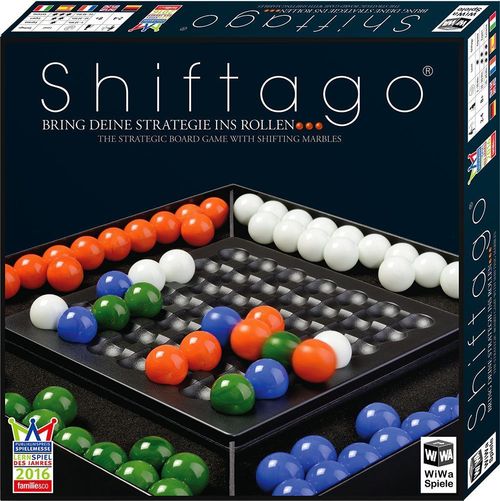
Shiftago
Shiftago Rulebook
Table of Contents
Table of Contents
Contents
- 1 game board (7x7 squares)
- 22 OPAL orange marbles
- 22 OPAL green marbles
- 22 OPAL blue marbles
- 22 OPAL white marbles
- 4 red score markers
- 4 double sided score cards
- 1 instruction leaflet in 5 languages
Idea of the Game
The idea is to arrange your marbles into vertical, horizontal or diagonal lines as quickly as you can. To win the game, you must create one or more lines of marbles, the length of which depends on which game variation you choose to play and the number of players.
Setting Up the Game
Place the open box with the game board inside it on the table between the players. Each player has 22 marbles of one colour. These are kept in their compartment in the game board. Each player also takes one of the four score cards and a score marker. Use any method to decide who starts.
Basic Game Mechanism
- Insert a marble onto the game board. Marbles are always inserted from the edge of any side and in any direction on the game board.
- If there is already a marble at the edge of the board where you wish to play, this marble and any adjacent ones are pushed one field on when you insert your marble.
- You may not insert a marble onto a line on the board that is already full; marbles must never be pushed out of the game area!
The touch decides: As soon as the marble in play touches either the board or another marble, the move must be completed (provided it complies with the rules).
When inserting a marble, ensure that it touches the adjacent marble exactly in the middle!
Game Variations
The game can be played in one of three variations:
- Shiftago Express: Simple and yet intricate
- Shiftago Expert: Tricky and sophisticated
- Shiftago Extreme: Complex and challenging
Players must agree on a variant before starting to play.
Tip: to familiarise yourself with the mechanism of the game, it is a good idea to begin with a few games of Shiftago Express.
Shiftago Express
Duration: 1-15 minutes
Aim of the game
- 2 players: The first player to form a line of five or more marbles wins.
- 3-4 players: The first player to form a line of four or more marbles wins.
How to play
The player whose turn it is takes one of his marbles from its compartment in the board and slides it into a track on the board. His move is then over and play progresses in a clockwise direction to the next player.
End of the game
The player whose turn it is wins as soon as he has created a sufficiently long horizontal, vertical or diagonal line of marbles of his colour after inserting his marble. Lines of marbles of other colours do not count!
If the players run out of marbles or if the board is completely full, the game ends in a draw.
Express tournament
The first player to win ten games is the winner of the tournament. Use your marker to keep count of how many games you have won on your score card. The player to the left of the winner commences the next game.
Examples
Example 1: Blue wins after playing his turn, even though White now has a longer line of marbles.
Example 2: Orange pushes Green to create a line of four marbles (Fig. 1). Now it is Blue's turn, and he could, if he wanted to, destroy the line of green marbles (Fig. 2 A), however, he overlooks this and plays a different move (Fig. 2 B). Now Green can play any move to win the game, as long as it doesn't destroy his line of four marbles (Fig. 3).
Shiftago Expert
Duration: 10-30 minutes
Aim of the game
To create lines of marbles of sufficient length to be awarded a score. The first player to reach ten or more points wins.
Scoring
2 players: Lines of five or more marbles are awarded a score as follows.
| Line length | Score |
|---|---|
| 5 marbles | 2 |
| 6 marbles | 5 |
| 7 marbles | 10 |
3-4 players: Lines of four or more marbles are awarded a score as follows.
| Line length | Score |
|---|---|
| 4 marbles | 2 |
| 5 marbles | 5 |
| 6 marbles | 8 |
| 7 marbles | 10 |
Only marbles belonging to the player whose turn it is are eligible for scoring. Marble lines may be laid horizontally, vertically or diagonally.
The score is always awarded after inserting the marble.
A line of marbles is always assessed for scoring in its full length! For example, a line of six marbles may not be rated for scoring purposes as a line of five or four marbles.
Only one line of marbles receives a score, even if the line is intersected or touched by another line.
If, after inserting his marble, a player touches a line of marbles that is eligible for scoring, then he must take its score too.
Players are not permitted to give each other hints regarding the progress of the game. There is one exception to this rule: should a player forget to score his move after inserting a marble, the other players must draw his attention to this fact.
How to play
The player whose turn it is takes one of his marbles from the compartment in the board and inserts it onto a track on the board. He then has two options:
-
The player has one or more lines of marbles on the board that can be assessed for scoring (see 'Scoring'). In this case, he must evaluate a score. If he has several lines, he may choose which one to use for scoring purposes.
The player then removes marbles from the line that received the score, as follows:
- 2 players: Remove all except the two end marbles.
- 3-4 players: Remove all except one of the two end marbles. The player may choose which of the two end marbles to leave on the board.
After removing the marbles, he returns them to their compartment and receives the appropriate score (see 'Scoring'). He then moves his marker the appropriate number of spaces on his score card.
The same player now takes another turn.
-
The player has no line of marbles on the board that can be assessed for scoring. His turn is now over and play moves on to the next player in a clockwise direction.
End of the game
The player whose turn it is wins as soon as he obtains ten points.
When the player whose turn it is has no more marbles, or the board is completely full of marbles, the player with the most points wins.
If two or more players have the same score, the game ends in a draw.
Example
Orange creates a line of five marbles (Figs. 1 and 2), scores the corresponding number of points (Fig. 3) and then plays again (Fig. 4).
Shiftago Extreme
Duration: 15-45 minutes
Shiftago Extreme is an extension of the Shiftago Expert variation, and the aim of the game, how to play the game and how the game ends are all the same, with the following exception:
Scores are also awarded to lines of four marbles (2 players) or three marbles (3-4 players); however, the score obtained in this case is 0 (see below). Even after receiving a score of 0 points, it is the same player's turn again, just as when awarding scores for lines of any other length.
Scoring
2 players: Lines of four or more marbles are awarded a score as follows.
| Line length | Score |
|---|---|
| 4 marbles | 0 |
| 5 marbles | 2 |
| 6 marbles | 5 |
| 7 marbles | 10 |
3-4 players: Lines of three or more marbles are awarded a score as follows.
| Line length | Score |
|---|---|
| 3 marbles | 0 |
| 4 marbles | 2 |
| 5 marbles | 5 |
| 6 marbles | 8 |
| 7 marbles | 10 |
Example
Blue inserts a marble and in doing so creates a line of three for Orange (Fig. 1), forcing Orange to take a 0 score for this line of marbles. However, in his subsequent turns, Orange is able to skilfully turn things around and create a line of 5 to score 5 points (Figs. 2 to 7).
Optional: Balancing Ability Levels (all variations)
A stronger player must sit out between one and six turns (as agreed beforehand).
To count out the missed rounds he places the appropriate number of marbles (1 to 6) to one side before the game starts. For each round he sits out, he returns one marble to the compartment in the board. Once all of the marbles have been returned, he may begin to play normally.
Special Case
As long as there are only marbles of one colour on the board, these may not touch each other. This means that a player playing two or more marbles onto the board one after the other (because all other players are missing a turn) is not allowed to place them on vertically or horizontally adjacent spaces.