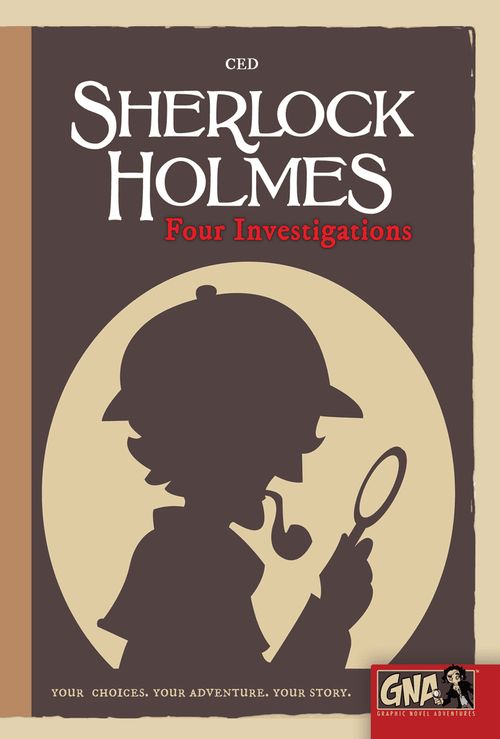
Sherlock Holmes: Four Investigations
Sherlock Holmes: Four Investigations Rulebook
Table of Contents
Table of Contents
Overview
You play as either Dr. John Watson or Sherlock Holmes himself, working through a connected sequence of cases that flood into 221B Baker Street. The first investigation is played as Watson and doubles as a tutorial; once it is complete, you are free to attempt the remaining three investigations in any order, and you may choose a different character — Watson or Holmes — for each one.
Playing the book is like playing a "Choose Your Own Adventure" story built from comic panels instead of text paragraphs. Panels are numbered, and the numbered panel bottoms let you flip straight to the next one an instruction sends you to. You never read straight through from cover to cover — you jump from panel to panel in whatever order your choices and investigation lead you.
No dice, character statistics, or skill scores are used anywhere in the book. The only equipment you need beyond the book itself is a pencil, to mark checkboxes during interrogations and to fill in your case-tracking sheet.
Choosing Your Character
After the tutorial case, a rules panel lays out the choice you face before each remaining investigation, reproduced here verbatim:
From now on, you may choose which case you would like to attempt to solve. You have the choice of being Dr. John Watson or Sherlock Holmes.
Doctor Watson can: ask four questions during an interrogation, can ask Holmes for hints, and may examine a victim's body. Actions specific to Watson can be identified by their beige frame (like this one).
Sherlock Holmes can: only ask three questions during an interrogation. He can use his powers of deduction, which will help you ask useful questions. Actions specific to Holmes can be identified by their blue frame (like this one).
The investigations are otherwise the same. If you choose Holmes, your job will be more difficult. You may choose a different character for each investigation.
Watson is the easier role: he gets an extra interrogation question, can ask Holmes for a hint when he's stuck, and can examine victims' bodies for clues that Holmes cannot access directly. Holmes gets one fewer question per interrogation but can use deduction to help him ask more useful ones. Panels belonging to a Watson-only or Holmes-only path are printed inside a colored frame — beige for Watson, blue for Holmes — so you always know which choices are open to your chosen character.
Interrogating Suspects
Whenever your investigation brings you face to face with a suspect or witness, the panel presents a bank of possible questions, each pointing to a different panel number, along with a reminder of the rule. One such panel reads:
If you are Watson, you may ask four questions, but only three if you are Holmes. For each question asked, mark the corresponding checkbox (with a pencil). Be careful, as certain questions could offend your witness, and cause him to refuse to answer further questions.
When you're finished, go to [panel number].
Read through the available questions and pick which ones to ask, in any order, up to your character's limit (four for Watson, three for Holmes). Mark off each checkbox as you use it so you don't lose track of how many questions you have left. Some questions are safe; others risk upsetting the person you're questioning. If you upset a witness, the panel you're sent to will tell you so and cut the interrogation short — for example:
"Quite badly, as a matter of fact... but that question seems awfully personal." You seem to have upset [the witness]. Return to [panel number], but you may not ask her any more questions.
When that happens, you must stop interrogating that suspect immediately, even if you have questions left to ask, and move on with whatever answers you already collected.
Hidden Clues and Typewriter Keys
Beyond the panels' explicit questions and choices, the artwork itself hides extra information. Some panels conceal a number worked into the illustration — spotting it can matter later, even in a panel you have already visited. Scattered throughout the book are also a number of hidden typewriter keys tucked into the art; finding them is optional and does not affect whether you solve the four main cases, but a panel near the end of the book asks how many keys you found in total, and a handful of additional keys can be earned by solving extra puzzles Moriarty leaves along the way. Keep track of every key you find on your case-tracking sheet as you go.
The Case-Tracking Sheet
Bound into the book is an "Investigation Sheet" with a row for each of the four cases and a blank box beside each one for you to write down that case's solution once you believe you have cracked it:
| Case | Question the case asks |
|---|---|
| "The Cat of Baker Street" | Where did Mrs. Hudson's cat go missing to? |
| "The Lifeline" | Who killed Madame Yvette? |
| "The Amnesiac of Highgate Woods" | Who is responsible for what happened to John Doe? |
| "The Scarab of the British Museum" | Who stole the scarab? |
At the bottom of the sheet is a line for the number of typewriter keys you have found. Fill in a numeric solution for each case as you solve it, and keep a running tally of your typewriter keys, so that everything is in one place when you're ready to check your final answers.
Solving the Cases
Each case's solution is a number rather than a name, worked out from the clues, contradictions, and deductions you gather during that investigation. Once you have written down a solution number for all four cases, you add the four numbers together into a single final sum and check that sum against the answer given at the back of the book. The check only tells you whether your combined total is correct — it does not tell you which of the four individual cases (if any) you got wrong, so a single wrong digit will not spoil the solution to the others. If your total doesn't match, you are free to go back through any case, reconsider the clues, and revise your answer before checking again.
The Four Investigations
Once the tutorial case is behind you, an index panel lists the remaining three investigations along with the panel number where each one begins, depending on whether you're playing as Holmes or as Watson:
| Investigation | As Holmes, begin at panel | As Watson, begin at panel |
|---|---|---|
| "The Lifeline" | 43 | 127 |
| "The Amnesiac of Highgate Woods" | 124 | 142 |
| "The Scarab of the British Museum" | 102 | 14 |
("The Cat of Baker Street" is the tutorial investigation and is always played first, as Watson, from the very start of the book.)
Turn to whichever panel matches the investigation and character you want to play, and begin following the numbered panels from there.
Achievements and Replaying
Once you have completed and correctly solved all four investigations, the book rewards a thorough search of its pages: your total count of hidden typewriter keys, plus any extra ones earned by solving Moriarty's side puzzles, contributes to how completely you've explored the story. Because the final check only confirms your combined total rather than exposing individual solutions, you can safely play through the book again — with a different mix of Holmes and Watson, or hunting for typewriter keys and hidden numbers you missed the first time — without the earlier playthrough having already given away every answer.