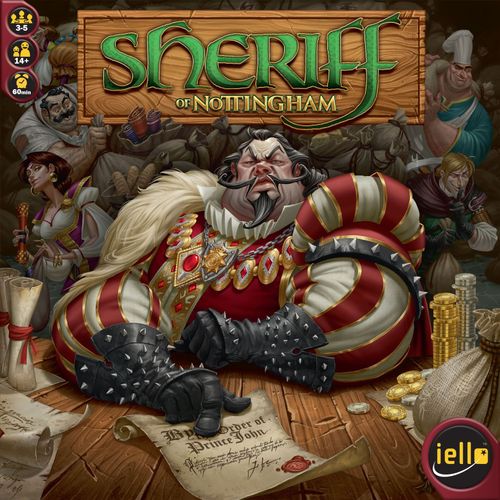
Sheriff of Nottingham
Sheriff of Nottingham Rulebook
Table of Contents
Table of Contents
Game Components
Sheriff of Nottingham includes:
- 216 Goods cards, including:
- 144 Legal Goods (green)
- 60 Contraband (red)
- 12 Royal Goods (red with a gold banner and Sheriff's badge on the bottom)
- 110 Gold coins, in four denominations:
- 39 1-gold coins
- 42 5-gold coins
- 17 20-gold coins
- 12 50-gold coins
- 1 Sheriff marker
- 5 Merchant Stands
- 5 Merchant Bags
- Rulebook
The Goods Cards
Each card shows a product that a merchant can sell in the Nottingham market.
The top right corner shows the "Value" of the Goods. This is the number of points it will be worth at the end of the game if it's in your Merchant Stand.
The bottom right corner shows the Good's "Penalty." This is the amount of Gold you must pay if you are required to pay a Penalty during the Inspections Phase (see Phase 4: Inspection).
There are 144 Legal Goods in the game:
- 48 Apples worth 2 Gold each
- 36 Cheese worth 3 Gold each
- 36 Bread worth 3 Gold each
- 24 Chickens worth 4 Gold each
There are also 60 Contraband in the game:
- 22 Pepper worth 6 Gold each
- 21 Mead worth 7 Gold each
- 12 Silk worth 8 Gold each
- 5 Crossbows worth 9 Gold each
In addition, there are twelve Contraband Goods called "Royal Goods", marked with a gold banner and a Sheriff Badge on the bottom. These are used only if you are playing with the optional "Royal Goods" rules (see Optional Rules).
Note: The 36 Bread cards are marked with a "4+" icon — use them only when playing with 4 or more players.
Setting Up the Game
Each player takes a Merchant Stand along with the matching Merchant Bag, and places those items in front of them.
Choose one player to act as the "banker." The banker gives each player (including himself) 50 Gold. The banker keeps the rest of the Gold close at hand so he can make change during the game. The banker must not mix his own money with the bank's funds!
Starting coin amounts per player: one 20-gold coin, five 5-gold coins, and five 1-gold coins.
For your first couple of games, you may wish to play the basic game. The basic game is played without the Royal Goods cards. Remove the twelve Royal Goods cards from the deck and return them to the box (to use these cards, see "Royal Goods" under Optional Rules). Then, shuffle the rest of the Goods cards together, and deal six cards to each player face down.
Place the rest of the cards in a face down draw pile.
Turn over five cards from the draw pile to form a discard pile.
Turn over another five cards from the draw pile to form a second discard pile.
Yes, there are two discard piles! All players can examine the cards in both discard piles at any time.
Finally, the player with the highest value of actual cash on their person will be the first Sheriff. Give that player the Sheriff marker. If there is a tie (or if no one has any money!), then randomly choose the Sheriff.
3 Player Games
If you are playing a three-player game, you must make two changes:
Before shuffling the cards, remove all cards that have the "4+" icon (return them to the box). This includes: all 36 Bread cards, four Pepper, five Mead, and three Silk. If playing with the Royal Goods, one Bleu Cheese, one Golden Apples, one Pumpernickel Bread, one Royal Rooster, and two Rye Bread should also be removed prior to shuffling.
Continue playing until all players have been the Sheriff three times.
The Play of the Game
The game is played over a series of rounds. During each round, one player will act as the Sheriff while the other players act as merchants.
Each round is divided into five phases, which must be played in order:
- Market
- Load Merchant Bag
- Declaration
- Inspection
- End of Round
Note that the player who is acting as the Sheriff only participates in Phase 4, Inspection, and Phase 5, End of Round. He would do well to observe the actions of the other players during the other phases.
At the end of each round, players will pass the Sheriff Marker to the left allowing a new player to become Sheriff. The game continues until each player has been the Sheriff twice (three times in a three-player game).
Phase 1: Market
In this phase, you may discard unwanted cards and draw new ones, hoping to get a set of Goods to take to market.
Starting with the player to the Sheriff's left and going clockwise, each merchant player takes one turn. On your turn, you may set aside up to five cards from your hand (face down), then draw cards until you again have six cards in your hand.
Note: The Sheriff player does not play during this phase, and cannot exchange cards. But when you are the Sheriff you should watch the other players carefully for hints about what they might pack into their bags!
When you draw cards, you may take them from the top of either discard pile (or both) or the draw pile, in any combination, one at a time. Yes, this means that if you really want the third card down in a discard pile, you have to draw the two on top of it first!
Note: Any player can examine the cards in the discard piles at any time, and you must allow the other players to see each card you take from the discards as you draw them.
You must always draw any cards you want to take from the discard piles before drawing any cards from the draw pile. You cannot take some cards from the draw pile, and then decide to take cards from the discard piles.
After you have drawn back up to a total of six cards in your hand, place the cards you set aside at the beginning of this phase on either one of the discard piles, face up, in any order you choose (you must discard all the cards into a single pile).
Remember: In this phase, you always draw exactly as many cards as you discarded, so you will always end up with six cards in your hand.
Playing hint: Drawing cards from the discard pile is a good way to get the cards you want, but it also shows the Sheriff what you take! Of course, this may also be a way to trick him… Note that if one of the discard piles is completely emptied, then it remains that way until a player decides to discard into it.
Phase 2: Load Merchant Bag
In this phase, you place the Goods cards that you want to take to market in your Merchant Bag.
All merchant players place Goods in their bags at the same time. You can place from one to five Goods in your Merchant Bag. You cannot place zero Goods or more than five Goods in your bag.
Be careful that you don't let the Sheriff or the other merchants see which cards you put in your bag.
When you are satisfied with the Goods in your bag, snap it closed and place it on the table in front of you. Once you close your bag, you cannot change your mind later!
Phase 3: Declaration
In this phase, you must declare to the Sheriff what Goods you are delivering to the market. Of course, you can feel free to lie to him. In fact, you will probably have to lie at some point during the game!
Starting with the player to the Sheriff's left and going clockwise, each merchant player looks the Sheriff in the eyes and tells him what Goods he is taking to market. When you make your declaration, you must hand your Merchant Bag to the Sheriff.
Important: The Sheriff cannot look in the Merchant Bags at this time!
You must declare exactly the number of Goods in your Merchant Bag and announce only one kind of Legal Goods (which may or may not even be in your bag!). Other than that, you can make any declaration you wish.
Remember:
- You can only declare Legal Goods, never Contraband.
- You can only declare one kind of Goods, even if your bag has a mix of Goods.
- You must declare only the exact number of cards in your Merchant Bag.
Phase 4: Inspection
Now the Sheriff can choose to inspect the Merchant Bags!
When you are the Sheriff, you get to decide which Merchant Bags you will inspect. You can inspect any number of Merchant Bags during this phase — you can even decide not to inspect any bags — and what order to perform the inspections. If you inspect a bag and discover that its owner lied about its contents, you will collect a fine. But be careful! An honest merchant can charge you a penalty if they were telling the truth.
As the Sheriff, you may choose to threaten the owners of the bags with an inspection, hoping to get a hint of what's inside or to solicit a bribe. The merchants can also offer you bribes to avoid inspection, or even to convince you to inspect another merchant's bag! All players can participate in all negotiations for this entire phase, but the Sheriff has the final say when the negotiating is over.
A bribe can be just about anything you can think of, in any combination. Here are some of the things that you can offer as part of a bribe:
- Gold
- Legal Goods from your Merchant Stand
- Contraband from your Merchant Stand
- Goods in your bag
- Promises of future favors
Note that all players can get involved in the negotiations with the Sheriff at the same time. For example, merchants may offer the Sheriff a bribe to ignore other merchant's bribes, or to inspect a bag regardless.
Important: You cannot offer any of the cards in your hand as part of a bribe!
When the Sheriff has made his decision about a Merchant Bag, he has two choices:
- Accept whatever final bribe was offered (if any) and hand the bag back to its owner; or
- Reject any bribe that may have been offered and unsnap the Merchant Bag, revealing the cards inside.
Note: Only the Sheriff can touch the Merchant Bags until he inspects them or returns them to their owners.
As soon as the Sheriff hands back a bag or opens it, all negotiations over that bag are over. Once the Sheriff has made a choice, it's too late to change their mind! If the Sheriff gives the bag back, the final bribe promised (if any) must be paid, if possible. If the Sheriff does take a bribe, he cannot inspect the bag. See "Honor Among Thieves" for more details.
If you receive a bribe as the Sheriff, add any Goods included as part of the bribe to your Merchant Stand (whether they came from another player's Merchant Stand or their bag). Any Gold paid is added to your supply.
If the Sheriff Lets You Pass
You must now show the cards in your bag to the other players.
All Legal Goods are placed in the matching spaces of your Merchant Stand face up. The Legal Goods of your Merchant Stand can always be inspected by any player at any time.
All Contraband is kept secret! You must reveal the number of Contraband cards you have smuggled into Nottingham, but not their type. Keep your Contraband face down at the top of your Merchant Stand.
If the Sheriff Inspects Your Bag
There are two possible outcomes:
If you were telling the truth, and your bag has exactly what you declared, the Sheriff must pay you Gold equal to the Penalty on every Legal Good in your bag. Your Legal Goods are then added to your Merchant Stand, as above.
If you were lying, and your bag does not have exactly what you declared, three things happen:
- Any Goods that you did declare truthfully are allowed into the market. Place them on your Merchant Stand face up, as normal.
- Any Goods that you did not truthfully declare are confiscated — whether they are Legal Goods or Contraband! The Sheriff takes all of those Goods and places them on one of the discard piles, in any order he chooses.
- You must pay a fine to the Sheriff for all confiscated Goods. The fine is equal to the Penalty shown at the bottom of each card.
Playing hint: When offering bribes to the Sheriff, keep in mind that you will have to pay him a Penalty for any confiscated Goods anyway. Sometimes it's worth offering him a little bit more to avoid having your Goods confiscated.
Honor Among Thieves
Normally, all deals you make must be honored! However, there are a couple of exceptions:
- Promises of future favors, which take place after the current round of play, are not binding!
- A merchant might offer the sheriff a bribe which includes Goods from his bag or stand. Of course, he might be lying about what Goods he actually has! If he is allowed to pass, when he reveals the Goods in his bag he only has to pay the Sheriff the Goods he promised if they actually exist. If you promised Goods to the sheriff which are not in your bag or Merchant Stand, you do not have to pay those Goods (though you must prove that you don't have the Goods promised by showing your cards to the Sheriff).
- A "deal" is complete when an offer is made by either a Merchant or the Sheriff and the other player accepts it. Until then, it's still under negotiation. Usually, it is obvious when a deal has been accepted. But if there is ever any confusion, just use the word "deal" to show that you agree to the terms.
Phase 5: End of Round
If all players have been Sheriff twice (or three times in a three-player game), the game ends immediately!
Otherwise, the player who was the Sheriff passes the Sheriff marker to the player on his left. That player will be the Sheriff during the next round.
All players now draw cards from the draw pile until they again have six cards in hand. Note that the Sheriff should already have six cards in hand from the last round.
The next round begins with Phase 1, the Market Phase.
Running Out of Gold
It is possible that you will run out of Gold coins during the game. You cannot offer Gold for bribes if you do not have the coins to pay.
If you cannot pay a Penalty you owe, you must give the player Legal Goods from your Merchant Stand with a value (the number in the coin) at least equal to the amount you owe. This may mean that you give more value than you owe, but you don't receive change for the excess. If you do not have enough Legal Goods, you must reveal and hand over Contraband to make up the difference. The player who received the Goods must then add them to their Market Stand.
If you have exhausted all the Goods and contraband in your Market Stand to pay a debt, any leftover debt is considered paid. This helps a desperately poor player!
Reshuffling Cards
In the event that you run out of cards during the game, you will need to shuffle all but the top five cards from each of the two discard piles to recreate the draw pile.
Note that if one of the discard piles is completely emptied, then it remains that way until a player decides to discard into it.
Winning the Game
The game ends after all players have had two chances (three chances in a three-player game) to play as the Sheriff. At the end of the last round, all players discard any cards they have in hand — those cards are not worth any points!
Then, reveal your Contraband cards and count up your score. You earn points equal to:
- The value of all Goods you have in your Merchant Stand (Legal and Contraband);
- Any Gold coins you have; plus
- Any bonuses you have earned for being the "King" or "Queen" of a type of Good.
The player with the most points wins.
If two players tie for the same amount of points, the player with the most Legal Goods wins. If there is still a tie, then the player with the most Contraband Goods wins.
Playing hint: You can use the extra coins from the bank to help add up your score. Simply take coins equal to the value of the Goods in your Market Stand and for any "King" or "Queen" bonuses you earned. Then just count up your coins!
So, You Want to Be the Chicken King?
The player who has successfully delivered the most and the second most of each type of Legal Good is declared the "King" and "Queen", respectively, of that Good. They receive bonus points as follows:
| Type of Good | King's Bonus | Queen's Bonus |
|---|---|---|
| Apples | 20 | 10 |
| Cheese | 15 | 10 |
| Bread | 15 | 10 |
| Chickens | 10 | 5 |
If there is a tie for the King's Bonus, add the King and Queen bonuses together, and divide the total equally between all the tied players (rounding down). Do not pay out bonuses for second place.
If there is a tie for the Queen's Bonus, divide those points equally between the tied players (round down).
Optional Rules
Royal Goods
Royal Goods are the finest quality Goods in the kingdom. Prince John has declared that these Goods can only be used by himself and his most loyal cronies. So, all Goods marked with a gold banner and a Sheriff's badge are considered Contraband!
When you are first learning the game, it is recommended that you remove the Royal Goods. When you're ready, add the twelve Royal Goods cards to the deck before you shuffle. Note that six of the Royal Goods cards are marked with a "4+" icon and must be removed during a three-player game.
During the game, Royal Goods are treated just like any other Contraband. This means that they count as one card when you are making your declaration. If your bag is inspected, they are always confiscated and you must pay the indicated fine. If you manage to smuggle them into the market, they are placed face down by your Merchant Stand with your other Contraband.
At the end of the game, any Royal Goods you have in your Merchant Stand are added to your other Legal Goods before you determine who wins the King and Queen bonus for each type of Good. Each Royal Good counts as 2 or 3 of the matching type of Good, as listed on the Royal Good card.
Inspection Time Limit
Sheriff of Nottingham is even more fun when you put a time limit on the Inspection Phase! The Sheriff only gets 1 minute for each merchant in the game. So, in a four-player game, the Sheriff only gets 3 minutes to decide if he is going to inspect any of the Merchant Bags. If you run out of time, any merchants you have not inspected must be allowed to pass without bribing you.
Removing Cards Before the Game
Have annoying card counters in your group? Frustrate them with this optional rule! At the beginning of the game, after shuffling the cards, randomly remove 10 cards from the deck and return them to the box without revealing them. This way, no one will know which cards were removed!
Seven Card Hand
Increase each player's hand size from six cards to seven. This gives the merchants more control and makes it a little more challenging for the Sheriff.
Promo Cards
Promotional cards for Sheriff of Nottingham can be identified by the blue banner at the bottom of the card. These cards may be added to the deck without needing to remove other cards.
Card Quantities
| Goods | 3 Player | 4-5 Player | Gold Value | Penalty |
|---|---|---|---|---|
| Legal Goods | ||||
| Apples | 48 | 48 | 2 | 2 |
| Cheese | 36 | 36 | 3 | 2 |
| Bread | 0 | 36 | 3 | 2 |
| Chicken | 24 | 24 | 4 | 2 |