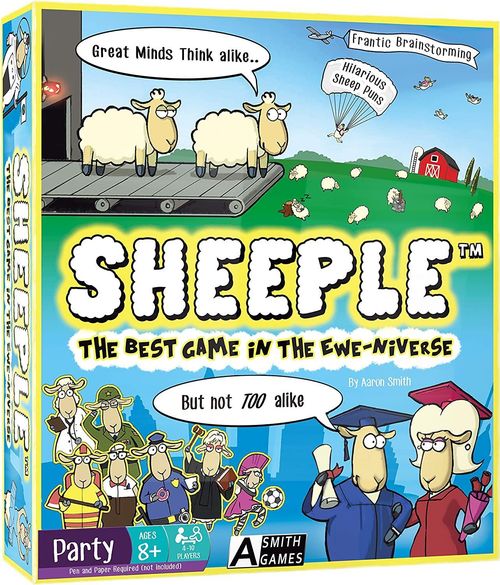
SHEEPLE: The Best Game in the Ewe-niverse
SHEEPLE: The Best Game in the Ewe-niverse Rulebook
Table of Contents
Table of Contents
Premise
A group of sheep from Mary's flock have decided that they are no longer content being sheep. They want to become more civilized, to become more like people — to become SHEEPLE™. To do so, they must walk like people walk, dress like people dress, and most importantly, think like people think.
Objective
Help your sheep think like people think and graduate from the Ewe-niversity first, evolving from a sheep to a SHEEPLE™. The first sheep to reach the Ewe-niversity space wins.
Icons printed beside the Objective: 4–10 players, ages 8–99, 30 minutes.
Components
- 1 Game Board
- 10 Stand-up Characters
- 108 Category Cards
- 42 Pun Cards
- 1 Rulebook
- 1 Sand Timer
Set Up
- Pop the SHEEPLE™ characters from the cardboard, and attach to the stands.
- Each player (sheep) takes a pad of paper, a pencil, and a SHEEPLE™ character marker.
- Each sheep puts their SHEEPLE™ character on the starting space, the E-lamb-entary School.
- The youngest sheep goes first.
Board art captions: "Start at the E-lamb-entary" and "End at the ewe-niversity".
How to Play
- On your turn, you are the "Shepherd".
- Draw a category card.
- Choose one of the three categories, and read it aloud.
- After reading the card aloud, start the 1 minute sand timer, and sing "SHEEPLE".
- Each sheep has 1 minute to make a list of items that match the category. An item may include: a. An object b. A person c. A place d. An idea e. An action f. A descriptive word (i.e. adjective or adverb) g. A phrase (a combination of words that forms an idea or saying) h. A word
Hint: Try to think like other sheeple think, and put down Items that are common - yet a little ewe-nique.
- Scribble down as many items as you can.
- Items may be more than one word.
- Use abbreviations to save time!
- When the time is up, you may finish writing the item you are currently writing.
- Then, sheep compare items and determine how many points they scored.
Category card example (printed beside How to Play): the category card shows three example categories: "Islands", "Heavy things", and "Car makes, models, and companies".
Scoring
- No cheating - any items that were stated outloud, prior to the scoring phase, or are used as examples on a category card, are crossed off of everyone's list.
- The sheep whose turn it is reads his list of Items first.
- For each item that is read, all other sheep with a matching item raise their hand (hoof) and score as follows: a. If exactly 2 players match, it is worth 2 points to each player. b. If 3 or more players match, it is worth 1 point to each player. c. If your item does not match, it is worth 0 points. d. Thus, you earn the most points with items that are ewe-nique, but not too ewe-nique.
- If your item scored points, write the number of points next to it. Otherwise, cross it out.
- Each remaining sheep, in clock-wise order, reads off his unmatched Items. (Don't skip the last player.)
Example:
| Alice's list | Bob's list | Chris's list |
|---|---|---|
| 2 camel | 2 camel | |
| 1 dog | 1 dog | |
| 1 dog | 2 cobra | |
| 2 cobra |
Matching
- MATCHING relies on two items having the same MEANING - word sharing is irrelevant. a. "Hacker" and "computer hacker" are the same. b. "Computer" and "computer hacker" are different.
- Plurality and verb tense do not matter. a. "Banana" and "bananas" are the same. b. "Ski" and "skiing" are the same.
- Acronyms and abbreviations count as if the entire word was written. a. "OR" and "Oregon" are the same. b. "apt." and "apartment" are the same.
- Two items are not the same if one is more specific than the other. a. "Chocolate cake" is not the same as "cake", because "chocolate cake" is more specific than "cake". b. Therefore, you might want to list the more general item ("cake") or even list them both! c. Here's a form of shorthand that may come in handy for that: i. "(Chocolate) cake" is the same as writing "Cake" and "Chocolate cake" down. ii. However, writing down sequences of things like movie sequels or planets, individual names must be used. i.e. "Star Wars 1-9" is not legal, but "A New Hope", "Empire Strikes Back", etc. is.
- If it is still unclear whether Items are the same, it shall be decided by a vote. If a vote is tied, the shepherd decides the outcome.
- No double-dipping. Once matched and scored, an item cannot be re-matched with a different item and scored again.
- If multiple Items are written on a sheep's list that the group considers to be the same item, the redundant ones are crossed off the list. Then, matches with other sheep are reconsidered.
Moving
- After each round, each sheep, starting with the Shepherd, totals his points and moves his SHEEPLE™ piece that many spaces on the board.
- When you land on a space with a description, read the description aloud. Go forward or backward that many spaces.
- When you land on a SHEEPLE™ face, draw a SHEEPLE™ face card. Read the description aloud. Go forward or backward that many spaces. a. If that causes you to land on a space with a description or a SHEEPLE™ face, read the description aloud, and go forward or backward that many spaces, etc.
Board art captions: "Event space" (sample card reads "Learn how to count sheep" / "Forward 4") and "SHEEPLE™ space" (sample card is the SHEEPLE™ face card).
Winning
The game ends at the end of a turn in which any SHEEPLE™ passes the Ewe-niversity space.
The extra points are used to advance the SHEEPLE™ marker along the victory track.
If two sheep reach the Ewe-niversity on the same turn, the sheep who advanced the farthest the victory track is the winner! In the case of a tie, the winners bask in their shared victory.
Children (Lambs)
When playing with lambs:
- Only "lamb-friendly" categories with a blue dot (as opposed to a red dot) should be chosen.
- If playing with lambs who are... a. 6 and under: may team up with an adult (sheep), and whisper answers into their ear; the sheep writes down both his own items and those of the lamb. Any items whispered too loudly and heard by other sheep are crossed off everyone's list. b. 9 and under: lambs may scrawl pictures and symbols in lieu of words if they choose, with the lambs interpreting them during the matching phase.
- If playing with lambs who are... a. 10 and under: all players are limited to 10 items or less. b. 12 and under: all players are limited to 15 items or less. c. Otherwise: unlimited items d. After the time is up, players who went over the limit must choose excess items to eliminate. (This makes it fair to lambs who cannot write as fast.)
These rules give all players a fair shot. Adjust as needed.
Teams (Flocks)
- Sheep and lambs can form 3-10 teams (flocks).
- When a flock reads aloud their items, all of the flock-members' items are pooled together and treated like they were part of a single list. (Duplicates are removed.)
- During scoring, a Bullock is chosen from the flock and acts on its behalf by: a. reading all of the flock's items, b. raising his hoof when one of the flock's items matches one read by another flock, c. voting, d. moving the SHEEPLE™ piece and following the cards.
Optional Pun Rule
- Players may work sheep puns into their items.
- If an item with a pun matches, it scores +1 point.
- The item it matched with is not required to contain a pun.
- Players may only use one kind of each sheep pun per turn. e.g. For the category "Round Things", the item "baaa-l" would score an extra point for the active player if another player put down "ball". Note: the next pun from that player could not contain "baaa"; but "lamb-p" would be alright.