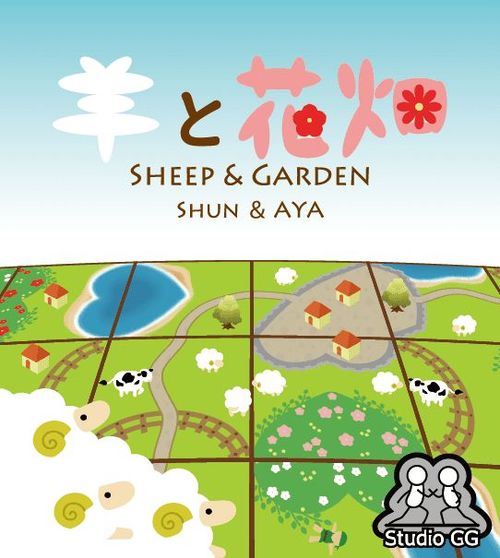
Sheep & Garden
Sheep & Garden Rulebook
Table of Contents
Table of Contents
Description
- Each player starts the game with three objective cards.
- On a turn, you choose one of the three tiles on display and add it to the shared landscape everyone is creating in the centre of play.
- Once all 37 tiles have been placed, players score points based on their objectives, and whoever has the most points wins.
Components
- Rulebook (this) and Summary (Tile & Card List)
- Tiles x 37
- Objective cards x 12
- Marker x 1
- Scoring board x 1
- Felt x 1
Set up (for 2 players)
See the Solo rule for solo play.
Shuffle the tiles, then put 1 on the centre of the table and 3 on the side of the table, face up. The rest are stacked face down as a deck.
Each player receives 3 objective cards, 1 of them face up and the rest face down.
Each player can check their own objective cards at any time.
Set up (for 3-4 players)
Set up tiles as for 2 players.
The objective cards are set in front of each player, and between each two players, face down.
The diagram labels the positions as follows: "For A only", "For B only", "For C only", "For D only", "For A and B", "For B and C", "For C and D", "For A and D".
※Each player can check their own objective cards at any time.
Game flow
Select the first player randomly.
In a turn, the player chooses 1 tile from the 3 tiles on the side and places it connected to tiles already placed on the centre of the table.
Then, replenish tiles so there are 3 tiles on the side, and the left player takes a turn.
When all tiles are placed, the game ends.
Rule of tile placement
Four kinds of areas, and roads and fences, are illustrated on tiles: Lake, City, Garden, Grasses, Road, and Fence.
When a tile is placed, the areas and roads MUST be connected.
- A fence can be placed anywhere on grass.
- A road must be connected.
Objective cards
Objective cards show what is scored in the game. Each card has:
- a card name;
- a description;
- a score per one object;
- a bonus (some objective cards have a bonus).
Example: this card presents 4 points per completed lake, and 1 point per fish in completed lakes.
"Area completion" is explained in the next section.
Area completion
Almost all objective cards refer to the "completed area". A "completed area" denotes the area which is closed as follows: Garden, Lake, City, Grasses, Road.
※Only "Number of Lands" does not require completion.
※Roads and Fences complete Grasses.
A Road is completed when both sides of it connect to Cities.
Objects on area
The following objects are also illustrated on tiles: Sheep, Cow, Human, Tree, House and Fish.
These are counted for scores by some objective cards. For example, "Number of Trees" and "Number of Cows" score Trees and Cows in completed areas.
End of game (scoring)
The game ends when all tiles are placed.
Each player calculates their score based on their objective cards and placed tiles. The player who gets the highest score wins the game.
In the case of 3-4 players, each player sums the scores of the 3 objective cards placed in front of them, and between their neighbours.
An explanation of how to use the scoring board is on the next pages.
How to use the scoring board
When calculating scores, the scoring board is useful. (Write with the marker, and erase with the felt.)
Write the score of each objective card on the inside squares, and write the score of each player on the outside squares.
In the case of the previous example, write as follows. Use this side for 1, 2 and 4 players. Use the opposite side for 3 players.
Written on the board as printed (the circled numbers are the objective-card squares 1 to 8):
- D: ⑧+①+②
- A: ⑧+⑦ +⑥
- C: ②+③ +④
- B: ⑥+⑤+④
Solo rule
Shuffle the tiles, and place 1 tile on the centre of the table.
Place 3 objective cards in front of you, and the other 3 cards on the opposite side, marked as the enemy's objectives. In the solo play, draw a tile from the deck and place it immediately.
At the end of the game, you get the following praise based on the total of your objectives minus the total of your enemy's objectives.
| Result | Points | Result | Points |
|---|---|---|---|
| Beginner | 20 | Awesome | 50 |
| Good | 30 | Extraordinary | 60 |
| Excellent | 40 | Unbelievable | 70 |
Details of objective cards
Number of Hearts
You get scores for each completed heart-shaped area.
A heart-shaped area can be made on Gardens, Cities and Lakes as shown in the diagram. The diagram marks one arrangement as not counted for the heart-shaped area.
Number of Lands
Lands are the areas composed of areas except Lakes (i.e., Cities, Gardens and Grasses).
Lands are completed only by Lakes. (Edges not connected to a tile are regarded as a Lake.)
Count as shown in the example, where the numbered lands are counted separately.
Number of Cows
Count the total number of Cows on the completed areas. You can catch any number of Cows on one area. Same for "Number of Trees".
Example: "Number of Cows" is 3.
Number of Areas with Sheep
Count the number of completed areas that contain Sheep. Regardless of the number of Sheep, count the number of areas.
Example: although there are 3 Sheep, "Number of Areas with Sheep" is 1.
Number of Empty Areas
An empty area means a Grasses area that contains no objects.
Number of Settlements
A settlement means a completed area that contains 3 or more Houses. Houses are on Grasses and Cities. Do not count an area with 2 or fewer Houses.
Bonus of objective cards
There are 2 kinds of bonuses: one gives points per specified area or object; one gives fixed points if you achieve the objective.
- Example, per-object bonus: if there are 5 fish in completed Lakes, you get 5 points.
- Example, fixed bonus: you get 3 points if there are 7 or more Sheep on a completed area.
Other rules
If all 3 tiles cannot be placed, shuffle their tiles, reveal new tiles and choose from them.