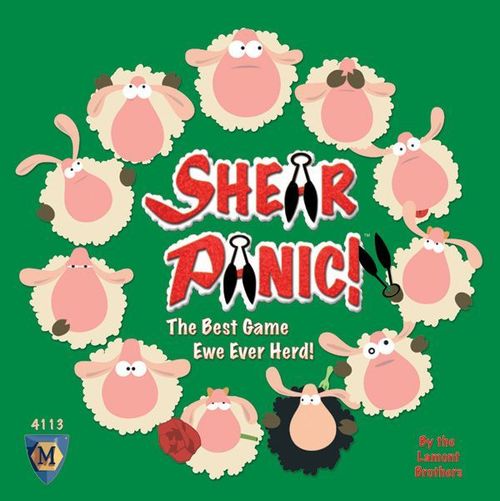
Shear Panic
Shear Panic Rulebook
Table of Contents
Table of Contents
Contents
- 9 sheep on their square bases (8 white sheep — 2 blue, 2 green, 2 red and 2 yellow — plus 1 black sheep)
- 1 Roger the Ram
- 1 Shearer
- 4 command menus (1 per player)
- 1 time track (2 double-sided sheets, for 3 or 4 players)
- 1 flock panic die (white, with 6 colours)
- 1 return-to-flock die
- 1 time counter (white token)
- 48 tokens (12 in each of the 4 colours)
- 4 markers (1 in each of the 4 colours)
- The rules (if these are not included, stop reading immediately!)
Setup
"Let's just play, we'll work out the rules as we go..."
Set up the flock as shown in the diagrams. Place the time track corresponding to the number of players on one side of the table. The track for 3 players has 56 spaces, the track for 4 players has 74 spaces.
The player who starts is the person who most recently had a haircut (the most recently "shorn" one!). They choose a command menu, 12 tokens, and a marker of the same colour. The player to their left does likewise, and so on until everyone has chosen a colour for the game.
Each player places their marker at the start of the time track (in the sheep truck). The time counter is also placed on the space marked 0 in the pen. You are now ready to begin.
In a 3-player game, one colour of sheep remains neutral. It does not score points for anyone.
Start of the Game
The sheep begin the game by jumping down from the truck into the field. Starting with the first player and continuing clockwise, each player rolls the panic die and carries out a Lamb Push with a sheep of the colour rolled (see "The Command Menu" below for a description of this action). If the flock ends up disconnected, it must be regrouped before the next player's turn (see "Regrouping the Flock" below). The player has a free choice between the two sheep of the colour drawn, except if it is black (there is only one black sheep, sorry) or if white is drawn (in which case the flock does an Ewe Turn). The player's turn ends by moving their marker from the truck to the space marked 0.
Example — Red goes first and draws blue on the panic die. Red applies a Lamb Push to the blue sheep. The player then moves their marker to the space marked 0 to show they have played.
Yellow is the next player and also draws blue. They choose to push the top sheep diagonally up-left. Yellow then moves their marker. This continues until all players have had their turn. At this point, all players' markers must be in the green field.
The flock is thus completely shuffled before the game itself begins! Note that no points have yet been scored while jumping down from the truck. The sheep are about to enter the teammates' field. The game can begin!
Tip for your first game: when carrying out your Lamb Push, remember that the aim of the first field (the teammates' field) is to bring your sheep together. So try to move them closer together.
In the Fields
The sheep are now ready to enter the first field. Throughout the game, the field the sheep are in is determined by the position of the time counter on the track.
Starting with the first player and continuing clockwise, each player on their turn carries out steps A to E (each step is explained in detail later in the rules):
- A) Choose an action from the command menu. The player covers the chosen action with a token of their colour. This action can no longer be used for the rest of the game. The flock is changed according to the chosen action (see "A — The Command Menu"). The menus and the actions available to each player must remain visible to everyone and may not be hidden under any circumstances!
- B) If the flock has been split, it is then regrouped (see "B — Regrouping the Flock").
- C) The time counter advances by the number given on the action (see "C — Moving the Time Counter").
- D) The player may score points depending on the position of the counter and the field currently being crossed (see "D — Scoring Points").
- E) If the time counter is on a space marked with the sheep panic symbol, this panic is resolved (note: this happens after the player has scored, and gives no further score this turn — see "E — Panic in the Flock").
You can see pictures of Roger the Ram or the Shearer on the time track. When the counter reaches or passes the picture, Roger the Ram or the Shearer must be placed facing the flock. Roger the Ram and the Shearer are always placed facing the sheep's heads, and must be moved if the flock undergoes an Ewe Turn. Roger the Ram is removed when the counter leaves his field.
If the counter ends on a yellow space, if it passes through a gate, or if it reaches the final pen, there is then a scoring phase (see "D — Scoring Points"). To avoid mistakes, remove Roger the Ram as soon as the counter reaches the pen marking the end of his field.
Example — Yellow chooses a Lamb Push and places a token on it. They push the sheep in the centre row to the left. They advance the time counter by 3 spaces. They will also score 1 point (see "D — Scoring Points") since two yellow sheep are touching diagonally; this is recorded by advancing the yellow marker on the track. Finally, Yellow must carry out a Lamb Push since the time counter is on a panic symbol.
A — The Command Menu
Each action tile on a player's command menu shows: the player's team colour, the action's picture, any restriction symbol, and the number of spaces the counter advances if that action is chosen. A player aid explaining the actions is also provided.
Symbols found on the menu commands have the following meanings:
- Sheep-face symbol: Only applies to one of your own sheep.
- Die symbol: No reverse move allowed unless a die has been rolled.
- Crossed-out circle symbol: No reverse move allowed.
Actions
A note that may be useful, you never know: the word "orthogonal" (i.e. non-diagonal) is used throughout. Simply put, it refers to the way a rook moves in chess.
Lamb Push — a sheep moves one space in any direction (including diagonally), pushing all the sheep that are ahead of it in its direction of movement. All sheep in the line of direction are pushed. However, sheep that are in the chosen direction but behind an empty space are not pushed. For example, if the yellow sheep undergoes a diagonal Lamb Push up and to the right, an isolated blue sheep at the top will have to rejoin the flock (see "B — Regrouping the Flock"). A sheep carrying out a Lamb Push is not required to push others: it simply moves one space to an empty space. This command can only be used with one of your own sheep (unlike this same action when triggered by a panic-die roll from the position of the time counter).
Line Push — the player pushes a row or column by one space — so to the right, left, up, or down. A row or column may contain only a single sheep. If there is an empty space in the row or column being pushed, then the sheep beyond that space do not move. The Line Push is always carried out from outside the flock.
Note — the difference from the Lamb Push is that the push starts from outside the flock. A Lamb Push can start anywhere there is a sheep and can result in a sheep pushing from the centre of the flock outward.
Diagonal Push — the same as a Line Push, except it's diagonal! The player can push any diagonal line of sheep by one space — so from top-left to bottom-right, bottom-left to top-right, top-right to bottom-left, or bottom-right to top-left. A diagonal may contain only a single sheep. Sheep located beyond an empty space in a line are not moved. For example, if the black sheep pushes up and to the left, the two sheep isolated at the top-left and bottom-right will have to rejoin the flock (see "B — Regrouping the Flock").
Alignment — the sheep have met a barrier! The player whose turn it is chooses one side of the flock (front, back, left, or right). They align the flock against the chosen side. All rows or columns are aligned against this virtual barrier. Any resulting empty spaces are filled in.
Lamb Roll — the chosen sheep moves one space in any direction. The destination space must be empty (you cannot push a sheep during a Lamb Roll). The chosen move must not separate this sheep from the flock: it must remain connected to at least one other sheep (though the move may cause another sheep, other than the one moving, to become isolated). This action can only be used with one of your own sheep.
Leapfrog — the chosen sheep jumps from anywhere along a column or row until it reaches the first available empty space (which may be at the end of the row or column, but not necessarily). Diagonal jumps are not allowed. This action can only be carried out with one of your own sheep.
Ewe Turn — all the sheep in the flock turn 90 degrees, either left or right.
Note: if Roger the Ram or the Shearer are present (see "In the Fields" above), they are then moved to the front of the flock according to its new orientation. It is not possible to immediately play an action that would return the flock to its starting position.
Symbols are shown on the menu commands. They mean the following:
- Sheep-face symbol: Only applies to a sheep belonging to you.
- Die symbol: No reverse move is allowed until a panic die or a regrouping die has been rolled. The effect is identical to the crossed-out circle symbol, but you may make a reverse move if the flock underwent a die roll before your turn.
- Crossed-out circle symbol: You cannot use the same action as the previous player to move back. For example, you cannot replay an Ewe Turn to bring the flock back to its starting position. But you can repeat the action to turn the flock another 90 degrees in the same direction, since that does not reverse the previous action.
B — Regrouping the Flock
After an action is applied, the flock may end up split (sometimes to your great benefit!). The flock is split if not all the sheep are connected orthogonally (diagonal contact does not count). When the flock is split, it is regrouped using the following procedure:
- Identify the smallest group of sheep. It may consist of one or several sheep. If there is a choice between several smallest groups of the same size, the active player decides which one to regroup.
- Roll the regrouping die.
- If the side marked + is showing, this group of sheep must be regrouped by an orthogonal move (i.e. not diagonal) until it rejoins the flock. It cannot move diagonally or change direction. There may be several possible routes. The player is free to choose between the different routes, as long as the group of sheep rejoins the flock by an orthogonal move.
- If the side marked X is showing, the smallest group of sheep must rejoin the main body of the flock diagonally. The sheep cannot change direction and must follow a straight diagonal line. Here too, there may be a choice between several routes. If the groups meet at a corner, the active player may choose which side the group slides to in order to attach to the main flock. A group that touches the main flock diagonally simply slides one space to rejoin the rest of the flock.
- There is a small chance that it may be impossible to regroup with a diagonal move. If that is the case, carry out the regrouping with an orthogonal move instead.
Example — The flock starts intact. The bottom red sheep carries out a Diagonal Push up and to the left. As a result of this move, 3 groups become separated from the flock. The black sheep is alone at the top. Since it is connected diagonally to the flock, the active player may choose which side of the green sheep to attach it to — right or down. The active player moves it right. The active player also decides to move the isolated yellow sheep (already in diagonal contact) by sliding it up (had they slid it left, it would have regrouped everything at once, but that is not their choice). This leaves a group of 2 isolated sheep. The player rolled an X. The group must therefore move diagonally to regroup. The player decides to move the group diagonally up and to the left to finish regrouping the flock.
C — Moving the Time Counter
Each chosen action has a number shown at the bottom right. When an action is chosen, the time counter is moved that many spaces along the time track. For example, one of the Alignment actions has the number 3. If this action is chosen, the time counter must be advanced 3 spaces along the track.
D — Scoring Points
The sheep cross 4 different fields during the game. The current field is the one where the time counter is. The way points are scored differs depending on which field the flock is in. Points scored are recorded on the time track. This has no effect on the progress of the game (for example, you do not carry out a Lamb Push when a colour marker lands on a space marked with the panic symbol). Points are scored as follows:
Teammates' Field
(for 3 players, spaces 1 to 9; for 4 players, spaces 1 to 12)
The active player scores 1 point when their sheep touch diagonally, and 2 points if they touch on a side. Scoring happens right after the player has moved the sheep, regrouped the flock, and moved the counter, but before rolling any panic die that would trigger a Lamb Push. IMPORTANT — once the counter has left the teammates' field (the yellow spaces), points are no longer scored for sheep that are together.
Roger the Ram's Field
(for 3 players, spaces 10 to 28; for 4 players, spaces 13 to 37)
Points are only scored in this field when the counter passes the gate or reaches the pen. Each sheep is then scored individually. Sheep score as follows: 4 points for the row closest to Roger the Ram (row 1), 3 points for row 2, 2 points for row 3, and 1 point for row 4.
Black Sheep Field
(for 3 players, spaces 29 to 37; for 4 players, spaces 38 to 49)
The active player scores 1 point for each of their sheep touching the black sheep by a corner, and 2 points for each of their sheep touching the black sheep by a side. Scoring happens right after the player has moved the sheep, regrouped the flock, and moved the counter, but before rolling any panic die that would trigger a Lamb Push. IMPORTANT — once the counter has left the black sheep field (the yellow spaces), points are no longer scored for sheep close to the black sheep.
Shearing Field
(for 3 players, spaces 38 to 56; for 4 players, spaces 50 to 74)
As soon as the time counter has passed through the gate or entered the pen, the row closest to the Shearer is removed from the flock to be shorn! The sheep removed are placed beside the game board, no longer score any points, and no longer take part in the game.
After removing the shorn sheep, 4 points are awarded to the sheep in the row furthest from the Shearer, 3 points to those in the second-to-last row, 2 points to sheep placed in the third row from the back, and finally 1 point to sheep placed in the fourth row from the back. Each sheep is scored individually.
Example — one poor green sheep is all alone in front of the Shearer: it is removed from the game. Points are now awarded as follows: Red scores 3 points (2+1), Green 2 points (2+0), Yellow 5 points (3+2), and Blue 5 points (4+1).
If the flock is split apart as a result of the shearing, scoring is carried out first, and only afterwards is the regrouping carried out by the active player.
E — Panic in the Flock
If the timer ends on a space marked with the panic symbol, the active player must carry out an extra Lamb Push (important note: points are scored in the yellow fields before applying this additional Lamb Push). The panic die is rolled to determine which sheep panics (note the difference between black and green on the die, as the colours are close). The active player chooses a sheep of that colour and carries out a Lamb Push. They may have no choice if black is drawn, or if sheep of the drawn colour have disappeared due to shearing. If no sheep of the drawn colour remain in the flock (due to shearing), the die is rolled again.
If the die shows white, the whole flock panics and carries out an Ewe Turn, 90 degrees left or right, at the active player's choice.
End of the Game
The game ends when the counter enters the final pen (space 56 or 74, depending on whether it is a 3- or 4-player game). One last shearing then takes place. The shorn sheep (the front row) are once again removed and score no points. The rest of the flock is then scored one final time.
The winner is whoever has the most points. In case of a tie, the winner is whoever has the most sheep left in the flock. If the tie persists, the winner among those tied is whoever would have played earliest if the game had continued, i.e. whoever's last turn was the earliest.
Players whose two sheep have both been shorn during the first shearing no longer take part in the game, but can still win. Exceptionally, when a lot of sheep have been shorn, the counter may fail to reach the final pen. In that case, players simply continue taking one action on their turn. Once all actions are finished, the final shearing takes place, as if the counter had reached the final pen. If the flock consists of a single colour of sheep (congratulations!), no shearing takes place, and the flock is scored as normal.
A Few Tips
- Keep your options open — try to keep an action of each type for each counter number.
- Leapfrog and the Ewe Turn should not be used lightly.
- Pay attention to which field is coming up next, as well as the actions remaining to your opponents; remember to sometimes slow the counter down to make sure you get another turn in the field you're crossing.