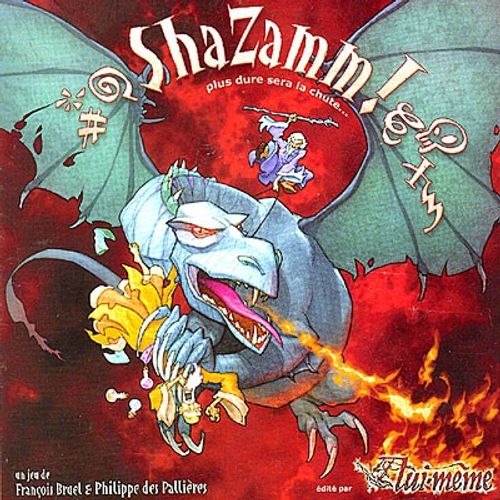
Shazamm!
Shazamm! Rulebook
Table of Contents
Table of Contents
Components
- 3 figures — representing the wizards, and the wall of fire that each tries to push toward the other.
- 1 board — representing the bridge where the wizards face off, and the "Mana reserve," symbolized by a dragon.
- 2 marker tokens — 1 in each wizard's color, for the "Mana reserve."
- 2 dials — wheel counters that let each wizard bet a certain amount of Mana. (Note: the small wheel must be set on the left, the large one on the right.)
- 16 "collapsed bridge" tiles.
- 30 "spell" cards — 2 decks of 15 spell cards (including 1 "false spell card") for each player (see the card descriptions on the following pages).
Game Setup
The two players sit facing each other, each at one end of the bridge. The wall of fire is placed in the middle of the bridge, and each player places their wizard on one of the symbols drawn on the bridge, three spaces from the wall of fire (two empty spaces between the wall of fire and each wizard).
The markers are placed on space 50 of the Mana reserve.
Each player takes a dial and a deck of 15 "spell" cards, which they shuffle after removing the "false spell card," then places it in front of them to form their draw pile. Each player therefore has their own personal draw pile. Each player takes into hand the first 5 cards of their draw pile, plus the false card, and looks at their hand without revealing it to the opponent. The "collapsed bridge" tiles are set aside for now.
The Game
The game is played over several rounds. For each round, players each have 50 points of Mana, which they will use to try to push the wall of fire toward their opponent.
When the wall of fire reaches a wizard's space, the round ends (as it also does if one of the players has exhausted their Mana reserve). The loser — the one reached by the wall of fire — must then retreat three spaces, and the winner advances to three spaces from the fire. A new bridge tile collapses at each end of the bridge, and a new round begins with 50 points of Mana each.
As soon as a wizard ends up on a "collapsed bridge" tile, they have lost the game!*
* When a new bridge tile collapses, if a wizard was standing on it, they have obviously lost the game.
How Do You Move the Wall of Fire?
On each turn, each player secretly bets, using their dial, part of the Mana remaining in their reserve. Each player must bet at least 1, and may bet at most everything they have left. At the same time, each player may place face-down the "spell" card(s) they wish to play this turn.
When both players are ready, they simultaneously reveal their dials and any "spell" cards played. The power of the attacks, which equals the bet, is evaluated by applying the effect of the "spell" cards. Whoever's attack ends up higher moves the wall of fire one space toward the opponent (ONLY ONE SPACE, regardless of the difference in attack value between the players).
Once applied, "spell" cards are discarded, into separate discard piles for each player. Each player has, in total, 14 spells for the whole game (barring a card's special effect). Each player subtracts from their Mana reserve the Mana they just spent.
And it's on to the next turn!
What Happens If Several "Spell" Cards Are Played on the Same Turn?
If both players play the same "spell" card, the two spells cancel each other out: both cards are discarded without their spells being applied.
It is important that the spells on both players' "spell" cards be applied in ascending order of the priority numbers shown in the upper left of the cards. Some "spell" cards interfere with each other, and the final effect is not the same depending on the order of application.
Mana Exhaustion
If a player's Mana reserve is exhausted, the other player may move the wall of fire toward their opponent by as many spaces as they have Mana points remaining, up to reaching the opposing wizard. If the wall of fire cannot reach the wizard, each player repositions three spaces from the new location of the wall of fire.
End of Round
The round ends when the wall of fire reaches a wizard's space (or when both players have exhausted their Mana reserve: see the previous paragraph).
A "collapsed bridge" tile is placed on the not-yet-collapsed bridge tile closest to each end, thereby shrinking the play area.
The wall of fire does not move, and each wizard repositions three spaces from the wall of fire.
The "Mana reserve" is reset to 50 for both players. Each player draws 3 more "spell" cards (adding them to their hand), provided there are still cards left in their draw pile.
Variants for Expert Wizards
Variant 1: you may decide that wizards have all their "spell" cards in hand from the very start of the game, instead of drawing them progressively each round. This is more tactical, but when you don't yet know the "spell" cards, it's a lot to take in at once!
Variant 2: each player takes all their cards, looks at them, and chooses the order in which they will draw them over the course of the game (as in the base rules: 5, then 3, then 3, then 3).
Spell Card Descriptions, in Priority Order
0. False Spell Card — These "spell" cards have no effect; they are not real spells but decoys. Use them so your treacherous opponent cannot guess whether you are going to play real "spell" cards, and how many. Don't forget to take them back into your hand once the "spell" cards are revealed: "false spell cards" are never discarded!
1. Silence — No spell has any effect anymore, for either player, until the end of the ROUND. This takes effect as soon as this "spell" card is applied: so all "spell" cards played this turn are inoperative and discarded. If, before the end of the round, a careless player forgets that Silence has been applied, too bad for them — they will have played "spell" cards for nothing! (Note: this spell is the only one whose effect continues AFTER the end of the turn in which it is played.)
2. Clone — I choose one of the "spell" cards played by my opponent on the previous turn, and place it in front of me. It applies this turn, as if I had played it (and following its own priority order).
3. Theft — All "spell" cards played by my opponent this turn, and not yet applied, pass to my side. Each spell is, at my choice, applied in my favor or destroyed.
4. End of Round — Immediate end of the round! The wall of fire stays where it is. A new round begins, repositioning three spaces apart on each side, and doing everything normally done at the start of a round. Other "spell" cards played this turn, and not yet applied, are void and discarded.
5. Middle — I immediately put the wall of fire back between the wizards, at equal distance from both, as at the start of the round. The turn then continues as if nothing had happened. After this reset to the center, the wall of fire will move according to the result of the attacks.
6. Recycling — This card lets you recycle your bet: once all cards have been checked, either I recover 5 points of my initial bet, or I may add up to 5 points to my bet.
7. Attack Boost — The power of my attack is increased by 7 points. Of course, I still only pay what I bet.
8. Double Dose — The power of my attack is multiplied by two. Of course, I still only pay what I bet. This card can be combined with Attack Boost: I then double the new strength after adding the 7 points.
9. Reversal — The wall of fire moves in the opposite direction from what it should, that is, toward the wizard whose attack is stronger! This, of course, only if the wall of fire was going to move at all.
10. Blaze — The wall of fire, if it must advance, advances two spaces instead of one. This applies regardless of the direction of that movement.
11. Resistance — The wall of fire does not advance toward me. If it was supposed to advance toward me, it does not move.
12. Miser (Sore Loser) — If I lose the turn (that is, if the wall of fire actually moves toward me), I do not pay my Mana bet.
13. Reserve Boost — My Mana reserve increases by 13 points. However, I can never exceed 50 points.
14. Drain — My reserve increases by the amount of my opponent's BET. (Not the value of their attack!) I can never have more than 50 points.