Shashki
Shashki Rulebook
Table of Contents
Table of Contents
6.1. Russian Draughts
6.1.1. The Board
The draughts board consists of 64 identical squares, alternately light (white) and dark (light brown). Play takes place only on the dark squares. The board is placed between the players so that the dark corner square is at the bottom left from the perspective of each player.
[Figure 1: The draughts board in sports disciplines whose names include the words "Russian draughts".]
In official competitions a board meeting the following requirements must be used:
- the playing surface must be not less than 35 cm;
- the surface of the board must be matt;
- the alternation of light and dark squares must be distinct; the colours must not be too pale and must not blend with the colour of the pieces.
6.1.2. Naming the Diagonals of the Board
[Figure 2: A draughts board with the diagonals drawn in (Russian draughts).]
A row of squares running diagonally from one edge of the board to another forms a diagonal.
Diagonals that end at the lower edge (side) of the board are called lower diagonals; those that end at the upper edge are called upper diagonals (Figure 2).
The longest diagonal, consisting of 8 dark squares and crossing the board from left to right, is called the "big road" (bolshaya doroga).
Two diagonals of 6 squares each, lying on either side of the "big road", and the two diagonals of 3 squares each that connect them, form the "troinik" (triple). The large diagonals of the "troinik" are called the lower and upper "troinik" respectively; the small ones are called the lower and upper "troinichek" (small triple).
Two diagonals crossing the "big road" and the "troinik" (7 squares each) form the "dvoinik" (double). The large diagonals of the "dvoinik" are called the lower and upper "dvoinik" respectively; the small ones are called the lower and upper "dvoinichek" (small double).
The two diagonals following the "dvoinik" (5 squares each), together with the diagonals joining them at their ends (4 squares each), form the "kosyak" (slanting group). They are called the lower and upper "kosyak", and the lower and upper "kosyachok" (small slanting group).
6.1.3. Pieces
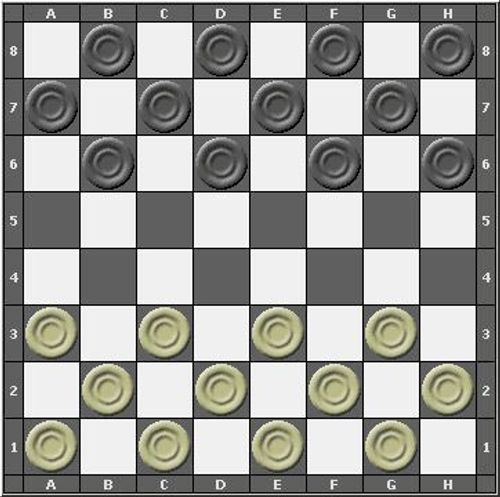
6.1.3.1. Before the start of the game each opponent is given 12 white and 12 black pieces. The pieces are placed on the dark squares of the first three horizontal rows on each side (Figure 3). Their diameter must be smaller than the board square by 5–10 mm. Other requirements for the pieces are described in clause 4.2.
[Figure 3: Draughts board with pieces (Russian draughts).]
6.1.4. Moves of Pieces
6.1.4.1. A move in the game is the movement of a piece from one square of the board to another. The first move is made by the player with the white pieces, except where the opening moves or the starting position are determined by a draw under the table specified in the Regulations (Rules of Competition). The partners alternate, making one move each, until the game ends.
6.1.4.2. Pieces are divided into men (простые шашки, "simple pieces") and kings (дамки).
6.1.4.3. A man moves only forward, to an adjacent square on a diagonal.
6.1.4.4. When a man reaches one of the squares of the last horizontal row (counting from the player's own side), it is promoted to a king and acquires new rights. A king is marked by stacking two pieces on top of one another, or by turning a man upside down (in competitions held under the rules of the international draughts federation, a king is marked only by a stacked pair). Failure to mark a king is a violation of the Rules.
6.1.4.5. A king (once it has been marked in accordance with clause 6.1.4.4), unlike a man, moves to any free square (one not occupied by another piece) along a diagonal in any direction, both forward and backward. As with a man, it may stop only on squares not occupied by other pieces, and it may not jump over its own pieces.
6.1.4.6. A move is considered made when, after moving a piece from one square to another, the player has released the piece.
6.1.4.7. If the player whose turn it is touches one of his own pieces that has a legal move, he is obliged to move that piece. If he touches two or more pieces, he must move the piece he touched first, if a move or capture with that piece is possible. Touching one of one's own pieces that has no legal move under the rules has no consequences, and the player is free to make any legal move.
6.1.4.8. If during a move the player has moved his piece to another square without releasing it, he is obliged to continue with that piece, but he may place it on any other square available to it.
6.1.4.9. If a player wishes to adjust one or more pieces, he must first clearly announce to his opponent: "I am adjusting" ("поправляю"). Pieces may be adjusted only on one's own turn.
6.1.5. Capture
6.1.5.1. If a man is on a diagonal next to an opponent's piece with a free square behind it, it must be moved over that piece onto the free square. The opponent's piece is then removed from the board.
6.1.5.2. If a king is on a diagonal, adjacent to or at a distance from an opponent's piece, with one or more free squares behind it, it must be moved over that piece onto any free square. The opponent's piece is then removed from the board.
6.1.5.3. Capturing an opponent's piece is compulsory and may be made both forward and backward. A capture counts as one move played. Capturing one's own pieces is forbidden.
6.1.5.4. A capture must be clearly indicated and carried out in a defined order. It is considered complete after the opponent's piece has been removed from the board.
6.1.5.5. If, during a capture, a man again finds itself on a diagonal next to another opponent's piece with a free square behind it, it must be moved over that second, third, etc. piece.
6.1.5.6. If, during a capture, a king again finds itself on a diagonal adjacent to or at a distance from an opponent's piece with one or more free squares behind it, the king must necessarily be moved over that second, third, etc. piece and occupy any free square on the same diagonal beyond the last piece captured.
6.1.5.7. After a capture under clauses 6.1.5.5 and 6.1.5.6 is completed, the opponent's pieces that were captured are removed from the board in the order in which they were captured or in the reverse order. This is called a sequential capture.
6.1.5.8. During a sequential capture it is forbidden to move pieces over one's own pieces.
6.1.5.9. During a sequential capture it is permitted to pass through the same square several times, but it is forbidden to move one's own piece over the same opponent's piece more than once (see clause 6.1.5.17).
6.1.5.10. A capture must be clearly indicated: piece by piece, placing the capturing piece on each intermediate square and then on the final square. Failing to indicate a capture is considered unsporting and incorrect conduct.
6.1.5.11. A sequential capture is considered finished when, at the end of the movement of the piece, the player has taken his hand off it.
6.1.5.12. Captured pieces must be removed from the board only after the sequential capture has been completed, in the same order as they were captured or in the reverse order (see clause 6.1.5.7).
6.1.5.13. The removal of captured pieces from the board is considered complete when the player has removed the last captured piece.
6.1.5.14. When a king or a man has the option of capturing in two or more directions, the choice is made by the capturing player, regardless of the number or quality (king or man) of the pieces removed.
6.1.5.15. If a man, in the course of a capture, reaches the last horizontal row (counting from its own side) and is given the opportunity to continue capturing, it must continue the capture in the same move, now with the rights of a king.
6.1.5.16. If a man reaches the last horizontal row without capturing and is then given an opportunity to capture, it must capture (if that opportunity remains) only on its next move, with the rights of a king.
6.1.5.17. Examples illustrating certain features of the capture rule. The "Turkish strike" rule.
In the position in Figure 4, when it is their turn, the black pieces must capture with a king as follows: a5:e1:g3:e5 (the white piece on d4 cannot be captured by the king, because the piece on c3, like the pieces on f2 and f4, is removed from the board only at the end of the move), after which White plays d4:d8 (clause 6.1.5.12).
[Figure 4: Example illustrating the capture rule in accordance with clause 6.1.5.12 (Russian draughts).]
In the position in Figure 5, when it is their turn, the white pieces must capture with a king as follows: e1:a5:d8:f6:d4. The king must stop on d4, because it may not jump over the piece on c3 a second time, and it may also not jump over the piece on c5, in accordance with clauses 6.1.5.9 and 6.1.5.12. (Note: the source reads "6.5.12" at this point; this is corrected to 6.1.5.12.)
[Figure 5: Example illustrating the capture rule in accordance with clauses 6.1.5.9 and 6.1.5.12 (Russian draughts).]
In Figure 6, the last move of White was c3-d4, and in reply Black must capture with the man on a5, for example: a5:c3:e1:g3:e5:c3. On c3 the black man, now promoted to a king, must stop, because it may not jump a second time over the piece on b4 or d2. If, however, Black captures by another route, i.e. a5:c3:e5:g3:e1:c3, then again the black piece must stop on c3. In reply, White plays b2:d4:b6:d8:f6:h8 (clause 6.1.5.9).
[Figure 6: Example illustrating the capture rule in accordance with clause 6.1.5.9 (Russian draughts).]
6.1.6. Draughts Notation and Recording of Games
6.1.6.1. Draughts notation is the system of conventional designations for the squares of the board.
Straight rows of squares, consisting of 8 squares (4 dark and 4 light) and running from bottom to top, are called files (vertikali).
Straight rows of squares, consisting of 8 squares (4 dark and 4 light) and running from left to right, are called ranks (gorizontali).
The eight ranks of the board are designated by the digits 1 to 8, and the eight files by the small Latin letters from "a" to "h" (a, b, c, d, e, f, g, h), or in Russian pronunciation: "а", "бэ", "це", "дэ", "е", "эф", "же", "аш". The letter "a" designates the leftmost file from the side of the player with the white pieces (the rightmost file from the side of the player with the black pieces). The first rank is the rank nearest to the player with the white pieces.
Each square of the board is designated by the combination of a letter and a digit, showing the file and the rank at whose intersection the square lies (Figure 7).
[Figure 7: Designation of the squares of the draughts board (Russian draughts).]
6.1.6.2. Using the notation makes it possible to record both complete games and individual positions. For example, the arrangement of pieces at the start of a game (diagram 3) is recorded as follows: White – a1, a3, b2, c1, c3, d2, e1, e3, f2, g1, g3, h2 (12); Black – a7, b6, b8, c7, d6, d8, e7, f6, f8, g7, h6, h8 (12).
To record the move of a piece, the square on which the piece stood is written first, then a dash, then the square on which it is placed, for example: a3-b4. When recording a capture (strike), a colon is written instead of the dash.
When several pieces are captured in one move, the move is recorded as follows: first the square from which the piece began its move is written, then a colon, and then the square on which it stood after the capture.
If it is necessary to note the direction of a capture, then after the square from which the capture began, the squares at which the direction changed are written in order. A colon is placed between the designations of the individual squares.
In the position shown in Figure 8, three capture directions are possible, and they are recorded as follows:
- d2:h6:f8:c5:a7
- d2:g5:e7:c5:a7
- d2:g5:d8:a5
[Figure 8: Position illustrating the correct recording of a capture ("strike") of pieces (Russian draughts).]
In positions of this kind the full record must be made on the score sheet, as indicated above.
When recording a game, the moves of the sides are written in a column. The moves of White are written in the left column and those of Black in the right column; a move by White together with Black's reply is numbered as a single move.
For example:
White: Ivanov Black: Petrov
- e3-d4 d6-c5
- f2-e3 f6-g5
- c3-b4 g5-h4
- b4:d6 h4:f2
- e1:g3 c7:h4 White resigned.
Besides the full form of recording shown above, an abbreviated form is permitted, by which the same game may be recorded as follows:
Ivanov – Petrov: 1. ed4 dc5 2. fe3 fg5 3. cb4 gh4 4. b:d6 h:f2 5. e:g3 c:h4. White resigned.
6.1.7. Winning a Game
The player who first reaches a position in which:
- the opponent has no pieces left;
- all of the opponent's pieces are blocked (locked in); or
- the opponent has acknowledged defeat
is recognised as the winner.
In addition to the above, a game may also be lost by a player when the opponent's time on the tournament clock expires (clause 5.4.2.6), or when a player is awarded a defeat for violation of the Rules (clauses 1.5 and 5.4.15).
6.1.8. Drawn Endings of a Game
6.1.8.1. In competitions in the sports disciplines "Russian draughts" and "Russian draughts – team competitions", a player may offer a draw if each opponent has made at least 20 moves in the game.
6.1.8.2. A game is considered drawn in accordance with clause 5.4.12, and also in the cases provided for in clauses 6.1.8.3 – 6.1.8.8.
6.1.8.3. If a player, having three kings against one opponent's king in an ending, and controlling the "big road", does not capture the opponent's king with his 15th move (counting from the moment the balance of forces was established).
6.1.8.4. If a player having three or more pieces (men and kings) in an ending against one opponent's king does not capture the opponent's king with his 15th move (counting from the moment the balance of forces was established).
6.1.8.5. If a player having three pieces (three kings, two kings and a man, a king and two men, or three men), none of them on the "big road", against a lone opponent's king that is on the "big road", does not manage to capture the opponent's king with his 5th move, the exception being a position in which one of the sides has a possibility of winning.
6.1.8.6. If, in a position where both opponents have kings, the balance of forces has not changed (i.e. there has been no capture and no man has become a king) during:
- 2- and 3-piece endings – 5 moves;
- 4- and 5-piece endings – 30 moves;
- 6- and 7-piece endings – 60 moves.
6.1.8.7. If, in a clearly drawn position, a player wishing to play for a win does not reach a winning position with his 5th move, then in a clearly drawn position the player who wishes to claim the draw has the right to count 5 moves aloud, and if the opponent does not achieve a win, the game is recorded as drawn. The lawfulness of claiming a draw is determined by the judge. Clearly drawn positions include king endings in which accuracy is not required in defence, bypassing elementary traps. For example, avoiding the placement of a king in a "loop" does not require accuracy.
6.1.8.8. If:
- in 4- and 5-piece endings, during 15 moves the players have made moves only with kings, without moving men and without making any capture; or
- in 6- and 7-piece endings, during 25 moves the players have made moves only with kings, without moving men and without making any capture,
the game is drawn.
6.1.9. Time Control for Thinking Time
6.1.9.1. In competitions in the sports disciplines "Russian draughts" and "Russian draughts – team competitions", time control (for each player) of 20 minutes or more until the end of the game applies.
Recommended time controls:
- 20 minutes or more plus 30 seconds per move until the end of the game;
- 30 minutes plus 30 seconds per move until the end of the game.
6.1.9.2. In competitions in the sports disciplines "Russian draughts – rapid play" and "Russian draughts – rapid play – team competitions", time control (for each player) of 7 to 15 minutes until the end of the game applies. Recommended time controls:
- 8 minutes plus 4 seconds per move until the end of the game;
- 7 minutes plus 5 seconds per move until the end of the game.
6.1.9.3. In competitions in the sports disciplines "Russian draughts – lightning play" and "Russian draughts – lightning play – team competitions", time control (for each player) of 3 to 5 minutes until the end of the game applies. Recommended time control: 3 minutes plus 2 seconds per move until the end of the game.
6.1.9.4. The Regulations (Rules of Competition) for a competition may establish a different time control, provided it does not contradict the Rules.
6.1.10. Rapid and Lightning Play Competitions
6.1.10.1. Competitions are held in the sports disciplines whose names include the words "rapid play" and "lightning play", with the time controls specified in clauses 6.1.9.2 and 6.1.9.3 respectively.
6.1.10.2. The use of tournament clocks is mandatory. Recording of moves in the game is not mandatory. If the game is not recorded, the players may agree to a draw only when each player has 6 or fewer pieces (men and kings) remaining.
6.1.10.3. Any player wishing to appeal to the judge for a decision on a situation arising during the game has the right to stop the clock while his complaint is considered. If the appeal to the judge is unfounded and the clock was stopped, the judge may apply sporting sanctions to that player in accordance with clause 5.4.14.2.
6.1.10.4. When a control without added time per move is used, the positions described in clauses 6.1.8.5 and 6.1.8.6 (2- and 3-piece endings only) are not played, and a draw is recorded immediately, unless the game has an obvious continuation and the player can demonstrate a win.
6.1.10.5. If a player in a theoretically or clearly won position does not have enough time to win the game, the offer of a draw by him and the stopping of the control clocks record a drawn result for that game. The judge is entitled to determine the lawfulness of the recording of a draw.