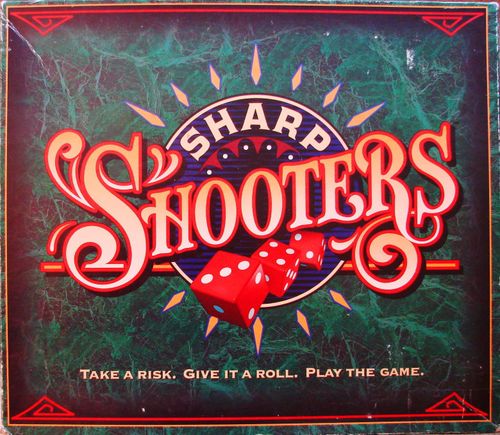
Sharp Shooters
Sharp Shooters Rulebook
Table of Contents
Table of Contents
Contents
- 8 double-sided game tiles
- 70 point chips (25 silver-colored chips worth "10", 45 gold-colored chips worth "50")
- 30 dice
- 1 dice cup
Objective
Whoever reaches 500 points first (with 2 to 4 players), or 400 points (with 5 or 6 players), wins the game.
Setup
The 8 game tiles are stacked in the middle of the table in any order.
Note: Beginners are advised to put the tile numbered "1" on top of the stack.
All the dice are divided evenly among the players. With 4 players, two dice are left over; put them back in the box.
The point chips are sorted by value and set out in the middle of the table as a general supply. At the start, each player receives 3 silver chips and 1 gold chip, which they place face up in front of themselves.
Gameplay
Here we go. The game is played over several rounds. A round ends when a die is placed on the last free space of a game tile. The most well-behaved player starts the first round; after that, play passes clockwise around the table. Whoever is on turn takes the dice cup and carries out their turn, which is divided into the following steps:
- Roll
- Place dice
- Roll again or stop
1. Roll
The player on turn takes 5 of their dice and rolls them all at the same time.
- If a player has more than 5 dice in front of them, they set the extra dice clearly aside as a reserve; these are not used during this turn.
- If, later in the round, a player has fewer than 5 dice available, they always roll with all the dice they still have.
- If a player ever has no dice left at all, they no longer take part for the rest of the round and are simply skipped.
2. Place dice
Next, the player must — if possible — place one matching die on the game tile lying on top of the stack. Additional matching dice may be placed, but this is not required.
A die counts as matching if it can be placed according to the following rules:
- Each game tile shows six rows, each made up of one or more spaces. Exactly one die can be placed on each space, and only if it shows the same number of pips as the space.
- In a row, the leftmost space must always be filled first, then the space to its right, and so on.
Example row layout (illustrated on the tile): a row of dice-value spaces (showing pips 1 through 6 across several rows) is worth increasing point totals the further along it is completed — shown on this tile as circled point values of 80, 60, 50, 30, 10, and 20 next to its six rows.
-
In a row marked with black or white stars, any die at all may be placed as the first die, at the leftmost space. Every further die placed in that row must then show the same number of pips as that first die.
-
Rows marked with mixed colored stars (red/yellow) mean that in such rows, the number of pips of the first three dice must be identical to each other, and the number of pips of the last two dice must be identical to each other — but the two groups of dice must show different numbers from one another.
Example row layout (illustrated on the tile): a row of five spaces, the first three marked with dark stars and the last two marked with light stars.
Dice that have been placed on a tile stay in place until the end of the round.
3. Roll again or stop?
After the first roll, a player may decide whether to keep playing or end their turn.
- If they keep playing, they roll again with all the dice from this turn that have not been placed on a tile (that is, without the dice they set aside as a reserve at the start of their turn!). The same rule applies again: they must place one matching die on a tile, and may place further matching dice. Then they decide again: keep playing or stop, and so on. In total, a player must roll at least once and may roll up to five times per turn, and on every roll they must place at least one die.
- If a player wants to stop (which is often sensible for tactical reasons), they take back all dice that were not placed into their own reserve, where they are available again for their next turn.
No matching die
If a player has not rolled a single matching die, their turn ends immediately. In this case too, they take back the dice that were not placed into their own reserve.
Last die in a row
If a player places a die on the last (or only) space of a row, the following applies — completely regardless of who placed the other dice in that row:
- White row (circled value, e.g. 80): For a white, and therefore positive, row, the player who placed the last die takes the point value shown in the circle behind the row, in the form of chips from the supply in the middle of the table.
- Black row (circled value, e.g. 30): For a black, and therefore negative, row, the player who placed the last die pays the point value shown in the circle behind the row, in the form of their own chips, back to the supply in the middle of the table.
The "can" and "must" of a turn, once more in short form
Whoever is on turn...
- must roll once — with 5 dice if possible;
- must place a matching die if they can (otherwise their turn ends);
- can place more than one matching die;
- can roll more than once (but must then place at least one matching die again on each roll, or else end their turn if they cannot).
End of a round
As soon as a die is placed on the last free space of a game tile and the corresponding points have been awarded, a round ends:
- The dice are taken off the game tile. Together with the dice still lying in front of the players, they are redistributed so that all players again have the same number.
- A new tile is revealed, by sliding the tile just played to the bottom of the stack or by turning it over.
- The player to the left of the player who placed the last die on the previous tile becomes the starting player of the next round.
- Naturally, the players keep the chips they have won so far.
End of game
The game is played over several rounds, and ends
- with 2 to 4 players, when after a round at least one player has 500 or more points.
- with 5 or 6 players, when after a round at least one player has 400 or more points.
The player who then has the most points wins the game.
Answers to frequently asked questions
- Chips can be exchanged at any time.
- If a player must pay out more points than they have, they pay everything they have and continue playing with 0 points.
- If a tile shows several rows with stars (of whatever color), these are considered separately from one another. For example, two rows with black stars do not have to have the same number placed in them. Likewise, a die placed on a red or yellow star does not have to differ from dice placed on white or black stars.
- Since a player can place up to 5 dice per turn — and these can be placed in different rows — it is entirely possible for a player to "finish" several rows in a single turn and collect, or have to pay, the corresponding points for each.
- It is not allowed to "hold" dice between rolls — that is, to neither place them on a tile nor roll them again. If a player wants to keep playing, they must always do so with all of the remaining dice (of this turn!).
- For the player who finishes a round, their turn always ends automatically as well.
Note: This game idea first appeared in 1998 under the title "Gambler" under the FX brand.