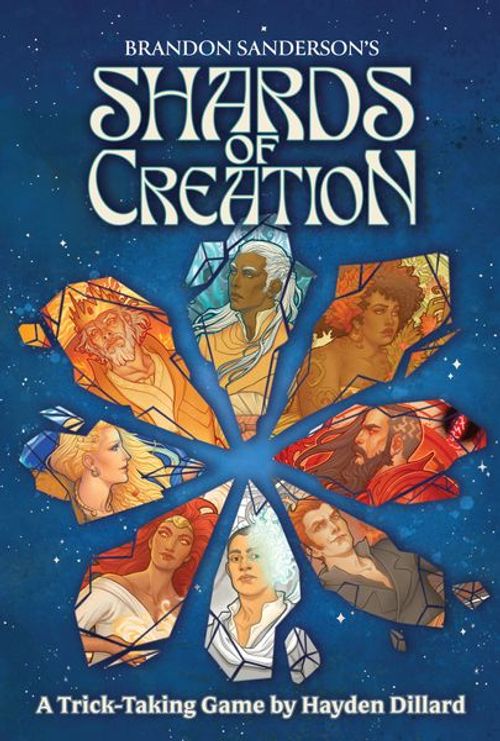
Shards of Creation
Shards of Creation Rulebook
Table of Contents
Table of Contents
Components
- 8 Shards, each containing:
- 16 play cards
- 1 trump card
- 1 reference card
- 4 Scoring aids
- 1 Scorepad
Each Shard deck includes a trump card, play cards, and a reference card. Reference cards show the scoring area, trumps and cards zones, active trump, discard area, and scoring area layout used during play.
Setup
- Prepare the draw deck by randomly selecting or choosing which Shards to include. The number of Shards depends upon the number of players. a. 4 Shards for a 2- or 3-player game. b. 5 Shards for a 4-player game. Shuffle the play cards for each of the chosen Shards together and place this "draw" deck face down in the middle of the play area.
- Prepare the trump deck by shuffling the trump cards for each of the chosen Shards and place it face down near the draw deck.
- Place each Shard's reference card face up near the draw deck, so they are visible to all players.
- Give each player a scoring aid. Flip it to the appropriate side for the player count.
Gameplay
The game is split into three rounds of ten tricks each.
Round Setup
At the start of each round, draw and reveal the top card of the trump deck. For the round, cards from this trump Shard beat cards from all other Shards.
Deal each player a hand of 11 cards from the draw deck.
Note: The effects of some trump Shards alter how hands are dealt.
For the first round, the first player is chosen randomly. For later rounds, the first player is the winner of the previous round's last trick. The first player begins the round by playing the first trick.
Playing a Trick
Each player, beginning with the first player and proceeding clockwise, plays one card from their hand face up. Cards played to a trick may change through a card's ability. The cards played by all players collectively form a trick.
After playing a card, immediately resolve its non-scoring ability (if any). All abilities are mandatory unless they say "may."
- If an ability does not have a valid target, ignore that aspect of the ability.
- Abilities with choices must be completely resolved before the next card is played.
Note:
- Whenever an ability lets a player draw cards, the ability will also force them to discard cards so their hand size doesn't grow.
- If an ability causes a player to lose or discard cards, they will draw the same number of cards from the draw deck to replenish their hand.
- If the draw deck is empty, shuffle the discard pile and form a new draw deck.
The Shard of the first card played is known as the lead. The first player may choose any Shard as the lead. All other players must follow the lead by playing a card matching the lead Shard if able. If they do not have a card matching the lead Shard, they may play any card.
Once each player has played and resolved the ability of their card for the trick, the player with the strongest card wins the trick. The strongest card is determined by the following criteria:
- The highest rank card of the trump Shard is the strongest.
- If no one played a card from the trump Shard, the highest rank card of the lead Shard is the strongest.
- If tied for highest rank, the last tied card played wins the trick.
The winner of each trick chooses one of the played cards from the trick and places it face up in their scoring area in front of them. Place the other played cards into the discard pile.
Example 1: In a 3-player game, Autonomy is the trump Shard for the current round.
- Azure plays a Ruin 10 (a card with no ability). The lead Shard for the trick is Ruin.
- Hoid follows the lead and plays a Ruin 7 (a card with an ability).
- Its ability immediately allows Hoid to reveal and discard the top card of the draw deck and subtracts its rank from Azure's card. The top is an Honor 8, so the rank of Azure's Ruin is now only 2.
- Khriss does not have any Ruin cards, so she can play any card from her hand. Khriss plays an Autonomy 1 (a card with an ability).
- The ability says "may," so Khriss chooses not to use its ability.
- With Autonomy as the trump Shard, Khriss's card is the strongest, and she wins the trick.
- Khriss chooses the Ruin 7 as the played card to place into her Scoring Area and places the other played cards into the discard pile.
- As the winner of the trick, Khriss is the first player for the next trick.
(The Autonomy reference card notes: You may not lead with Autonomy unless you have no other Shard in your hand. You may discard an Autonomy card from your hand. If you do, draw a card.)
Example 2: As the first player, Khriss leads the next trick. Autonomy is still the trump Shard.
- Khriss plays a Preservation 8 (a card with an ability). Its ability makes Khriss draw a card from the draw deck, then discard a card.
- Azure follows the lead and plays a Preservation 8 (a card with an ability). Its ability increases the card's rank by 1 for each Preservation card in Azure's Scoring Area. She does not have any, so its rank remains an 8.
- Hoid also follows the lead and plays a Preservation 8. Its ability also makes the player draw a card from the draw deck, then discard a card.
- With a three-way tie, Hoid wins the trick, since he played the last tied card.
- Hoid chooses to transfer the Preservation card he played to his Scoring Area and places the other played cards into the discard pile. As the winner of the trick, he is the first player for the next trick.
Round End
The round ends after 10 tricks, so every player will have one card left in their hand. Each player places that card face up in their Scoring Area.
Note:
- If Devotion is the trump, players do not transfer the last card of their hand to their Scoring Area. Rather, the last card in each player's hand is played to another trick.
- If Odium is the trump, its trump ability activates at the end of the round.
If this is the third round, the game ends and each player tallies their final score. Otherwise, shuffle the discard pile into the draw deck and start the next round.
End Game Scoring
Each player scores the cards in their Scoring Area in the following order:
- Activate each card with a Scoring ability. You may resolve your cards' abilities in any order.
- Score for each Shard set. Separately, count how many cards you have of each Shard. Refer to the Scoring aid to see how many points each Shard set is worth. (Rank has no effect on scoring.)
- Score for each full set of Shard types (Resonance). Each full set must contain one card from all 4 Shards (5 in a 4-player game).
Note: The same card may be scored in steps 2 and 3, contributing to both the number of an individual Shard you have, and a Resonance set.
Cards with scoring abilities have a dark background for their text to help distinguish them! The scoring ability of the card has no effect when played.
After each player totals their scores, the player with the highest total wins. If tied for highest total, the player with the least amount of cards in their Scoring Area wins the tie. If there is still a tie, they share the victory.
Example: In a 3-player game with Honor, Ruin, Autonomy, and Preservation, Hoid has 2 Honor cards, 1 Ruin card, 3 Autonomy cards, and 8 Preservation cards. His Ruin card has a scoring ability, giving him -2 points. His Shard sets score 3 points for Honor, 1 point for Ruin, 6 points for Autonomy, and 36 points for Preservation. Hoid only collected one complete set of Shards, so he scores 5 additional Resonance points. Note: In a 4-player game, full sets require a copy of five different shards and score more points.
Hoid's scoring breakdown for this example: Honor 3, Ruin 1 (with a -2 scoring-ability adjustment), Autonomy 6, Preservation 36, plus 5 Resonance points, for a total of 49.
Appendix
Card Abilities and Rank Distributions
Each Shard in Shards of Creation has 8 cards with no abilities, 4 cards with one ability, and 4 cards with a different ability.* A card's text describes its ability, but the Shard's two abilities are also summarized on the Shard reference card.
A card's non-scoring ability resolves immediately after it is played. If an ability changes a card's rank, that card maintains its new rank until it is transferred to a Scoring Area or discarded.
Most Shards have card ranks ranging from 1 to 16. However, the distribution of ranks varies slightly for each Shard.** The specific rank distribution for each Shard can be found on the Shard reference card.
* Exceptions: Honor cards have no abilities. Preservation has abilities on 15 of its 16 cards!
** Exception: Preservation has 15 cards with the same rank.
Trump Abilities
Each Shard has a unique trump ability (except for Honor). The trump ability is active for the entire round the Shard is trump.
Some abilities, like Cultivation, trigger at the beginning of the round. Others, like Ruin, change which cards can be transferred to a Scoring Area after winning a trick. Some trump abilities, like Odium, can trigger at the end of the round. Finally, some abilities, like Autonomy, affect which cards can be played as lead.
Trump effects always take precedence over card abilities, which take precedence over rules in the rulebook, in case of a contradiction.