Shaolia: Great Houses
Shaolia: Great Houses Rulebook
Table of Contents
Table of Contents
1. Introduction
I. Game Components
- Lv2 card x 60
- Character card x 7
- Quest card x 20
- Quest tracker x 24
- Lv1 minion card x 4
- Lv2 minion card x 11
- Boss lock card x 3
- Boss gauge tracker x 1
- Noble house tile x 11
- Boss board x 1
- Rule book x 1
You need a copy of 'Shaolia: Warring States' to play this expansion.
II. Game Setup
In addition to the basic Shaolia game setting, you'll need some additional settings to play the expansion. Set up the game according to the basic Shaolia game setting. Leave some table space for 'Quest cards' and 'Noble house tiles' and follow the additional instructions below.
- Noble House Tile Deck: Shuffle 'Noble house tiles' and place the deck face down.
- Noble House Tile Pool: Draw 4 tiles from the Noble house tile deck and place them side by side, face up.
- Quest Card Deck: Shuffle 'Quest cards' and place the deck face down.
- Quest Card Pool: Draw 5 cards from the Quest card deck and place them side by side, face up.
- Quest Card Discard Pile: Leave some space for a discard pile.
- Quest Tracker: Each player chooses one color from the Quest trackers. Take all 6 of the chosen trackers and place them near the Territory board.
Note: The Great Houses expansion has new game systems, 'Quests' and 'Noble house tiles'. While playing this expansion, you will complete various quests to use the great power of 11 'Great houses'.
2. Quest & Noble House Tile
I. Quest Cards
- A player who satisfies the condition written on a specific Quest card during their turn is considered to have completed that quest. The player who completed the quest takes the completed Quest card from the Quest card pool into their hand.
- After taking a Quest card from the pool, draw a new Quest card from the Quest card deck to refill the pool.
- A Quest card is considered a resource and is not included in the hand card limit of 8 cards.
- A Quest card is normally used to purchase 'Noble house tiles'.
- If you don't need to buy 'Noble house tiles', you can sell a Quest card and gain 2 gold at any time on your turn.
There are two kinds of Quest cards.
1) Immediate type
Quest cards with plain text are immediately completed when you satisfy the written condition.
Ex) This Quest card is immediately completed when you have 4 infantries built in your territory.
2) Repeating type
Quest cards with counting slots are completed by repeating the written quest as many times as the number of counting slots.
Ex) Since there are 3 counting slots on this Quest card, you have to complete the "Trade with 'Sell Mineral' trading post" action three times to complete this Quest card and take it into your hand.
- Place a Quest tracker of your color on the counting slot every time you complete the written quest to count how many times you've completed that quest.
- Each Quest can only be completed by one player. If a player has placed his or her tracker on a Quest card, the other players can no longer place their tracker on that card.
II. Noble House Tile
How to get
- You can purchase 'Noble house tiles' from the Noble house tile pool with the Quest cards you've earned by completing various quests.
- You can purchase 'Noble house tiles' during the purchase phase.
- After taking a Noble house tile from the pool, draw a new Noble house tile from the Noble house tile deck to refill the pool.
Tile Ability
- Each Noble house tile has a unique ability.
- The abilities of Noble house tiles are applied in the same way as Lv1 and Lv2 cards. Some tiles have passive abilities and some tiles need dice to activate their ability.
- Noble house tiles can't be attacked, blocked, or destroyed. Once you purchase a Noble house tile, you benefit from its ability until the end of the game.
Purchase Cost
Every Noble house tile has a purchase cost. The scroll icon means the number of Quest cards that is required to purchase this tile. You have to pay 2 Quest cards and 1 gold to purchase this tile.
Placement
Place the purchased Noble house tile near your Territory board. You now benefit from its ability until the end of the game.
Printed tile example (House of Tigris)
The rulebook's example for this tile reads: "Tile Ability: You'll gain 1 attack token at the beginning of every action phase if you have purchased this Noble house tile." The tile card itself reads "Place 1 ATK token on an ATK card before rolling dice" with a P (passive) badge. Both are transcribed as printed.
Tiles shown in this rulebook
The expansion has 11 Noble house tiles, but this rulebook prints only the four below; the other seven tiles are not described in this rulebook.
The rulebook prints the following tiles. Each tile's badge is printed on its card: "ANY" and "P" are the base game's command icons (ANY: the ability can be activated with any rolled number; P: passive ability, used without dice; see the Shaolia: Warring States rulebook).
- House of Taurus (Quest cost: 1 scroll). ANY: Gain 3 gold.
- House of Tigris (Quest cost: 2 scrolls and 1 gold). P: Place 1 ATK token on an ATK card before rolling dice.
- House of Lepus (Quest cost: 2 scrolls). ANY: Place one blockage token on any card in your opponent's territory.
- House of Dracon (Quest cost: 2 scrolls). P: When an opponent attacks your palace, you can choose to destroy this tile to prevent that attack. See FAQ.
Quest cards and Noble house tiles in 3~4 player mode
- Quest cards are considered as a resource, so you can share them with your team mate if you pay 1 gold to share resources.
- You can't collectively complete a single quest with your team mate.
- You can't share Noble house tiles with your team mate.
3. New Card Feature
I. New Action Commands: Gold Command
A new type of action command has been added to 'Shaolia: Great Houses'. The 'Gold command' is a normal action command with some gold coin icons next to it. You have to pay the stated amount of gold with the matching die to activate the ability.
- To activate Mounted Archers, you have to spend a rolled die '1' and 3 gold.
- To activate Chariot, you have to spend any rolled die and 1 gold.
TIP: The Gold card will help you easily utilize a card with a 'Gold command'.
II. Cards with Multiple Classes
In this expansion, some cards have multiple class values. You can identify these cards by the class icon in the upper left corner of the card.
- The Totem is considered as both culture and defense cards. Since it is a defense card, a Totem has to be built in the front row of your Territory board. The Totem can be used with cards that create synergies with culture or defense cards to create cool combos.
- The Sacred tree has all class values except for defense. It is considered as a gold, mineral, culture, attack, and trade card. If Sacred tree is activated on a territory, regardless of the ability you choose to use, it is considered that 5 types of cards have been activated at the same time.
Synergy Example
- Let's say that you have built Sacred tree, Garden, and Ambassador on your territory.
- You decided to spend your rolled die and activate Sacred tree to gain 1 mineral.
- Since Sacred tree is considered as a culture card, you can benefit from the Garden's ability "Gain 1 culture when a culture card activates on your territory".
- Also, Sacred tree is considered as a trade card and you can benefit from the Ambassador's ability "Gain 1 gold when a trade card, including this card, activates on your territory".
- As a result of this activation, you'll get 1 mineral, 1 culture score, and 1 gold with a single die.
4. Game Mode
I. Game Modes from 'Shaolia: Warring States'
This expansion provides 4 new game modes, including a solo mode. These new game modes are explained in the sections below. In addition to the new game modes, players can also play game modes from 'Shaolia: Warring States' with the newly added expansion Lv2 cards. You can also apply Quest and Noble house tiles to these game modes.
These are the new Lv2 card deck recommendations for game modes from 'Shaolia: Warring States'.
II. Trade War
Court Dancers, Parade, Library, Fleet, Pirate ship, Chariot, Port, Ambassador, Bank, Smelter, Signal fire, Mansion, Use 1 of each wonders card.
III. Hidden Figures
Grave yard, Theater, Totem, Cultists, War drum, Mounted Archers, Ambassador, Mine, Orchard, Draw bridge, Sacred tree, Use 1 of each wonders card.
IV. The Three-Cornered War / V. The Alliance / VI. The Tyrant / VII. Rumble
Grave yard, Court Dancers, Parade, Totem, Pirate ship, Chariot, War drum, Mounted Archers, Ambassador, Port, Smelter, Mine, Orchard, Looters, Sacred tree, Draw bridge, Signal fire, Use 2 of each wonders card.
VIII. The Sellswords
The Lords of Shaolia, who became used to the 100-year-long peace, had to quickly enhance their military power during this new time of chaos. That was the reason they brought in the mighty northern nomads, the 'Khun', who had historically not been on harmonious terms with the people of Shaolia, into the heart of Shaolia.
The 'Khun' are very famous for their combat prowess because they were forced to develop their mercenary skills in order to survive the harsh environment of their homeland. Now, they are on the main stage of Shaolia and are willing to do anything that turns a profit.
TIP: "The Sellswords" mode consists of very powerful attack cards that can be activated with gold in addition to dice. These cards are highly efficient in destroying an opponent's cards. It is important to counter these powerful attack cards with the new culture card 'Graveyard' if you want to achieve a culture victory.
Objective of the Game
a. Destroy your opponent's palace by dealing 12 damage, or b. Gain a culture score of 18.
Starting Resource
Each player takes 8 gold and 2 random character cards.
Card Setting
- LV 1 CARD: Use every Lv1 card (48 cards).
- LV 2 CARD: Use these Lv2 cards below (47 cards).
- War drum x 4
- Mounted Archers x 4
- Chariot x 4
- Wall x 4
- Graveyard x 4
- Temple x 4
- Library x 4
- Raiders x 4
- Ranch x 4
- Smelter x 4
- Port x 4
- War elephant x 1
- Ancestral valley x 1
- Fortress x 1
- Use 1 of each wonders card.
Trading Post Tile
Place these tiles on the empty slots of the trading board:
- Hire mercenary: Deal 1 dmg. Max 2. Costs 2 gold.
- Buy Character card: Draw 1 random card. Max 1. Costs 3 gold.
IX. Prosperity of Shaolia
The 100 years of peaceful time after the long 'Warring States' period was sweet. Beginning with the 'Silver Coast' area, the Mecca of economic growth, numerous types of entertainment businesses and arts flourished. Economic maturity was great, but it caused income inequality between the people of Shaolia. Some of the lower-income classes turned to piracy and threatened the wealth and wellness of others.
TIP: In this game mode, you'll find powerful culture and attack cards that can create synergies with trading. Build better and faster synergies than your opponent to become victorious!
Objective of the Game
a. Destroy your opponent's palace by dealing 12 damage, or b. Gain a culture score of 18.
Starting Resource
Each player takes 8 gold and 2 random character cards.
Card Setting
- LV 1 CARD: Use every Lv1 card (48 cards).
- LV 2 CARD: Use these Lv2 cards below (47 cards).
- Cavalry x 4
- Pirate ship x 4
- Gym x 4
- Ambassador x 4
- Caravan x 4
- Parade x 4
- Court dancers x 4
- Library x 4
- Bank x 4
- Mine x 4
- Drawbridge x 4
- War elephant x 1
- Ancestral valley x 1
- Fortress x 1
- Use 1 of each wonders card.
Trading Post Tile
Place these tiles on the empty slots of the trading board:
- Hire mercenary: Deal 1 dmg. Max 2. Costs 2 gold.
- Buy culture: Max 3. Costs 3 gold.
X. Religion and Belief
To make it through the difficult time of the 'Warring States' period, various folk religions emerged among the common people of Shaolia. These religions influenced each other and merged to create something very unique. The folk religions of Shaolia began to develop their own systems during the extended peace and have now grown into a force that can't be ignored.
TIP: You'll find cards with multiple classes in this game mode. These cards have a lot of different strategic possibilities. Create your unique synergies and lead yourself victory!
Objective of the Game
a. Destroy your opponent's palace by dealing 12 damage, or b. Gain a culture score of 18.
Starting Resource
Each player takes 8 gold and 2 random character cards.
Card Setting
- LV 1 CARD: Use every Lv1 card (48 cards).
- LV 2 CARD: Use these Lv2 cards below (47 cards).
- Cultists x 4
- Mounted archers x 4
- War drum x 4
- Signal fire x 4
- Sacred tree x 4
- Garden x 4
- Theater x 4
- Totem x 4
- Orchard x 4
- Mine x 4
- Ambassador x 4
- War elephant x 1
- Ancestral valley x 1
- Fortress x 1
- Use 1 of each wonders card.
Trading Post Tile
Place these tiles on the empty slots of the trading board:
- Hire Assassin: Ignore def cards, deal 1 dmg. Max 3. Costs 4 gold.
- Buy turn: Become first player in next round. Max 1. Costs 4 gold.
XI. The Usurper (Solo)
A long time ago, there was one more powerful noble family in addition to the 11 'Great Houses'. The 'House of Aries' played the largest role during the 'Warring States' period and were trusted implicitly by the Emperor.
But they were never satisfied. They were hungry for more power and betrayed the Emperor in an attempt to take his throne. The treason was unsuccessful and most of the members of the 'House of Aries' were executed by the other great houses. Some of the remaining members of the 'House of Aries' grew their power in the shadows over a long period and finally succeeded in assassinating the young Emperor.
Now they have become the most terrifying force on the entire continent and are aggressively expanding their influence.
- The player will confront an enemy Boss in solo mode.
- There are 2 different difficulties for players to choose, 'normal' and 'hard'.
- Basic rules for players are applied in the same way.
Objective of the Game
a. Destroy the Boss by dealing 15 damage, or b. Gain a culture score of 18.
Starting Resource
- The player takes 8 gold and 2 random character cards.
- However, these 6 character cards are not used in the solo mode: Strategist, Rich baby, Politician, Worker, Lobbyist, Baby king.
- Boss does not use any kind of resources.
Boss & Minions
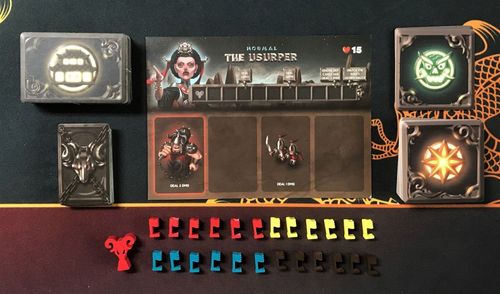
- Minion cards: The Boss will use various abilities such as attacking the player with 'Minion cards' built on the 'Boss board'. Lv 1 minion cards have basic abilities and Lv 2 minion cards have more powerful abilities.
- Boss board:
- Boss Life: You'll defeat the Boss if you deal 15 damage to the Boss.
- Boss gauge: The Boss will attack the player and unlock hidden abilities as the Boss gauge charges.
- Hidden ability: The leftmost card slot on the Boss Board is the 'Hidden ability'. Minion cards are not placed in this slot. The Hidden ability is locked at the beginning of the game but will be unlocked later as the Boss gauge charges.
- Minion card slot: You will place Minion cards on the Minion card slots. The Minion card slots have default Minions printed on them and players will put the Minion cards on them, covering the default Minions. When there are no Minion cards on the Minion card slots, the default Minion's ability will apply. Default minions are locked when you start the game and revealed as the game progresses.
Game Setup
- Players can create their own Lv2 card deck and use it while playing solo mode. Choose 9 kinds of Lv2 cards (36 cards), regardless of the class, and form a Lv2 card deck before starting the game.
- You can select Wonder Cards.
- If you include Wonder cards into your own Lv2 card deck, you'll have fewer Lv2 cards.
- 'Swamp' and 'Catapult' are not used in solo mode.
- Select 2 Trading post tiles you want to use during the game, and place them on the empty slots of the Trading board.
- Set up the game like a regular 2 player game, except:
- Place the Boss board instead of the opponent's Territory board.
- Choose the difficulty you want to play and place the Boss Board, corresponding side up.
- Quest cards and Noble house tiles are not used in the solo mode.
- Shuffle Lv2 minion cards and place them face down, on the left side of the Boss board.
- Shuffle Lv1 minion cards (4 cards) and place them on the Lv2 minion cards. Don't shuffle Lv1 and Lv2 minion cards. Now the Minion card deck is ready.
- Draw a card from the top of the Minion card deck and place it on the leftmost slot of the Minion card slots (not on the Hidden ability slot).
- Place Boss lock cards on the Hidden ability slot and the rest of the Minion card slots.
- Leave some space for the discard pile on the right side of the Boss board.
- Place the Boss gauge tracker at the starting point.
Round Order
The player becomes the first player at the beginning of the game. After a round finishes, the first player changes.
- Round 1: Purchase phase: Player's turn, then Boss's turn. Building phase: Player's turn. Action phase: Player's turn, then Boss's turn.
- Round 2: Purchase phase: Boss's turn, then Player's turn. Building phase: Player's turn. Action phase: Boss's turn, then Player's turn.
- First player changes after each round.
Additional Rules
The solo mode follows the same basic rules as a 2 player game, but there are some additional rules for each phase.
I. Purchase Phase
At the beginning of every Boss's purchase phase:
- The Boss will draw a card from the top of the 'Minion card deck' and place it on the leftmost slot of the 'Minion card slots'.
- By doing this, existing Minion cards or Lock cards at the Minion card slots will be pushed into the slots on the right side.
- If the rightmost card gets pushed, it will be discarded.
Existing cards are only pushed into the right side when there is not enough space.
- If the second slot of the Minion card slots is empty (when the default Minion is open), the existing card in the first slot will be pushed into the second slot as the new card is drawn.
- But the existing card in the third slot will not be pushed, and none of the cards will be discarded.
II. Building Phase
Nothing happens during the Boss's Building phase.
III. Action Phase
- All of the Boss abilities, including Minion cards, default Minion, and Hidden ability, are passive abilities which will be applied every action phase without rolling dice.
- On the Boss's turn of the Action phase, apply every unlocked ability on the slots sequentially from left to right. If the Hidden ability is unlocked, the Hidden ability should be applied prior to other abilities.
- When there are no Minion cards on the Minion card slots, the default Minion's ability will apply.
1. Boss's Attack
The Boss attacks the player according to priority. It attacks first-priority objects first, and then attacks second-priority objects if there are no first-priority objects. If there are no first or second-priority objects, it attacks third-priority objects.
-
First priority objects: Defense cards.
-
Second priority objects: Lv2 cards on the player's Territory board.
-
Third priority objects: Player's palace.
-
The Boss never attacks Level 1 cards and character cards.
-
If there are multiple cards at the same priority level, the player gets to choose the target.
-
If the Boss's ability specifies attack conditions such as 'Deal damage to all cards in the front row' or 'Ignore defense cards', ignore the priority and follow the instruction.
2. Boss Gauge Charging
- Minions and default Minions with 'Charge' ability will charge the Boss gauge. As the Boss gauge charges, move the Boss gauge tracker on the gauge.
- The Boss gauge ability will activate immediately when the Boss gauge charges and the Tracker gets to the corresponding spot.
- The printed gauge spots, from left to right: "Deal 2 dmg"; "Deal 3 dmg" (the spot marked 'A', where the Boss deals 3 damage to the player); "Ignore def cards and deal 3 dmg"; "Unlock the Boss's Hidden ability".
Boss Gauge Reset
- If the Boss gauge is fully charged, discard the Boss lock card on the Boss's 'Hidden ability' slot.
- Then, move the 'Boss gauge tracker' to the starting point again and restart the charging.
- If the Boss gauge fully charges again, just move the Boss gauge tracker back to the starting point because the Hidden ability is already unlocked.
- After the Hidden ability is unlocked by fully charging the Boss gauge, this ability will apply every action phase.
3. Player's Attack
If the player activates an Attack card, they can choose one between the Minion cards or the Boss itself and deal damage. If there is a Minion card with the 'Must be attacked first' ability, the player should attack that Minion first.
- If a player attacks the Boss, place a matching number of Damage counters on the Boss board to track damage.
- If a player attacks a Minion card, place a matching number of Damage counters on the Minion card to track damage.
- If a Minion card is destroyed, it goes into the discard pile. You receive loot for destroying Minion cards, just like destroying the opponent's card in the 2 player game mode.
- Loot for destroying Lv1 Minion cards: 1 gold.
- Loot for destroying Lv2 Minion cards: 2 gold.
- Hidden ability and default Minions can't be attacked.
- Because all of the Boss abilities are passive abilities, none of the Boss's abilities can be blocked.
5. FAQ
Noble house tiles (House of Dracon)
Noble house tiles can't be destroyed but House of Dracon is the only exception. House of Dracon can be destroyed to prevent an attack once. After being destroyed, place the tile into the box.
Lobbyist (Character card: "Gain a tile from the Noble house tile pool that costs 1 Quest card.")
This card can only gain tiles that cost 1 Quest card. You can't gain a tile that costs 1 Quest card and 3 gold, even if you pay the 3 gold.
Warrior (Character card: "Deal 2 damage. Can't ignore defense cards.")
Attack tokens cannot be applied to this card.
Baby King (Character card: "When an opponent uses a character card, you can use this card to cancel its effect.")
You can't use this card when your opponent sells their character card. To cancel build type character cards, you have to use it when your opponent opens the card and tries to build it.
Pirate Ship (Infantry or Pirate ship; "Deal 1 dmg when a trade card activates in your territory. Atk tokens can't apply.")
Apply the Pirate ship's ability after you complete the trading action.
Parade (School or Parade; "Gain 1 culture when a trade card activates in your territory.")
Apply the Parade's ability after you complete the trading action.
Ambassador (Market or Ambassador; "Trade once." and "Gain 1 gold when any trade card activates in your territory.")
Since the Ambassador is also a Trade card, it will also produce 1 gold every time it activates.
Sacred Tree ("Deal 1 dmg or gain 1 culture or gain 3 gold or gain 1 mineral or trade once.")
You can choose one option from 'Deal 1 damage', 'Gain 1 culture', 'Gain 3 gold', 'Gain 1 mineral', and 'Trade once' when this card activates.
Mounted Archers (Infantry or Mounted Archers; "Deal 2 damage twice. Atk tokens only apply to the first attack.")
Attack twice with 2 damage for each attack. You may choose 2 different targets with each attack. You can't do any other actions between those 2 attacks. Attack tokens will be discarded after the first attack.
Cultists (Infantry or Cultists; "Deal 3 dmg. Deal 1 dmg to this card when activated.")
Attack tokens do not apply to the damage cultists deal to themselves.
Drummer card (card shown without a printed name in this rulebook; text: "Increase all Boss's attack DMG by 1")
This ability applies to all Boss attacks, including charge abilities, Minion cards, and default Minions if this card is present on the board.