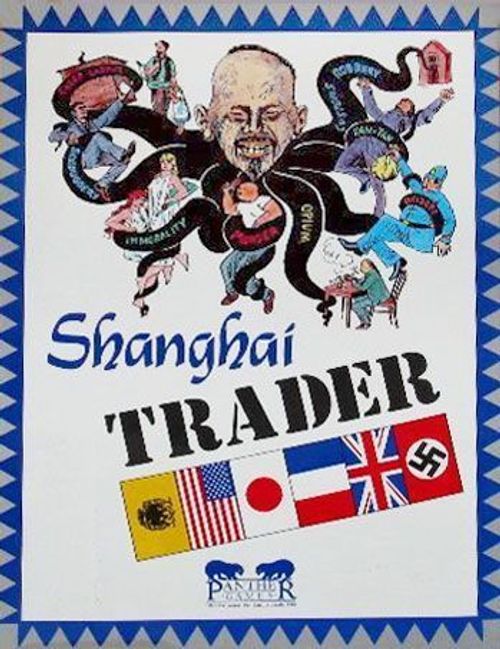
Shanghai Trader
Shanghai Trader Rulebook
Table of Contents
Table of Contents
1. Introduction
1.1 General Description
Shanghai Trader is a thrilling game of wheeling and dealing in the economic jungle of Shanghai in the early 20th century. Players represent American, British, French, German, Japanese or White Russian trading barons. You must create your trading empire and amass the largest fortune in your international bank account without succumbing to the treachery and vice of Old Chinatown, the skulduggery and unscrupulous practices of the established rackets, or the dirty tricks of other players.
Shanghai Trader can be played using either the basic or advanced rules. We recommend that players begin with the basic game. Read the first two sections of the rules and begin playing, referring to the other sections when specific details are required.
Shanghai Trader can be played by 3-6 players. When playing with more than 3 players, the fourth player plays the Russian, the fifth the German and the sixth the Japanese. This includes use of their special contractors, if playing with the advanced rules (Section 11).
1.2 Scale
The mapboard depicts the city of Shanghai, and is divided into 19 districts, each comprising a number of establishments (trading posts, warehouses, factories, utilities and/or rackets). Counters represent individual players, their employees and contractors. The game is played in yearly cycles, with one Cycle Turn and four Seasonal Turns per year. A basic game with 5-6 players lasts for 8 years and for 10 years with 3-4 players.
1.3 Aim
You must rip off the local economy for as much as you dare, and get out of the city with the biggest international bank account before the game ends. If you're still in the city at the end of the game, you've succumbed to the revolution, and forfeit your possessions, your fortune and, alas, your life.
1.4 Components
Each game should consist of:
- one box
- one map
- one rules book
- one counter sheet
- one track display
- one die
- one wad of money, comprising:
- 20 x $100ooo
- 20 x $50ooo
- 100 x $10ooo
- 20 x $5ooo
- twelve racket cards
If any of these components are missing or damaged please write, enclosing any damaged parts, to Panther Games Pty. Ltd., P.O. Box 8, Hughes, A.C.T. 2605, Australia.
1.5 Counters
There are four categories of counters - representing players, employees, contractors and markers. Player and employee counters (and passport markers) are coloured differently for each nationality. Players are represented by their respective flag counters: the duplicates are used as markers on the Initiative Track. All other markers and contractors are printed black on white.
1.6 Map
The map depicts the exotic and notorious city of Shanghai. In the centre is the International Settlement, seized by Western traders after China's defeat in the Opium Wars of 1842. The International Settlement is made up of two zones, one dominated by British concessions (bordered in red) and the other by French concessions (bordered in blue). In all there are 12 districts within the International Settlement. Each is comprised of three establishments, one being a racket and the others either trading posts or utilities.
Outside the comparatively safe (red and blue) boundaries of the International Settlement are the remaining 7 districts. The most important of these is Old Chinatown, wherein all manner of skulduggery is pursued, and where those unfortunate enough to be kidnapped (Shanghaied) end up. The other six districts contain warehouses, factories, docks, the international consulates, railway stations and the airfield.
1.7 Track Display
The display contains the Year, Turn and Initiative Tracks as well as the Shipping Table/Track and the Cost, Revenue and Sequence of Play Charts. Markers are provided to record details on the tracks.
1.8 Racket Cards
A card is provided for each racket, summarizing its nature and method of operation; further details are provided in Section 6. Individual racket cards are held by the player controlling the racket.
1.9 Money
A wad of bank notes is provided. This should be separated and each of the four denominations - $5ooo, $10ooo, $50ooo and $100ooo - placed in its respective pile on the map. You draw from and return notes to these piles (referred to as the "bank"), and may freely obtain change during play.
2. How to Play
2.1 Set-Up
Lay out the playing board and place the Track Display at the top or anywhere that's convenient for all to see. Punch out the counters and place the hourglass markers in the first box of the Year and Turn tracks and the anchor marker on any die roll number in the Shipping Table/Track.
Separate the two sets of flag counters. One set is used as markers for the Initiative Track and the other as the individual player counters. Place this latter set in a cup. Each player then determines what nationality they are by randomly selecting a counter from the cup. Once selected, place the player counters at Garden Bridge and roll a die to determine the initiative (when they move) for the first year - see Section 2.4. Use the other set of flag counters to indicate who has the highest initiative by placing their counter in the "1st" box and so on.
Place the tong (dragon) counter and the three general courtesan (heart/$) counters in the Tong and Brothels districts respectively of Old Chinatown. Place the three police counters in the Shanghai Club; the two monks in the Bubbling Well Road Monastery; the two ships in the Great Orient Shipping Line; the Lido Courtesan (fan) in the Lido Nightclub; the customs inspector in the Customs Swindle; the passports in the International Consulates; and the thug (pistol), mugger (cosh) and assassin (scope) markers just off-board but within easy reach.
Separate the money into the four denominations ($5ooo, $10ooo, $50ooo and $100ooo) and place them in their respective piles on the map. Players then draw $100ooo each, in any denominations they like, as their initial cash-in-hand. Cash-in-hand should be kept in your hand or pocket and money in the bank should be placed in an envelope marked "BANK".
Place the twelve racket cards in a pile just off-board. You are now ready to start. Good luck - you're going to need it.
2.2 Sequence of Play
Each year comprises a Cycle Turn and four Seasonal Turns (winter, spring, summer and autumn). The Turns are composed of phases which must be completed in sequence. Some phases are themselves divided into segments, which also must be completed in sequence. The term 'active player' is used to refer to the player who currently has the initiative and is therefore moving.
The sequence of play for each year is:
- Cycle Turn
- Revenue Phase
- Initiative Phase
- Collusion Phase
- a. Negotiations Segment
- b. Deployment Segment
- c. Exchange Segment
- Winter Turn
- Shipping Phase
- Event Phase
- Movement Phase - each player, in order of initiative:
- a. Moves their player counter.
- b. Pays any fine.
- c. Purchases an establishment.
- d. Hires any one general contractor (ie. thug, mugger, assassin) and/or any number of special contractors (spy, lido courtesan, customs inspector, tongs, general courtesan)
- Spring Turn (as above)
- Summer Turn (as above)
- Autumn Turn (as above)
2.3 How to Play
You start each year (except for the first - see below) by working out how much money/revenue you receive. Count up the number of independent trading post and functioning trading pyramids (see Section 4) you have and consult the Revenue Chart on the Track Display to work out how much you receive. You can never get less than $20ooo, even if your trading empire has been totally wiped out. You may also have to pay the owner of the Transport Company for each functioning factory you operate.
Next on the agenda is determining Initiative, or the order in which players move. Each player counts how many player and employee counters they have on the board. The player with the most puts his/her initiative marker in the '1st' box of the Initiative Track, the second highest in '2nd', etc. Tied results are decided by a die roll - highest going first.
Collusion follows. Players are free to publicly or privately negotiate agreements, offer bribes, threaten, cajole, or grovel their way in or out of deals. After say five minutes of negotiation players should return to the playing area - no more private negotiating till next year.
The owner of the Shanghai Club then deploys the three police counters into any three districts within the International Settlement (there is no additional effect for having more than one police counter in a district). The owner of the Bubbling Well Road Monastery then does likewise with the two monk counters and then the White Russian minder (affectionately known as Terry) is given to whoever he is minding.
Now players get their only opportunity to transfer control or exchange trading posts, warehouses, factories or rackets. This ends the yearly Cycle Turn so advance the turn record marker into Winter.
Each of the four Seasonal Turns are identical. The first thing that happens is shipping. Each winter the owner of the Great Orient Shipping Line (or, if unowned, the player with the highest initiative) rolls a die and with the anchor marker indicates the result on the Shipping Table. The result determines the number of ships arriving each turn that year. Each Shipping Phase the owner of the Great Orient decides at which dock the ship arrives. When two ships are arriving in the same turn they must go to separate docks. If no one owns the Great Orient, refer to the schedule at the bottom of the Shipping Table to determine where each ship arrives. Indicate which dock(s) are receiving the ship(s) by placing a ship marker at the dock(s).
Immediately flip over to their "serviced" side all overseer counters on the dock, unless they are compromised by a courtesan, closed down by a customs inspector or the owner does not want the warehouse serviced. Note that an overseer purchased during the turn cannot be "serviced" until the following Shipping Phase. This is important, because serviced warehouses produce much greater revenue.
It's now special event time. The Turn Track indicates which event. Refer to Section 5 for details on which racket runs it and how. If the appropriate racket is unowned, the event does not take place.
Next, players conduct their movement. Each player moves separately beginning with the player with the highest initiative. When you're moving you are the "active" player. First, you move your player counter. Indicate the district you want to move to and roll a die. Each location within a district has a number range between 1 and 6 printed on it. The result of the die roll tells you which location you should place your player counter.
If you move to any of the districts outside the International Settlement and you roll a 6 you're shanghaied to Old Chinatown and must roll again to determine which den of iniquity you've been dragged into - see Section 7 for details.
There are a few instances when you can make an automatic move (ie. you can choose which location you wish to be placed in without having to roll). You can move automatically to any racket you own or to a racket owned by another player if they allow you. If you control both trading posts in a district you can move automatically to its racket and purchase it. When escaping you can move automatically to the International Consulates and the Airport.
Note each player must move somewhere each turn. You can stay put only if you could make an automatic move to that location.
You may immediately move again if you land on a railway station. You have the same option if you land on the airfield, but in this case must pay $5ooo to the owner of the Transport Company to do so. If the Transport Company is not owned the fee is waived. If you land on an establishment that is owned by another player (ie. has an employee counter) you must pay a fine of $5ooo to that player, unless otherwise agreed.
If you end up in a trading post, warehouse, factory or racket that is not already owned, you can buy control of it by purchasing a coolie, overseer, manager or racketeer as appropriate and placing its counter in the establishment. Purchase costs are detailed in the Costs Chart on the Track Display. Note that before you can purchase a racket you must control both trading posts in the district: except for the Shanghai Club - see Section 6.
Having finished moving and purchasing you can now hire any contractors. These can be hired and used in any order you wish. You can hire only one general contractor (ie. thug, mugger or assassin) but, subject to their specific provisions, any number of special contractors - see Section 3.3 and 11.4 for details. The reasons for using these hired contractors is to hinder, interfere or attack your rival players and their interests.
After all players have gone through this routine the turn ends, the track marker advanced and a new seasonal turn begun. At the end of Autumn the year is over, the track markers adjusted and a new year begun, starting with another Cycle Turn.
As play proceeds, you should go to either the Currency Trader or the Imperial Trading Banks and deposit some of your accumulated wealth into your international bank account. Money must be deposited (or withdrawn) in lots of $50ooo. If you use the Currency Trader you will have to pay the owner a commission for the service, unless otherwise agreed - see Section 8.2.
Towards the end of the game you should start looking to escape. This involves buying a passport from the International Consulates and flying out in one piece from the airport. In the last year of the game there is no shipping, special events or contractors other than assassins and bodyguards - see Section 10 for details.
If you fail to get out of the city alive when the game ends you have fallen foul of the revolution and needless to say do not win the game. If you do get out and have the largest international bank account you've won the game. Please note that your cash-in-hand is worthless to you at the end of the game and does not count towards determining who won.
2.4 First Year Provisions
In the first year there is no Revenue or Collusion Phase and initiative is determined by each player rolling a die. The highest roll goes first, the second highest goes second and so on. Tied results are rolled again. In addition, there is no shipping or special events.
Start playing your first game now. Refer to the following sections as you need specific details.
3. The Playing Pieces
3.1 Players
Players are represented by their own individual counter, which bears their nation's flag. (A duplicate counter is used to record the player's initiative.) Player counters are moved each Seasonal Turn, cost nothing to maintain, and can only be eliminated by an assassin.
3.2 Employees
Whenever you purchase an establishment, you automatically hire an employee to look after it. Thus a coolie, overseer, manager or racketeer counter is placed in a newly acquired trading post, warehouse, factory or racket. Employees can never move and cost nothing to maintain (their cut has already been factored into the revenue figures).
Coolies can be eliminated by thugs; overseers and managers by tongs; and racketeers are immediately removed from play if you fail to control at least one trading post in the racketeer's district. (Note that once gained, control of the Shanghai Club can never be lost).
3.3 Contractors
These are specialists hired to do certain rather dirty one-off jobs. Some are automatically controlled by whoever controls a particular racket. The remainder can be hired by the active player. If you control a contractor and hire him/her out to another player, you cannot withdraw that contractor until the end of the year. If you lose control of a racket, any controlled contractor "out on the job" is immediately withdrawn and cannot be used again until the next year.
As the active player you can hire no more than one general contractor (ie. thug, mugger, assassin) and any number of special contractors (ie. all others).
Lido Courtesan. The Lido Courtesan is a high class prostitute and is controlled by the owner of the Lido Nightclub. Each year he/she (we're liberal minded) can be used once to target one player. This can be announced during the controlling player's Movement Segment of any Seasonal Turn. If a deal cannot be struck between the owner and the targeted player, a sex scandal will occur if the Lido Courtesan gets to the North China Daily Mail before the targeted player. If so compromised, the targeted player must immediately lose half their cash-in-hand (rounding up to the nearest $5ooo).
Customs Inspector. The customs inspector is controlled by the owner of the Customs Swindle and can be used, during any Seasonal Turn, to raid one warehouse per year. If a deal cannot be struck between the two players involved, the owner of the Customs Swindle rolls a die and the inspector uncovers some illicit goods and temporarily closes down the warehouse. He does this by placing the inspector counter on top. A 5-6 means insufficient evidence was found and there is no effect. The die roll is modified by +3 if protected by a Japanese Marine Detachment. Even after a successful customs raid, the parties can do a deal to remove the inspector. If the Inspector is still on top of the warehouse in the next Revenue Phase, it cannot function as part of a trading pyramid. The inspector is removed at the end of the Revenue Phase.
Police. The three police contingents are controlled by the owner of the Shanghai Club. During the Deployment Segment of the Collusion Phase, they must be placed in one or more of the districts in the International Settlement, except Bubbling Well Road. They add +2 to any thugging and mugging die roll in the district and prevent monks from entering. They have no effect on courtesans or assassins. There is no additional effect for having more than one police counter in a district.
Monks. The two gangs of monks are controlled by the owner of the Bubbling Well Road Monastery. They run a nice little protection racket in whichever district of the International Settlement they are deployed to, during the Deployment Segment of the Collusion Phase. Each Seasonal Turn they can extract $5ooo from each coolie in the district. They also add +2 to any thugging and mugging die roll in the district. They cannot be placed in a district that is under police protection. They have no effect on courtesans or assassins.
Tongs. These are controlled by no-one, but may be hired to loot and pillage a warehouse or factory. To hire them you must voluntarily and successfully move to their establishment in Old Chinatown and pay $20ooo. You then place their counter on top of the targeted warehouse or factory and roll a die. A 1-4 means the target is looted and the resident overseer or manager killed or chased off (the owner losing control of the warehouse or factory). A 5-6 means they may have got the wrong address. Roll the die again. The result is the location within that district they actually went to, which may be the original target! If a 6 is rolled, they have decided the fee wasn't enough and have gone back to Old Chinatown. Japanese Marine Detachments provide protection against the Tongs - see Section 11.4.
General Courtesans. These three not-so-high class prostitutes work similar to the tongs but are hired to compromise overseers and managers. To do so you must voluntarily and successfully move to the Brothels in Old Chinatown and pay $20ooo. You can only hire one courtesan per Seasonal Turn and only three can be in play at any one time. Place their counter on the selected overseer/manager and roll a die. A 1-4 and the overseer/manager is compromised (place the courtesan counter on top). A 5-6 means their charms have not worked, and its back to the Brothels. Successful courtesans are removed at the end of the next Revenue Phase or earlier if the parties do a deal.
Thugs. As the active player, you can hire a thug for $10ooo to eliminate a coolie. The contract lasts only for that Seasonal Turn and cannot be used outside the International Settlement. Indicate the target by placing the thug counter on top and roll the die. A 1-4 kills the coolie. A 5-6 means the thug has botched it (long live Bruce Lee) or run off with the money. The die roll is modified by +2 if there is a police or monk present in the district.
Muggers. These work in the same way as thugs, but cost $30ooo, and target individual player counters. A 1-4 means they are successful and the targeted player loses half of their cash in hand (rounding up to the nearest $5ooo). Muggers cannot be used outside the International Settlement. The die roll is modified by +2 if there is a police or monk present in the district or by +3 if the target is protected by the minder - see Section 11.4 (these modifiers are not cumulative). To appease Buddha and atone for their sins, all successful muggers must pay half their take (rounding up to the nearest $5ooo) to the owner of the Temple of the Jade Buddha. The remainder is placed in the bank.
Assassins. As the active player, you can hire an assassin to try and eliminate an escaping player (ie. one with a passport) at the airfield. They cost $40ooo and kill on a die roll of 1-4. The die roll is modified by +1 for each bodyguard protecting the target. The minder also has an effect - see Section 11.4. Assassins cannot be used against a player in the International Consulates. Once hit by an assassin a player is out of the game - that's Shanghai.
Bodyguards. When you're escaping to the airfield, you can hire up to three bodyguards to protect you from assassins. Depending on whether you pay nothing, $25ooo, $50ooo or $100ooo, place your counter in the Nil, one, two or three bodyguard box at the airfield. Assassination die rolls will then be modified by Nil, +1, +2 or +3 until you escape, return to the International Consulates or are eliminated. Once hired bodyguards protect you until either you escape or move back to the International Consulates. During subsequent Movement Segments, you can upgrade your protection to the maximum of "3" bodyguards, by paying the difference. (Eg. by paying an extra $25ooo you could move from the "1" box to the "2" box and with $75ooo you could move to the "3" box).
4. Trading Pyramids
4.1 General
While trading posts can operate independently, warehouses and factories need to be supported in a trading pyramid. A warehouse pyramid consists of just two trading posts and a warehouse. A factory pyramid consists of two trading posts, a warehouse and a factory.
In supporting a pyramid, the location of the trading posts, warehouse and factory does not matter. Different trading posts and/or warehouses can be used from turn to turn.
All elements of the pyramid must be operating at the commencement of the Revenue Phase. To stop a trading post operating you have to successfully thug it out: extorting money through the use of the Monks does not stop it operating. Warehouses and factories can be put out of operation by the Tongs and/or courtesans.
The amount of revenue received from a trading pyramid is detailed in the Revenue Chart and depends on whether the warehouse was serviced by shipping in the previous year.
5. Special Events
5.1 General
During the Event Phase of each Seasonal Turn, all players must participate in the special event listed on the Turn Track. The event will be organized by one of the rackets. If the racket concerned is uncontrolled then no event takes place. There are no events in the first year. No matter where they are players participate without moving their individual player piece - after all, its only for one day or night.
5.2 Gala Performance
The notorious Lido Nightclub commences each year with its spectacular Gala Performance, in which all players throw discretion to the wind, and partake in its activities. Some unfortunately throw too much discretion to the wind and end up causing a scene. In order to protect their reputations such players have to pay dearly to suppress the details. All players, other than the owner, roll a die. If you roll a 1-2 you cause a scene and must pay the owner $20ooo, unless otherwise agreed.
5.3 Roulette Rouble
For one special night each year the famous Frenchtown Casino buzzes with the excitement of roulette rouble, where all players, other than the owner, must wager a minimum of $10ooo in a frenzied gambling spree on the special house roulette wheel. More can be wagered, up to a maximum of $50ooo, at each player's discretion. Each player specifies the amount of his/her wager, rolls one die and consults the following table:
| Die roll | Result |
|---|---|
| 1 | A great night. Collect twice the amount of the wager from the bank. |
| 2 | Well done. Collect an amount equal to your wager from the bank. |
| 3 | You came out even. No effect. |
| 4-6 | No hard feelings. Pay your wager to the owner of the Casino (or if you are the owner to the bank). |
The owner of the Casino subtracts one from his/her die roll.
5.4 Bastille Day Bash
The French Club hosts the annual Bastille Day celebrations by turning on a huge feast, which all players must attend. In true Shanghai-French style the owner can single out one or more of the guests to pick up the tab. The maximum size of the tab is $50ooo, though this can be reduced at the owner's discretion and of course ends up in his/her pocket.
5.5 Picnic Races
Each autumn the Shanghai Racetrack runs the picnic races and all players must have a flutter of $10ooo. The bets are placed in a prize pool on the table, which is then increased by 50% (rounding up to the nearest $5ooo) from the bank. The owner now has the option to take 50% of the pool (rounding up to the nearest $5ooo) and withdraw from the race or else continue and take his/her chances on the die roll.
Each player then rolls a die, with the highest roll winning the prize pool. Tied results are decided on a further die roll. The owner adds +2 to his/her die roll(s).
Example. The prize pool from five players would equal $50ooo + $25ooo from the bank, totalling $75ooo. The owner could withdraw and take $40ooo from the pool, but decides to have a go. The owner rolls a 4, which becomes a 6. However, another player also rolls a 6, so the two roll again. This time the owner rolls a 2, modified to 4. But the other player rolls a 5 and wins the $75ooo. (Oh! How we love to see the owner miss out.)
6. Rackets
6.1 General
There are twelve rackets, located one per district, inside the International Settlement. All rackets begin the game uncontrolled.
You gain control of a racket by first controlling all trading posts in the district; then spending one turn to make an automatic move to the racket and purchasing a racketeer at the rate indicated on the Racket Card. The Shanghai Club, having no trading posts in its district, is controlled by merely landing on it and purchasing the racketeer, as above. You indicate control by placing one of your racketeer counters in the racket. Note you cannot employ a racket's special contractor on the same turn you acquired the racket.
Once gained, you can only lose control of a racket by losing control of all trading posts in the district (ie. you must retain control of at least one). Control of the racket is lost immediately should this occur. Exception: once gained, you can never lose control of the Shanghai Club.
Upon agreement, you can transfer control of any racket to another player during the Collusion Phase.
6.2 Effect
The details of how each racket works and its effect on play are summarized on the Racket Cards, which you acquire when you gain control. Each racket has its own unique effect on play, ranging from special events; contractors; skimming money; controlling shipping; gambling rip-offs; protection; and economic concessions.
7. Old Chinatown
7.1 General
Old Chinatown is the "red light" district of Shanghai and has a reputation of "anything goes". It consists of four establishments, notorious for one vice or another. You may voluntarily move to Old Chinatown, determining which establishment in the usual way. Alternately you may be shanghaied there. The effects of each establishment vary according to whether you moved there voluntarily or were shanghaied.
7.2 Shanghaied
If you move to a district outside the International Settlement and roll a 6, you're kidnapped or "shanghaied" to Old Chinatown by the tongs. If you own the Temple of the Jade Buddha you get a second chance and roll again. If you roll another 6 you're shanghaied, otherwise you immediately and automatically move to the Temple.
If shanghaied from across the river, you do not have to pay the ferry charge (the tongs were not allowed on the ferry). Once shanghaied you must roll again to determine which establishment you've been dragged to and refer to the following sections for details on what happens next.
7.3 Fan Tan Gambling
If shanghaied you must wager half your cash-in-hand (rounding up to the nearest $5ooo). A 1-4 means you have lost the wager (half of which, rounding up to the nearest $5ooo, is pocketed by the owner of the Frenchtown Casino). A 5-6 and you've doubled it - anything goes in Old Chinatown.
As a volunteer you must wager a minimum of $10ooo (or up to $50ooo if you wish). A 1-3 you lose: a 4-6 and you double your wager (ie. you get the wager back plus an equal amount from the bank).
7.4 Brothels
If shanghaied you must roll a die and consult the following table to see what percentage (rounding up to the nearest $5ooo) of your cash-in-hand is lost to the pimp:
| Die Roll | % |
|---|---|
| 1 | 10 |
| 2 | 20 |
| 3 | 30 |
| 4 | 40 |
| 5 | 50 |
| 6 | NIL (they liked you) |
As a volunteer you may hire a courtesan to compromise an overseer or manager - see Section 3.3.
7.5 Terror of the Tongs
If shanghaied you automatically lose half your cash-in-hand (rounding up to the nearest $5ooo).
As a volunteer you can contract the Tongs to do-over a warehouse or factory - see Section 3.3.
7.6 Opium Dens
If shanghaied you must immediately pay a once only fine of $40ooo. In subsequent turns you must roll a 1-3 to get out, otherwise you're "hooked" for another turn. Once you roll a 1-3, you can immediately make a normal move to whichever district you like.
As a volunteer you have the option to either immediately pay the fine and thereby move freely in the subsequent turn, or not pay the fine and take your chances on rolling a 1-3 to move next turn. Having decided not to pay, you can't get the option in subsequent turns.
8. Utilities
8.1 Imperial Trading Banks
To deposit or withdraw money from your international bank account, you must either use the Currency Trader or the Imperial Trading Banks on the Bund. Using the Imperial Trading Banks is free and there is no need to declare the details. However you must first successfully move there (ie. roll a 1-2).
While at the banks you may freely transfer money, in multiple lots of $50ooo, from or to your account. We recommend players use an envelope for holding the wad of notes that hopefully will accrue in the bank.
8.2 Currency Trader
This provides an alternative banking service. It works the same as the Imperial Trading Banks, except that, subject to the owner's permission, you can automatically move there. However, you will have to pay the owner a commission on the transaction (deposit or withdrawal), unless otherwise agreed. A 10% commission is recommended. To use the Currency Trader all players, including the owner, must spend a turn moving there.
Each Revenue Phase the owner receives 10% interest on his/her international bank account. This is paid out from the "bank" as cash in hand.
8.3 North China Daily Mail
In addition to its role in the Lido scandals, the North China Daily Mail is a useful place to go to obtain details of another player's money, both cash-in-hand and in the bank. The selected player must inform you (we recommend in writing) how much money he has in each. If trust has already fallen by the wayside, you can elect to physically inspect the amounts.
8.4 International Consulates
Apart from its important role in the escape process - see Section 10 - and offering a safe haven against muggers and assassins, the International Consulates at Garden Bridge have no other effect on play.
8.5 Railway Stations
If you land on a railway station you get the option to roll again. As long as you keep landing back there you can keep on rolling. However, you cannot try and move to another district.
8.6 Airfield
This works the same as the railway stations, except that you must pay $5ooo to the owner of the Transport Company for each extra roll, unless otherwise agreed. This fee is waived if no one owns the Transport Company. In addition, the airfield is the place you must go to to escape from Shanghai - see Section 10 for details.
9. Loans, Auctions and Deals
9.1 Loans
You may freely borrow from and lend money to other players at any time during play.
9.2 Auctions
If you cannot pay a fine or meet an obligatory commitment, you must immediately auction off a controlled establishment or, if there are no takers, cash it in to the bank for half its purchase price. You cannot voluntarily cash in an establishment. Thus you can't auction-off a racket to buy a warehouse or to hire a contractor.
9.3 Deals
Within reason any financial deal is possible. You are free to vary or waive fines, charges and commissions. While the wagers on the Roulette Rouble and Picnic Races are fixed the owner can always pay back to the hapless players all or part of any money wagered. However, the fines, wagers and losses incurred in Old Chinatown and the purchase cost of employees, general contractors and passports are all fixed.
10. Escape
10.1 Escaping
To win, you must first get out of Shanghai alive. Technically this is an easy task but time and assassins are usually against you.
As the active player you can make an automatic move to the International Consulates and either purchase your passport for $50ooo or pay nothing and roll the die. If you roll a 5 you get your passport for free. Otherwise you stay in the queue at the Consulates until next turn, when you again have the option to buy or roll.
You can stay at the International Consulates for as long as you like. In any subsequent turn, you can move automatically to the airfield and, if you have the money, purchase one or more bodyguards - see Section 3.3.
Each turn thereafter you can roll to escape. A 1-3 means you have successfully escaped. A 4-6 and you'll have to wait for another plane (or a bullet as the case may be). Note that you'll have to run the assassins' gauntlet for at least one turn.
You can elect to forego an escape roll and instead move back automatically to the International Consulates. However, once you've got your passport you may never move elsewhere in the city.
10.2 Last Year
In the last year of the game there is no shipping or special events. All contractors, other than assassins, bodyguards and the minder are out of play.
10.3 Effects
If you escape, you immediately lose all your cash-in-hand (now declared illegal tender by the revolutionary government) but retain money in your international bank account. You cannot re-enter or participate in further play, including collusion and lending money. You automatically lose control of all on-board assets, including special contractors, and any benefits these provide. For example, if you were the owner of the Currency Trader you could no longer accrue interest on your bank account.
11. Advanced Game
11.1 General
Once you have mastered the basic game add any or all of the following rules to spice up the action.
11.2 Sudden-Death Ending
Rather than have the "last year" fixed at year 8, roll a die at the start of year 6. If the result is a 6 the game finishes at the end of that year. Otherwise roll again at the beginning of year 7. If the result is still not a 6 the game continues until it automatically finishes at the end of year 8. (Transcription note: the printed text is cut off at this point, reading "h automatically finishes"; read here as "it automatically finishes", which matches the sense of the rule.) The same procedure is followed when there are only 3-4 players, but from years 8-10.
You can increase the probability of an early ending by opting to end the game on a roll of 5-6 or even 4-6. Note that the "last year" provisions of Section 10.2 come immediately into effect if a 6 is rolled.
11.3 Variable Game Length
If you want a longer or shorter game you can nominate your own maximum duration. You can combine this with a sudden death ending, even extending the range of years in which you roll. For example a 5-6 player game could run for 15 years with the possibility of a sudden death ending beginning with year 11.
Shorter games reduce the scope for involved faction fighting and to a degree lessen the effectiveness of certain rackets and contractors. Longer games provide plenty of scope for using all contractors and allow Old Chinatown to come into its own.
11.4 National Differences
To better reflect some of the historical differences, each nationality has been given a special privilege or contractor.
Exclusive Control of Rackets. The Shanghai Club, the French Club and the Currency Trader can only be controlled by the British, French and American players respectively. Any player can control the other rackets. Control is not automatic: you still have to gain control of the trading posts in the district, or in the case of the Shanghai Club just move there. Control of the Shanghai Club, the French Club and the Currency Trader can never be transferred.
Japanese Marine Detachments. The two marine detachments are controlled by the Japanese player, who in the Deployment Segment, places them on any warehouse or factory within the four dock districts. They can be contracted out to guard the warehouses and/or factories of other players. They add +3 to any initial Tong die roll and send the Tongs packing back to Old Chinatown if they land there on a second die roll. In addition, they add +3 to any die-roll by the Customs Inspector. There is no additional benefit for having both detachments guarding the one warehouse or factory. They have no effect on courtesans.
White Russian Minder. The minder is controlled by the Russian player, but can be leased out for the year to another player during the Collusion Phase. While protected by the minder, all mugging die-rolls against you are modified by +3. If an assassination attempt against you is successful and you are protected by the minder the assassin must roll again. A 1-4 means the minder sacrifices his/her life so that you escape unscathed. A 5-6 means the minder bites the bullet but alas so do you. The minder does not protect you from courtesans or from being 'shanghaied'.
German Spy. The spy is controlled by the German player and can be used each year to target one player. If a deal cannot be struck, there is an automatic diplomatic scandal and the targeted player is immediately placed in the International Consulates. The German rolls a die. On a 1-2 the target must spend his/her next turn in the Consulates doing nothing (though they can still hire contractors). A 3-4 and it's the next two turns; a 5-6 and it's the next three turns.
12. Miscellaneous
12.1 Historical Background
Shanghai Trader is based on the true story of the "wickedest city in the world". For over one hundred years, Shanghai was an adventurer's paradise for the international traders who flocked to the city to make their fortunes. Although Shanghai had been an important Chinese district city as early as 1360, it was not until the 19th century that the "real story" began.
In 1842 China was defeated in the Opium Wars and was forced, through the Treaty of Nanking, to cede Hong Kong to Britain and to allow foreign settlements in Shanghai and the so-called "treaty ports". Under the treaty, British merchants were given concessions to trade in a muddy swamp between Soochow Creek and the walled city (Old Chinatown).
The British merchants wasted no time in moving-in and were soon followed by the French and Americans. All were keen to take advantage of the fabulous trade in silk, tea and opium. Both Britain and France actually controlled portions of the city (represented on the board) and the Americans manipulated the city's financial institutions. Shanghai became an extraordinary Western oasis in the midst of the turbulent and mysterious Eastern continent of China.
The strategic value of Shanghai was enormous, as all the riches of the East flowed down the nearby Yangtze River past the city to the sea. As the city prospered and flourished during the first half of the twentieth century, the Westerners ruled supreme inside. Shanghai grew to become the fourth largest city in the world and even in the last years (before the city fell to the Communists in 1949) was still the most prosperous and busiest port in Asia.
The unique International Settlement was maintained by its own municipal council, police force and customs authority. There was even a volunteer force to protect the international trading community. The city was studded with glittering nightclubs, glamorous hotels, exclusive clubs (catering solely for the Western traders) and mysterious temples. It became famous for the great trading houses of the wealthy "taipans" and the imperial banks lining the waterfront of the Bund.
Amidst the opulence, most Chinese tried to scratch a meagre living and drowned in a sea of poverty and exploitation. The streets teemed with beggars and prostitutes; and in evil slums, brothels and opium dens every conceivable crime and vice proliferated.
The legends of Shanghai multiplied throughout the 20th century - the vice, depravity and corruption giving it an infamous reputation. To be "shanghaied" meant to be kidnapped for some evil or nefarious purpose. Anything or anybody could be bought or sold in a city worthy of the fictional characters of Charlie Chan and Fu Manchu.
The city believed itself "above war and politics unless a profit was to be made". The traders and taipans continued to sip gin and tonics in the Long Bar of the Shanghai Club as the rest of China went through the political upheavals of the 20's and 30's. But ultimately the old Shanghai was doomed. The Japanese seized Hongkew (North Shanghai) during the 30's and swallowed up the International Settlement during the Second World War.
Even after the war, as the city spiralled into a giddy whirl of speculation and inflation, the traders returned to recover their fortunes. But all was in vain, for in 1949 the most famous symbol of Western exploitation in Asia fell to the triumphant forces of Mao Tse Tung. With the fall of the "sin city" an era had come to an end.
Although Shanghai Trader is set in China, it has been designed as the classic game of Western exploitation of the Third World. If you want to know why the East is Red, why they toast the Kremlin in Havana, or why there is unrest from San Salvador to Johannesburg play Shanghai Trader.
12.2 Player Notes and Hints
Most games of Shanghai Trader have three discernable stages; acquisition of trading empires; collusion and collision between players (when most skulduggery is practised); and escape.
Early Moves - The First Stage. Players are advised to obtain some trading posts and thereby establish the base of their trading pyramids as soon as possible. One proven strategy is to gain control of two trading posts and then purchase a warehouse and factory. This has to be offset against the advantages of controlling a racket early on, especially one of the four conducting a special event.
In the advanced game the British, French and American players have the option of leaving those rackets reserved for their exclusive control until after they have gained control of one or more of the other rackets. However, be wary that other players don't grab one or more of the trading posts in these districts and make it hard for you to claim them later.
Collusion and Collision. There are plenty of options and opportunities for skulduggery against players either through rackets, contractors and Old Chinatown. Don't be afraid of using Old Chinatown but always have at least $40ooo on hand in case you're unfortunate enough to land in the Opium Dens and have to pay a fine.
Be careful not to antagonise too many players at the one time by indiscriminate use of contractors and the more punitive contractors. Fighting thugging and mugging wars can be a very costly and time consuming past-time.
Also be wary of the "tall poppy" syndrome. Avoid being seen by the other players as the richest and most powerful, or you'll end up targeted for a gang-up and rub-out.
Always keep enough cash-in-hand to cover your yearly expenses: don't forget the special events. At the same time avoid having too much cash, in case you're mugged, shanghaied, or targeted by the Lido Courtesan. Go to the bank regularly. Often it's worth using the Currency Trader: while it costs more money it can save valuable time.
It's a good idea to have a little depth in your trading pyramids by securing an extra trading post. That way you can afford to lose one just prior to a Revenue Phase, a good offensive tactic worthy of note.
Escape. Don't leave building-up your international bank account until the last minute - if you can't get access to the Currency Trader you may run out of time trying to get to the Imperial Trading Banks.
Provide enough time to plan and execute your escape: three turns is the bare minimum. If you've got plenty of money in the bank and can afford the bodyguards, it's worth maximising your chances of escaping by making your run early. If not so fortunate, you'll have to risk hanging about and hiring a few assassins to cut down the early birds. Remember, even if there is no money in your bank account, you still win if you're the only one to escape.