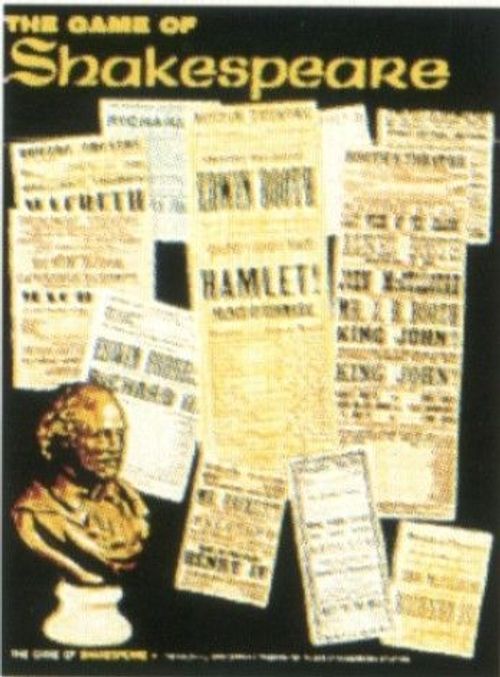
Shakespeare (1966)
Shakespeare (1966) Rulebook
Table of Contents
Table of Contents
Overview
Shakespeare is played by moving chesspieces around the playing board by roll of the dice. The object is to be first into the Globe Theatre at the center of the board.
In general players act on the instructions printed on many of the board spaces. Those spaces that contain no play instructions serve to identify each Play as to whether it is a Comedy (smiling mask), a Tragedy (sad mask) or an Historical Play (crown.). Some spaces also give brief outline sketches of the most popular of the Shakespearean Plays.
All 37 Shakespearean Plays are found in synopses form in the 52-page booklet that also contains identification of all quotation cards, a chronology of English Kings plus a biography of the great bard himself.
Basic Game
Knowledge of Shakespeare is not necessary. The game is fun in itself without relying on familiarity of the plays. A fringe benefit is the absorption of information about Shakespeare's creations without having to make a conscious effort to do so.
Prepare for Play
Players select 3 chesspieces each of the same color and design. Players then select one of the 4 characters (Othello, MacBeth, Hamlet, or Romeo and Juliet) and places all 3 of their chesspieces on their respective corner spaces. One player is designated to shuffle all 112 quotation cards placing them in one pile anywhere near the board, face down, showing Shakespeare's portrait up. Each player then rolls the dice, highest number to move first, followed by the other players to the right, in counterclockwise order.
— Shorter game: When 3 or 4 players are participating in the game, each player can use two chesspieces rather than 3, if desired, to reduce the length of the game.
How to Play
-
Player who goes first rolls the dice and moves one of his 3 chesspieces the total of the dice-roll. Movement is counterclockwise. He then acts on the instructions of the board space, if any, he has just landed on. If no further action is necessary, play moves on to the next players in sequence.
-
All remaining players take their turns and play continues in like manner until all chesspieces have been moved out of their respective starting corners.
-
As soon as all chesspieces are out of the starting corners, play continues the same except that players are allowed to move only their rear-most chesspiece when acting on the dice-roll.
-
Each chesspiece must be moved around the board once. When it returns to its corner starting space, it is then moved up the diagonal ladder toward the Globe Theatre.
-
Players receive extra turns every time they roll doubles. Upon throwing a double, continue playing the same chesspiece, do not switch to another.
-
When cards send you or opponents backward or forward, only one chesspiece is involved—for yourself it's the one you have in play, or for the opponent it is the next piece eligible for playing. Such a move cannot eradicate a player's loss of turn, if on such a space to start.
-
On instructions to go to nearest comedy, history, or tragedy, movement is made only to those printed on Pink spaces.
To repeat: Only one chesspiece can be moved per turn — and it must be moved the full number of the dice-roll.
How to Win
The winner is the first player to get all 3 of his chesspieces into the Globe Theatre. It is not necessary to move into the Globe Theatre by exact count of the dice.
Board Instructions
-
If a player lands on a PICK CARD space, he takes the top Quotation Card and immediately acts on the instructions printed in red. If such instructions land him on another PICK CARD space, he acts again and so on until he eventually lands on a space containing no further instructions.
-
Once a chesspiece has moved to a new location, and new instructions are received from the board or Quotation Cards, such instructions apply only to the chesspiece that has just been moved (unless otherwise stated). A "Lose Turn" refers to the player, himself, and applies to his next round. That player is still entitled to any bonuses of current turn, such as rolling again via a doubles roll.
-
If the board does not contain any spaces ahead upon which the instructions of a Quotation Card can be used, such instructions are ignored and play passes to the next player.
-
Movement of a chesspiece as directed by an opponent's Quotation Card can be applied to any chesspiece rather than just the rear-most one. Opponent decides which one to move.
-
If a player is instructed to move back, no chesspiece can move back beyond its starting corner space.
-
If a chesspiece is moved by instructions from an opponent, that chesspiece does not act on the instructions of the space just moved to. If it lands on an occupied space, it is placed on the first empty space behind the occupied space.
Landing on Occupied Spaces
-
No space can contain more than one chesspiece.
-
If a player lands on a space already occupied by one of his own chesspieces, he rolls the dice again and moves either chesspiece forward. If a doubles on the dice has caused the player to have the double occupancy, the extra throw is still available after tossing an interim roll to move out of the double occupancy. (Exception: A doubles which is thrown in getting out of double occupancy does not give an extra dice-toss to the player.)
-
If a player lands on a space occupied by an opponent's chesspiece, he ignores any board instructions. Instead, he takes the top Quotation Card and acts on its instructions. If such instructions land him on another occupied space, he continues playing until he eventually ends up on an unoccupied space containing no further movement instructions.
-
If a card's instructions do not seem applicable, the card may be placed in the discard pile and the next card taken.
Advanced Game
Knowledge of Shakespeare is still not necessary. However, elements of judgment and skill are introduced into the game. For full flavor and enjoyment we suggest that the Quotations and the movement instructions be read aloud. All of the basic game rules apply including those indicated here:
-
Players are not required to move their rear-most chesspiece. They have a choice of moving any one... but only one during their turn.
-
If a player lands on a space occupied by an opponent, he ignores the board instructions and he does not take a Quotation Card. Instead, he moves his chesspiece forward an additional 4 spaces and moves his opponent's chesspiece backward 4 spaces. If such move lands him on another occupied space, he repeats the same procedure until he eventually ends up on an unoccupied space containing no further instructions.
-
A player whose chesspiece is moved back 4 spaces does not act on the instructions of the space he lands on. However, if such backward movement lands him on a space occupied by any other chesspiece, including one of his own, he moves back another 4 spaces, continuing to move back at 4-space intervals until eventually landing on an unoccupied space.
-
Forward movement is not allowed for chesspieces that occupy spaces the backward moving chesspieces happen to land on.
-
If an opponent lands on your starting corner, he must draw a Quotation Card and you have the option of forcing him to act on the card's instructions.
-
A player may move up a diagonal ladder other than from his own starting corner if the roll of the dice would land him by exact count on a space of that ladder already occupied by an opponent. The player taking his turn returns his chesspiece down the diagonal ladder to the corner space and he ends his turn at this point. His opponent's chesspiece is returned all the way back to the previous corner space. If either or both corners are occupied, both chesspieces are subject to the normal occupied space rulings.
Tournament Game
The play is exactly the same as in the Advanced Game. However, extra value is placed on display of knowledge. Keep the 52 page booklet handy for reference.
All previous rules apply including those indicated here:
-
Whenever a player lands on a space containing the name of a Play, he has the option to move ahead one space for each character he can name from that Play. He does not have to name any, but may name up to three characters per turn. If he names one or two characters, he ends his turn. But as a bonus for naming three, he has the option of acting on the instructions of the space he is entitled to. Characters previously named cannot be repeated. (It is suggested that a written list be kept.) A list of characters to all Shakespearean Plays is found in the 52-page booklet. However, players do not consult the booklet until there is a challenge. The first person to yell "challenge old chap" consults the list of characters and if the challenged player is wrong his turn automatically ends at this point and he does not act on any space instructions. In addition he loses his next turn. The challenger is entitled to an extra turn when it becomes his turn to play. However, if the challenged player is correct, he is entitled to another full turn and immediately rolls the dice again while the incorrect challenger loses his next turn. A player can be challenged more than once in the same turn but not by more than one opponent over the same character.
-
Whenever a player picks a Quotation Card he ignores the instructions in red. Instead, he must identify the actual quotation by stating which Play it is from. He then moves his chesspiece forward 5 spaces, ending his turn at this point without acting on any board instructions. The list of quotations and the Plays or Sonnets they are from is found in the booklet. However, players do not consult the booklet until there is a challenge. Only the challenger consults the booklet. Challenging players do not have to state the correct answers. Challenges are made and acted upon exactly as in rule 1 (above).
-
When landing on PICK CARD at a PLAY space, players have the choice of picking a Quotation Card or naming characters from that play. They must elect to do one or the other, not both.
Optional
Players can make rule 2 (above) even more competitive, and cut-throat, by naming the Act, Scene and Line of each Quotation. The bonus movement is 5 spaces in each case. Thus it is possible for a player to move a total of 20 spaces for each quotation.
Solitaire Game
As a Solitaire game, Shakespeare becomes a test of knowledge. Using 3 chesspieces, play follows generally that of the Tournament Game. You may move anyone of your chesspieces in attempting to land on as many PICK CARD spaces as possible. When landing on occupied spaces you must take a Quotation Card and identify the quotation. Do not take bonus moves for correct identification. The object is to amass as many points as possible before moving into the Globe Theatre. Award yourself 5 points for each Play or Sonnet correctly identified; 2 points for identifying it as coming from a History Comedy or Tragedy. Award yourself 1 point for each character you correctly identify (3 characters maximum per turn) when landing on the PLAY spaces. Characters previously mentioned cannot be repeated. Consider yourself a true Thespian with scores of 100 points or more.