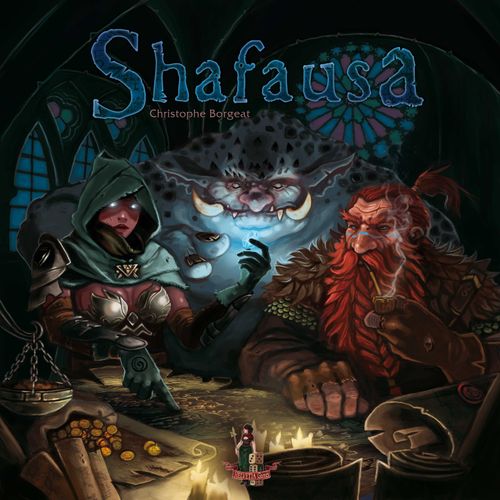
Shafausa
Shafausa Rulebook
Table of Contents
Table of Contents
Rules of the game
Contents
- 1 administration board (double-sided)
- 7 resource boards
- 8 player's boards
- 6 miner's boards
- 6 help cards
- 6 x 4 cylindric coloured pieces (1 colour per player)
- 1 black bag
- 280 ressources in cube form:
- 50 brown (wood)
- 50 grey (stone)
- 50 blue (iron)
- 40 black (coal)
- 40 orange (copper)
- 25 white (silver)
- 25 yellow (gold)
- Chafouin coins value 1, 5, 10, 50
- 5 x 11 'Building' tiles and 2 'Engineer's Office' tiles
- 80 mines (double-sided)
- 14 market transaction markers (2 per resource with a cross on the back - only for GEEK version)
- 26 'set-up' tiles (only for COLONIAL version)
- 24 POWER cards (3 per tribe) (only GEEK version)
- 1 double-sided score card
- FAMILY rules (1 double-sided page)
- this 'rules of the game' leaflet
Presentation of certain elements of the game
Board (administration and resources)
The board diagram labels: selling price; buying price; resources; game version; unavailable buildings; available buildings; order of play; sold.
Miner's board
The miner's board diagram labels: version; warehouses; miners; warehouse markers; price to be paid; reserve; number of miners.
Help card
The help card diagram labels: version; cost of mine; cost of speculation.
Player's board
The player's board diagram labels: number of the town; space for mine or building; price of the town; possessions at start of game; tribe; version; CHF at the beginning of the game.
GEEK Rules
Object of the game
To have the most number of victory points at the end of the game.
The idea
Each player represents a Helvetian tribe, who has come to propose a new monetary system based on an exchange of resources.
At each round, the players can make purchases (buildings, mines, warehouses), exchange currency and by these transactions influence the stockmarket, for the prosperity of their region.
To set up
The administration board and resources board (GEEK side) are placed in the middle of the table. Each player chooses a colour and takes a player's board, LEGEND side, a miner's board GEEK side and a help-card GEEK side up.
- Each player places a piece of his own colour on his first town (player's board), another next to order of play on the administration board, the third next to his number of miners and the last next to his warehouses (miners' board).
- Each player takes the amount of chafouins as indicated on his player's board. The rest of the money is placed within reach on the table. All the building tiles (except 'Engineer's Office') bearing the figure corresponding to the number of players will be used; the others are not needed for this game. (example: with 4 players one uses the tiles 2, 3, 4).
- If one or more buildings are figured on the player's card he will place the corresponding tile directly on the outline on his board. If a player has an Engineer's Office on his board he can take it from the box and place it on his board. The Engineer's Office is considered a privilege for the tribe and cannot be bought during the game. The remaining buildings are put in the black bag. The first player takes as many buildings from the bag as there are players and places the tiles on the building grid (available buildings, BUILDINGS). Then one by one he fills up the 'unavailable buildings' grid (FUTURE) using again the same number of tiles as players.
- The resources and the mines are placed on the table near the players. The transaction markers of buying and selling prices are placed on their starting squares (grey).
- If a player chooses Primitiva, he places his miner's marker on 6.
- If a player chooses Luserna or Sanagal, he places his city's marker on 2.
- Each player takes the POWER cards of his chosen tribe.
- The order of play is then chosen at random.
Side note on the player's board: on the player's board, the buildings and mines are out-lined. It is important to place a building tile on the space provided (their number is limited).
Procedure of play
The game is played in several rounds. Each round has 7 phases. In each round each player in turn plays the first phase, then each plays the second phase and so on until the 7 phases have been played.
At this stage a new round can be started and this continues until the game ends.
The 7 phases of a round:
- Extraction
- Order of play
- Buying of property and construction of 2 warehouses
- Management
- Administration
- Speculation
- End of game conditions
1. Extraction
Each mine and certain buildings produce resources.
As a rule, each mine produces a corresponding resource, for example the coal mine produces coal.
Certain buildings, such as the Ironworks, also produce a resource.
Other buildings affect certain mines, such as The Quarry which doubles the production of a maximum of 2 stone mines.
The owner of 'The Inn' earns 3 CHF at each extraction phase.
2. Order of play
During this phase, a new order of play is established by bidding.
Starting with the first player, each person can either:
- bid 1 CHF more than the player before (the player who starts bids 1 CHF),
- or pass.
The first player to pass places his pawn on the bottom of the grid corresponding to the next round.
The next player who passes can choose to place his pawn either before or after a pawn that has already been placed on this grid.
The third player who passes can place himself either in front, behind or between two pawns already placed. This continues until everybody has passed.
Each player pays the last sum that he bid before passing.
The amount bid cannot exceed that in the player's possession.
The money must be visible to all players at all times.
(Margin note: when a player passes, he must pay the last amount that he bid.)
(Margin note: a player can only possess one of each building.)
3. Buying of property and construction of 2 warehouses
Each player in turn (according to the order of play previously defined) has the option to buy one and only one building from the available buildings grid.
This building will be placed in the player's reserve. (The player must wait until the management phase before placing his acquired building on the grid.)
The price of a building is indicated on the tile.
Instead of buying a building, a player can decide to remove it (put it back in the black bag) from the available buildings grid by paying the current buying price (this can be a building that the player already owns).
A player can only own one of each building.
During this same phase each player can build up to two warehouses. The warehouses enable the stocking of resources (1 per warehouse) during the administration phase. They must be built in the order indicated on the miner's board. The price is marked in the corresponding square.
(Margin note: one can only buy 2 warehouses per round!)
(Margin note on the building tile diagram: a building tile shows its price, its points of victory and its effect.)
Particularity: if a player buys a Builder's House and he already possesses an Engineer's Office, he only pays the difference between the two buildings, that is 3 CHF.
(Margin note: if a player owns all the available buildings and he wants to make space on the grid for the next round, he must pay to remove it.)
4. Management
This phase is played simultaneously by all the players. In the case of conflict, one proceeds by order of play. Each player can execute as many actions as he likes:
- Build a mine according to the price indicated on the help card. This mine must be immediately placed on a free space of an existing town. NB: you cannot own more mines than your number of miners (+1 if you have built a 'Booster Shop').
- Increase the number of his miners (in order) according to the price on his miners' board.
- Develop a new town (in order) according to the price on his player's board.
- Build a bought property (which was placed in reserve during phase 3) on a free space of an existing town for the price of one iron.
- exception: if one builds a 'Builders' House' and one already owns an 'Engineer's Office' then the 'Builder's house' overrules the 'Engineer's Office'.
- Buy resources from the bank according to the buying price on the stock market.
- Sell resources to the bank according to the selling price on the stock market. The first resource of each type sold is placed on the SOLD space beneath the space on the exchange table. The other resources of the same kind are put in the reserve.
(Margin note: all must be built in the right order: miners, towns (in numerical order), warehouses, etc.)
Example: Anne decides to sell a wood and two irons. The wood earns her 1 CHF and the iron 2x3 CHF. The wood is placed on the SOLD space on the wood resource board. The irons are put in her box since Bernard has already sold one during this same phase. So it is Bernard's iron on the SOLD space on the resource board.
5. Administration
Resources
Each player checks that all his resources can be stocked in one of his warehouses or in his 'Loft'. The excess resources must be sold to the bank at the stock exchange selling price.
Buildings
Each player pays 1 CHF for each building still on the 'Reserve' space on his miners' board. The free available building spaces are then filled up according to the number of players, by taking those from the unavailable grid in order of arrival. The spaces on this grid are then filled up with new buildings taken from the black bag until there are the same numbers of buildings as there are players on each grid.
Free trade
If at least one type of goods has been sold on the stock exchange (indicated by placing it on the SOLD space at the lower end of each corresponding ladder), then its selling price goes down by 1 CHF.
Example: Copper is sold at 10 CHF during the management phase during which Charles has sold one. So there is one copper on the SOLD space on the copper resource exchange board. So the selling price of copper drops to 9 CHF during the 'administration' phase and the marker is moved accordingly.
6. Speculation
In round order the players can now once each influence the exchange rate.
Each time that an exchange marker is influenced by a player it is turned cross-side up: nobody else can speculate on this column for this round.
(Margin note: it is forbidden to move an exchange marker turned cross side up.)
A player can do ONE of the following actions:
- pass,
- FIXED PRICE: with 1 CHF, the player can block the buying or selling scale of a resource. The marker is not moved but simply turned over,
- MINIMUM RISE/FALL: with 1 CHF, the player can move the resource exchange marker one up or one down on the buying or selling scale, the marker is then turned over,
- MAXIMUM RISE/FALL: with 3 CHF, the player can move the resource exchange marker two up or two down on the buying or selling scale, the marker is then turned over,
- VARIATION ON ONE RESSOURCE: with 3 CHF, the player can move the resource exchange marker one up or one down on the buying scale and one up or one down on the selling scale of the same resource (not necessarily in the same direction). These markers must not be cross-side up.
- FIXED PRICE ON ONE RESSOURCE: with 3 CHF, the player can block the buying and selling scale of a ressource.
It is then the turn of the next player to influence the stock exchange, and so on until everybody has speculated. This is not obligatory.
The exchange markers are then turned cross face down.
7. End of game terms
The game ends when one of the following conditions is met:
-
one of the player's 5 towns have been built and filled up,
or
-
one of the player's 11 warehouses has been built and filled up.
If such is the case, the game ends, and the victory points are counted. The player who has the most victory points wins. In the case of a draw the winner is the one with the most chafouins. If there is still a draw then all those equal at this stage are declared winners.
Victory points (VP)
Each player scores (property that has been built):
- 1 VP per town,
- 1 VP per warehouse,
- 1 VP per miner,
- VP per building (indicated on the tile),
- VP per mine (indicated on the tile),
- 2 VP if 10 buildings have been built,
- 4 VP if the 11 buildings have been built (non-cumulative with the preceding point),
- 2 VP if the 11 warehouses have been built,
- 1 VP if the 11 warehouses are full,
- 3 VP if the 5 towns are full,
- 2 VP if the maximum number of miners is reached.
Certain POWER cards take effect during the reckoning. Then, each player changes all his assets into chafouins according to the current buying rate.
Each player also scores:
- 1 VP for each 20 chafouins.
Rule Precision
Power cards
Each community has 3 POWER cards at their disposal at the start of the game.
A player can use only one of these cards during a game. His choice will be revealed when he decides to use its effect for the first time. The other cards will then be put away in the box.
COLONIAL Version
The GEEK rules are used for this variation. The difference is in the initial setting up.
The players enter a world devoid of all initial infrastructures. They have to start by colonising the region into which they venture for the first time. An initial phase precedes the first round.
To set up
The administration board and the resource boards are placed GEEK side up in the centre of the table. Each player chooses a colour, takes a player's board COLONIAL side up, a miner's board and a help card (GEEK side).
- Each player places his 4 coloured pawns as in the GEEK version.
- Each player takes 25 chafouins, the rest is placed within reach on the table.
All the building tiles (except 'Engineer's Office') bearing the figure corresponding to the number of players will be used, the others are not needed for this game: (e.g. with 4 players the tiles figuring 2+, 3+, 4+ will be used.) The pile of buildings stays on the table until the end of the initial phase.
The Start-up tiles corresponding to the number of players (as for the building tiles) are placed face up on the table.
The rest of the setting up is as in the GEEK version.
Initial phase
Each player will now choose 3 Start-up tiles.
The first player chooses his first tile, then the next player does the same and so on until all players have chosen a tile. Then in reverse order each player chooses his second tile. When all the players have two Start-up tiles, the order of play is redefined. Everybody totals the figures of their two tiles; the player with the lowest number will then go first, the second lowest will be second etc. In case of equal numbers the player holding the tile with the lowest figure goes in front.
Each player now chooses his third tile following the new order of play.
Once everybody is served, each adjusts his set-up according to the indications on his tiles: he takes the chafouins that he is allowed, and the buildings that he has the right to from the building pile (these are built immediately). He then organises his towns and his miners.
The rest of the building tiles are put in the black bag. The two building grids are placed as in the GEEK set-up.
The first round can now start, following the GEEK rules.
The Power Cards
Each tribe has three POWER cards. The cards are listed below by tribe.
Gineva
- Bribery: At the start of each round, the richest player gives you 2 CHF and the second richest gives you 1 CHF. If two or more players are tied, all the richest players give you 1 CHF.
- Charity: At each round, just before the administration phase, you can change the arrival order of the unavailable buildings.
- Influence: For 4 chafouins, you can speculate as to MAXIMUM RISE / FALL by moving an exchange marker +/- 3 spaces.
Zugriga
- Skyscraper: You can build 5x on your starting town (town n°1 uses 5 spaces).
- Rich: You start the game with 12 CHF more than your quota.
- Lender: Once per round you can stand in for the bank. In the buying or selling of one of the basic raw materials (wood, stone, iron, coal), you buy the goods sold by a player at his selling price, or you sell goods to a player who wants to buy from the bank at his buying price.
Sanagal
- Tax rebate: You have a reduction of 2 CHF on all your speculations.
- Property developer: You can replace your mines either by other mines or by buildings.
- Alchimist: The gold and copper mines cost you 2 stones less or 3 wood less (the choice can be different for each mine built).
Luserna
- Greedy for coal: The gold and silver mines cost you 1 coal less.
- Distraction: During the round order phase, you can pass once and still stay in the auction. When it's your turn to bid again, you must either bid or pass.
- Precious stone: At the end of the game, the stone mines are worth 2 VP instead of 1 VP.
Tessina
- Undeclared workers: You can increase your number of miners by one space (1x per game).
- No wood: No need to pay the wood for building your towns.
- Pre-speculation: You can speculate for free as in HIGH/LOW MINIMAL at the start of the speculation phase, but this will not block the column (the exchange marker is not turned 'cross-side up'). The player can speculate normally as well as having this advantage.
Primitiva
- National anthem: Instead of 5 VP, Helvetia earns you:
- 6 VP if you have one of the following buildings: -7 VP if you have 2 of the following buildings: - 8 VP if you have 3 of the following buildings: the Loft, the Builders' House, the Inn.
- Middle term: You can buy a building from the unavailable grid by paying 1.5 x the price indicated (rounded down to the nearest whole figure). E.g. Helvetia would cost (13+(13/2)+13+7.5=22.5 that is 22 CHF).
- Privilege: When you have to pay your bill, in the round order phase, you pay 2 CHF less.
Shafausa
- Balance: At the end of the management phase, you can move ONE sold resource marker (on the sold space) from the exchange towards another resource or take it off.
- Precious iron: The copper and silver mines cost 2 irons less.
- Forced labour: Your ironworks OR your coalworks produce one extra resource. At each round you can choose one of the two.
Grisa
- Parsimonious: You earn 1 VP for each set of 3 warehouses that you have built.
- Reduction on copper: At each management phase, you can buy one copper at the selling exchange rate (the Powerbroker applies).
- Surprise!: You can immediately build 1 warehouse stocked with 1 coal - 1x per game.
Transcriber note: the POWER card table on page 15 of the source PDF is a low-resolution raster. Card wording above is read from the page image; a few words in the Primitiva, Grisa and Sanagal entries are best-effort readings of the small print, and should be checked against the printed sheet before release.
The Buildings
- Inn: You earn 3 CHF at each extraction phase.
- Loft: Can store 2 resources.
- Sawmill: Doubles the production of 2 wood mines.
- Builder's house: Your buildings cost 4 CHF less (min 0 CHF).
- Quarry: Doubles the production of 2 stone mines.
- Helvetia: Earns 5 VP instead of 1 (marked on the tile).
- Coalworks: Produces 1 coal at each extraction phase.
- Pawnbroker: The selling price of your resources increases by 1 CHF.
- Ironworks: Produces 1 iron at each extraction phase.
- Engineer's office: Your buildings cost 2 CHF less (min 0 CHF).
- Booster shop: You may build 1 more mine than your current miner's number.
- Lost and found: When you build a new mine, you may opt to remove one of your mines first (1x/game).
The Pictograms
The pictograms used on the building tiles, boards and cards are: miner; warehouse; buying price; selling price; chafouin; victory point; mines; building; keep in reserve; build property; zone of depot; exchange; wood; stone; iron; coal; copper; silver; gold.
The 7 Phases of a Round
- Extraction
- Order of play
- Buying of property and construction of 2 warehouses
- Management
- Administration
- Speculation
- End of game terms