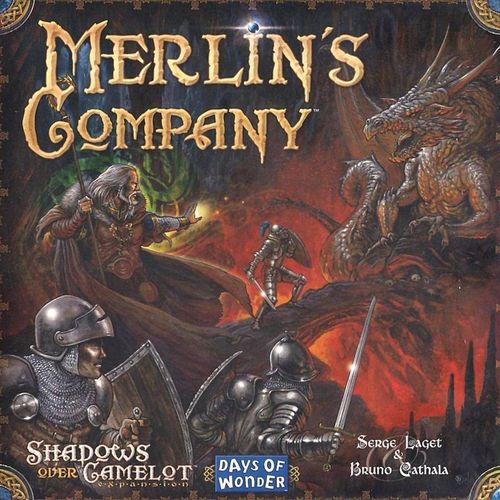
Shadows over Camelot: Merlin's Company
Shadows over Camelot: Merlin's Company Rulebook
Table of Contents
Table of Contents
Components
Welcome to Merlin's Company, an expansion for the Shadows over Camelot board game. To play, you must have a copy of the original game.
This expansion consists of:
- A figure of Merlin - a new independent character on the board, who may sweep in at times of dire need to aid your cause
- 7 New Knights, represented by their own unique Coat of Arms, each matching the color of one of the original 7 knights of the original game (King Arthur excepted, of course, as there can only be one true king!)
- 63 New cards:
- A new deck of Loyalty cards, including 1 additional Traitor card (9 Loyalty cards: Loyal and Traitor)
- 16 New Travel cards, featuring events that might occur as you travel from Quest to Quest (16 Red cards: Travel)
- 14 Black cards, including 7 new Special Black cards - all witches allied to Morgan - to ensure a mix of new and old threats (14 Black cards: 7 Standard and 7 Special)
- 23 White cards, including 8 new Special White cards - much needed beneficial events to supplement those in your original game (the component art is captioned "28 White cards", but the text and card count give 23: 15 Standard and 8 Special)
- And a Summary card for Merlin
- This expansion also includes a bonus figure of Sir Bedivere, a now hard to find promotional figure that was introduced at the original game's launch and, for the first time, a copy of his oft-requested official Coat of Arms and colored die.
Modifications to the Original Game Set-Up
Before beginning to set up your game using Merlin's Company:
- Shuffle the 16 new Travel cards included in the expansion to form a Travel deck, and place it off the board, within easy reach of the players.
- Place the figure of Merlin next to the Travel deck. Merlin won't enter the board until the first Merlin Travels card is drawn from the Travel deck sometime during the course of the game.
- Add the 14 Black cards included in this expansion to the Black cards of the original game.
- Add the 23 White cards included in this expansion to the White cards of the original game.
Some of the new White and Black cards included in this expansion are identical to some of the cards that came with the original game, but it does not matter if differences in wear and tear between your old deck and these new cards are visible or not. You will never know whether a new card is not just an old one with a fresher back. These apparent redundancies help preserve the balance of effects and proportions in the now larger White and Black decks.
Each card in this expansion is also marked with an "M" to help you quickly sort cards out at the end of the game.
Then proceed with the game's normal set-up as described on pages 6 and 7 of the original Shadows over Camelot rulebook.
Seven New Knights
In Merlin's Company, due to his unique stature, King Arthur is always present. Assign his Coat of Arms at random to one of the players before proceeding further.
When the time comes to draw Knights (Step 5 of the original game set-up), you may now either:
- Replace the entire set of Knight's Coat of Arms that came with the original game (including Sir Bedivere, but excluding King Arthur who is already assigned) with the 7 new Knights included in Merlin's Company: Sir Bors, Sir Caradoc, Sir Gaheris, Sir Gareth, Sir Geraint, Sir Lamorak and Sir Owain, before drawing Knights at random from this new set of Coat of Arms;
- Or select the Knight of your choice (old or new), provided that no two Knights be of the same Coat of Arms' color (i.e. if a player selects Sir Gaheris and his yellow Coat of Arms, then Sir Galahad cannot be in the game). Use the Knight figure that matches the color of your Coat of Arms to represent you on the board.
Merlin
The wise old wizard is now a full-blown independent character in the game, complete with his own figure. Merlin starts the game off the board; once certain events occur (see Travels & The Travel Deck), Merlin moves onto the board and starts traveling from Quest to Quest, lending help to the Knights as follows:
- Once during each player's turn, when his Knight is present on the same Quest as Merlin, the player may choose to draw a White card from the draw pile. This draw is a free Action and does not count toward the Knight's Heroic Action(s) for the turn.
- In addition, whenever Merlin travels to a Quest that is no longer in play (Quests for Excalibur, the Holy Grail, and Lancelot & the Dragon), the drawing of a corresponding Black card does not trigger the addition of a Siege Engine around Camelot; instead, the Black card drawn is discarded, with no further effect.
Travels & The Travel Deck
The roads around Camelot have become uncertain and dangerous. Unlike in the original game, moving from Quest to Quest is no longer a sure thing for the Knights...
Each time a Knight chooses to Move to a new Quest as a Heroic Action during his turn or through the use of his Special Power (Sir Tristan), he must:
- first declare where he wishes to move;
- then draw a Travel card from the top of the Travel Deck and apply its effect before potentially completing his move and reaching his intended destination.
All other moves in the game, such as those triggered by the completion of a Quest, or those made out of turn, in reaction to the play of a Special White or Black card, do not trigger the draw of a Travel card, and are still governed by the same rules as in the original game. It is only those moves made by the Knight as a Heroic Action during his turn or through the use of his Special Power that are modified.
- If the Travel card drawn is a Nothing Happens card, then... nothing extraordinary happens! The Knight completes his move and successfully reaches the Quest of his choice. Gameplay resumes as normal.
- If the Travel card drawn is a Merlin Travels card, the Knight successfully reaches the Quest of his choice and Merlin's figure is moved to his side on this new Quest. Because Merlin is not a Knight, he is allowed to travel to join a Knight on any Quest, including a Solo Quest (Black Knight, Lancelot).
- If the Travel card drawn is a Vision card, the Knight becomes so inspired by the vision of the Grail that he moves to that Quest, instead of his intended destination. If the Grail Quest is no longer in play, the Vision has no effect and the Knight may complete his move as if he had drawn Nothing Happens.
- If the Travel card drawn is a Charged!, Lost! or Ambushed! card, the Knight must successfully complete the challenge described on that card or suffer the consequences and immediately end his turn.
- If the Travel card drawn is a Captured! card, the Knight is captured and held for ransom. He remains in place and can no longer play (place the Captured! card under the Knight's figure, to remember this) until one of his companion Knights spends one of his Heroic Actions to discard a Special White card and free up the hapless Knight! Note that a Knight cannot free himself, nor participate in any game action (card exchange, etc...) until freed by another participant. If an unmasked Traitor is still captured at game end, he cannot reveal himself, nor turn White swords into Black ones. So one must be careful not to unwittingly free up a Traitor, nor unwittingly keep a fellow Loyal Knight out of action!
Once the effects of a Travel card have been completed, place it in a discard pile. In the unlikely event the Travel deck runs out, shuffle all the discarded Travel cards to form a new deck. Do NOT reshuffle the Travel deck in any other instance, such as when instructed to reshuffle the Black and White draw and discard piles.
Disposing of Black Cards for Quests No Longer in Play
When Black cards are drawn that relate to a Quest that is no longer in play (Quests for Excalibur, the Holy Grail, and Lancelot & the Dragon), they are now permanently removed from the game, rather than discarded. Thus they cannot appear in subsequent reshuffles of the decks during the game. Drawing such a card still leads to the addition of a Siege Engine around Camelot, whenever applicable.
7 and 8 Player Games: Two Traitors!
With Merlin's Company, the game now accommodates up to 8 players (7 Knights & King Arthur). This comes with a price though: in 7 and 8 player games, you will now add the second Traitor card you received to the mix of Loyalty cards, at the start of the game.
The two Traitors do not know who the other might be, or even if another one is present in the group or not. At game's end, if there is one undiscovered Traitor, he will have to turn over 2 White Swords to the Black side. If there are two undiscovered Traitors, they now turn over 3 White Swords to the Black side! If they win, they revel together in their treachery...
Appendix
The Traitor
Play per the original game rules. Also see 7 and 8 player games: Two Traitors! in this rulebook.
Card Manifest: The Travel Deck
- Lost! (x2)
- Ambushed! (x2)
- Captured! (x1)
- Charged! (x2)
- Merlin Travels (x5)
- Nothing Happens (x3)
- Vision (x1)
Card Manifest: Additional Standard Black Cards
- Despair (x2)
- Excalibur (x2)
- Mercenaries! (x1)
- Picts! (x1)
- Saxons! (x1)
Card Manifest: Morgan's Seven Witches
1st WITCH (1 card) Triggers an immediate reshuffle of the Black and White draw and discard piles (but not the Travel deck!).
2nd WITCH (1 card) Until a new Quest is won, the Knights:
- can no longer sacrifice a Life point during their Progression of Evil Phase;
- can no longer sacrifice a Life point to gain an additional Heroic action;
- and Sir Caradoc is also temporarily deprived of his Special Power.
3rd WITCH (1 card) Adds a Pict and a Saxon figure to their respective Wars, at once. This may cause one or both Wars to be lost. If need be, the consequences of placing the Pict figure is resolved first, then the consequences of placing the Saxon.
4th WITCH (1 card) Each Knight immediately discards a Grail card or loses a Life point. If a Knight has no Grail card, then he MUST lose a Life point, even at the peril of his life!
5th WITCH (1 card) For the rest of the game, each false accusation causes 2 White Swords to turn over to their Black side on the Round Table. Just like in the regular game, if there are no more White Swords to turn over, the false accusation has no effect.
6th WITCH (1 card) For the rest of the game, each Merlin card played is permanently removed from the game, rather than discarded.
7th WITCH (1 card) All Knights not present on the next Quest that is lost will immediately lose 1 Life point. The Witch is then discarded.
Card Manifest: Additional Standard White Cards
- Fight (x3), Fight (x2), Fight (x1), Fight (x1), Fight (x1): the five Fight card faces are captioned with these counts in the printed manifest, left to right
- Grail (x3)
- Merlin (x1)
- Fight ? (3 cards): The value of this card, between 1 and 5, is set by the Knight at the time he chooses to play it. Note that this card, despite its unique effect, is a Standard White card, like all other Fight cards, not a Special White card.
Card Manifest: New Special White Cards
CALL FOR HELP (1 card) Knights may move to your Quest, at no cost, and without drawing Travel cards. You cannot call for help when on a Solo Quest, but you can leave a Solo Quest - and suffer the consequences - to respond to a Call for Help from a fellow Knight.
DISPEL (1 card) Discard the permanent or semi-permanent Special Black card (Dark Forest, Mists of Avalon, Mordred, Vivien and Morgan's Witches #2, #5, #6, #7) of your choice. Can also be used, like any other Special White card, to free up a Captured! Knight.
DIVINE FAVOR (1 card) The next tie that occurs in the game is broken in favor of the forces of Good. If it is a tie in the number of Black and White Swords, at game's end, the Loyal Knights win!
DRAGON SLAYER (1 card) Draw 3 White cards from the draw pile. If you are on the Dragon's Quest, you may choose to play 2 Fight cards instead (though you could still draw 3 White cards, if you preferred). You could thus play up to 3 Fight cards on the Dragon's Quest during a single turn: 1 as your Heroic action, and 2 more when playing the Dragon Slayer after sacrificing a Life point.
MERLIN TO THE RESCUE (1 card) Immediately move Merlin's figure to the Quest of your choice. This does not need to be a Quest you are currently on. It could even be a Quest that is no longer in play (Excalibur, Holy Grail, Lancelot & the Dragon) so as to prevent the placement of a Siege Engine when Black cards of the corresponding type are drawn!
NEW HOPE (1 card) Discard all your White cards, including this one, to draw an equal number of new White cards from the draw pile.
TOURNAMENT (1 card) Gain 2 Life points OR (if playing under Squire's Challenge rules) immediately make 1 Squire a Knight. When this card is played, you do not need to be where the Squire is, nor does the Squire need to be in Camelot for him to become a Knight.
TRUCE (1 card) Ends a War of your choice (Saxon or Pict) in a truce. All Fight cards are discarded and all figures removed from it, with neither camp achieving victory. If Mordred is present, it is discarded too.