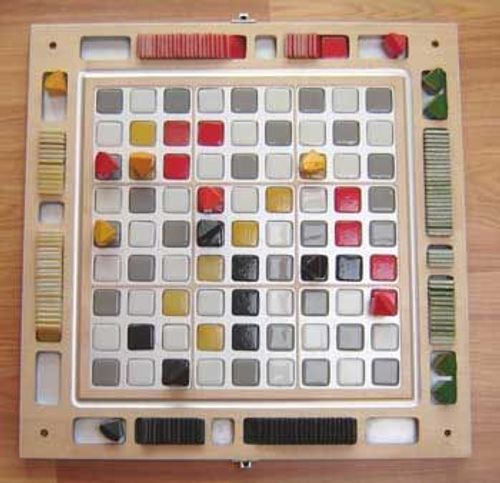
Shacru
Shacru Rulebook
Table of Contents
Table of Contents
Contents
- 1 Pacru gameboard.
- 16 chevron-shaped pieces: 4 of each colour.
- 200 markers (small columns): 50 of each colour.
- 1 booklet.
- 1 box of each colour for the chevrons and markers.
Terminology
This section is just for reference if a word or phrase in the rules is puzzling or ambiguous. You can skip it and go straight to the rules of Shacru, Azacru or Pacru.
The whole board is divided into nine borderlands by the black borders. Each borderland contains nine fields. A field is shaped as an eight-pointed star containing a circle. There is no difference in play between the fields with a light circle and the fields with a dark circle; the variation just makes the diagonals more obvious.
When a marker is placed on a field it should be located in the centre of the field (inside the circle). When a chevron is placed on a field its outer edges should be lined up with one of the points of the star to make it clear which direction it is facing.
A field with no markers in it is called a neutral field. At the start of each game all the fields are neutral fields. A field with, for example, a red marker on it is called a red field. So "change the fields to your colour" simply means remove markers of any other colour (if there are any) on the fields and put down markers of your colour. A field with no chevron on it (whether there is a marker on it or not) is called an unoccupied field. A field with a chevron on it is called an occupied field.
Sometimes players refer to fields as "squares", "stars" or "positions", call markers "columns" or "tiles", refer to chevrons as "pieces" or "arrows" or call borderlands "areas". All of these uses are perfectly acceptable.
Starting the Game {S-R1}
Each player is represented by a colour and uses the chevrons and markers of that colour. The order of play between the different colours is a matter of choice. You can decide which player uses which colour, and the order of play, by any reasonable means.
Setting up the opening position. (The printed line reads "Setting up the the opening position"; the duplicated "the" is corrected here.)
If there are three or four players, each player starts with three chevrons. For the two player game, each has four. Follow the diagrams on the back page of this guide.
Taking Turns {S-R2}
Players take turns and move one chevron at a time. You can only pass on a turn if you cannot move any of your chevrons. You may find that you have to pass on each subsequent turn until the end of the game, but you could still win the game if the other players cannot get more fields than you.
Moving {S-R3}
You can move a chevron one field straight ahead, or one field forty five degrees to the right or the left of the direction the chevron is pointing. As you complete your move forwards, set the chevron down pointing in the direction it has travelled.
Each time you move a chevron you change the neutral field in which you are setting down the chevron (not the field you are leaving) to your own colour by placing one of your markers on it.
You always have just three potential directions in which you can move your chevron, whether it points out of a corner or a side.
Borderland Twist {S-R4}
When you move a chevron across a border, you can set it down as normal after the move (leaving the chevron pointing in the direction it has travelled) or twist the chevron forty five degrees to the left or the right before completing your turn.
Diagram note (as printed): if you cross a border you can leave the chevron facing in the direction it has moved, or twist it forty five degrees to the left or the right. In the printed example the red chevron cannot move directly ahead or to the left, because the chevron and the marker prevent it. The red chevron's only move is to the field across the border.
What is Forbidden in Shacru {S-R5}
- You may not move onto a field of another player's colour.
- You may not move onto a field occupied by another chevron.
Winning the Game {S-R6}
A game ends either when there are no players left able to make a move, or when none of those able to move can acquire any further fields on this or subsequent turns (but could only occupy fields already their own colour).
The winner of the game is the player with the most markers on the board at the end of the game. It is possible to use each player's total as a score and then play several games as a set, totalling the score from each game.
Starting Positions
The starting-position diagrams on the back page of the booklet are graphical. The chevron counts, by number of players, are:
- Two players: four chevrons each.
- Three players: three chevrons each.
- Four players: three chevrons each.