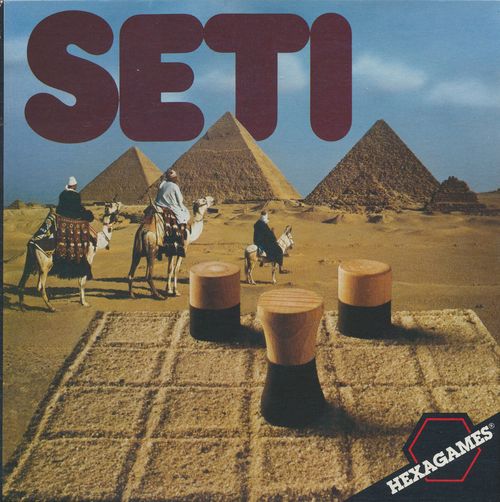
Seti (1979)
Seti (1979) Rulebook
Table of Contents
Table of Contents
Components
- 18 two-coloured game pieces in three different shapes
- 1 game board
Playing time: approx. 30 minutes.
Transcriber's note: the printed component count is 18 pieces. The rules use 6 pieces per player in both variants (12 in total), so the printed count is kept as printed.
Seti-Aleph
1. Setup
Every game piece is two-coloured. One player plays with the white side up, the other with the brown side up. Each player receives:
- 1 Pharaoh
- 2 High Priests
- 3 Ships of the Dead
The board for Seti-Aleph is divided into 3 x 10 squares (the two edge strips are not used in this game). The Pharaoh and his two High Priests are placed on the starting row.
[Diagram: a 3 x 10 board labelled "Baseline" at each end. On each player's starting row stand "H P H" (H = High Priest, P = Pharaoh).]
The Ships of the Dead stay off the board at first; they only come into play during the game. The colours are determined by lot. White begins.
2. Object of the Game
The aim of the game is to reach the opponent's starting row with a Pharaoh or High Priest.
3. Course of Play
The players take turns, each moving one of their pieces.
3.1 Movement
Pharaoh
- Moves only one square: horizontally, vertically or diagonally.
- Cannot jump over other pieces.
[Diagram: a central square with eight arrows, one step in each direction.]
High Priest
- Moves horizontally, vertically or diagonally two squares, or in a knight's move (2 squares straight, 1 square sideways).
- May jump over its own and opposing pieces.
[Diagram: a knight's-move pattern from a central square.]
Ship of the Dead
- Can only be placed or removed. Both count as a move.
- Cannot be moved, but can be placed or removed any number of times.
- May be placed on an empty square or under a piece already standing there, and may also be removed from there.
- May not be placed on the goal row.
[Diagram: a black square piece.]
Ships of the Dead are excellent as traps or diversions. Attacks with single pieces carry a high risk.
3.2 Capturing
A piece is captured by moving or jumping directly onto the opposing square. The captured piece is turned over and passes into the possession of the capturer. If the captured piece is a Pharaoh or High Priest, it is placed on the capturing player's own starting row. From there it can re-enter play on the next move.
If there is no room left on the starting row, the row in front of it is filled, beginning with the middle square.
Attention!
- If a Pharaoh or High Priest stands on a Ship of the Dead, neither the ship nor the piece standing on it can be captured.
- From a Ship of the Dead another piece can be captured. In doing so the ship must be left, since it cannot be moved.
- A Ship of the Dead standing alone can be captured and then passes into the possession of the capturer. It is removed from the board and can be placed at will on the capturer's next move.
Transcriber's note: the German text says "eigene Startreihe" (own starting row). After the capture the piece belongs to the capturing player, so this is read as the capturer's own starting row.
4. End of the Game
The winner is the player who reaches the opponent's starting row with his Pharaoh or High Priest without being captured by the opponent on the opponent's next move.
... and here are a few more tips:
- The Pharaoh is very well suited as a defender left behind.
- Breakthroughs by enemy pieces through one's own line should be avoided at all costs.
Seti-Beth
1. Setup
Each player receives:
- 2 Pharaohs
- 4 High Priests
The Ships of the Dead are omitted. The game is played on 5 x 10 squares (both edge strips are used). The pieces are placed on the starting row (see Fig. 2).
[Diagram (Fig. 2): a 5 x 10 board. Each player's starting row reads "H P H P H" (H = High Priest, P = Pharaoh), and one further High Priest stands on the middle square of the row in front of it.]
The colours are determined by lot. White begins.
2. Object of the Game
As in Seti-Aleph.
3. Course of Play
As in Seti-Aleph, with one exception: once a piece has been captured it is removed from the game and cannot be placed again.
4. End of the Game
As in Seti-Aleph.