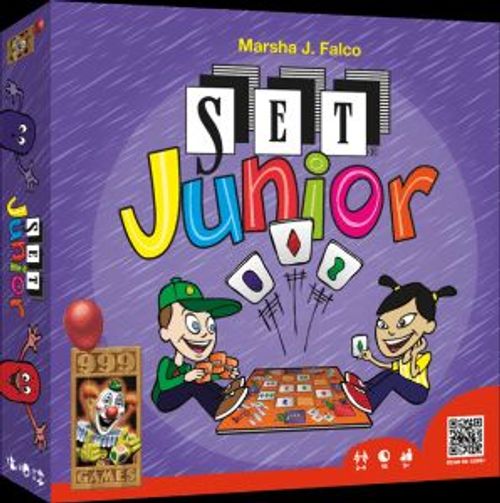
SET Junior
SET Junior Rulebook
Table of Contents
Table of Contents
Contents
- Double-sided board (Face 1 and Face 2)
- 27 SET tiles
- 24 Point tokens
What Is a SET?
A SET is a group of three tiles in which each characteristic is either TOTALLY IDENTICAL or TOTALLY DIFFERENT on all three tiles. Each characteristic must be checked individually.
The Three Characteristics
Each tile has three characteristics:
- Colour: Red, Green, Purple
- Shape: Oval, Wave, Diamond
- Number: One, Two, Three
A SET is a group of three tiles in which each of the three characteristics is either TOTALLY IDENTICAL or TOTALLY DIFFERENT on the three tiles of the SET. So the three tiles form a SET if and only if:
- the colour of the symbols is strictly identical or totally different;
- the shape of the symbols is strictly identical or totally different;
- the number of symbols is strictly identical or totally different.
Examples
- Colour: Yes, they are all TOTALLY IDENTICAL. Shape: Yes, they are all TOTALLY IDENTICAL. Number: Yes, they are all TOTALLY DIFFERENT. = It is a SET. (Printed example: one, two and three green diamonds.)
- Colour: Yes, they are all TOTALLY DIFFERENT. Shape: Yes, they are all TOTALLY IDENTICAL. Number: Yes, they are all TOTALLY IDENTICAL. = It is a SET. (Printed example: one red oval, one green oval and one purple oval.)
- Colour: Yes, they are all TOTALLY DIFFERENT. Shape: No, they are not all totally identical nor all totally different (two diamonds and one wave). Number: No, they are not all totally identical nor all totally different (two tiles have a single symbol and one tile has three symbols). = This is NOT a SET. (Printed example: one red wave, one purple diamond and three green diamonds.)
Face 1
Object of the Game
Win the most Point tokens.
Setup
- Place the board with "Face 1" visible (see the image above).
- Shuffle the SET tiles and form a draw pile with them, face down, so that all players can easily reach it.
- Form a stack with the Point tokens so that all players can easily reach it.
- Each player draws three tiles.
- The youngest player starts, and play continues clockwise.
Gameplay
The board contains three magic squares showing a SET in each horizontal, vertical and diagonal line. The first player places one of their three tiles on the matching space of the board. The tile must be totally identical (colour, shape, number) to the board space it covers. The player then draws a new tile. Then it is the next player's turn. There are 27 tiles in total and 27 matching spaces on the board.
When a player completes a SET with their tile, they win a token. If a player completes more than one SET by placing a single tile, they win one token for each SET completed. There are 24 tokens to win.
When all 27 spaces on the board are covered, the players count their tokens. The player with the most tokens wins the game!
Example
It is possible to complete several SETs with a single tile. If the spaces circled in yellow in the printed example were already covered earlier, and a player places the tile with three red waves, that player wins two tokens.
Face 2
Object of the Game
Win the most SETs.
Setup
- Place the board with "Face 2" visible (see the image above).
- One player shuffles the SET tiles and places one of them, face up, on each orange space of the board. They then place the remaining tiles, face down, on the red space of the board to form a draw pile.
Gameplay
There is no turn order; you must be the fastest to find SETs!
When a player sees a SET, they call out "SET!". The other players must then stop. If all the players confirm that the SET is correct, the player who found the SET takes the three tiles of the SET and places them, face down, on the purple space of the board in front of them. The three tiles that were won are then replaced by three new tiles from the draw pile.
Caution
If a player calls out "SET!" but was mistaken, the tiles stay on the board and the player must discard a SET won previously, if they have one.
End of the Game
When the tile pile is exhausted and there are no more SETs on the board, each player counts the number of SETs they won during the game. The player with the most wins the game.
Variants
(Printed on the Face 2 side of the sheet.)
- When the tile pile is exhausted, the players carry out a first count and note their scores. Then the player to the left of the previous dealer shuffles all the tiles again and places one on each orange space of the board. A new round begins. The game ends when every player has been the dealer.
- For players who are still learning to spot a SET, play one at a time, in turn, rather than simultaneously.
- When a player finds a SET, they remove the SET from the board and take a Point token. The player with the most at the end of the game wins.