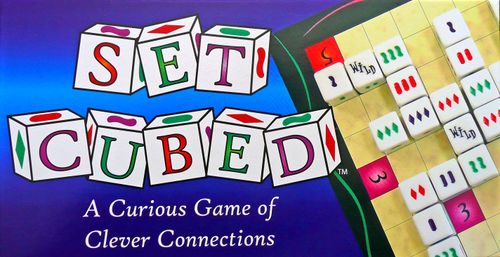
Set Cubed
Set Cubed Rulebook
Table of Contents
Table of Contents
Goal of the Game
Score the maximum number of points by making SETs, connecting 3 dice at a time in each game with the dice already played on the board.
Preamble: What Is a SET®?
The Rule
A SET® contains 3 dice. Each individual feature of the 3 dice must be either the same on all 3 dice, or completely different on each of the 3 dice.
The 3 features are:
- COLOURS: Red, Green, Purple
- SHAPES: Ovals, Waves (beans), Diamonds
- NUMBER: there is one, two or three shapes
Remember: ALL features must separately satisfy the rule.
For example: this is a SET because the three dice all have the same colour, AND three different shapes, AND all the same number.
Quick Check Questions
This makes it easy to check whether you are playing by the rule. You must be able to answer YES to all three of the following questions to make a SET.
- Q1: Is the colour either the same or different on each of the 3 dice?
- Q2: Is the shape either the same or different on each of the 3 dice?
- Q3: Is the number of shapes either the same or different on each of the 3 dice?
If your answer is NO to any of them... it is not a SET.
Examples of SETs
- Q1: YES, all dice have the same colour. Q2: YES, all dice have the same shape. Q3: YES, all dice have the same number.
- Q1: YES, all dice have a different colour. Q2: YES, all dice have the same shape. Q3: YES, all dice have the same number.
- Q1: YES, all dice have the same colour. Q2: YES, all dice have a different shape. Q3: YES, all dice have a different number.
- Q1: YES, all dice have a different colour. Q2: YES, all dice have a different shape. Q3: YES, all dice have a different number.
Examples That Are NOT SETs
If you can say that 2 of the 3 dice are the same and 1 is different in any feature, then it is NOT a SET.
For example:
- Q1: YES, all dice have a different colour. Q2: NO, two are ovals and one is a wave. Q3: YES, all dice have the same number.
- Q1: YES, all dice have a different colour. Q2: YES, all dice have the same shape. Q3: NO, two show 3 shapes and one shows 2.
- Q1: NO, two are red and one is purple. Q2: YES, all dice have the same shape. Q3: YES, all dice have the same number.
Remember This Rule
Each feature, seen individually, must be the same OR entirely different on each of the 3 dice.
Now take a short break and take a minute to try making a few SETs. To start, take any two dice and check each feature one by one, to see which colour, which shape and which number the third die must have to make a SET. For every pair of dice there is a third die that makes a SET.
The Game
Contents
42 dice, 1 board (the tablier), 1 fabric pouch, and these rules.
How to Play
A. Put the dice into the fabric pouch.
B. Each player takes 5 dice from the pouch without looking (blindly).
C. As soon as each player has their 5 dice, everyone rolls their dice simultaneously. The first person to discover a SET among their dice announces "SET" and plays first. If no player has a SET, everyone rolls their dice again and starts over.
Note: Only the upper face of a die may be played. It is forbidden to turn dice over, except at the moment specifically indicated.
D. After the first SET has been announced, it is placed on the logo in the middle of the board. The points of that player are then scored (see Results).
E. Once the first SET has been played, play continues clockwise, and each player may connect up to 3 dice at a time to make new SETs with the dice already showing on the board. Each player's points are recorded at the end of each game.
SETs can only be made horizontally or vertically, not diagonally or around corners.
When a die is played, it must make at least one SET in one direction. If the die makes more than one SET with its connection, all of the SETs count for points. Dice may touch other dice without making a SET, provided that 1 SET has been made with new dice and the dice already played on the board.
F. If a player cannot make a SET on their turn, they may pass and play continues. Each player also has the right to pass their turn. If no player can make a SET, all players roll their dice again and a new round begins.
G. The round ends when every player has had a chance to play. At the end of each round, all players take the dice they need from the pouch so that each has 5 dice again. The new dice must be rolled immediately, then added to the other dice.
H. Reroll. Before a new round begins and all players complete their hand to 5 dice (see exception I), each player may reroll some or all of their dice once before play continues. The first player must wait until all the other players have decided on their reroll before continuing.
Note: Players may agree beforehand on a time limit for deciding on a reroll, for example 30 seconds.
I. On the last draw, there may no longer be enough dice for every player to have 5 again. The first player draws first, then every other player, clockwise, takes turns drawing, so that each player has 5 dice again or whatever remains. This evens out the first player's disadvantage, since at the start that player could only score 3 points with the first SET.
J. Play continues until a player has no dice left. As soon as that player has finished, each player who has not yet had the chance to take their turn may play one last time before the game is truly over.
Example
The example below shows the ways dice can be connected to score points. Dice framed in black are already on the board. Dice framed in yellow are the ones the player has added.
- The yellow die is connected to the black die on the board, making 2 SETs, and each is worth 3 points. Total: 6 points for the first die connected.
- The player then adds a second yellow die, making another SET worth 3 points. The cumulative result is now 9 points for the first two dice played.
- The player adds the third and last die for this turn, making yet another SET = 3 more points. Total for this turn = 12 points. Points can be earned with each die that makes a new SET.
Note the two arrows pointing to the die "two, oval, purple." That die does not make a SET in both directions. But it is still valid, since there is at least 1 SET in at least one direction (horizontal).
Wild
A Wild die can replace any other die to make a SET. When a player places a Wild, they must announce the features that die represents, and those features cannot be changed. Any number of Wild dice may be played during a turn or in a SET.
Wild Replacement
At the start of each player's turn, that player may replace a Wild with a die, provided that die has the features previously announced. This replacement does not score points and is not one of the 3 dice the player is allowed to play. The player cannot automatically use the Wild side of a die; they must roll the die before continuing their turn. The die may be played during that same turn.
Figure caption: A Wild die can replace any die to make a SET. Once played, its features can no longer be exchanged.
Figure caption: At the start of any player's turn, the Wild die may be exchanged for the die with the requested features.
Bonus Squares
The bonus squares are the numbered squares on the board. When a bonus square is occupied for the first time, that player receives the indicated bonus, which is added to their total. Bonus points only count the first time, no matter how many SETs are subsequently made there.
Note: The bonus values are printed on the board and are not listed in the rules text.
Results
Ordinary dice: A player receives one point per die in a SET. If the same die is part of another SET, it counts one point per SET.
Wild: No points are scored for the Wild when it is first played. However, once its features have been determined, it counts as a regular die in a SET. If a Wild die occupies a bonus square, the player receives the bonus points. There are no bonus points or ordinary points at the moment the Wild is replaced by the die with the indicated features.
At the end of the game, the points of each round and of each player are added up. Unused dice count for nothing at the end of the game.
The player with the most points wins.