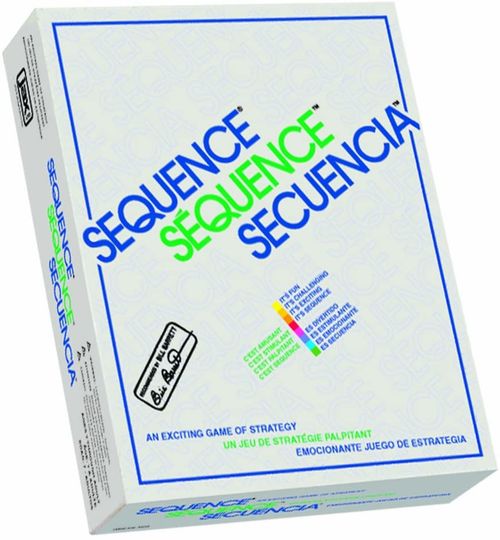
Sequence
Sequence Rulebook
Table of Contents
Table of Contents
Components
- 1 game board
- 50 green marker chips
- 50 blue marker chips
- 35 red marker chips (red chips are used only with three players/teams)
- 104 Sequence cards (two standard 52-card decks; jokers are not used)
Object of the Game
A Sequence is a connected series of five of the same-colored chips in a row—up or down, across, or diagonally on the board. To win: with 2 players or teams, score two Sequences; with 3 players or teams, score one Sequence.
Setup
Choose a chip color (green, blue, or red). Each board space (except the corners) shows a standard playing card, and each card in the deck appears on the board twice. Shuffle the cards and deal each player a hand based on the number of players:
- 2 players → 7 cards each
- 3 players → 6 cards each
- 4 players → 6 cards each
- 6 players → 5 cards each
- 8 players → 4 cards each
- 9 players → 4 cards each
- 10 players → 3 cards each
- 12 players → 3 cards each
Place the remaining cards face down as the draw deck (keep a discard pile beside it).
How to Play
Players take turns clockwise. On your turn:
- Play one card from your hand face up onto your discard pile.
- Place one of your marker chips on either board space showing that card (if both are already covered, see Dead Card).
- Draw a replacement card from the deck. (If you fail to draw before the next player begins their turn, you lose the right to draw and must play the rest of the game with fewer cards.)
The Corners
The four corners of the board are free spaces that count for all players. A player may use any corner as though it were their own chip—so a Sequence that uses a corner needs only four of your own chips.
The Jacks
There are two kinds of Jacks:
- Two-eyed Jacks (Diamonds and Clubs) are WILD. When you play a two-eyed Jack, place one of your chips on any open space on the board.
- One-eyed Jacks (Hearts and Spades) are anti-wild. When you play a one-eyed Jack, remove one of an opponent's chips from the board, then discard the Jack (you do not place a chip that turn). You cannot remove a chip that is part of a completed Sequence.
Dead Card
If you hold a card and both of its board spaces are already covered by chips, it is a "dead card." On your turn, you may exchange it: place it on the discard pile, announce "dead card," and draw a replacement. You may do this only once per turn, and you must then play a normal turn.
Completing a Sequence
Once you have five of your chips in a row, place a marker (or announce it) to indicate a completed Sequence—it cannot be broken by a one-eyed Jack, nor used by opponents. One chip from a completed Sequence may be used as part of a second Sequence in a different direction, but a Sequence may share only one chip with another (i.e. each new Sequence needs at least four new chips).
Team Play
For 3, 4, 6, 8, 9, 10, or 12 players, play in teams. Teammates must be seated so that players alternate around the table (no two teammates sit consecutively). Teammates may not talk about or coach each other's plays; if a team does, the offending team must forfeit a card of the other team's choosing. All players on a team work toward the team's Sequences.
Winning
The first player or team to complete the required number of Sequences (two for 1–2 players/teams, one for 3 players/teams) wins the game.